

Learn how Arizona personal representative compensation, reimbursements, expenses, records, court review, and tax reporting work.
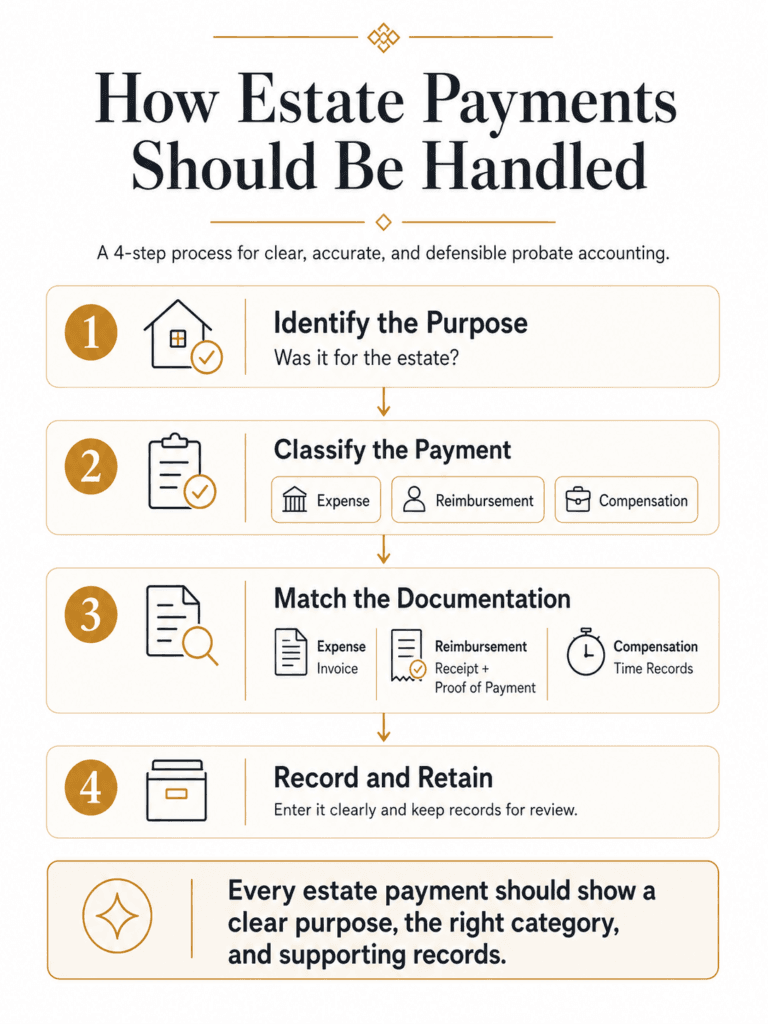
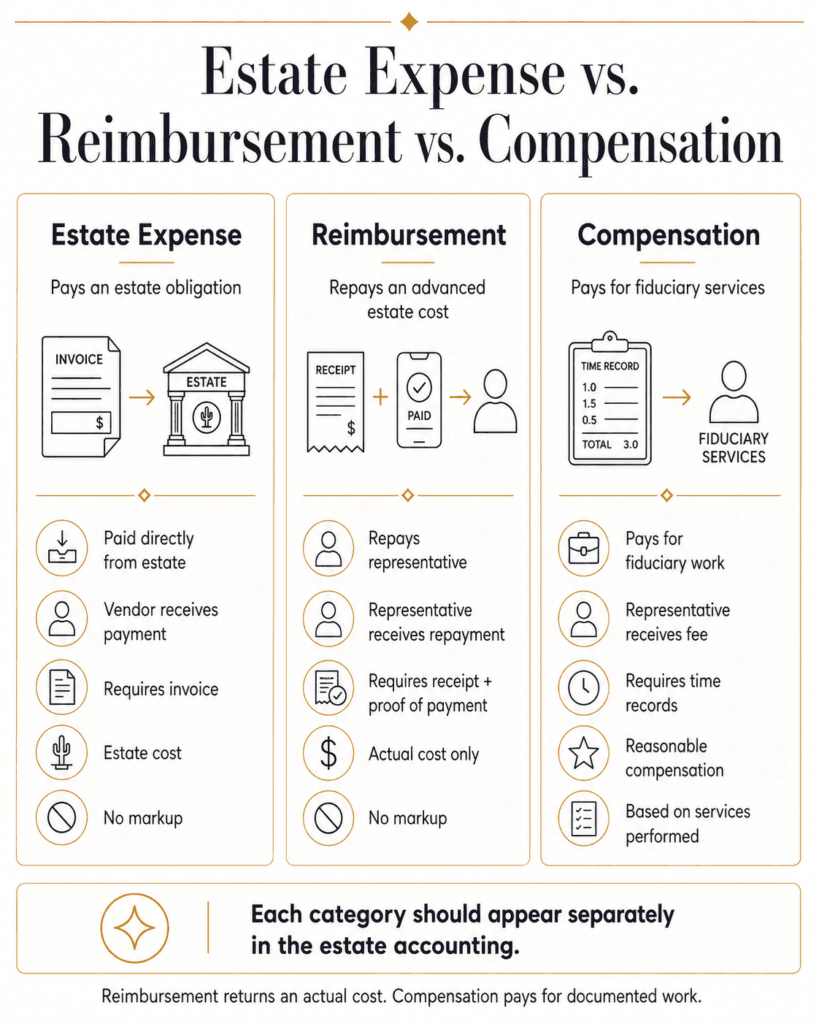
Arizona personal representative compensation pays for the time and work required to administer an estate. Reimbursement serves a different purpose: it repays the representative for proper estate expenses paid with personal money.
Arizona generally allows a personal representative to receive reasonable compensation. The estate may also pay proper administration expenses, including exact reimbursement of supported costs the representative personally advanced.
These payments must remain separate in the estate records:
- Expenses paid directly by the estate
- Reimbursements for actual documented costs
- Compensation for fiduciary services
The personal representative is a fiduciary. Estate money belongs to the estate—not to the person managing it.
Three types of payments involving a personal representative
Payments connected to a personal representative usually fall into three categories.
Estate expenses
An estate expense is a proper cost paid directly from estate property for the administration, protection, management, or distribution of the estate.
For example, the estate account may pay:
- A court filing fee
- A creditor-notice publication charge
- Property insurance
- An appraisal invoice
- An attorney or accountant
- A necessary repair
- A valid creditor claim
- A tax-preparation expense
The payment goes from the estate to the vendor.
Reimbursements
A reimbursement repays the personal representative for personal money used to cover a proper estate expense.
For example, the representative may pay a $92 court fee before the estate account is available. The estate may later reimburse that exact supported amount.
A reimbursement is not payment for the representative’s labor.
Compensation
Compensation pays the personal representative for services performed while administering the estate.
Those services may involve:
- Time
- Effort
- Skill
- Judgment
- Responsibility
- Risk
- Management of difficult estate issues
Compensation is not repayment of a receipt or invoice.
Keeping these categories separate makes the accounting easier to understand and defend.
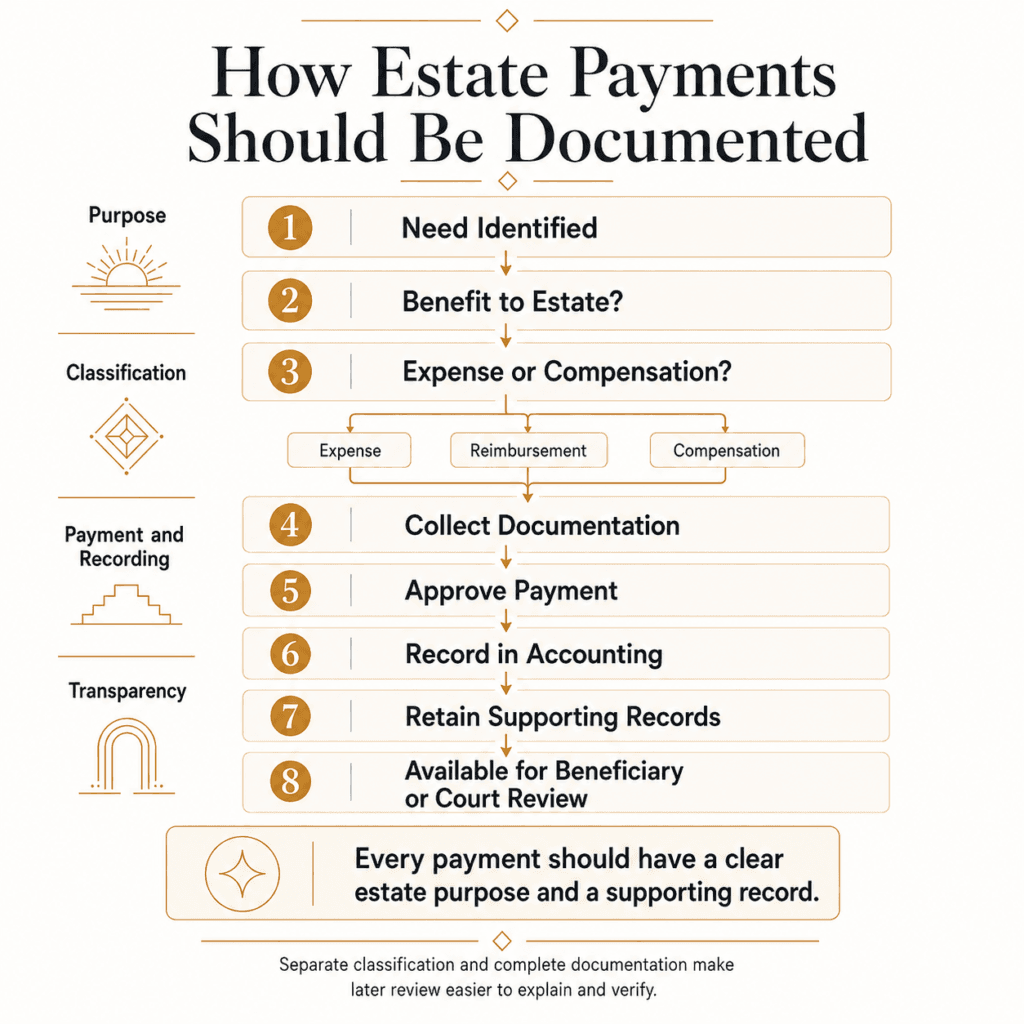
What qualifies as a proper estate expense?
A proper estate expense is generally a reasonable cost connected to administering, preserving, protecting, managing, or distributing estate property.
Depending on the estate, those costs may include:
- Court fees
- Certified copies
- Publication charges
- Postage and delivery
- Property insurance
- Necessary utilities
- Security and locksmith services
- Repairs and maintenance
- Appraisals
- Storage
- Tax preparation
- Professional services
- Costs of selling property
- Business-administration expenses
- Expenses connected to required notices or filings
Arizona authorizes a personal representative, subject to the will and applicable court orders, to take many actions needed to administer an estate. Those powers include insuring and repairing property, hiring professionals, selling assets, settling claims, paying taxes, paying reasonable compensation, and paying other expenses connected to administration. See A.R.S. § 14-3715.
That authority does not make every purchase reasonable.
Before spending estate money, ask:
- Is the expense connected to the estate?
- Is it necessary or likely to benefit the estate?
- Is the amount reasonable?
- Is a less expensive option available?
- Does the expense mainly benefit a beneficiary or the representative personally?
- Does the will restrict the transaction?
- Has the court imposed any limits?
- Can the estate afford the expense?
Apply a benefit-to-the-estate test
A personal representative must administer the estate efficiently and use estate authority in the interests of the estate’s successors while respecting creditor and family rights. See A.R.S. § 14-3703.
For example, replacing a failed air-conditioning system may be reasonable when needed to protect a vacant Arizona home from heat damage or preserve its market value.
An expensive cosmetic renovation may be harder to justify when it is unlikely to increase the sales proceeds enough to benefit the estate.
Before approving a substantial expense, document:
- The problem
- The alternatives considered
- The expected benefit
- The estimates or quotes received
- Why the selected option was reasonable
That short record may answer a beneficiary’s question months later.
Pay estate expenses directly when possible
Once an appropriate estate account is available, proper estate expenses should ordinarily be paid from that account.
Direct payment creates a clear trail:
Estate account → vendor → invoice or receipt → accounting entry
Each payment should identify:
- Vendor or recipient
- Date
- Amount
- Service or property provided
- Estate purpose
- Supporting invoice
- Payment confirmation
Avoid routinely paying estate expenses through a personal checking account or credit card.
Occasional personal advances may be necessary, especially before an estate account is opened. Frequent advances make reconciliation harder and increase the risk of mixing personal and estate transactions.
Rahnema Law’s probate administration overview explains how expenses, reimbursements, creditor work, accounting, and distributions fit into the larger estate process.
When reimbursement may be appropriate
Reimbursement may be appropriate when the personal representative personally pays a reasonable and necessary estate expense.
Common examples may include:
- Certified death certificates
- Court charges
- Emergency property security
- Necessary postage
- Publication fees
- An urgent insurance premium
- A locksmith
- A required bond
- A process server
- A case-specific expert
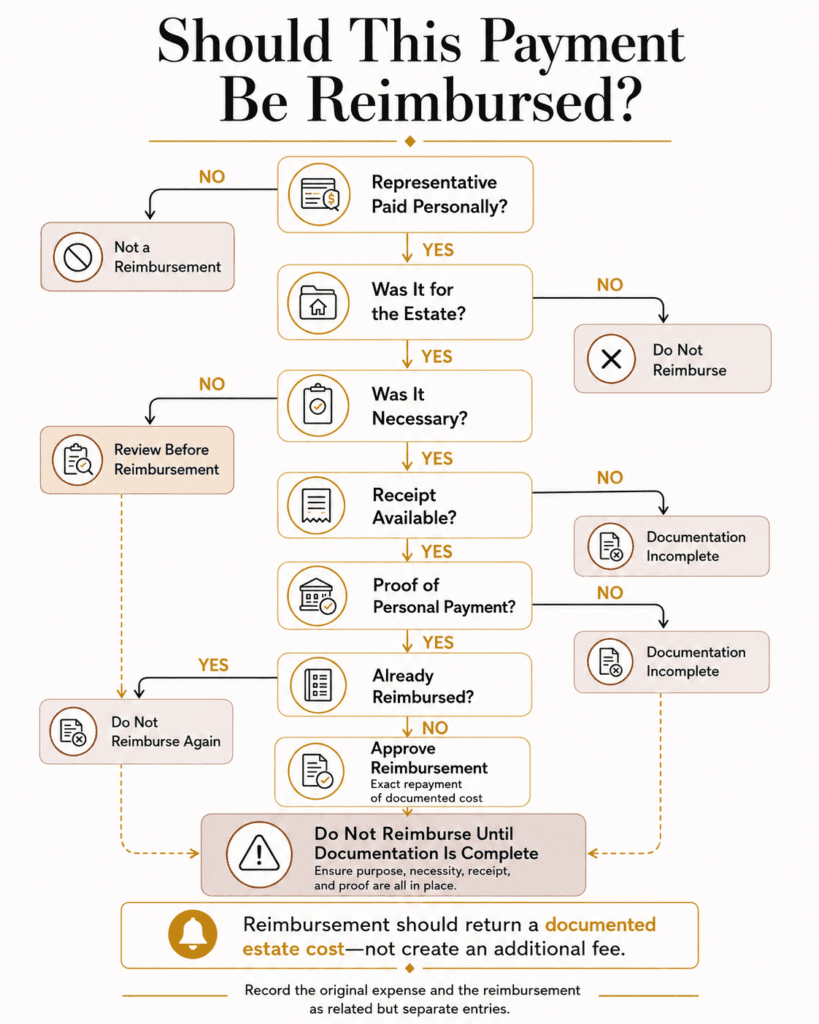
Before reimbursing the representative, confirm:
- The expense was connected to the estate.
- The representative actually paid it.
- The amount was reasonable.
- The estate received the benefit.
- An invoice or receipt exists.
- Proof of personal payment exists.
- The estate or another person did not already pay it.
Reimbursement should equal the actual supported cost
A reimbursement generally repays the representative’s actual documented expense.
Suppose the representative pays a $92 filing charge personally.
The reimbursement ordinarily should be $92—not:
- $100 as a rounded amount
- $92 plus a handling charge
- $92 plus a percentage markup
- $92 plus an undocumented service fee
Arizona’s statewide probate fee guidelines provide that reasonable costs incurred in the estate’s best interests are reimbursable at actual cost, without an increase in price. The listed examples include estate-specific goods and services, postage, publication, process-server charges, expert fees, messenger costs, and case-specific bonds.
Time spent arranging the transaction may be considered separately when evaluating compensation.
The expense itself should not be increased to pay for that time.
Preserve the receipt and proof of personal payment
An invoice shows that a vendor charged an amount.
It does not always prove that the personal representative paid the charge.
A bank or credit-card statement may show that money left an account.
It may not explain what was purchased.
The strongest reimbursement record generally includes both:
- The vendor’s invoice or receipt
- Proof that the representative personally paid it
The accounting entry should identify:
- Original vendor
- Original payment date
- Estate purpose
- Amount advanced
- Reimbursement date
- Estate-account transaction
For example:
Reimbursement to Maria Lopez for $92 probate filing fee personally advanced on July 5
That description is more useful than:
Reimbursement — $92
General overhead is different from a case-specific cost
Arizona’s statewide fee guidelines distinguish estate-specific costs from general overhead.
Reimbursable costs generally do not include expenses that cannot be tied directly to goods or services provided to the particular estate.
For a professional fiduciary, general overhead may include:
- Office rent
- Ordinary office equipment
- Routine administrative systems
- General business insurance
- Standard office utilities
For a family member serving as personal representative, the same practical principle weighs against arbitrary charges for:
- Use of a home computer
- Ordinary household internet
- General telephone service
- A home-office percentage
- Unidentified office supplies
Case-specific postage, copying, mileage, shipping, or supplies may be different when they are supported and reasonably connected to the estate.
Do not charge personal purchases to the estate
The estate account should not pay the representative’s personal expenses.
Meals, entertainment, household purchases, ordinary living costs, and personal travel do not become estate expenses merely because probate work happened during the same period.
Some travel may benefit the estate.
For example, a trip taken specifically to inspect, secure, or prepare distant estate property may be different from a personal visit to family members.
When an expense has personal and estate components:
- Identify the estate-related portion.
- Exclude the personal portion.
- Preserve the calculation.
- Explain why the estate portion was necessary.
Charging the full cost of mixed-purpose travel may be difficult to defend.
What Arizona personal representative compensation pays for
Compensation pays for fiduciary services performed for the estate.
Compensable work may include:
- Locating and collecting probate assets
- Communicating with banks and financial institutions
- Reviewing deeds, titles, and ownership records
- Safeguarding property
- Preparing the probate inventory
- Managing the estate account
- Evaluating bills and creditor claims
- Maintaining accounting records
- Coordinating with attorneys, accountants, and appraisers
- Managing or selling property
- Communicating with heirs and beneficiaries
- Preparing distributions
- Completing closing work
- Addressing disputed or unusual issues
Arizona law states that a personal representative is entitled to reasonable compensation for services. It does not establish one automatic percentage or flat fee for every estate. See A.R.S. § 14-3719.
A large estate containing two easy-to-transfer accounts may require less work than a smaller estate involving:
- A distressed house
- A family business
- Missing records
- Disputed creditors
- Tax complications
- Beneficiary conflict
Estate value is relevant context. It does not determine the fee by itself.
Review the will before deciding how compensation works
The will may contain a compensation provision.
Under A.R.S. § 14-3719, when a will specifies compensation and no separate compensation contract exists, the nominated personal representative may renounce the will’s provision before qualifying and instead receive reasonable compensation.
The personal representative may also give up all or part of the right to compensation. A written renunciation may be filed with the court.
Before qualification, review:
- Whether the will specifies an amount or formula
- Whether it directs service without compensation
- Whether a separate compensation agreement exists
- Whether the nominee wishes to accept or renounce the provision
- Whether a waiver should be documented
- Whether the timing of the decision affects available options
Do not ignore the will and later assume the estate must pay a different fee.
Keep records even when compensation may be waived
A family member may begin the case intending to serve without compensation.
Time records should still be maintained.
The estate may:
- Remain open longer than expected
- Require a difficult property sale
- Develop a creditor dispute
- Involve missing assets
- Require substantial travel
- Encounter beneficiary conflict
- Require temporary business management
Time records also explain what the representative did, even when no compensation is ultimately accepted.
A representative who waives compensation can document that decision separately.
What makes compensation reasonable?
Reasonableness depends on the estate’s complete circumstances.
Relevant considerations may include:
- Actual time spent
- Nature of the services
- Difficulty of the work
- Responsibility assumed
- Skill and experience required
- Customary market rates
- Urgency
- Results obtained
- Benefit to the estate
- Estate complexity
- Whether work was duplicated
- Whether a lower-cost person could have handled the task
- Prior fee disclosures or estimates
- Terms of the will
- Applicable court orders
When a court determines whether compensation is reasonable, Rule 33 directs it to follow the statewide fee guidelines in Arizona Code of Judicial Administration § 3-303.
Those guidelines cover licensed and unlicensed court-appointed personal representatives paid by an estate, subject to stated exceptions. They require a case-specific review of the total circumstances rather than one isolated factor.
The existence of those statewide standards does not mean that every billing or reimbursement provision in ACJA § 3-303 independently governs every private personal representative payment outside its applicable scope.
A high number of hours does not automatically establish that a fee is reasonable.
The work may have been:
- Unnecessary
- Duplicated
- Poorly organized
- Performed at an unreasonable rate
- Unrelated to the estate’s interests
Keep contemporaneous time records
A personal representative expecting compensation should maintain a time log as the work occurs.
Each entry should identify:
- Date
- Specific task
- Time spent
- Purpose
- Asset or issue involved
- Person performing the task
- Rate, when an hourly method is used
A useful entry might say:
July 18 — 1.2 hours — Reviewed date-of-death bank statements, confirmed account ownership, and updated the probate inventory worksheet.
A weak entry might say:
July — 12 hours — Worked on estate.
Detailed entries make it easier to evaluate:
- What was done
- Why it was needed
- How long it took
- Whether the rate fits the work
- Whether another professional duplicated it
Rahnema Law’s Arizona probate inventory checklist illustrates how detailed asset work can become part of the representative’s administration responsibilities.
Avoid block billing
Block billing combines several tasks into one total entry.
For example:
Reviewed mail, called attorney, paid utilities, updated spreadsheet, and spoke with beneficiary — 5.5 hours
That entry does not show how much time each task required.
Rule 33 does not permit block billing in a request for fee approval. In covered compensation reviews, Arizona’s statewide fee guidelines also prohibit block billing. Hourly billing governed by those guidelines generally must use increments no larger than one-tenth of an hour and reflect actual time rather than an assigned “value” for a service.
A clearer record separates the tasks:
- Reviewed and organized estate mail — 0.6 hour
- Call with probate attorney regarding creditor claim — 0.4 hour
- Reviewed and paid property utilities — 0.3 hour
- Updated estate ledger — 0.7 hour
- Beneficiary status call — 0.5 hour
The goal is not to create unnecessary paperwork.
The goal is to make the fee understandable.
Match the rate to the work performed
Not every probate task requires the same skill or judgment.
Complex fiduciary work may include:
- Negotiating a disputed claim
- Managing an operating business
- Resolving a title problem
- Comparing competing property-sale options
- Addressing contested distributions
Routine work may include:
- Scanning documents
- Opening mail
- Basic data entry
- Scheduling appointments
- Organizing records
- Making copies
When the statewide fee guidelines apply, they state that a rate should be appropriate for the task performed. They also provide that clerical and secretarial work is not separately billable by covered professionals.
A family member may perform every task personally because no staff is available.
Even then, the nature and complexity of the work remain relevant when deciding whether the overall compensation is reasonable.
Can a family member receive compensation?
Yes.
A spouse, child, sibling, heir, or other relative is not automatically required to administer an estate without payment.
When a court reviews compensation covered by the statewide fee guidelines, those guidelines recognize that a nonlicensed fiduciary related to the decedent may receive reasonable compensation appropriate to the services performed.
Family compensation can still create tension because:
- The representative may also inherit
- Compensation reduces the amount left for beneficiaries
- Other relatives may not see the work being performed
- Family expectations may differ
- No fee arrangement may have been discussed early
Clear communication can reduce misunderstanding.
Consider explaining:
- Whether compensation is expected
- How it may be calculated
- What records are being kept
- When the final amount will be determined
- Whether beneficiaries will receive a summary before payment
Transparency does not replace legal requirements or court review. It can prevent surprise.
Avoid double billing
The estate should not pay twice for the same service or expense.
Suppose the representative personally pays a delivery fee.
The estate may reimburse the actual charge.
The representative may separately record reasonable time spent arranging the delivery, but should not:
- Mark up the delivery charge
- Enter the same time twice
- Include the charge in another expense category
- Seek compensation for work performed entirely by someone else
Duplication can also occur among:
- Personal representative
- Attorney
- Accountant
- Bookkeeper
- Property manager
- Real estate agent
- Other professionals
Before paying invoices, determine:
- Who performed each task
- Whether the service was necessary
- Whether someone else billed for the same work
- Whether the rate matched the skill required
- Whether the estate received the benefit
Arizona allows the personal representative to employ attorneys, auditors, investment advisers, and other agents. The representative must still act reasonably for interested persons.
Correcting personal errors is not ordinarily an estate benefit
The estate should not automatically pay for every cost caused by avoidable mistakes or misconduct.
In covered fee reviews, Arizona’s statewide guidelines state that time and expenses connected to misfeasance or malfeasance are not compensable. They also exclude time and expenses spent correcting or reducing harm caused by the professional or staff.
Examples may include:
- Repeating work because records were lost
- Correcting an avoidable filing error
- Defending personal misconduct
- Repairing harm caused by an unauthorized transaction
- Paying penalties caused by neglect
Not every honest mistake eliminates compensation.
The question is whether shifting the cost of fixing the problem to the estate is reasonable.
Hiring attorneys and other professionals
A personal representative may hire professionals to help administer the estate.
Those professionals may include:
- Probate attorney
- Accountant
- Tax preparer
- Appraiser
- Real estate agent
- Property manager
- Business valuator
- Investment adviser
- Bookkeeper
The personal representative should:
- Review the engagement terms
- Understand the billing arrangement
- Monitor invoices
- Question vague entries
- Identify duplicated services
- Confirm that the work benefits the estate
- Confirm that charges are properly classified
- Question charges that appear excessive, unrelated, unnecessarily duplicative, or caused by an avoidable error
- Preserve invoices and payment records
Professional fees and personal representative compensation should appear as separate categories in the accounting.
Hiring an attorney does not transfer every fiduciary decision to the attorney. The personal representative remains responsible for administering the estate.
Sign contracts in a representative capacity
When hiring a vendor or professional, the personal representative should identify:
- The fiduciary role
- The name of the estate
- The capacity in which the agreement is signed
Arizona generally provides that a personal representative is not individually liable on a contract properly entered into in a fiduciary capacity unless the representative fails to disclose the representative capacity and identify the estate, subject to the terms of the agreement. See A.R.S. § 14-3808.
The signature block should make clear that the individual signs as personal representative—not as an individual customer.
This may be particularly important for:
- Repair agreements
- Property-management contracts
- Professional engagements
- Leases
- Real-estate services
- Storage contracts
- Business agreements
Review any personal-guaranty language before signing.
Litigation expenses may be payable when the proceeding was pursued in good faith
Probate disputes can create substantial legal fees.
Arizona provides that a personal representative—or a person nominated to serve—who prosecutes or defends a proceeding in good faith may receive necessary expenses and disbursements from the estate, including reasonable attorney fees, whether successful or not. See A.R.S. § 14-3720.
Success and good faith are different questions.
Losing does not automatically prevent reimbursement.
Winning does not automatically establish that every expense was reasonable.
Relevant considerations may include:
- Purpose of the proceeding
- Information available when the decision was made
- Whether the position protected the estate
- Proportionality of the expense
- Personal interests of the representative
- Available alternatives
- Conduct during the dispute
When litigation serves both personal and estate interests, allocation or separate legal advice may be needed.
Administration expenses receive high payment priority
When estate assets are insufficient to pay every valid claim, costs and expenses of administration receive the highest priority under Arizona’s creditor-payment statute. See A.R.S. § 14-3805.
That priority does not make every requested expense valid.
The cost must still be:
- Connected to administration
- Reasonable
- Supported
- Consistent with fiduciary duties
- Payable from the applicable estate property
Before paying compensation or reimbursement, the representative should preserve enough estate property for:
- Statutory family protections
- Taxes
- Unresolved administration expenses
- Allowed creditor claims
- Claims still under review
- Other unbarred liabilities
- Closing expenses
Arizona requires the representative to make provision for allowances, unresolved claims, potential unbarred claims, and administration expenses before proceeding with payment of allowed claims after the applicable presentation period. See A.R.S. § 14-3807.
Even a solvent estate may still face later costs such as final tax preparation, accounting, recording or closing charges, continuing property expenses, claim resolution, litigation, tax assessments, or corrective transfer work.
Depending on the estate and any applicable court order, a prudent payment process may include:
- Interim compensation supported by records
- A reasonable reserve for remaining work and liabilities
- Disclosure of compensation already paid
- Final reconciliation before the last compensation payment
- Adjustment when actual work or remaining obligations differ from earlier estimates
Paying the representative too early can create problems if the estate later lacks enough property to complete administration.
Do not pay compensation casually
A personal representative should not withdraw an unexplained amount and label it “executor fee.”
Before payment, prepare a compensation summary showing:
- Period covered
- Services performed
- Hours
- Rates or other calculation method
- Total compensation requested
- Reimbursements listed separately
- Compensation already paid
- Estate property remaining
- Unresolved obligations
- Effect on beneficiaries
Also confirm that:
- The will was reviewed.
- Any renunciation or waiver was handled properly.
- The estate can afford the payment.
- Higher-priority obligations are protected.
- An adequate reserve remains for unfinished administration.
- The amount remains reasonable.
- Supporting records are complete.
- Any required court order was obtained.
- The accounting will describe the payment clearly.
When substantial disagreement is likely, beneficiary agreement or court review before payment may reduce the risk of a later refund dispute.
Is advance court approval required?
Under current Arizona Rule of Probate Procedure 33, a personal representative and the representative’s attorney generally are not required to petition for advance approval of fees unless the court orders otherwise.
When approval is requested, it may be included with a petition to approve an account or presented in a separate petition.
An hourly fee request should identify:
- Services provided
- Tasks performed
- Date of each task
- Time spent
- Person performing the task
- Position of that person
- Hourly rate
A nonhourly request should explain the arrangement and how the fee was calculated.
A reimbursement request should identify each cost, the date, purpose, and amount requested.
Rule 33 also prohibits block billing in a request for approval. The current rules are available through the Arizona Judicial Branch court-rules page.
The absence of a universal advance-approval requirement does not place the fee beyond later review.
Supervised administration, a specific court order, a contested accounting, or other case circumstances may create additional requirements.
Beneficiaries may object to compensation
An interested person may question:
- Number of hours
- Hourly rate
- Need for the work
- Duplicated services
- Personal expenses
- Reimbursements without receipts
- Work that did not benefit the estate
- Payment made before estate obligations were understood
- Failure to follow the will’s compensation provision
Many concerns can be addressed by providing:
- Time entries
- Receipts
- Invoices
- Work summaries
- Professional engagement agreements
- Explanation of unusual tasks
- Compensation calculation
- Estate financial summary
An objection does not automatically prove that the compensation was improper.
It does mean the representative should be able to explain and support it.
The court may review compensation and order a refund
After notice to interested persons, the court may review:
- Whether employment of an estate professional was proper
- Whether compensation paid to an employee or agent was reasonable
- Whether the representative’s own compensation was reasonable
A person who received excessive compensation may be ordered to refund the estate. See A.R.S. § 14-3721.
Payment does not make the amount final.
The supporting records should remain strong enough to justify the fee if it is reviewed later.
Improper payments may create fiduciary liability
A personal representative may be liable for loss caused by an improper exercise of estate authority or breach of fiduciary duty.
Potential problems include:
- Paying personal expenses from estate funds
- Taking excessive compensation
- Reimbursing unsupported costs
- Paying the representative before protecting higher-priority obligations
- Violating the will’s compensation provision
- Duplicating professional services
- Withdrawing fees without keeping an adequate reserve
- Hiding fees under vague accounting labels
Good records do not make an improper payment proper.
They help show what the representative considered and whether the decision-making process was reasonable.
Report compensation and reimbursement separately
The estate accounting should show compensation and reimbursements as different transactions.
Clear entries may include:
- Reimbursement—certified death certificates
- Reimbursement—emergency locksmith
- Reimbursement—probate filing fee
- Reimbursement—documented estate mileage
- Personal representative compensation—January through June
- Attorney fees
- Accounting fees
- Appraisal expenses
Avoid combining these items under descriptions such as:
- Miscellaneous
- Estate costs
- Representative payment
- Administration
- Reimbursement and fee
Each reimbursement should connect to a receipt and proof of personal payment.
Each compensation payment should connect to a time record or other reasonable calculation.
Professional fees should connect to the engagement, invoice, and payment record.
Consider notifying beneficiaries before a substantial payment
Informal advance disclosure does not replace a required notice, accounting, court filing, or court approval.
However, a clear summary before a substantial compensation payment may reduce surprise and allow questions to be addressed before funds leave the estate.
A useful summary may include:
- Compensation period
- Total hours
- Rate or calculation method
- Major tasks
- Reimbursements listed separately
- Professional fees
- Compensation already paid
- Estate balance
- Remaining obligations
Communication should remain factual and neutral.
Do not pressure beneficiaries to approve a fee without enough information to evaluate it.
Arizona personal representative compensation is taxable
The IRS states that personal representatives must include fees received from an estate in gross income.
A person who is not in the trade or business of serving as an executor generally reports the fees as other income. A person who operates an executor or fiduciary business generally reports the fees as self-employment income. Different treatment may also apply when the estate operates a business and the representative actively participates in it.
The current federal guidance appears in IRS Publication 559.
A supported reimbursement of an actual estate expense is different from compensation. Its tax treatment still depends on the facts and the quality of the records.
The estate and representative should preserve the distinction and obtain tax advice when needed.
Common compensation and reimbursement mistakes
Common mistakes include:
- Failing to review the will before qualification
- Assuming Arizona uses an automatic percentage fee
- Waiting until closing to estimate time
- Reconstructing vague time entries months later
- Combining several tasks into block entries
- Using one high rate for every type of work
- Losing receipts
- Treating general overhead as a case-specific expense
- Adding a markup to reimbursement
- Using cash without enough supporting documentation
- Mixing personal and estate purchases
- Charging the full cost of mixed-purpose travel
- Failing to preserve a mileage or travel allocation
- Claiming reimbursement and compensation for the same item
- Duplicating work billed by a professional
- Charging the estate to correct avoidable errors
- Ignoring a substantial conflict or related-party transaction
- Signing a contract without identifying the representative capacity and estate
- Paying compensation before taxes and claims are understood
- Failing to preserve an adequate reserve
- Hiding fees in vague accounting categories
- Failing to communicate with beneficiaries
- Assuming payment prevents later court review
- Ignoring the representative’s tax reporting

Personal representative expense and compensation checklist
For every estate expense, confirm that:
- The expense benefited the estate.
- The amount was reasonable.
- The vendor and service are identified.
- The invoice or receipt is preserved.
- Payment used a traceable method when practical.
- If cash was necessary, the payee, amount, purpose, and signed receipt are preserved.
- Any conflict or related-party relationship was identified and addressed.
- The accounting category is accurate.
For every reimbursement, confirm that:
- The representative personally advanced the money.
- The underlying expense was proper.
- Proof of personal payment exists.
- Reimbursement equals the actual supported cost.
- No markup was added.
- The expense was not already paid or reimbursed.
- The accounting identifies the original expense.
For travel or mileage, confirm that:
- The travel was reasonably connected to estate administration.
- The date, destination, distance, and estate purpose were recorded.
- Receipts for material travel costs were preserved.
- Any personal portion was excluded.
- The allocation for mixed-purpose travel was preserved.
- A less expensive practical alternative was considered when appropriate.
For compensation, confirm that:
- The will was reviewed.
- Any renunciation or waiver was handled correctly.
- Time was recorded as the work occurred.
- Each entry identifies a specific task.
- Block billing was avoided.
- The rate reflects the work performed.
- Duplicated services were removed.
- Improper corrective work was excluded.
- The total amount is reasonable.
- The estate can afford the payment.
- Taxes, claims, remaining costs, and an appropriate reserve are protected.
- Prior and proposed compensation are identified.
- Compensation appears separately in the accounting.
- Beneficiary communication was considered.
- Court approval was obtained when required or advisable.
- Tax reporting was reviewed.
Treat every payment as a fiduciary transaction
Arizona law recognizes that administering an estate requires real work.
A personal representative may receive reasonable compensation and may be repaid for proper expenses personally advanced.
The clearest approach is to maintain three separate categories:
- Expenses paid directly by the estate
- Reimbursements of exact documented costs
- Compensation for fiduciary services
Accurate time records, complete receipts, traceable payments, appropriate rates, prudent spending, careful travel allocation, transparent accounting, and clear beneficiary communication make those payments easier to explain.
They also reduce the risk that a valid payment will look like an unexplained withdrawal.
An estate involving substantial compensation, litigation, business operations, unusual travel, related-party transactions, disputed professional fees, insufficient property, or beneficiary conflict may require individual legal and tax guidance before payment.
Rahnema Law’s Arizona probate FAQs provide additional guidance about personal representative duties, records, expenses, claims, and estate administration.
Legal Disclaimer: This information is for educational purposes only and does not constitute legal advice. Arizona probate law is complex and varies based on individual circumstances. Always consult with a qualified probate attorney for guidance specific to your situation.
FAQs
Arizona law generally entitles a personal representative to reasonable compensation for services. The right remains subject to the will, any separate compensation agreement, a waiver or renunciation, fiduciary duties, and court review.
No automatic statutory percentage applies to every Arizona estate. Compensation must be reasonable based on the services performed and the circumstances of the administration.
Yes. A relative serving as personal representative may receive reasonable compensation appropriate to the services performed.
The will should be reviewed before qualification. When the will specifies compensation and no separate compensation contract exists, the nominated personal representative may renounce the will’s provision before qualifying and instead receive reasonable compensation. A representative may also give up all or part of the right to compensation.
Compensation pays for fiduciary work. Reimbursement repays an actual estate expense that the personal representative paid with personal funds.
When Arizona’s statewide fee guidelines apply, qualifying reimbursable costs are treated as actual-cost reimbursements without a price increase. The representative’s compensable time should not be hidden inside an increased reimbursement.
Preserve the vendor invoice or itemized receipt, proof of personal payment, estate purpose, date and amount, and the estate-account record showing reimbursement.
Once an estate account is available, direct payment usually creates the clearest record and reduces the need for repeated personal advances and reimbursements.
When practical, a traceable payment method creates a stronger estate record. If cash is necessary, preserve a signed receipt, date, amount, payee, description, estate purpose, and related accounting entry.
Potentially. Travel should be reasonably connected to administration and properly documented. Keep an appropriate travel or mileage log and supporting receipts. If a trip also serves a personal purpose, exclude the personal portion and preserve the allocation.
A representative seeking compensation should keep contemporaneous, itemized records. When court approval of hourly compensation is requested, Rule 33 requires detailed information about the services, tasks, dates, time, person performing the work, position, and rate.
Rule 33 does not permit block billing in a request for fee approval. Arizona’s statewide fee guidelines also prohibit block billing when they apply to a covered compensation review.
The nature of the task matters when evaluating reasonableness. When the statewide guidelines apply, they require rates appropriate to the work and provide that clerical and secretarial work is not separately billable by covered professionals.
Generally, a personal representative does not have to petition for advance approval unless the court orders otherwise. Supervised administration, a specific order, a disputed accounting, or other case circumstances may change that procedure.
The payment should be evaluated in light of estate solvency, creditor priorities, taxes, remaining administration expenses, and necessary reserves. Paying compensation too early can leave the estate without enough property to complete administration.
Yes. An interested person may challenge the amount, hours, rate, necessity, supporting records, personal expenses, reimbursements, duplicated services, or compliance with the will.
Yes. Arizona law authorizes the court to review compensation and order an appropriate refund from a person who received excessive compensation.
Potentially. A personal representative or nominee who prosecuted or defended a proceeding in good faith may receive necessary expenses and reasonable attorney fees from the estate, whether successful or not.
The agreement should identify the estate and show that the individual is signing in the capacity of personal representative. Arizona law addresses individual contractual liability when fiduciary capacity and the estate are not properly disclosed, subject to the agreement’s terms.
Yes. IRS guidance states that fees paid to a personal representative from an estate must be included in gross income. The reporting method depends in part on whether the person is in the trade or business of serving as an executor.
No. A documented repayment of an actual estate expense is different from compensation for fiduciary services. The tax treatment of a specific reimbursement depends on the facts and should be confirmed with a qualified tax professional.