

Compare informal vs. formal probate closing in Arizona, including hearings, court review, disputes, accounting, cost, and discharge.
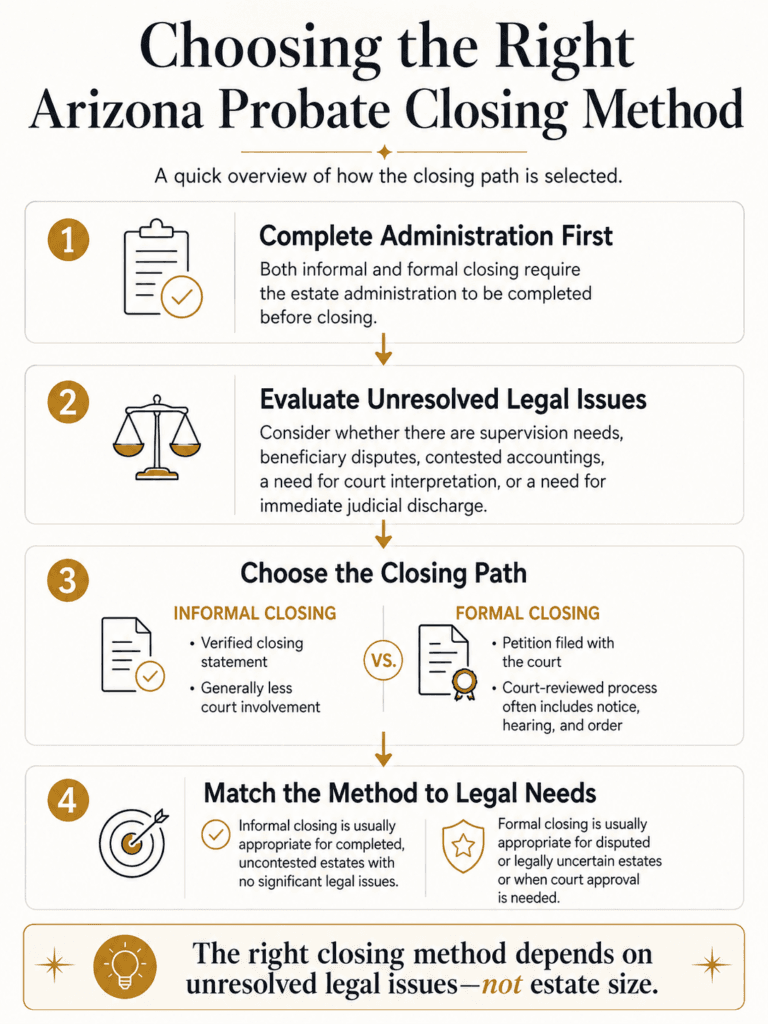
The choice between informal and formal probate closing in Arizona depends on what remains unresolved and whether the estate needs a judge’s decision.
Informal closing relies primarily on a verified statement from the personal representative. It is usually appropriate when administration is complete, the accounting is clear, the recipients are known, and no material issue needs judicial resolution.
Formal closing involves a petition, notice, a hearing, and a court order. It may be more appropriate when the estate involves disputed distributions, uncertain heirs, unclear will language, accounting objections, supervised administration, contested compensation, or a need for judicial approval and discharge.
The choice should not depend only on which form is easier or less expensive. It should reflect the estate’s actual legal and practical needs.
The Central Difference
The simplest way to understand the two methods is:
Informal closing asks the personal representative to verify that the work is complete.
Formal closing asks the court to review and decide the matters presented to it.
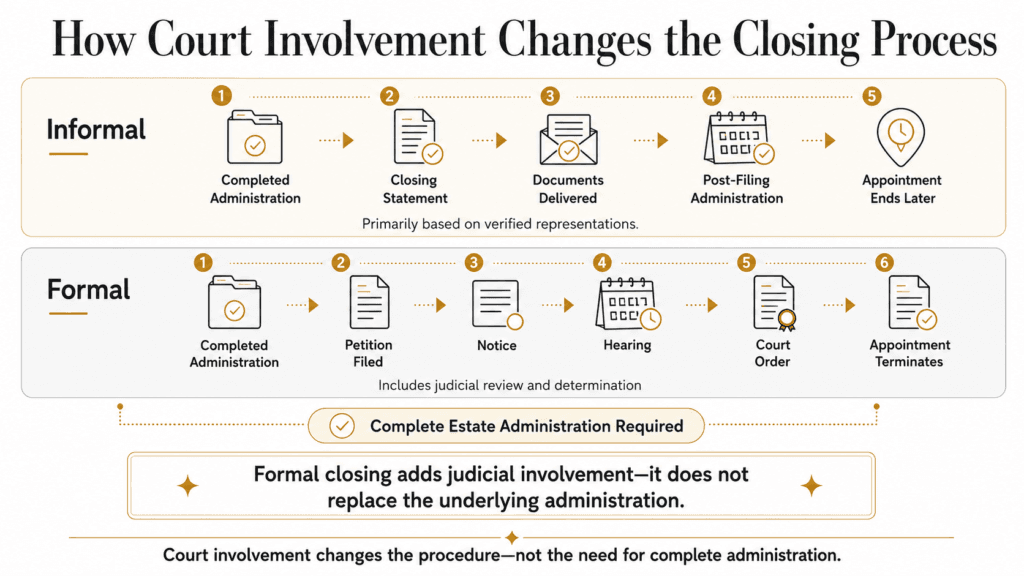
An informal closing statement does not ordinarily produce an immediate court order approving every expense, valuation, sale, distribution, or accounting entry.
A formal proceeding gives interested persons notice and an opportunity to be heard. The court may then enter an order addressing the accounting, distribution, heirship, will interpretation, settlement, or discharge within the scope of the proceeding.
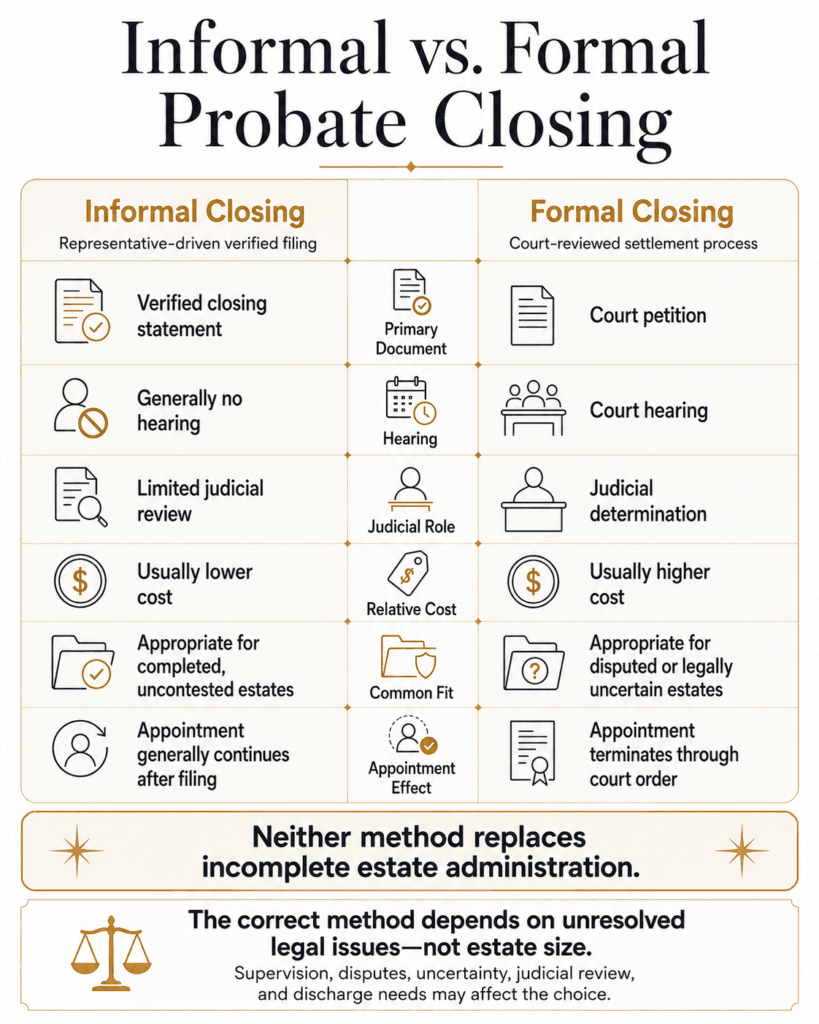
Informal and Formal Closing at a Glance
| Issue | Informal closing | Formal closing |
|---|---|---|
| Basic procedure | Verified closing statement | Petition, notice, hearing, and court order |
| Estate type | Generally unsupervised | Unsupervised or supervised, depending on the circumstances |
| Hearing ordinarily required | No | Yes |
| Automatic judicial review of accounting | No | Court may review, compel, or approve it |
| Will interpretation | Not decided by filing alone | Court may interpret the will |
| Heirship determination | Not decided by filing alone | Court may determine heirs |
| Dispute resolution | Requires a separate proceeding | Properly presented disputes may be decided |
| End of appointment | Generally one year after filing if no proceeding is pending | Terminates through the formal closing order |
| Cost and procedural burden | Usually lower | Usually higher |
| Best suited for | Completed, uncontested estates | Disputed, supervised, uncertain, or court-approval cases |
This comparison is only a starting point. The personal representative must still complete the legal and financial work required for the estate before using either method.
Neither Method Replaces Complete Administration
Choosing formal closing does not excuse unfinished administration.
Choosing informal closing does not allow the personal representative to promise that remaining work will be completed later.
Before either method, the representative should generally have:
- Located and collected the probate assets
- Prepared the inventory and any required supplements
- Addressed creditor deadlines and presented claims
- Completed required tax work
- Paid or provided for administration expenses
- Identified the correct beneficiaries and heirs
- For informal closing, completed distributions; for formal settlement, complete undisputed administration to the extent appropriate while unresolved distribution issues may be presented to the court.
- Executed and processed deeds, titles, assignments, and account transfers
- Prepared a complete estate accounting
- Identified and accommodated any liability that remains outstanding
Arizona treats the personal representative as a fiduciary responsible for settling and distributing the estate under the effective will, Arizona law, and applicable court orders as efficiently as the estate’s best interests permit. See A.R.S. § 14-3703.
The closing method should document or resolve the final administration. It should not conceal unfinished work.
For a broader view of the administration process, see Rahnema Law’s Arizona probate roadmap.
What Is Informal Closing?
Informal closing generally means completing an eligible unsupervised estate by filing a verified closing statement with the court.
Arizona permits this method unless:
- A court order prohibits it.
- The estate is under supervised administration.
- The statutory requirements for the closing statement have not been satisfied.
The statement may not be filed earlier than four months after the original appointment of a general personal representative.
The personal representative verifies that:
- The time for presenting creditor claims expired.
- Presented claims were paid, settled, or otherwise addressed.
- Administration expenses were addressed.
- Applicable estate, inheritance, and other death taxes were addressed.
- Estate property was distributed to the people entitled to receive it.
- Any undischarged claims were disclosed and accommodated.
- Copies of the statement were sent to the required recipients.
- A full written accounting was furnished to affected distributees.
These requirements appear in A.R.S. § 14-3933.
Informal Closing Is Not the Same as Informal Probate
“Informal probate” and “informal closing” describe different stages of an estate.
Informal probate concerns the beginning of administration, including matters such as:
- Admission of a will
- Appointment of a personal representative
- Issuance of Letters
- Initial commencement of the probate process
Informal closing concerns completion of the estate after administration.
An estate that began with a formal appointment may still potentially close through a closing statement if it remains unsupervised, no order prohibits that method, and all statutory conditions are satisfied.
Likewise, a will admitted through informal probate does not prevent the personal representative from later requesting formal settlement.
The opening procedure does not automatically determine the closing procedure.
Four Months Is Only the Earliest Possible Filing Point
The informal closing statement cannot be filed earlier than four months after the original appointment of a general personal representative.
That does not mean the estate is ready to close on the first day of the fifth month.
The representative must also confirm that the creditor periods have expired and that the administration satisfies every other statement required by the closing statute.
An estate may remain open because of:
- A known creditor’s later deadline
- A disputed claim
- A pending tax return
- An unresolved tax notice
- A delayed property sale
- A business interest
- A difficult title transfer
- A missing beneficiary
- Contested compensation
- Litigation
- An unclear will provision
- A beneficiary objection
Arizona Law Note: The earliest possible filing date is not a required closing date.
Informal Closing Usually Does Not Require a Hearing
The ordinary informal process relies on the personal representative’s verified filing rather than a hearing at which the court reviews every estate transaction.
That often makes informal closing more efficient and less expensive in an uncontested estate.
However, filing the statement should not be described as automatic judicial approval of:
- The accounting
- Personal representative compensation
- Legal or accounting fees
- Appraisals
- Property sales
- Tax allocations
- Beneficiary shares
- In-kind distributions
- Other fiduciary decisions
The personal representative remains responsible for the accuracy of the closing statement and the administration.
When an interested person raises a genuine dispute, that person may pursue an appropriate court proceeding. Filing a closing statement alone does not resolve the disagreement.
The Final Accounting Must Still Be Complete
Before informal closing, the personal representative must furnish a full written account of the administration to distributees whose interests were affected.
The accounting should trace the estate from the opening inventory through the final distribution.
It should identify:
- Opening probate property
- Later receipts
- Estate income
- Refunds
- Property sales
- Creditor payments
- Administration expenses
- Taxes
- Reimbursements
- Personal representative compensation
- Cash distributions
- Noncash distributions
- Any outstanding liability or balance and the legally sufficient arrangement used to address it
A clear accounting answers five questions:
- What did the estate begin with?
- What additional property or money did it receive?
- What did it pay?
- What did it distribute?
- What remained?
The totals should reconcile with the estate’s bank, investment, sale, tax, and transfer records.
Rahnema Law’s Arizona Probate Inventory Checklist explains how the initial inventory creates the starting point for that financial record.
The Accounting Is Not Automatically Court-Approved
Providing an accounting as part of informal closing does not necessarily mean that a judge reviewed and approved each entry.
This distinction is one of the main reasons a personal representative may consider formal settlement.
A formal proceeding expressly allows the court to consider, compel, or approve an accounting and distribution within the requested relief.
A representative who expects a serious accounting objection should not assume that filing a closing statement will settle the issue.
Who Must Receive the Informal Closing Statement?
The personal representative must send a copy of the closing statement to:
- All distributees of the estate
- Known creditors or other claimants whose claims remain unpaid and unbarred
The representative must also furnish the full written accounting to distributees whose interests were affected by the administration. Local forms or court orders may identify additional recipients.
Preserve:
- Recipient name
- Address
- Document delivered
- Date sent
- Delivery method
- Proof of mailing or delivery
- Returned correspondence
- Corrected delivery information
Arizona’s statewide probate forms are generic, and individual superior courts may maintain preferred local forms and instructions.
For example, Maricopa County currently provides a dedicated informal probate closing packet with a closing statement, final-accounting form, instructions, and mailing requirements. The court advises users to check for the most current forms before filing.
Creditor Deadlines Must Be Reviewed Carefully
Arizona generally requires publication of notice to creditors once a week for three successive weeks.
Creditors covered by publication are directed to present claims within four months after the first publication date.
Known creditors receive direct written notice. Their deadline is generally the later of:
- Four months after the first published notice, or
- Sixty days after direct notice was mailed or delivered
A known creditor who receives direct notice near the end of the publication period may therefore have a later deadline than other creditors. See A.R.S. § 14-3801.
The representative should calculate each material deadline correctly before selecting or completing the closing procedure.
For practical guidance on locating claims and estate records, see Rahnema Law’s article on finding assets and creditor information during Arizona probate.
Not Every Claim Fits One Published Deadline
Arizona separately addresses claims that arise after death.
The ordinary creditor rules also preserve certain rights involving:
- Mortgages, pledges, and other liens
- Proceedings limited to available insurance
- Contracts entered into during administration
- Property expenses
- Tax obligations
- Professional fees
- Personal representative compensation
- Expense reimbursement
- Litigation exposure
The general publication date is not the only possible deadline affecting the estate.
A Disallowed Claim May Still Require Time
When a claim is disallowed in whole or in part, the claimant generally has 60 days after the notice is mailed to petition for allowance or begin a proceeding against the personal representative.
The court may extend that period in limited circumstances involving claims that are not presently due or are contingent or unliquidated. See A.R.S. § 14-3804.
Failure by the representative to act on a timely presented claim can also produce the allowance consequence described in A.R.S. § 14-3806.
Before closing, verify:
- When the claim was received
- When the disallowance was mailed
- Whether the disallowance was complete or partial
- Whether a proceeding was started
- Whether the challenge period expired
- Whether the claim was later allowed or settled
An estate with an active claim dispute may benefit from formal court involvement rather than an informal filing.
Can an Estate Close Informally With an Unresolved Liability?
Potentially, but the liability cannot be ignored.
Arizona permits the closing statement to identify a claim that remains undischarged. The statement must explain either:
- That the estate was distributed subject to possible liability with the agreement of the distributees, or
- The detailed arrangements made to accommodate the outstanding liability
The closing records should identify:
- Claimant
- Nature of the liability
- Amount or estimated exposure
- Reason it remains unresolved
- Property or reserve available
- Agreement of affected distributees when applicable
- Other payment or accommodation arrangements
A significant dispute about the validity, amount, or priority of the liability may favor formal settlement.
After estate property has been distributed, an undischarged and unbarred claim may sometimes be pursued against one or more distributees. Liability is generally limited to the value received, and Arizona protects specified family allowances and exempt property. See A.R.S. § 14-3934.
Beneficiary agreement to possible liability should be informed and documented rather than assumed.
What Does Informal Closing Do to the Appointment?
Filing an informal closing statement does not immediately terminate the personal representative’s appointment.
If no proceeding involving the representative is pending, the appointment generally terminates one year after the closing statement is filed.
During that year, the representative may still need to address:
- A returned distribution
- A replacement check
- A title correction
- Tax correspondence
- A delayed refund
- A clerical error
- Residual account activity
- A beneficiary question
- A proceeding involving the administration
Arizona expressly distinguishes the one-year termination following a closing statement from termination through a formal closing order. See A.R.S. § 14-3610.
The personal representative should remain reachable and preserve the estate records after filing.
Certain Fiduciary Claims Have a Six-Month Period
Subject to earlier bars and the closing statement’s disclosures, certain claims by successors and creditors against the personal representative for breach of fiduciary duty generally must begin within six months after the closing statement is filed.
That limitation does not include claims involving fraud, misrepresentation, or inadequate disclosure related to settlement of the estate. See A.R.S. § 14-3935.
This rule should not be treated as permission to omit information. An incomplete accounting or misleading closing statement may undermine the protection the representative expected.
When Informal Closing Is Usually Practical
Informal closing may be appropriate when:
- The estate is unsupervised.
- No court order prohibits closing by statement.
- The creditor periods have expired.
- Claims were resolved or adequately accommodated.
- Tax work is complete or properly provided for.
- Estate property was distributed correctly.
- Title transfers were completed.
- The accounting is complete and understandable.
- Beneficiaries and heirs are known.
- No material objection remains.
- No legal issue requires judicial determination.
- Immediate discharge is not essential.
This method can avoid unnecessary hearing expense when nothing actually requires the court’s decision.
What Is Formal Closing?
Formal closing is a court proceeding seeking an order addressing the final settlement of the estate.
Arizona provides a general formal-settlement procedure through which the personal representative or another interested person may request an order of complete settlement.
The petition may ask the court to:
- Determine testacy when necessary
- Consider the final account
- Compel or approve an accounting
- Approve or direct distribution
- Interpret the will
- Determine heirs
- Adjudicate final settlement
- Discharge the personal representative
Interested persons receive notice, and affected distributees receive the final account. After a hearing, the court may enter appropriate settlement and distribution orders. See A.R.S. § 14-3931.
Who May Request Complete Formal Settlement?
The personal representative or another interested person may petition under Arizona’s general formal-settlement statute.
The personal representative may petition at any time, but the court cannot consider the petition until the period for presenting claims arising before death has expired.
Another interested person generally must wait until one year after the original personal representative’s appointment. The pre-death claim period must also have expired.
Arizona Law Note: The timing depends on who files the petition and whether the applicable creditor period has expired.
What Can the Court Decide?
Depending on the petition, notice, and evidence, the court may determine:
- Who is entitled to receive estate property
- Whether the accounting should be approved
- How the estate should be distributed
- Who the heirs are
- Whether a will controls
- What a will provision means
- Whether the final settlement should be approved
- Whether the personal representative should be discharged
Formal settlement can therefore provide a judicial answer when an informal filing would leave an important disagreement unresolved.
Formal Settlement Under an Informally Probated Will
Arizona provides a related procedure for an estate administered under a will admitted through informal probate.
The personal representative or a devisee may petition for settlement without asking the court to decide the decedent’s testacy status again.
The petition may ask the court to:
- Consider the final account
- Compel or approve accounting and distribution
- Interpret the will
- Adjudicate final settlement
- Determine the people entitled under the will
- Discharge the representative from claims of devisees covered by the proceeding
Notice must be given to the devisees and personal representative, followed by a hearing.
If part of the estate appears to pass by intestacy, the proceeding must be dismissed or amended to comply with the broader complete-settlement procedure. See A.R.S. § 14-3932.
The Two Formal Procedures Are Not Interchangeable
The general complete-settlement statute may apply to testate or intestate estates and can include determinations of testacy and heirs.
The narrower testate settlement statute applies when administration proceeds under an informally probated will and the petitioner is not asking the court to readjudicate testacy.
The correct petition depends on:
- Whether the estate is wholly testate
- Whether any property may pass through intestacy
- Whether testacy was formally determined
- Which people need to be bound
- Whether heirship must be determined
- Whether the will requires interpretation
- What relief the petitioner wants
The title of the petition should not be selected without considering the actual issues the court needs to decide.
Formal Closing Requires Notice and a Hearing
Formal settlement is not simply a private request for a judge to sign an agreed order.
The general complete-settlement procedure requires notice to interested persons and delivery of the final account to affected distributees.
The narrower testate settlement procedure requires notice to the devisees and the personal representative.
Notice matters because it affects:
- The opportunity to object
- Fairness of the proceeding
- The scope of the court’s decision
- The people bound by the order
- The protection expected by the personal representative
After notice, the court conducts a hearing on the requested settlement.
Interested persons may:
- Review the petition
- Examine the accounting
- Raise objections
- Present evidence
- Challenge proposed distributions
- Question compensation
- Address heirship
- Request interpretation of the will
- Ask for different relief
The court then decides the matters properly presented.
A Formal Order Can Approve the Settlement
After the hearing, the court may enter orders that:
- Determine the people entitled to distribution
- Approve the settlement
- Direct, approve, or decree distributions
- Discharge the personal representative from further claims or demands of the people covered by the proceeding
The protection created by a formal order depends on:
- The relief requested
- The issues disclosed
- The people notified
- The people represented
- The evidence presented
- The terms of the order
A formal order does not protect fraud, concealment, or matters outside the proceeding merely because a judge signed it.
A Formal Closing Order Terminates the Appointment
An order closing an estate under Arizona’s formal-settlement statutes terminates the personal representative’s appointment.
This differs from informal closing, where the appointment generally continues for one year after the closing statement is filed.
A formal endpoint may be valuable when:
- The representative wants judicial discharge.
- A bond remains in place.
- Beneficiaries dispute the administration.
- The estate involved substantial conflict.
- The accounting requires approval.
- The will requires interpretation.
- Heirship needs to be determined.
- The representative wants a clear termination order.
Record preservation remains important even after formal discharge.
Supervised Administration Generally Requires Formal Court Involvement
Arizona’s informal closing statute excludes estates under supervised administration.
A supervised personal representative:
- May not distribute estate property without a prior court order
- Must obtain court confirmation for sales of real property
- Remains subject to additional restrictions endorsed on the Letters
See A.R.S. § 14-3504.
Supervised administration continues under the court’s authority until an order approves distribution and discharges the personal representative or otherwise terminates the proceeding. See A.R.S. § 14-3501.
A supervised estate should not use an ordinary closing statement as a substitute for court-controlled settlement and discharge.
When Formal Closing May Be the Better Choice
Formal closing may be appropriate when:
- A beneficiary objects to the accounting.
- A beneficiary challenges an asset value.
- Compensation or reimbursement is disputed.
- The will contains unclear or conflicting language.
- Heirship is uncertain.
- A possible heir was omitted.
- A beneficiary cannot be located.
- Property ownership is contested.
- A distributee refuses to cooperate.
- An important creditor claim remains disputed.
- The estate is supervised.
- A judge’s direction is needed before distribution.
- The representative wants the accounting approved.
- The representative seeks termination through a court order.
Formal closing may also be useful when repeated private efforts have failed to resolve a disagreement.
A Beneficiary Objection Does Not Always Require Formal Closing
Not every concern requires a hearing.
First determine whether the problem is:
- A request for supporting records
- A mathematical mistake
- A missing accounting entry
- A misunderstanding about probate property
- A question about distribution timing
- A genuine legal dispute
Some concerns can be resolved by:
- Providing the estate ledger
- Explaining the calculation
- Correcting an error
- Producing an appraisal
- Revising a proposed distribution
- Completing a delayed title transfer
Formal settlement becomes more useful when the parties disagree about legal rights or cannot reach a reliable resolution.
Refusal to Sign a Receipt Does Not Automatically Require Formal Closing
A beneficiary may refuse to sign a receipt because:
- The accounting is disputed.
- The amount appears incorrect.
- The property was not received.
- The document is unclear.
- The receipt contains an overly broad release.
- The beneficiary is unresponsive.
The representative should identify the reason before assuming that formal proceedings are necessary.
Delivery may sometimes be proved through:
- A cleared check
- Wire confirmation
- Recorded deed
- Brokerage confirmation
- Vehicle-title record
- Certified delivery
- Other institutional records
Formal closing may become appropriate when the refusal reflects a material legal dispute rather than a documentation issue.
Complexity Alone Does Not Require Formal Closing
A large or complicated estate may still close informally when:
- Administration is complete.
- Records are clear.
- Interested persons agree.
- The estate is unsupervised.
- No court decision is needed.
An estate may contain real property, investments, tax filings, business interests, and numerous beneficiaries and still be suitable for a closing statement.
By contrast, a modest estate may require formal settlement because one legal question remains unresolved.
The important question is not merely the estate’s value or number of assets.
The question is whether judicial determination is needed.
Consider Cost and Time
Informal closing is usually less costly because it generally avoids:
- Preparing a formal settlement petition
- Formal notice procedures
- Hearing preparation
- A court appearance
- Litigation over objections
- Preparing a proposed order
Formal closing typically requires more attorney, accounting, and court time.
Those additional expenses may be justified when the proceeding:
- Resolves a material dispute
- Prevents competing distributions
- Interprets an unclear will
- Establishes heirship
- Approves a contested accounting
- Produces a court-ordered conclusion
The personal representative should compare the likely procedural cost with the risk of trying to close informally while an important issue remains unresolved.
Court Approval May Be Worth the Additional Expense
A formal order can be especially valuable after:
- Years of administration
- Substantial asset sales
- Complicated business transactions
- Extensive professional fees
- Significant beneficiary conflict
- Disputed in-kind distributions
- Unusual tax issues
- Litigation involving the estate
However, the representative should not request formal approval merely because the estate involved significant work.
Formal settlement is most useful when the requested court decision has a clear legal purpose.
Informal Closing May Be Better When Nothing Remains to Decide
A hearing may add expense without meaningful benefit when:
- Every recipient is known.
- The will is clear.
- The shares are agreed.
- The accounting reconciles.
- Claims are resolved.
- Tax work is complete.
- Property transfers are finished.
- No one objects.
- The estate is unsupervised.
- Immediate judicial discharge is unnecessary.
In that situation, the closing statement may provide a more efficient conclusion while preserving Arizona’s statutory post-filing period.
The Final Accounting Matters Under Both Methods
The same financial discipline should apply whether the estate closes informally or formally.
The accounting should trace each inventory asset to:
- Sale
- Distribution
- Payment of an estate obligation
- Correction through a supplemental inventory
- Exclusion from probate after ownership review
- Proper retention under a documented arrangement
It should separately identify:
- Creditor payments
- Administration expenses
- Taxes
- Compensation
- Reimbursements
- Cash distributions
- Noncash distributions
- Remaining property
A weak accounting does not become sufficient merely because the estate uses formal closing. The court may require an explanation, correction, or additional records before approving it.
The Expected Closing Method Can Change
The personal representative does not have to make an irrevocable closing decision when administration begins.
An unsupervised estate may proceed with the expectation of informal closing. Later events may justify formal settlement, including:
- An accounting objection
- An heirship question
- A will dispute
- Contested compensation
- An unresolved creditor claim
- A need for distribution instructions
- Beneficiary litigation
The representative should not file an informal closing statement while knowing that a material unresolved issue requires a court’s decision.
A Proceeding Can Delay Informal Termination
The personal representative’s appointment terminates one year after filing the closing statement only if no proceeding involving the representative is pending.
When a proceeding begins during that year, the appointment may remain active while the matter is resolved.
This is another reason not to treat informal filing as an immediate release from responsibility.
A closing statement also does not necessarily prevent later proceedings concerning:
- The accounting
- Distributions
- Fiduciary duties
- Undisclosed property
- Misrepresentation
- Inadequate disclosure
Material disputes should be addressed before filing rather than left for the post-filing period.
Later Recovery Claims May Have Separate Periods
Arizona separately limits certain actions to recover improperly distributed property from distributees.
Subject to the statute’s qualifications, certain noncreditor claims are barred at the later of:
- Three years after the decedent’s death, or
- One year after the distribution
Creditor claims against distributees follow the creditor-claim rules, and fraud remains an exception. See A.R.S. § 14-3936.
Preserve:
- Distribution dates
- Values
- Recipient information
- Receipts
- Recorded instruments
- Account-transfer confirmations
What Happens if Property Is Discovered After Closing?
Arizona permits later administration when additional estate property is discovered after:
- The estate was settled and the personal representative was discharged, or
- One year passed after a closing statement was filed
The same personal representative or a successor may be appointed to administer the newly discovered property.
A claim that was already barred cannot be revived through the later administration. See A.R.S. § 14-3938.
This process does not eliminate the representative’s duty to conduct a reasonable asset search before closing.
Neither Method Excuses Inadequate Disclosure
A personal representative may incorrectly assume that an uncontested informal filing is safe if no one objects immediately.
Arizona expressly excludes fraud, misrepresentation, and inadequate disclosure from the six-month limitation for certain fiduciary claims.
The closing statement and accounting should clearly disclose material facts, including:
- Outstanding claims
- Outstanding liabilities and any arrangement used to address them
- Compensation
- Reimbursements
- Related-party transactions
- Property sales
- Valuation adjustments
- Noncash distributions
- Unresolved title problems
Formal closing does not cure concealment either.
A court order is only as reliable as the proceeding that produced it. The personal representative should not expect formal approval to protect:
- Undisclosed assets
- Hidden transactions
- Inaccurate accountings
- Omitted interested persons
- False testimony
- Fraudulent conduct
- Matters outside the order’s scope
Formal closing provides judicial determination. It does not provide permission to withhold material information.
Personal Representative Liability Still Matters
A personal representative may be liable to interested persons for damage or loss caused by an improper exercise of estate authority or breach of fiduciary duty. See A.R.S. § 14-3712.
Potential closing-related problems include:
- Filing before creditor periods expire
- Distributing property to the wrong person
- Omitting a material asset
- Failing to disclose an outstanding claim
- Using unsupported values
- Paying unreasonable compensation
- Providing an inaccurate accounting
- Ignoring a supervision order
- Selecting informal closing despite a known unresolved dispute
The closing method should reduce legal uncertainty rather than disguise it.
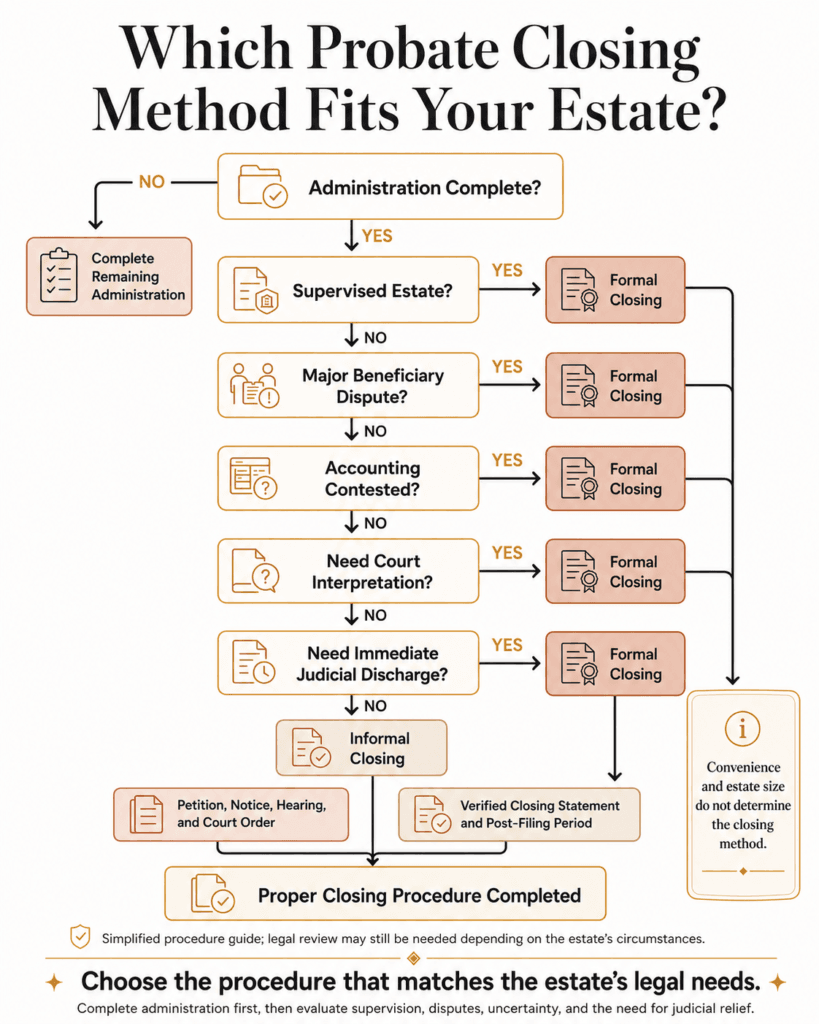
A Practical Decision Framework
Informal Closing Is More Likely Appropriate When:
- The estate is unsupervised.
- No court order prohibits it.
- Administration is complete.
- Every asset has a documented outcome.
- Creditor periods have expired.
- Claims were resolved or properly accommodated.
- Taxes were addressed.
- Distributions and title transfers are complete.
- The accounting reconciles.
- Beneficiaries understand the result.
- No material objection exists.
- No judicial interpretation is needed.
- Immediate discharge is not essential.
Formal Closing Is More Likely Appropriate When:
- The estate is supervised.
- The accounting is contested.
- Compensation is disputed.
- Heirship is uncertain.
- The will is unclear.
- Property ownership is disputed.
- A beneficiary or heir may have been omitted.
- A major creditor issue remains.
- The representative needs distribution instructions.
- Interested persons cannot agree.
- Judicial approval is important.
- The representative seeks termination through a closing order.
Questions to Ask Before Choosing
Before selecting the closing method, ask:
- Is the estate under supervised administration?
- Does a current order prohibit a closing statement?
- Have all creditor periods expired?
- Does any material claim remain unresolved?
- Is the remaining liability adequately accommodated?
- Is every probate asset accounted for?
- Were all title transfers completed?
- Does the accounting reconcile?
- Are the beneficiaries and heirs known?
- Does anyone object to the accounting?
- Is compensation disputed?
- Does the will require interpretation?
- Must the court determine heirship?
- Is a person entitled to notice missing?
- Does the representative need immediate judicial discharge?
- Would a formal order materially reduce legal risk?
- Is the expected protection worth the additional expense?
- Have the current local forms and procedures been confirmed?
Common Mistakes When Choosing a Closing Method
Common mistakes include:
- Confusing informal probate with informal closing
- Treating four months as an automatic closing date
- Assuming every uncontested estate requires a hearing
- Assuming a complicated estate cannot close informally
- Assuming a small estate never needs formal closing
- Filing a closing statement while a material dispute remains
- Using informal closing during supervised administration
- Believing the court approved the accounting because it accepted the closing statement
- Failing to send the accounting to affected distributees
- Omitting an unpaid and unbarred claim
- Assuming informal filing immediately terminates the appointment
- Seeking formal approval without identifying the relief needed
- Failing to notify all interested persons in a formal proceeding
- Using the narrower testate procedure when part of the estate may pass by intestacy
- Expecting a formal order to cure inadequate disclosure
- Using outdated or incorrect county forms
Do-and-don’t comparison for selecting an Arizona probate closing method based on supervision, disputes, court review, and the result needed.
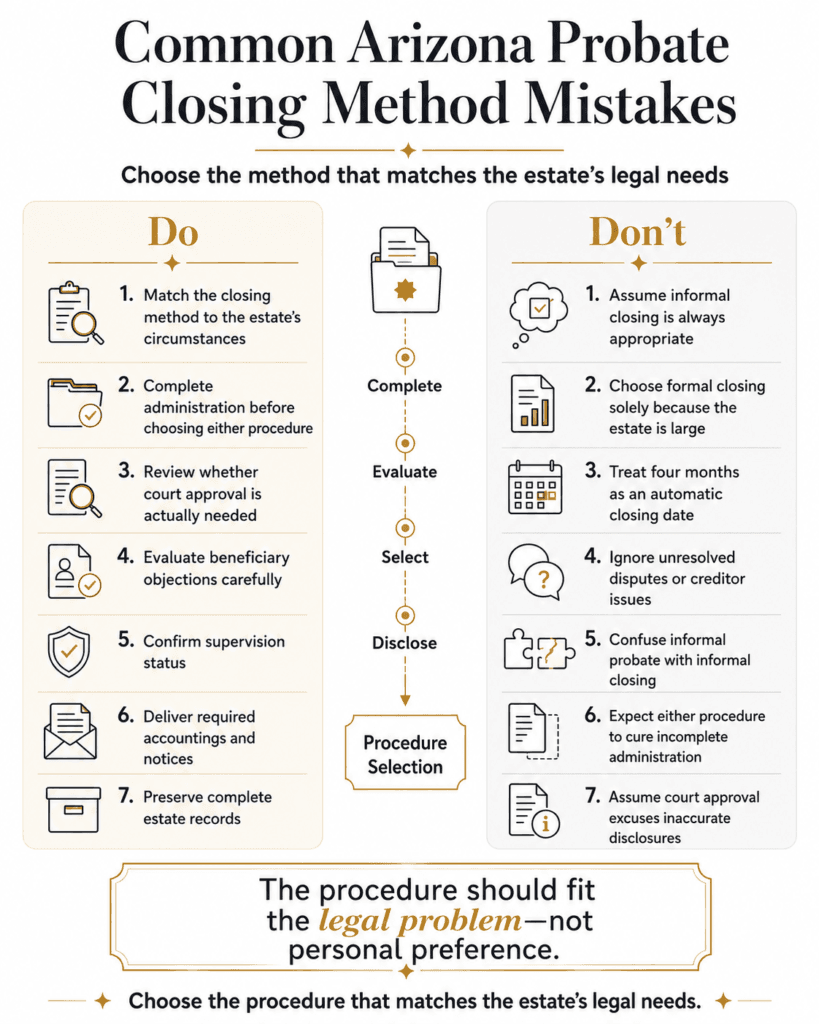
Choose the Method That Matches the Estate
Informal closing is often the practical choice for a completed, uncontested, unsupervised Arizona estate.
It allows the personal representative to verify that administration is complete without requesting a court hearing or judicial approval of every transaction.
Formal closing provides a court process for:
- Reviewing the accounting
- Interpreting the will
- Determining heirs
- Approving distributions
- Resolving objections
- Adjudicating settlement
- Discharging the personal representative
Neither method substitutes for accurate administration.
Before using either one, the representative should be able to explain:
- What happened to every probate asset
- How every known obligation was addressed
- What each recipient received
- Whether any legal uncertainty remains
- Why the selected closing method is appropriate
When an important issue requires a judge’s decision, formal closing may justify its additional time and expense.
When nothing material remains to decide, informal closing may provide the more efficient path.
Legal Disclaimer: This information is for educational purposes only and does not constitute legal advice. Arizona probate law is complex and varies based on individual circumstances. Always consult with a qualified probate attorney for guidance specific to your situation.
FAQs
Informal closing generally involves filing a verified closing statement after an unsupervised estate has been fully administered and the statutory requirements have been satisfied.
Formal closing is a court proceeding seeking an order addressing settlement, accounting, distribution, heirship, will interpretation, or discharge after notice and a hearing.
No. Informal probate concerns admission of a will, appointment of a personal representative, and the beginning of administration. Informal closing concerns completion of the estate.
Ordinarily, the closing-statement procedure does not require the settlement hearing used in formal closing.
Not necessarily. Informal closing generally relies on the personal representative’s verified statements. Formal settlement expressly allows the court to consider, compel, or approve the accounting.
No earlier than four months after the original appointment of a general personal representative, and only after the other statutory closing conditions have been satisfied.
No. Arizona’s closing-statement statute excludes estates under supervised administration.
No. A supervised personal representative may not distribute estate property without a prior court order.
Potentially. The closing statement must disclose the undischarged claim and describe either the distributees’ agreement to possible liability or the other arrangement made to accommodate it.
All distributees and known creditors or claimants whose claims remain unpaid and unbarred must receive copies. Affected distributees must also receive the full written accounting.
No. If no proceeding involving the representative is pending, the appointment generally terminates one year after the closing statement is filed.
Yes. An order closing the estate under Arizona’s formal-settlement statutes terminates the appointment.
The personal representative or another interested person may petition. Another interested person generally must wait one year after the original appointment, and the period for presenting claims arising before death must also have expired.
Yes. Arizona’s formal-settlement statutes allow the court to interpret the will when that relief is properly requested.
Yes. The general order-of-complete-settlement procedure permits the court to determine heirs.
Arizona’s statute does not require every distributee to sign one universal consent. However, an actual dispute may make formal settlement safer or necessary when the issue requires judicial resolution.
No. Complexity alone does not require a hearing when administration is complete, the estate is unsupervised, the records are clear, and no material issue requires a judge’s decision.
No. Its value depends on the relief requested, issues disclosed, people notified, evidence presented, and terms of the final order.
Yes. The method can change when an accounting objection, heirship issue, will question, creditor dispute, or need for judicial approval develops.
Certain successor and creditor claims for breach of fiduciary duty generally must begin within six months after filing. Fraud, misrepresentation, and inadequate disclosure are excluded from that limitation.
Arizona permits subsequent administration under the circumstances stated in the statute. The same personal representative or a successor may be appointed, but a claim that was already barred is not revived.