

Learn how to maintain an Arizona estate accounting, track assets and expenses, reconcile accounts, document distributions, and prepare to close.
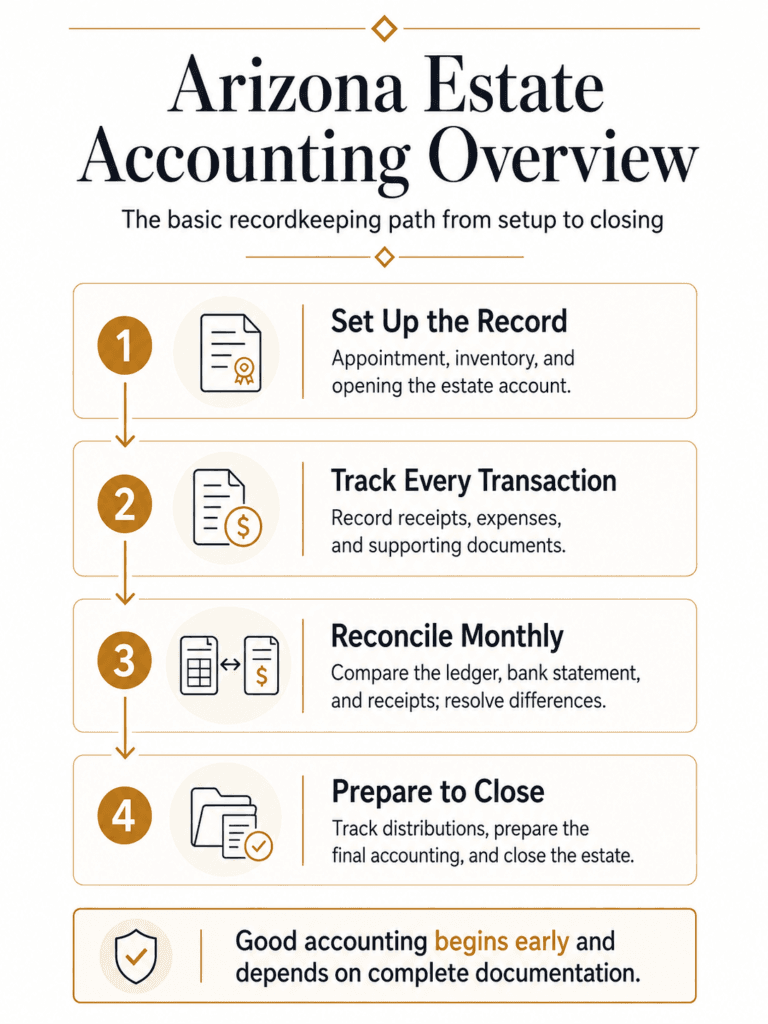
An accurate Arizona estate accounting shows what the probate estate owned, what it received, what it spent, what it distributed, and what remains.
The accounting should answer six basic questions:
- What property did the estate start with?
- What money or property did it later receive?
- What expenses, taxes, and creditor claims did it pay?
- What assets were sold or transferred?
- What did each heir or beneficiary receive?
- What remains in the estate?
Good accounting does not begin when the estate is ready to close.
It begins immediately after appointment, when the personal representative lawfully takes control of estate property.
Arizona treats the personal representative as a fiduciary. The representative must settle and distribute the estate efficiently, follow the will and Arizona law, protect creditor and family rights, and act in the best interests of the estate’s successors. Arizona also applies trustee accounting duties to personal representatives.
What is an Arizona estate accounting?
An estate accounting is the organized financial history of the probate administration.
It connects the estate’s opening assets to everything that happens afterward.
A clear accounting allows another person to determine:
- What the estate owned
- What the estate received
- What the estate spent
- Which assets increased or decreased in value
- What property was sold
- What distributions were made
- What property remains
The accounting should include both cash and noncash property.
A bank statement alone is not a complete accounting. It does not explain:
- Why each transaction occurred
- What happened to real estate or personal property
- Whether a payment was a creditor claim, tax, reimbursement, or distribution
- Which assets remain outside the bank account
- Whether a payment was properly supported
- How the ending balance connects to the property still held
The accounting is the estate’s financial story from appointment through closing.
Why accurate estate accounting matters
The personal representative should be able to explain what happened to every material estate asset.
Good records help show that the representative:
- Protected estate property
- Collected income and refunds
- Paid valid expenses
- Kept estate and personal funds separate
- Followed creditor-payment priorities
- Treated heirs and beneficiaries consistently
- Distributed property to the correct recipients
- Retained enough money for unresolved obligations
Incomplete records can cause:
- Beneficiary disputes
- Allegations that assets are missing
- Delayed distributions
- Difficulty preparing tax returns
- Problems closing the estate
- Formal court proceedings
- Potential fiduciary liability
A personal representative who improperly exercises estate authority may be liable to interested persons for the resulting damage or loss.
Begin recordkeeping immediately
Do not wait until the estate is almost ready to close.
At the beginning of the administration, create an organized system for:
- Probate documents
- Inventory records
- Bank statements
- Receipts
- Invoices
- Creditor claims
- Tax documents
- Property records
- Sale documents
- Professional invoices
- Distribution receipts
- Beneficiary correspondence
The system may be electronic, paper-based, or both.
A practical electronic folder structure might include:
- Opening Assets
- Estate Bank Account
- Income and Receipts
- Expenses
- Creditor Claims
- Taxes
- Asset Sales
- Compensation and Reimbursements
- Distributions
- Closing Documents
Create the accounting ledger at the same time.
Entering transactions as they occur is more reliable than reconstructing months or years of activity from incomplete statements.
Maricopa County’s current Order to Personal Representative directs representatives to keep detailed records of all funds and other assets received, every disbursement made, and receipts for out-of-pocket expenses.
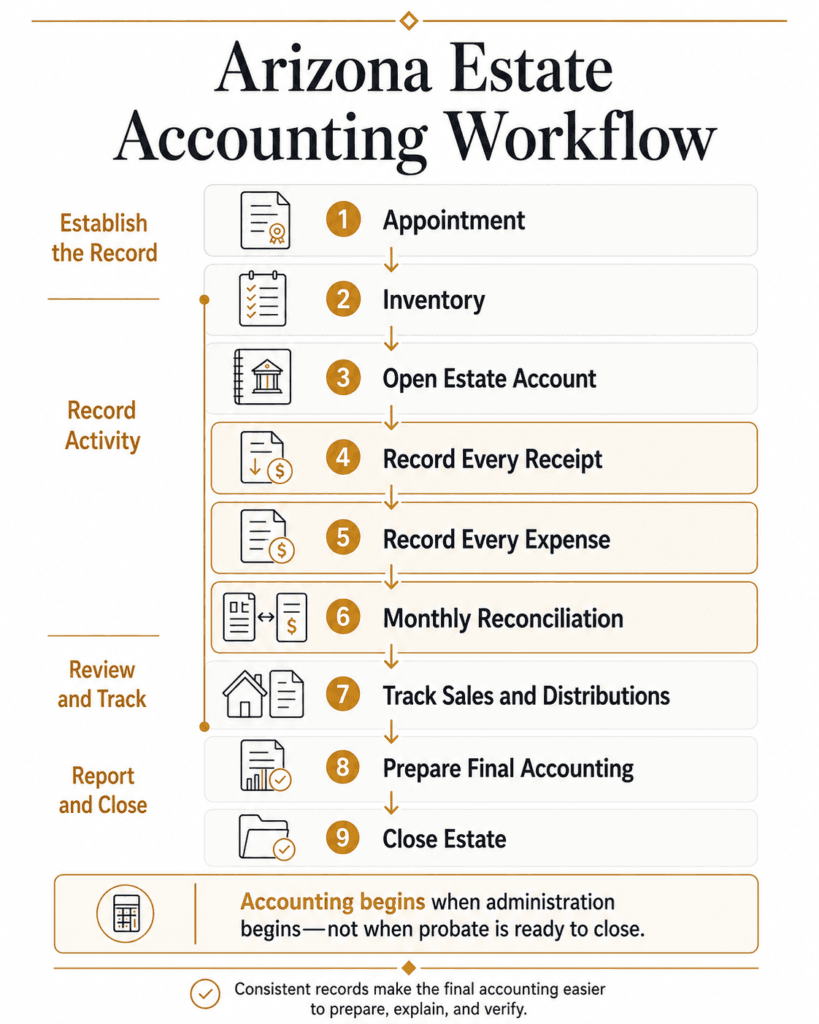
Start the Arizona estate accounting with the probate inventory
The probate inventory establishes the estate’s opening financial picture.
A qualifying personal representative generally must prepare the inventory within 90 days after appointment. It must identify:
- Property the decedent owned at death
- Each asset with reasonable detail
- Fair market value as of the date of death
- Whether the property was community or separate
- The type and amount of any encumbrance
These requirements appear in A.R.S. § 14-3706.
The estate accounting should later explain what happened to each inventory asset.
For example:
- A home was sold.
- A vehicle was distributed.
- An investment account was liquidated.
- Household property was divided among beneficiaries.
- A receivable was collected.
- An asset remained in the estate.
- An asset was later determined to be nonprobate.
- An omitted asset was added through a supplemental inventory.
An inventory asset should not disappear from the records without an explanation.
Rahnema Law’s Arizona probate inventory checklist explains how the opening asset list supports the rest of the administration.
Inventory value and accounting activity are different
The inventory generally reports an asset’s fair market value on the date of death.
The accounting shows what happened during administration.
Those figures may differ.
For example:
- A home valued at $450,000 at death later sells for $430,000.
- An investment account increases before distribution.
- A vehicle loses value.
- A receivable proves partly uncollectible.
- Repairs increase a property’s sales price.
- Commissions and closing costs reduce the cash received.
A difference does not automatically mean the inventory was wrong.
The accounting should identify the later transaction and preserve the records explaining the change.
However, when the original inventory description or value was erroneous or misleading, the personal representative may need to prepare a supplementary inventory rather than merely explaining the difference in the final accounting.
Build a transaction ledger
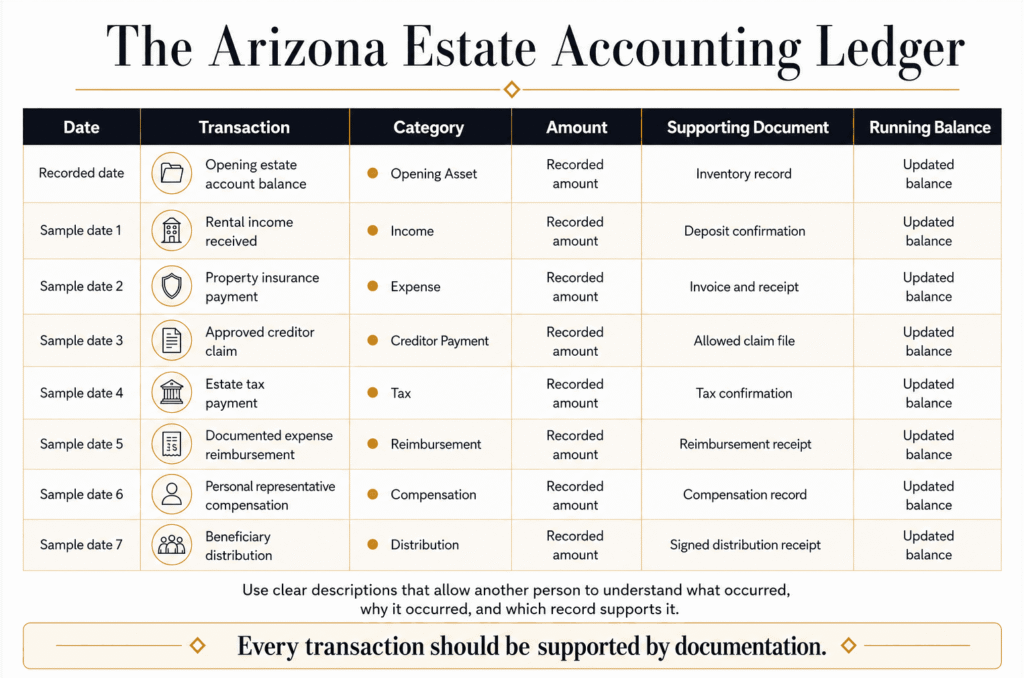
A working ledger should record every estate transaction.
For each receipt, include:
- Date received
- Payer or source
- Clear description
- Amount
- Account receiving the money
- Supporting document
For each payment, include:
- Date paid
- Payee
- Clear description
- Amount
- Payment method
- Expense category
- Supporting document
Useful categories may include:
- Administration
- Funeral expenses
- Creditor claims
- Taxes
- Property expenses
- Professional fees
- Personal representative reimbursement
- Personal representative compensation
- Beneficiary distribution
Each entry should make sense without requiring the reader to open every attachment.
Descriptions such as these are usually too vague:
- Check
- Transfer
- Payment
- Reimbursement
- Miscellaneous
- Property expense
A useful description explains what happened.
For example:
Emergency roof repair to prevent water damage at estate residence — $2,450
That entry tells the reader:
- Which property was involved
- What service was performed
- Why the expense was necessary
- How the estate benefited
The invoice and proof of payment should support the description.
Track every estate receipt
A receipt is money or property the estate receives during administration.
Common receipts include:
- Interest
- Dividends
- Rental income
- Tax refunds
- Insurance proceeds payable to the estate
- Sales proceeds
- Returned deposits
- Business income
- Service-provider refunds
- Money collected from a debtor
- Newly discovered accounts
Each entry should explain:
- Where the receipt came from
- Why it belongs to the estate
- Whether it represents principal, income, a refund, or sales proceeds
- Where it was deposited
Useful descriptions include:
- July rent from estate residence
- Federal income-tax refund payable to estate
- Net proceeds from vehicle sale
- Repayment of promissory note owed to decedent
- Interest credited to estate savings account
Preserve the check, deposit confirmation, account statement, closing document, or correspondence supporting the transaction.
Track every expense and payment
Every payment from estate property should be recorded.
Possible estate expenses include:
- Court filing fees
- Creditor-notice publication
- Insurance
- Utilities
- Property taxes
- Repairs
- Maintenance
- Appraisals
- Legal fees
- Accounting fees
- Creditor payments
- Funeral expenses
- Storage
- Shipping
- Necessary travel
- Costs of sale
The accounting should state:
- Who was paid
- What was purchased or performed
- Why it benefited the estate
- When it was paid
- How much was paid
Arizona gives a personal representative broad authority, subject to the will, court orders, statutory priorities, and the obligation to act reasonably for interested persons. Those powers include receiving assets, preserving and insuring property, making repairs, selling estate property, paying taxes and administration expenses, hiring professionals, and settling claims. See A.R.S. § 14-3715.
That authority does not eliminate the need to explain why an expense was reasonable and related to the estate.
Keep estate funds separate
Estate money should not be mixed with the personal representative’s money or anyone else’s property.
The personal representative should not:
- Deposit estate checks into a personal account
- Pay personal bills from estate funds
- Use estate money for undocumented purchases
- Combine personal and estate expenses in one transaction
- Treat estate property as an advance inheritance
- Title estate property personally without legal authority
Maricopa County’s current Order to Personal Representative expressly instructs representatives not to use estate assets for personal benefit or mix them with their own property or anyone else’s assets.
Separate handling creates a clearer record and reduces the risk of disputes or allegations of misuse.
Use the estate account consistently
When an estate account is appropriate:
- Deposit estate income and sales proceeds into it.
- Pay estate expenses from it.
- Avoid unexplained transfers.
- Preserve every monthly statement.
- Use traceable payment methods.
- Record bank fees and interest.
- Limit access to authorized people.
If the personal representative must pay an estate expense personally, preserve proof of the original payment and record the reimbursement separately.
Do not transfer a rounded amount to the representative without identifying the expenses being reimbursed.
Reconcile the estate account regularly
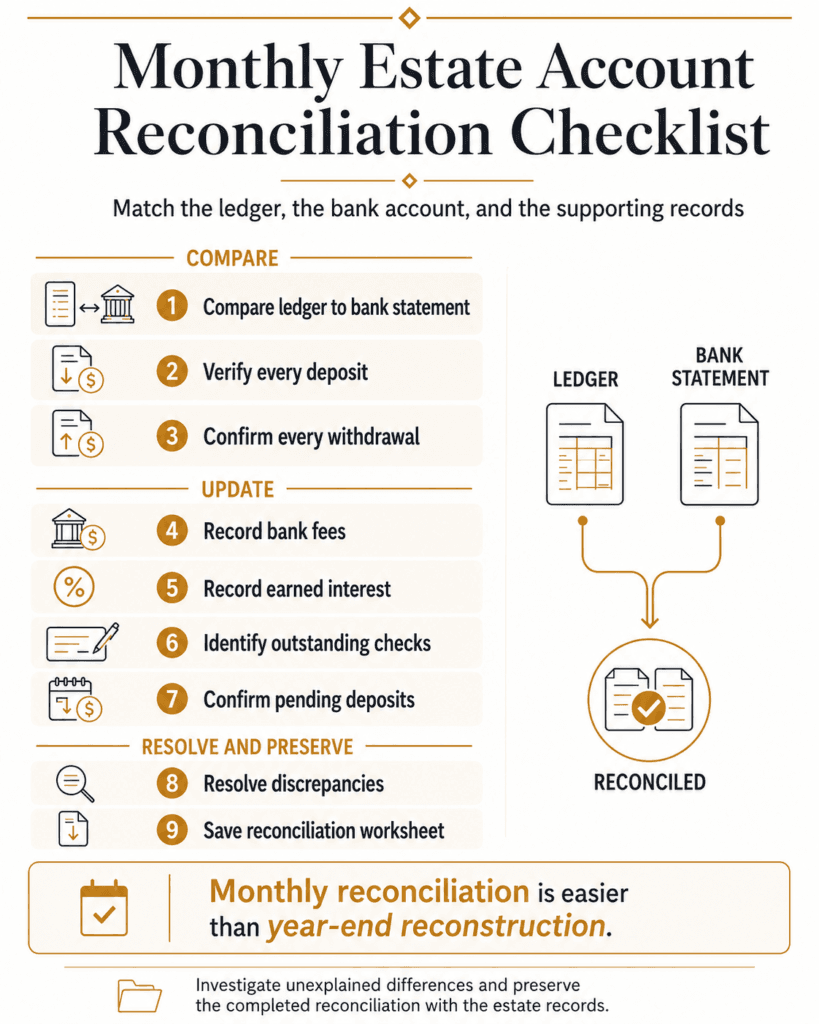
Reconciliation means comparing the estate ledger with the financial institution’s statement.
Monthly reconciliation is a strong practice.
Confirm that:
- Every deposit appears on the statement.
- Every withdrawal was authorized.
- Every check appears in the ledger.
- Bank fees and interest were recorded.
- Outstanding checks were identified.
- Pending deposits were listed.
- The adjusted ledger balance matches the adjusted bank balance.
Regular reconciliation may uncover:
- Duplicate payments
- Missing deposits
- Unauthorized withdrawals
- Incorrect amounts
- Bank errors
- Stale checks
- Unrecorded fees
- Transactions entered under the wrong category
A discrepancy found quickly is usually easier to investigate than one discovered during final closing.
Preserve a complete bank record
Keep:
- Monthly statements
- Check images
- Deposit records
- Wire confirmations
- Electronic payment confirmations
- Bank correspondence
- Account-opening documents
- Account-closing statements
- Reconciliation worksheets
Do not assume that online records will remain available indefinitely.
Download and preserve them while the account is open.
Explain asset sales from beginning to end
When an estate asset is sold, the accounting should show more than the final deposit.
For a real estate sale, preserve:
- Inventory value
- Appraisal or market analysis
- Listing agreement
- Purchase contract
- Repair invoices
- Settlement statement
- Commissions
- Taxes
- Loan payoff
- Seller charges
- Gross sales price
- Net estate proceeds
The accounting should allow the reader to follow this path:
Inventory asset → sale → expenses and debt payoff → net proceeds received
The same principle applies to:
- Vehicles
- Securities
- Business interests
- Jewelry
- Collectibles
- Equipment
- Other personal property
If the estate sells a vehicle for $18,000 but deposits only $12,500, the records should explain the difference.
For example:
- Gross sales price: $18,000
- Loan payoff: $4,700
- Sales expense: $800
- Net estate proceeds: $12,500
Record investment activity accurately
An investment account may contain:
- Opening securities
- Dividends
- Interest
- Purchases or sales
- Market gains or losses
- Management fees
- Cash distributions
- Transfers to beneficiaries
Do not record only the ending cash received when the account remained active during administration.
Preserve brokerage statements showing how the opening securities became the final cash or distributed investments.
Market appreciation is different from income. Both may also require tax review.
Explain changes in asset value
Estate property may increase or decrease in value.
The accounting should identify the reason when the change is material.
Possible causes include:
- Market appreciation
- Market decline
- Depreciation
- Damage
- Repairs
- Improvements
- Collection of a discounted receivable
- Discovery that the original value was inaccurate
Supporting evidence may include:
- Account statements
- Appraisals
- Photographs
- Inspection reports
- Repair invoices
- Comparable sales
- Sales documents
Do not insert an unexplained “gain,” “loss,” or “adjustment” simply to make the accounting balance.
Maintain a separate creditor-claim schedule
Creditor payments should be easy to trace.
For each claim, record:
- Creditor
- Amount requested
- Date received
- Timeliness determination
- Amount allowed
- Amount disallowed
- Settlement amount
- Priority classification
- Payment date
- Remaining balance
- Resolution documents
The creditor schedule and estate accounting should agree.
For example, suppose a creditor claimed $20,000 but accepted $13,000 in full settlement.
The accounting should show the $13,000 payment. The creditor file should preserve the written settlement and release.
The personal representative should not record the entire $20,000 as an expense if the estate paid only $13,000.
Record tax activity separately
Tax transactions should not disappear among general expenses.
Possible tax entries include:
- Decedent’s final federal income-tax payment
- Decedent’s final Arizona income-tax payment
- Federal fiduciary income-tax payment
- Arizona fiduciary income-tax payment
- Property taxes
- Payroll taxes
- Estimated tax payments
- Tax refunds
- Tax-preparation fees
Preserve:
- Filed returns
- Forms 1099
- Schedules K-1
- Payment confirmations
- Refund notices
- Tax correspondence
- Accountant workpapers
- Applicable tax certificates or closing records
The IRS’s Publication 559 explains federal responsibilities involving a decedent’s returns and the estate’s federal income-tax reporting.
Tax obligations can arise after the estate appears financially complete.
Do not automatically distribute the estate’s final dollar before tax matters are understood.
Separate reimbursement from compensation
A reimbursement repays the personal representative for a proper estate expense paid personally.
Compensation pays the representative for services performed.
They are not the same transaction.
A reimbursement entry should identify:
- Original expense
- Vendor
- Date paid personally
- Amount
- Estate purpose
- Receipt or invoice
- Date reimbursed
Examples may include:
- Court fee personally advanced
- Emergency locksmith payment
- Necessary property supplies
- Certified-mail expense
Do not reimburse the representative without proof that the expense was actually paid for the estate.
Document personal representative compensation
Arizona provides that a personal representative is entitled to reasonable compensation, subject to provisions in the will and any renunciation of compensation rights. The statute does not create an automatic percentage for every estate. See A.R.S. § 14-3719.
A representative seeking compensation should keep contemporaneous time records showing:
- Date
- Task
- Time spent
- Hourly rate
- Why the task was necessary
- Any unusual complexity
Maricopa County’s Order to Personal Representative recommends records containing the date, task description, time spent, and rate charged.
Do not record the same item as both:
- Reimbursed expense
- Compensable time
An interested person may ask the court to review the reasonableness of the representative’s compensation or the compensation paid to estate professionals. Excessive compensation may be subject to refund.
Record professional fees clearly
The estate may employ:
- Attorneys
- Accountants
- Appraisers
- Real estate professionals
- Property managers
- Investment advisers
- Business valuators
- Other agents
For each professional payment, record:
- Professional or firm
- Date
- Amount
- General service performed
- Matter involved
- Invoice reference
Preserve detailed invoices.
Do not combine all professional costs into one unexplained total unless an attached schedule provides the details.
Rahnema Law’s Arizona probate administration overview explains how professional assistance, creditor work, inventory, tax matters, distribution, and closing fit into the larger process.
Document every distribution
Each distribution should identify:
- Recipient
- Date
- Cash amount or property
- Whether it was partial or final
- Governing will provision or intestate share
- Value assigned to noncash property
- Transfer documents
- Signed receipt or acknowledgment
A distribution should not appear only as a reduction in the estate’s balance.
The accounting should show who received the property and why.
Record noncash distributions carefully
Estate property may be distributed in kind instead of sold.
Examples include:
- Real estate
- Vehicles
- Securities
- Jewelry
- Household property
- Business interests
The accounting should identify:
- Asset
- Recipient
- Distribution date
- Value used
- Supporting valuation
- Debt transferred with the property
- Transfer documents
The inventory value and distribution value may differ.
Under A.R.S. § 14-3906, certain in-kind distributions use fair market value at or near the distribution date. For property without a readily ascertainable value, a reasonable valuation dated no more than 30 days before distribution may control. The personal representative may use a reasonable valuation method, including a qualified appraiser, even if the property was valued before.
For example, a home may have been worth $400,000 at death but $455,000 when distributed one year later.
The first value may remain correct for the inventory. The later value may matter when determining the beneficiary’s distribution.
Preserve distribution receipts
A signed receipt can confirm:
- What the recipient received
- When the transfer occurred
- Whether it was partial or final
- The value assigned to the property
- Whether the recipient accepted an allocation
Receipts are especially helpful for:
- Cash payments
- Vehicles
- Jewelry
- Household property
- Securities
- Keys and possession of real estate
- Original documents
A receipt does not replace a deed, title transfer, assignment, or other instrument legally required to transfer ownership.
Identify all property remaining in the estate
An interim or final Arizona estate accounting should identify what remains at the end of the accounting period.
Remaining property may include:
- Cash reserve
- Real estate not yet sold
- Investment accounts
- Property awaiting distribution
- Tax refunds
- Uncollected receivables
- Business interests
- Contingent recoveries
The ending cash balance should reconcile with the estate’s bank records.
The ending noncash property should be described clearly.
If the accounting states that the estate holds $40,000 in cash, the bank statements and reconciliation should support that amount.
Use the basic accounting equation
A clear accounting should reconcile mathematically.
A practical summary is:
Opening estate property
- later receipts and additions
− expenses and distributions
= property remaining
Corrections and adjustments should be explained.
Do not add an unexplained number merely to force the totals to match.
Interim estate accountings
An interim accounting covers part of the administration.
It may be useful when:
- Probate lasts a long time
- Beneficiaries need a meaningful update
- A dispute arises
- The court requests information
- A successor personal representative takes over
- A major asset has been sold
- A substantial partial distribution is proposed
An interim accounting should state:
- Beginning date
- Ending date
- Opening property
- Receipts during the period
- Payments during the period
- Distributions
- Property remaining
The next accounting should begin with the prior accounting’s ending balance.
Final Arizona estate accounting
The final accounting covers the administration through final distribution or the point immediately before closing.
It should show:
- Opening estate property
- Additional receipts
- Income
- Asset sales
- Administration expenses
- Creditor payments
- Taxes
- Compensation
- Reimbursements
- Distributions
- Property remaining
The final accounting should connect directly to:
- Inventory
- Bank statements
- Creditor records
- Tax records
- Sales documents
- Distribution receipts
Accounting when an Arizona estate closes informally
Arizona allows an eligible unsupervised estate to close through a verified closing statement.
The personal representative must state, among other matters, that:
- The creditor-presentation period expired
- The estate was fully administered
- Presented claims were paid, settled, resolved, or appropriately accommodated
- Applicable administration expenses and death taxes were addressed
- Estate assets were distributed
- A full written account was furnished to distributees whose interests were affected
The personal representative files the closing statement with the court. The full written accounting is furnished to the affected distributees. See A.R.S. § 14-3933.
The accounting and closing statement are different documents.
Maricopa County’s informal-closing procedure
Maricopa County’s current closing packet directs the personal representative to:
- Complete the Final Accounting of Decedent’s Estate.
- Complete the Closing Statement.
- Keep copies of both documents.
- Mail the final accounting to the distributees or heirs.
- Mail the closing statement to the required recipients.
- File the original closing statement with the court.
The county’s final-accounting form states that the accounting itself is not filed with the court. It is sent to the estate’s distributees or heirs.
The current forms are available through the Maricopa County probate closing page.
That is Maricopa County’s informal-closing procedure.
Do not assume every county follows the same forms or instructions.
The Arizona Judicial Branch explains that its probate forms are generic and that individual courts may have preferred forms.
Accounting in a formal closing proceeding
A personal representative or another interested person may petition for a formal order completely settling the estate.
In that proceeding, the court may:
- Consider a final account
- Compel an accounting
- Approve an accounting
- Determine distribution rights
- Approve a settlement
- Direct distribution
- Discharge the personal representative
A copy of the final account must be sent to distributees whose interests are affected. See A.R.S. § 14-3931.
Formal review may be appropriate when:
- Beneficiaries disagree
- The administration is complicated
- Transactions are disputed
- The fiduciary wants judicial approval
- Distribution rights are uncertain
- The estate needs a binding settlement order
Communicate the accounting clearly
An accounting should make sense to someone who did not manage the estate.
Consider adding a short explanation for major events such as:
- Sale of a residence
- Significant property repair
- Investment loss
- Creditor settlement
- Large tax payment
- Personal representative compensation
- Reserve retained for unresolved obligations
Use neutral language.
The accounting should explain what happened without arguing with beneficiaries or including unnecessary personal commentary.
What happens when someone objects?
A beneficiary may question:
- A missing asset
- Repair expense
- Sales price
- Reimbursement
- Professional fee
- Personal representative compensation
- Distribution calculation
- Unexplained decline in value
An objection does not automatically prove wrongdoing.
It does mean the personal representative should be able to provide records supporting the decision.
Many questions can be answered with:
- Invoice
- Receipt
- Appraisal
- Bank statement
- Sales document
- Written calculation
- Distribution receipt
- Explanation of the representative’s reasoning
If the dispute cannot be resolved, an interested person may seek formal court review, including an order compelling or approving an accounting.
Correct accounting mistakes promptly
Accounting errors may include:
- Duplicate entry
- Wrong amount
- Incorrect category
- Missing bank fee
- Omitted receipt
- Payment assigned to the wrong creditor
- Distribution entered twice
- Mathematical error
Do not erase the original record without explanation.
Use a correction entry showing:
- Date
- Original error
- Correct amount
- Reason for correction
- Supporting document
If the error also affects the inventory, tax returns, creditor records, or beneficiary distributions, those records may require separate corrections.
Preserve supporting documents
The accounting is a summary.
The personal representative should retain the evidence behind it.
Important records include:
- Inventory
- Supplemental inventory
- Bank statements
- Reconciliation worksheets
- Check images
- Deposit confirmations
- Receipts
- Invoices
- Contracts
- Appraisals
- Sales settlement statements
- Creditor claims
- Settlement agreements
- Tax returns
- Professional invoices
- Time records
- Distribution receipts
- Transfer documents
- Court filings and orders
Store electronic records securely and maintain backups.
Do not rely entirely on one device, email account, or online banking portal.
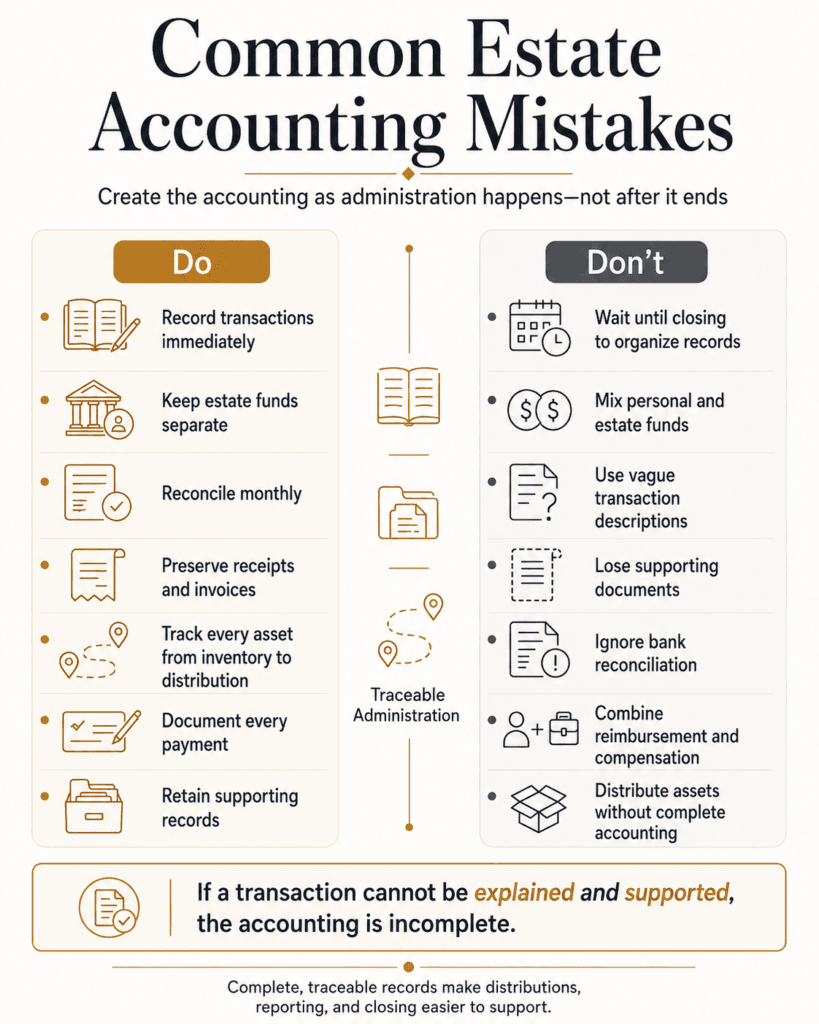
Common Arizona estate accounting mistakes
Common mistakes include:
- Waiting until closing to begin
- Mixing estate and personal funds
- Failing to reconcile the estate account
- Using vague transaction descriptions
- Losing receipts
- Paying expenses in cash
- Omitting bank fees or interest
- Failing to record income
- Treating bank statements as the full accounting
- Omitting noncash property
- Failing to connect assets to the inventory
- Reporting net sales proceeds without explaining costs
- Combining reimbursement and compensation
- Failing to keep time records
- Omitting distributions in kind
- Failing to obtain distribution receipts
- Showing an ending balance that does not match the property held
- Sending the accounting to the wrong people
- Following another county’s closing instructions without checking
- Failing to correct an error after discovering it
Arizona estate accounting checklist
Before finalizing the accounting, confirm that:
- Every inventory asset has been traced.
- The accounting period is clearly stated.
- Opening assets agree with the inventory or prior accounting.
- Every receipt is recorded.
- Every expense identifies its purpose.
- Supporting records exist for each material transaction.
- Estate and personal funds remained separate.
- Estate accounts were reconciled regularly.
- Sales show gross proceeds, expenses, debt payoff, and net proceeds.
- Material changes in value are explained.
- Creditor payments match the creditor log.
- Tax payments and refunds are recorded separately.
- Reimbursements are supported by original receipts.
- Compensation is separate from reimbursement.
- Professional fees are described clearly.
- Every distribution identifies the recipient.
- Noncash distributions include a value and transfer record.
- The ending balance matches the property still held.
- Mathematical totals reconcile.
- Required recipients received the accounting.
- Proof of delivery is preserved.
- Copies and supporting records are retained.
- County-specific closing procedures have been checked.
- Significant questions were resolved before the closing statement was filed.
Build one continuous financial record
An accurate Arizona estate accounting should show the full financial history of the probate administration.
It begins with the inventory.
It follows:
- Every receipt
- Every expense
- Every sale
- Every creditor payment
- Every tax transaction
- Every reimbursement
- Every distribution
It ends with a clear statement of what remains or how the estate was fully distributed.
Consistent recordkeeping, separate estate funds, regular reconciliation, complete supporting documents, and clear descriptions make closing easier.
They also give the personal representative the strongest practical response when a beneficiary, creditor, or court asks:
What happened to the estate property?
An estate involving business operations, substantial investments, disputed fees, complicated taxes, multiple property sales, fiduciary compensation, or beneficiary conflict may require individualized legal and accounting assistance.
Rahnema Law’s Arizona probate FAQs provide additional guidance about inventories, creditor claims, distributions, and closing.
Legal Disclaimer: This information is for educational purposes only and does not constitute legal advice. Arizona probate law is complex and varies based on individual circumstances. Always consult with a qualified probate attorney for guidance specific to your situation.
FAQs
It should identify:
· Opening estate property
· Later receipts
· Expenses
· Creditor payments
· Taxes
· Asset sales
· Compensation
· Reimbursements
· Distributions
· Property remaining
Recordkeeping should begin immediately after appointment, when the personal representative lawfully takes control of estate property. Do not wait until the estate is ready to close.
Generally, yes. The inventory establishes the opening probate property and its date-of-death value. The accounting then explains what happened to each listed asset.
Estate funds should be handled separately. The personal representative should not mix estate property with personal funds or anyone else’s property.
Monthly reconciliation is a strong practice. It can identify missing deposits, incorrect payments, bank errors, fees, and outstanding checks before they become difficult to investigate.
No. A bank statement does not describe noncash property or fully explain the purpose, authority, and supporting records for each transaction.
Record:
· Gross sales price
· Commissions
· Closing expenses
· Repairs
· Taxes
· Loan payoff
· Net proceeds
Preserve the purchase contract, settlement statement, invoices, and payment records.
That does not automatically mean the inventory was wrong. The inventory generally uses date-of-death value. A later sale reflects later market conditions, repairs, expenses, and negotiations.
A reimbursement repays the personal representative for a documented estate expense paid personally. Compensation pays the representative for services performed.
Arizona provides for reasonable compensation, subject to the will and any waiver or renunciation. The statute does not create an automatic percentage for every estate.
Identify:
· The asset
· Recipient
· Distribution date
· Assigned value
· Supporting valuation
· Debt transferred with the property
· Transfer documents
Certain distributions may require a current fair market valuation.
It depends on the proceeding and local court procedures. Arizona’s informal-closing statute requires the personal representative to furnish a full written account to affected distributees. Maricopa County’s current informal-closing form states that the final accounting is sent to distributees or heirs and is not filed with the court. The closing statement is filed.
Yes. In a formal settlement proceeding, the court may consider, compel, or approve an accounting and determine the estate’s settlement and distribution.
The personal representative should provide the records supporting the transaction and explain how the decision was made. If the dispute cannot be resolved, an interested person may seek formal court review.
Yes. A personal representative may be liable for loss caused by an improper exercise of estate authority or breach of fiduciary duty.