

Learn Arizona estate debt payment priority, including family allowances, administration costs, taxes, medical bills, and unsecured claims.
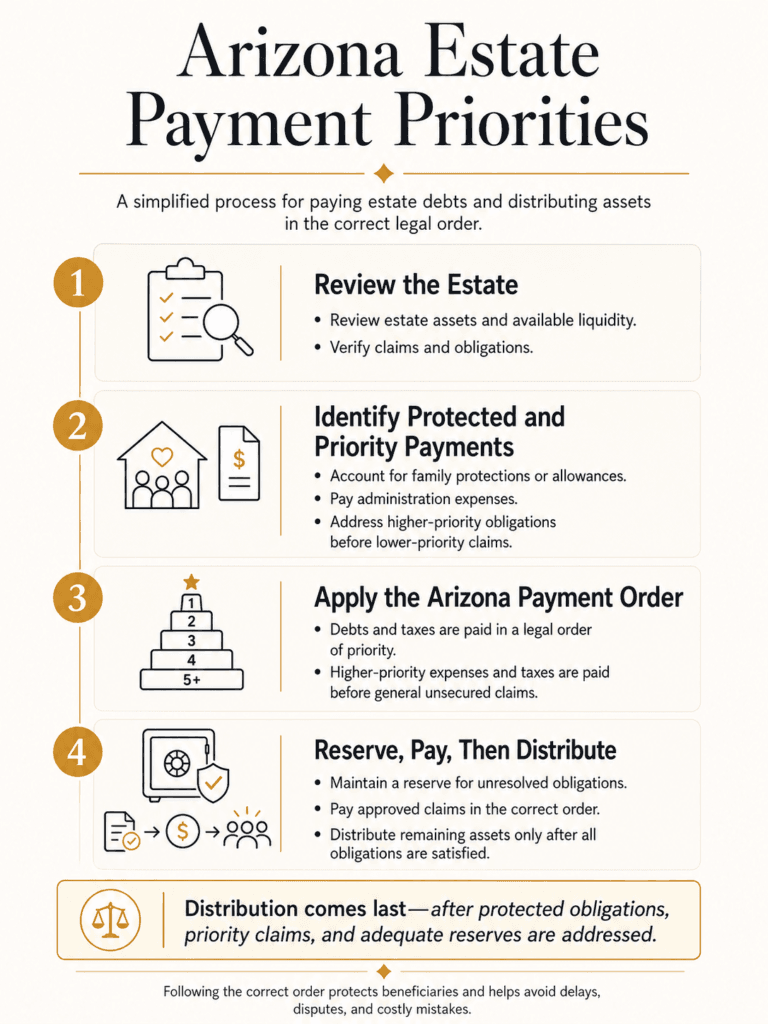
Arizona estate debt payment priority determines which valid obligations receive payment first when an estate does not have enough property to pay everything.
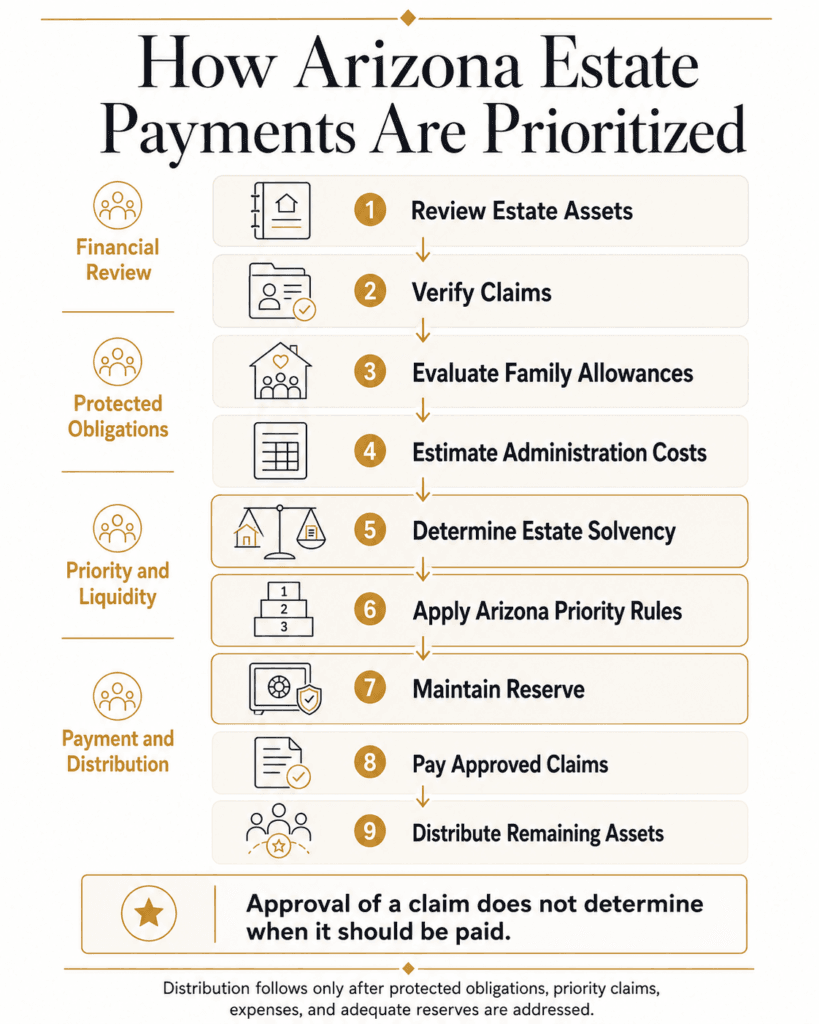
The personal representative should not pay bills in the order they arrive. Arizona law places estate claims into six classes:
- Costs and expenses of administration
- Reasonable funeral expenses
- Debts and taxes entitled to preference under federal law
- Reasonable and necessary expenses of the decedent’s last illness
- Debts and taxes entitled to preference under Arizona law
- All other claims
Claims within the same class do not move ahead merely because one creditor acted first or demanded immediate payment.
Before applying that list, the personal representative must also account for statutory protections available to a surviving spouse and qualifying children.
A familiar bill is not necessarily the next bill the estate should pay.
First determine whether the demand is a valid estate claim
Payment priority matters only after the personal representative determines that the estate should recognize the expense or claim.
A creditor generally must present a claim within the applicable Arizona deadline. The representative should then determine whether the demand is:
- Timely
- Supported by reliable records
- Legally enforceable
- Calculated correctly
- Owed by the decedent or estate
- Already paid or settled
- Covered by insurance
- Secured by specific property
- Subject to a defense or counterclaim
A bill should not be paid merely because it appears in the decedent’s mail or because a collection company requests immediate payment.
The personal representative should review:
- Contracts
- Account statements
- Invoices
- Payment histories
- Insurance records
- Tax notices
- Loan documents
- Court judgments
- Correspondence
- Proof of goods or services
Arizona requires creditors to present claims in accordance with specific notice and timing rules. The method of presentation, applicable deadlines, and consequences of disallowance are separate from the order in which an allowed claim receives payment.
Rahnema Law’s probate FAQ provides additional plain-English guidance about creditor claims, deadlines, disallowance, and estate payments.
Build the estate’s complete financial picture
Before making substantial payments, prepare a realistic summary of the estate.
The analysis should include:
- Cash currently available
- Property that may need to be sold
- Expected income and refunds
- Administration expenses
- Statutory family protections
- Taxes
- Allowed creditor claims
- Claims still under review
- Secured obligations
- Property-maintenance costs
- Professional fees
- Expected closing expenses
- Contingent or disputed liabilities
An estate is commonly described as insolvent when its applicable assets are insufficient to pay all valid expenses and claims.
That does not necessarily mean the personal representative mishandled the estate. The decedent may simply have left more obligations than available property.
However, once insolvency appears possible, payments are no longer routine.
The personal representative should stop, identify all likely obligations, preserve estate cash, and apply the correct priorities.
Rahnema Law’s guide to finding Arizona probate assets can help the representative build a more complete picture before deciding what the estate can afford to pay.
Family protections come before general creditor payments
Arizona provides statutory protections for a surviving spouse and qualifying children.
These protections are not ordinary creditor classes under the six-part claim statute. Even so, Arizona directs the personal representative to make provision for them before paying allowed claims.
The relevant protections may include:
- Homestead allowance
- Exempt property
- Family allowance
These rights can reduce the property available for creditors and beneficiaries.
Arizona homestead allowance
A surviving spouse is entitled to an $18,000 homestead allowance.
If there is no surviving spouse, the allowance is divided among the decedent’s minor and dependent children.
The homestead allowance is exempt from and has priority over all estate claims except expenses of administration.
This probate allowance is different from Arizona’s real-property homestead exemption.
It is a statutory estate benefit. It does not require the family to own a house.
Arizona exempt-property allowance
In addition to the homestead allowance, the surviving spouse is generally entitled to as much as $7,000 in net value from specified estate property, including:
- Household furniture
- Automobiles
- Furnishings
- Appliances
- Personal effects
If there is no surviving spouse, the decedent’s minor and dependent children share the same right.
When the available qualifying property does not reach $7,000 in net value, other estate property may be used to make up the difference, subject to the statute’s priority and abatement rules.
Do not assume every household item can be sold to pay general creditors before evaluating this protection.
Arizona family allowance
Arizona also provides a reasonable family allowance for the maintenance of:
- The surviving spouse
- Minor children whom the decedent was obligated to support
- Children the decedent was actually supporting
If the estate cannot pay all allowed claims, the allowance cannot continue for more than one year.
The family allowance has priority over all claims except:
- Expenses of administration
- The homestead allowance
The personal representative may determine a family allowance of up to:
- $12,000 as a lump sum, or
- $1,000 per month for as long as one year
An interested person may ask the court to review the determination, payment, proposed payment, or failure to act.
Do not treat all estate cash as available for creditors until these family protections have been reviewed.
How Arizona estate debt payment priority works
After accounting for statutory protections and unresolved administration needs, the personal representative applies Arizona’s six creditor-priority classes when the estate cannot pay every claim in full.
Each class must be evaluated in order.
Priority 1: Costs and expenses of administration
Costs and expenses of administration receive the highest priority under Arizona’s creditor-claim statute.
Depending on the estate, reasonable and necessary administration expenses may include:
- Court filing fees
- Creditor-publication costs
- Attorney fees
- Accounting fees
- Appraisal expenses
- Estate-bank-account charges
- Necessary insurance
- Property-security costs
- Necessary maintenance
- Costs of selling estate property
- Other expenses required to protect or administer the estate
Not every expense incurred while probate is open automatically belongs in this class.
Ask:
- Was the expense incurred for the estate?
- Was it reasonable?
- Is it documented?
- Did it protect or benefit the administration?
- Was it primarily personal?
For example, reasonable expenses to secure and insure an estate residence may qualify.
A beneficiary’s personal travel, undocumented purchases, or improvements made only for convenience may require a different analysis.
Document administration expenses clearly
For each administration expense, preserve:
- Invoice
- Receipt
- Contract
- Proof of payment
- Explanation of purpose
- Connection to the estate
- Any required approval
The accounting should explain what the expenditure accomplished.
Descriptions such as “miscellaneous,” “reimbursement,” or “estate expense” may be too vague to justify first-priority treatment.
Rahnema Law’s probate administration overview explains how creditor payments fit with asset collection, inventory, taxes, accounting, distribution, and closing.
Priority 2: Reasonable funeral expenses
Reasonable funeral expenses come after administration expenses under Arizona’s statutory order.
Potential expenses may include reasonable charges for:
- Funeral services
- Memorial services
- Burial
- Cremation
- Transportation
- Related arrangements
The word reasonable matters.
The estate may not be responsible for every expense selected by relatives, especially when:
- The cost was unusually high for the estate
- The item primarily benefited attendees
- Someone lacked authority to incur the expense
- Another person agreed to pay it
- Insurance or a prepaid plan covered it
A person seeking reimbursement should provide:
- Contracts
- Invoices
- Receipts
- Proof of payment
- Information about prepaid benefits or insurance
Priority 3: Debts and taxes preferred under federal law
Arizona places debts and taxes entitled to preference under federal law in the third state-law class.
However, federal law requires its own analysis.
Under the federal priority statute, a claim of the United States may receive priority when a deceased debtor’s estate does not have enough property to pay all debts.
A personal representative who knows about a qualifying federal claim and pays lower-priority debts first may face personal liability to the extent of the improper payments.
Possible federal obligations may include:
- The decedent’s federal income taxes
- Estate fiduciary income taxes
- Employment or payroll taxes
- Federal business liabilities
- Other debts owed to the United States
Review federal obligations early
Before paying lower-priority creditors or making distributions, determine whether:
- Required federal returns have been filed
- Prior-year returns remain outstanding
- The decedent operated a business
- Payroll or employment taxes may exist
- The IRS issued notices
- An audit or examination remains pending
- The estate earned taxable income
- Additional federal tax may become due
Do not assume the Arizona list alone resolves the payment order when the United States is a creditor.
Federal liens, secured interests, and other priority rules can make the analysis more complicated. An estate that may be insolvent and may owe federal taxes should receive tax and legal review before substantial payments are made.
Priority 4: Expenses of the decedent’s last illness
Arizona’s fourth class includes reasonable and necessary medical and hospital expenses from the decedent’s last illness, including compensation for people who attended the decedent.
This category does not automatically include every medical bill the decedent ever incurred.
Review:
- Date of service
- Relationship to the final illness
- Medical necessity
- Insurance payments
- Medicare or Medicaid adjustments
- Contractual reductions
- Prior payments
- Amount still legally owed
A provider’s original invoice may not show the final balance after insurance and other adjustments.
Not every medical bill receives fourth priority
A routine medical bill from years before death may belong in the final class as an ordinary unsecured claim.
The estate should preserve records showing why a particular expense qualifies as part of the last illness.
Useful records may include:
- Hospitalization dates
- Physician records
- Insurance explanations of benefits
- Hospice records
- Home-care invoices
- Payment histories
When the connection is uncertain, do not assign higher priority based only on the fact that the creditor is a medical provider.
Priority 5: Debts and taxes preferred under Arizona law
The fifth class consists of debts and taxes that another Arizona law gives special preference.
Not every debt owed to a state or local agency automatically belongs in this class.
The creditor or personal representative should identify the legal authority that grants the particular debt priority.
A government letter that uses the word “priority” does not replace the legal analysis.
Priority 6: All other claims
The final class contains valid claims that do not qualify for a higher priority.
This category often includes:
- Credit-card balances
- Unsecured personal loans
- General service bills
- Ordinary contractual debts
- Unsecured business obligations
- Family loans
- Other general unsecured claims
These claims are not invalid merely because they belong to the final class.
They receive payment after higher-priority expenses and claims have been paid or adequately provided for.
When the estate is insolvent, creditors in this class may receive only partial payment or nothing.
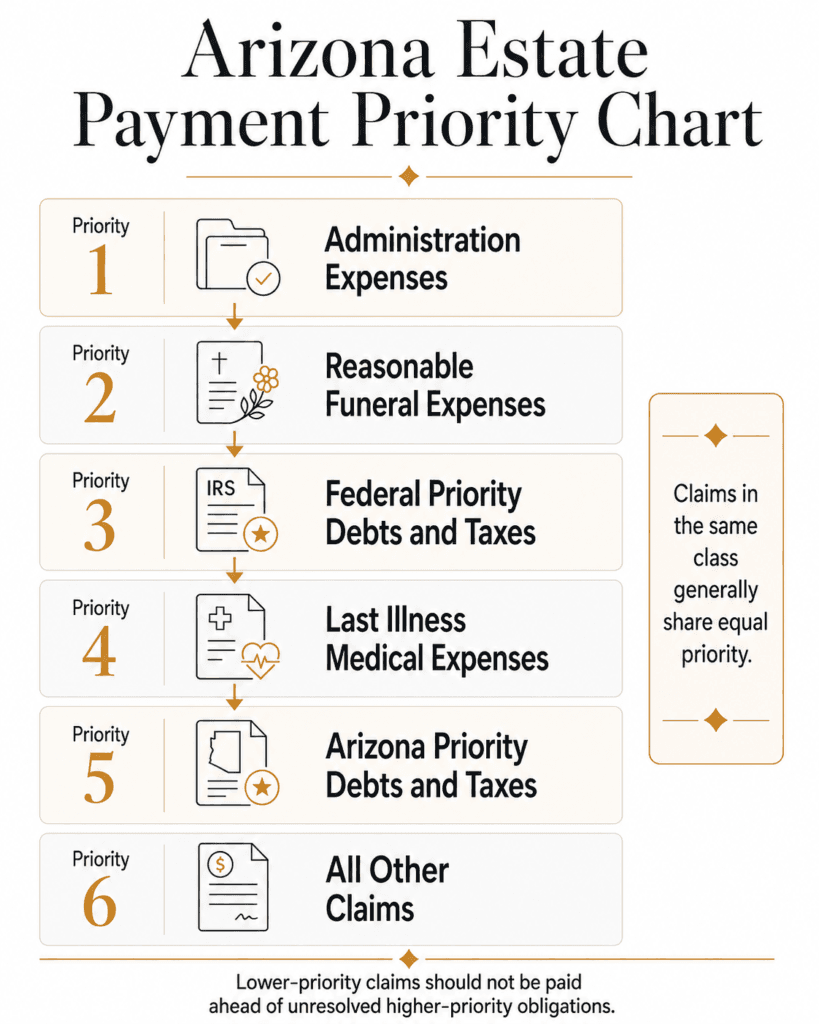
First, set money aside. Before any of the six classes below get paid, the Personal Representative must reserve enough for:
- The homestead allowance, exempt property, and the family allowance
- Claims that came in but have not been approved yet
- Claims that could still be filed on time
- The cost of running the estate
A.R.S. § 14-3807
Claims within the same class have equal priority
Arizona does not give one claim priority over another claim in the same class merely because:
- It arrived first
- It became payable first
- The creditor was more aggressive
- The creditor threatened collection
- The claimant is a relative
The personal representative should not:
- Pay the loudest creditor first
- Favor a family member’s loan
- Pay one credit card in full while ignoring another claim in the same class
- Give priority solely because a demand arrived earlier
If the estate cannot pay every claim in a class, the solution may require proportional treatment, creditor agreements, or court guidance.
A family loan does not receive special priority
A loan from a parent, child, sibling, friend, or business associate must be reviewed like any other claim.
The claimant should provide evidence such as:
- Promissory note
- Bank transfer
- Canceled check
- Repayment history
- Emails or messages
- Security agreement
- Tax records
The personal representative should determine whether the transaction was:
- A loan
- A gift
- An investment
- A shared expense
- An unenforceable informal promise
A close relationship does not move the claim into a higher class.
Secured debts require separate analysis
A mortgage, deed of trust, vehicle loan, pledge, or other secured obligation is tied to specific collateral.
Arizona’s ordinary claim limitations do not prevent a creditor from enforcing a valid mortgage, pledge, or other lien against estate property.
A lender may therefore retain rights against a home, vehicle, investment, or equipment even when its right to general payment from other estate assets is limited.
For each secured debt, identify:
- Collateral
- Current balance
- Payment status
- Interest rate
- Default provisions
- Insurance requirements
- Collateral value
- Estate equity
- Foreclosure or repossession risk
Decide whether maintaining the collateral benefits the estate
Possible approaches may include:
- Continuing payments temporarily
- Selling the property
- Paying the secured debt
- Negotiating with the lender
- Surrendering the collateral
- Allowing lien enforcement
- Distributing the property subject to the debt when legally appropriate
Compare:
- Cost of continuing payments
- Equity being preserved
- Expected sales proceeds
- Maintenance and insurance expenses
- Estate liquidity
- Beneficiary plans
- Risk of loss through default
Paying a mortgage may preserve valuable equity.
It may also consume cash needed for administration expenses or other higher-priority obligations.
How collateral affects the claim amount
Arizona distinguishes between a secured creditor that surrenders its security and one that keeps or exhausts it.
When the creditor surrenders the collateral, payment may be based on the allowed amount.
When the creditor retains or exhausts the collateral, the amount payable from other estate property is reduced according to the value or proceeds attributable to the security.
This prevents the creditor from receiving both:
- The full benefit of the collateral
- The full unreduced debt from unrestricted estate funds
The calculation may require:
- An appraisal
- Sale records
- Payoff statements
- An agreement with the creditor
- Arbitration
- Settlement
- Court determination
Community and separate debts in a married decedent’s estate
When the decedent was married, the personal representative may need to determine which property can be used to pay each claim.
Arizona provides that:
- Community debts are charged against community property.
- Separate debts are charged against separate property and the remaining balance of the decedent’s half of community property.
- Administration expenses are generally allocated between separate property and the decedent’s share of community property according to their relative values.
- Special expenses attributable to managing community property may be charged against the entire community property.
The name printed on a bill does not always determine whether the debt is community or separate.
Relevant facts may include:
- When the obligation arose
- Why it was incurred
- Who signed the agreement
- Whether it benefited the community
- The source of prior payments
- Marital agreements
- Separate- and community-property records
Do not assume every debt in one spouse’s name is automatically a separate obligation.
Do not pay claims too early
Arizona allows a personal representative to pay a just, unbarred claim before the full claim-presentation period expires.
Early payment can still create personal liability when:
- Another allowed claimant is harmed
- The representative failed to require adequate security for a necessary refund
- Negligent or willful payment deprived another claimant of statutory priority
Before paying early, consider:
- Unexpired creditor deadlines
- Claims already received
- Claims under review
- Taxes
- Family allowances
- Administration expenses
- Funeral expenses
- Last-illness expenses
- Professional fees
- Secured obligations
- Contingent claims
- Closing costs
Paying a familiar bill may feel responsible.
It can still leave the estate unable to satisfy a higher-priority obligation discovered later.
Maintain an adequate reserve
After the applicable creditor period expires, Arizona directs the personal representative to pay allowed claims in the proper order only after making provision for:
- Homestead allowance
- Exempt property
- Family allowance
- Claims presented but not yet allowed
- Claims under appeal
- Unbarred claims that may still be presented
- Costs and expenses of administration
The reserve should also account for:
- Estimated taxes
- Remaining attorney and accounting fees
- Property expenses
- Insurance
- Closing costs
- Contingent claims
- Pending litigation
Do not use an arbitrary reserve percentage without considering the estate’s actual risks.
Beneficiaries are paid after estate obligations
A will identifies who should receive probate property.
However, beneficiary gifts remain subject to:
- Administration expenses
- Statutory family protections
- Taxes
- Valid creditor claims
- Secured obligations
- Other estate responsibilities
When estate property must be used to pay obligations, beneficiary gifts may be reduced through a process called abatement.
Unless the will or testamentary plan requires another result, Arizona generally reduces gifts in this order:
- Property not disposed of by the will
- Residuary gifts
- General gifts
- Specific gifts
Reductions within the same class are generally proportional.
Do not promise that a beneficiary will receive a particular amount or asset before the estate’s obligations are understood.
An example of how priority changes the result
Assume an estate has $60,000 in available cash and these potential obligations:
- $15,000 in administration expenses
- $10,000 in reasonable funeral expenses
- $12,000 in qualifying federal tax debt
- $18,000 in qualifying last-illness expenses
- $30,000 in ordinary credit-card and personal-loan claims
Before paying creditors, the personal representative must also determine whether a surviving spouse or qualifying children have homestead, exempt-property, or family-allowance rights.
The estate cannot simply divide the $60,000 among all creditors.
It also cannot pay ordinary creditors merely because they contacted the estate first.
The personal representative must first:
- Validate each claim.
- Determine the property legally available.
- Provide for statutory family protections.
- Review federal-priority issues.
- Apply the Arizona claim classes.
- Treat creditors within the same class consistently.
- Preserve an appropriate reserve.
The precise calculation may also depend on secured property, community-property classification, tax liens, and the source of the estate’s assets.
Improper payments may need to be returned
A beneficiary or creditor who receives an improper payment or distribution may be required to return:
- The property received
- Income produced by the property
- The property’s value if it is no longer held
- Related income or gain
Recovering money after someone has spent it may be difficult.
A careful payment plan is safer than trying to recover improper payments later.
Creditors may pursue distributees after distribution
After estate property has been distributed, an undischarged and unbarred claim may sometimes be pursued against one or more distributees.
A distributee generally is not liable for more than the value of the distribution received.
Amounts received as exempt property, homestead allowance, or family allowance receive statutory protection.
This is another reason to maintain adequate reserves and resolve creditor issues before final distribution.
Personal liability of the personal representative
A personal representative may be liable to interested persons for damage or loss caused by an improper exercise of estate authority or breach of fiduciary duty.
Potentially harmful conduct may include:
- Paying a lower-priority claim first
- Favoring one creditor within the same class
- Ignoring a known federal obligation
- Paying creditors before reserving for family protections
- Distributing estate property too early
- Failing to account for collateral
- Using estate money for a personal debt
- Paying an unsupported family claim
Federal law may also create personal liability when a representative with knowledge of a qualifying federal claim pays inferior debts from an insolvent estate first.
Careful documentation does not make an improper payment proper. It does help show what information the representative considered and why a decision was made.
Document every payment decision
For every payment, preserve:
- Claim or invoice
- Supporting records
- Timeliness determination
- Allowance decision
- Priority classification
- Community or separate classification
- Security or lien information
- Insurance information
- Proof of payment
- Release or satisfaction
- Explanation of the estate benefit
The accounting should identify:
- Payee
- Amount
- Date
- Purpose
- Priority class
- Estate account used
Descriptions such as “bill,” “debt,” or “reimbursement” may not give beneficiaries or the court enough information to understand the transaction.
The personal representative should also keep the estate’s money separate from personal funds and preserve a complete trail of every receipt and payment.
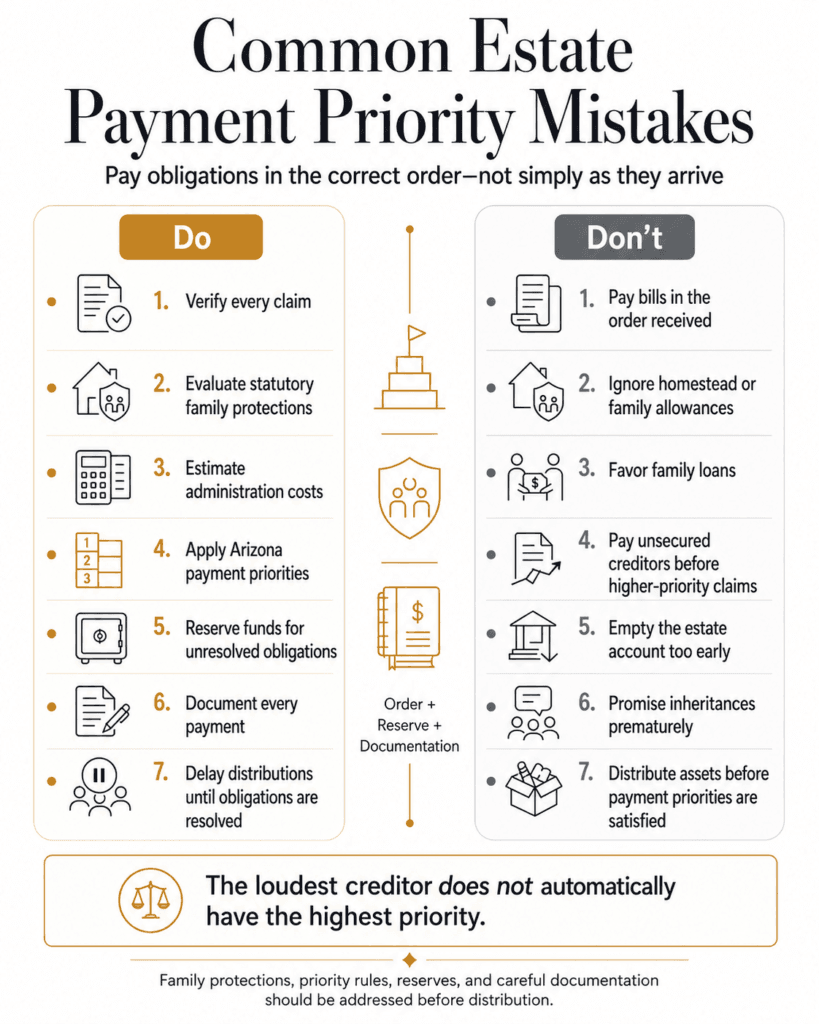
Common estate payment-priority mistakes
Common mistakes include:
- Paying bills in the order received
- Paying every familiar bill immediately
- Treating every demand as valid
- Ignoring family allowances
- Paying unsecured claims before administration expenses
- Treating every medical bill as a last-illness expense
- Assuming state law fully resolves federal priority
- Favoring a relative’s loan
- Paying one creditor while ignoring others in the same class
- Failing to identify liens
- Paying a secured creditor without accounting for collateral
- Misclassifying community and separate debts
- Failing to reserve for taxes and professional fees
- Promising inheritances too early
- Making final distributions while claims remain unresolved
A reliable claim log, cash forecast, deadline calendar, and payment record can reduce these risks.
Arizona estate debt payment priority checklist
Before paying estate obligations, confirm that:
- The estate’s assets and liquidity have been identified.
- Each claim was timely and properly presented.
- Supporting records were reviewed.
- Invalid or unsupported amounts were challenged.
- Homestead rights were evaluated.
- Exempt-property rights were evaluated.
- Family-allowance rights were evaluated.
- Administration expenses were estimated.
- Funeral expenses were reviewed for reasonableness.
- Federal debts and taxes were investigated.
- Last-illness expenses were identified.
- Any Arizona statutory preference was verified.
- Ordinary unsecured claims were placed in the final class.
- Claims within the same class were treated consistently.
- Secured debts and collateral were analyzed separately.
- Community and separate debts were classified.
- Taxes and professional fees were reserved.
- Contingent and disputed claims were protected.
- Beneficiary distributions were postponed when necessary.
- Every payment was documented in the accounting.
Follow the legal order, not the order of arrival
Arizona estate debt payment priority is not determined by which bill reaches the estate first.
The personal representative must ask:
- Is the obligation valid?
- Was the claim presented on time?
- Does a statutory family protection come first?
- Where does the claim fall in Arizona’s payment order?
- Does federal law affect the result?
- Is the debt secured?
- Which property can legally be used?
- Will enough remain for higher-priority obligations?
A representative who evaluates the entire estate, follows the correct priorities, preserves adequate reserves, and documents each decision is better positioned to protect creditors, beneficiaries, and the estate.
An estate involving insufficient assets, federal taxes, secured property, community obligations, contested claims, or substantial family allowances may require individualized legal and tax guidance before payments or distributions are made.
For a broader view of the full process, Rahnema Law’s Arizona probate roadmap explains how appointment, creditor administration, inventory, debt payment, distribution, and closing fit together.
Legal Disclaimer: This information is for educational purposes only and does not constitute legal advice. Arizona probate law is complex and varies based on individual circumstances. Always consult with a qualified probate attorney for guidance specific to your situation.
FAQs
When applicable estate property is insufficient, Arizona generally prioritizes:
1. Administration costs and expenses
2. Reasonable funeral expenses
3. Federally preferred debts and taxes
4. Reasonable and necessary last-illness expenses
5. Arizona-preferred debts and taxes
6. All other claims
Statutory homestead, exempt-property, and family-allowance rights must also be evaluated before allowed claims are paid.
No. Claims within the same statutory class do not receive priority merely because one was received or became payable first.
The Arizona homestead allowance has priority over all estate claims except expenses of administration.
A.R.S. § 14-2402 provides an $18,000 homestead allowance for the surviving spouse. If there is no surviving spouse, the amount is divided among the decedent’s minor and dependent children.
A.R.S. § 14-2403 provides as much as $7,000 in net value from specified estate property, including household furniture, automobiles, furnishings, appliances, and personal effects.
The personal representative may determine as much as $12,000 as a lump sum or $1,000 per month for as long as one year. An interested person may ask the court to review the amount or payment.
Arizona places reasonable funeral expenses before federally preferred debts in its state-law list. However, federal priority law requires separate analysis when an estate cannot pay all debts and owes money to the United States.
No. The fourth Arizona class applies to reasonable and necessary medical and hospital expenses from the decedent’s last illness, including compensation for attendants. An older or unrelated medical bill may be an ordinary unsecured claim.
Ordinary unsecured credit-card claims generally fall within the final class of “all other claims,” unless another law gives a particular obligation higher priority.
One claim does not receive priority merely because it arrived first. The estate may need proportional treatment, creditor agreements, or court guidance.
Not necessarily. Arizona’s claim-limitations statute does not prevent enforcement of a mortgage, pledge, or other lien against estate property.
Yes, Arizona permits early payment of a just, unbarred claim. However, early payment can create personal liability if it harms another allowed claimant or defeats the legal priority order.
Generally, no. Probate gifts remain subject to administration expenses, statutory family protections, taxes, secured obligations, and valid creditor claims.
Yes. A recipient of an improper distribution may be required to return the property, its value, and related income or gain.
Yes. Arizona law may impose liability for loss caused by breach of fiduciary duty. Federal law may also impose personal liability when a representative improperly pays lower-priority obligations ahead of a known federal claim in an insolvent estate.