
Arizona estate division depends on ownership, the will, intestacy, debts, family rights, valuation, and proper transfer documents.
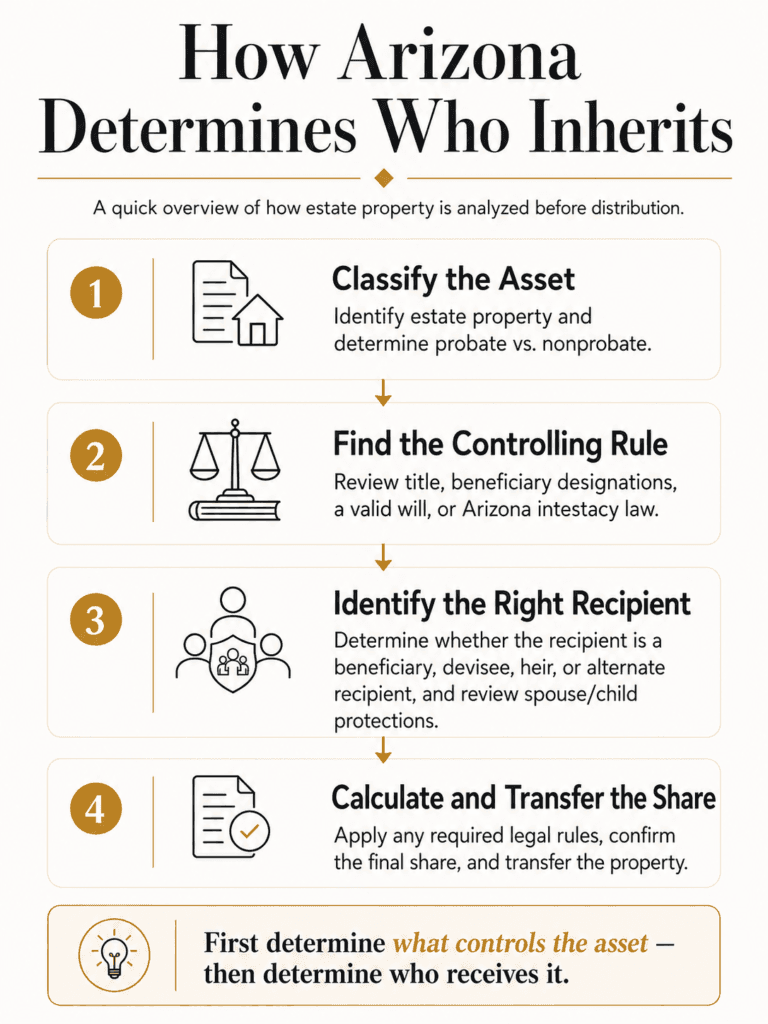
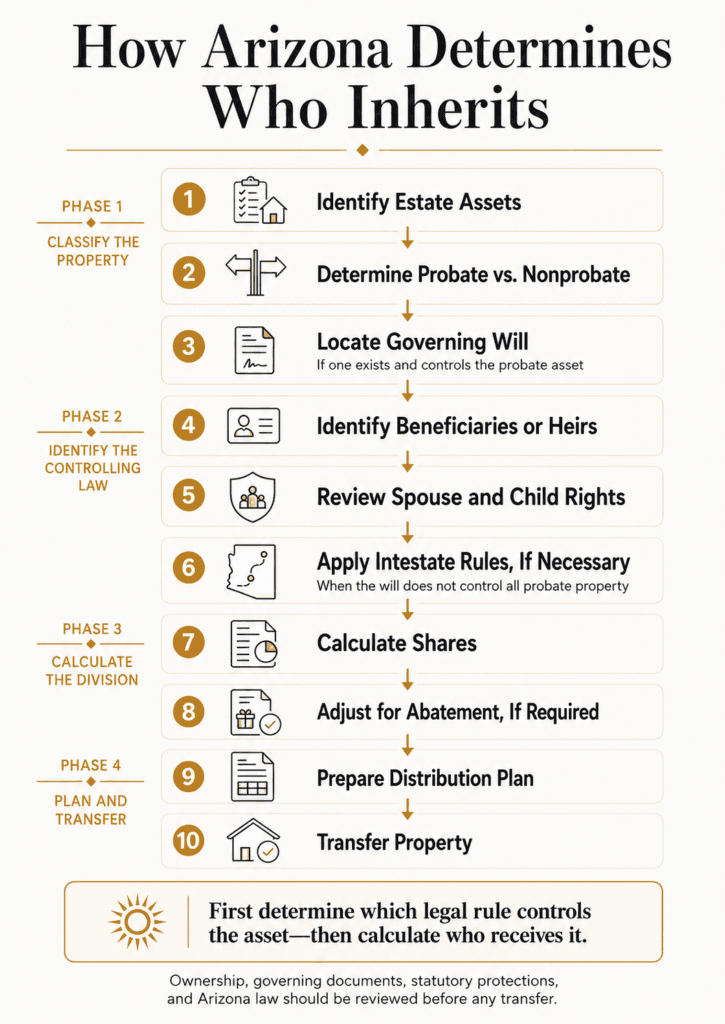
Arizona estate division involves much more than reading a will and writing checks to family members. Before the personal representative calculates anyone’s share, the representative must identify the probate property, determine which legal document controls each asset, address debts and statutory protections, and confirm who is legally entitled to receive what remains.
A straightforward estate may contain only cash, a clear will, and beneficiaries who all survived the decedent. A more complicated estate may involve:
- A blended family
- Community and separate property
- A beneficiary who died first
- A spouse or child omitted from an older will
- Gifts worth more than the estate can pay
- Disputed family relationships
- Property that passes outside probate
- Real estate or business interests that are difficult to divide
The personal representative should complete this analysis before releasing cash, signing deeds, transferring titles, or allowing family members to take estate property.
Start With the Assets, Not the Family Tree
The first question is not, “Who inherits?”
The first question is, “What property belongs to the probate estate?”
For a married decedent, the estate may include the decedent’s separate property and the decedent’s share of community property. The surviving spouse’s own share of community property is not an inheritance from the decedent.
Before placing an asset on a distribution schedule, review:
- Deeds
- Vehicle titles
- Account registrations
- Beneficiary-designation forms
- Trust records
- Retirement-plan documents
- Insurance contracts
- Business agreements
- Marital-property agreements
- Payable-on-death and transfer-on-death arrangements
- Other ownership records
An asset does not become probate property merely because the decedent used it, mentioned it in a will, or informally treated it as family property.
For a broader explanation of which property may require probate, see Is Probate Required in Arizona?
A Will Does Not Control Every Asset
A will generally controls property that belongs to the probate estate and is effectively disposed of by the will.
Many assets pass under other documents. Examples may include:
- Trust provisions
- Life insurance designations
- Payable-on-death accounts
- Transfer-on-death arrangements
- Retirement plans
- Account agreements
- Survivorship provisions
- Beneficiary deeds
- Other written transfer instruments
Arizona treats many written nonprobate transfer arrangements as nontestamentary. That means the transfer may operate outside the will even though it takes effect at death. A.R.S. § 14-6101 describes these nonprobate transfers.
For example, assume a will divides the estate equally among three children. One bank account, however, has a valid payable-on-death designation naming only one child.
That account may pass directly to the named child outside probate. The remaining probate estate would then be divided under the will.
The personal representative should not place the nonprobate account into the probate distribution merely to make the overall result appear more equal.
Beneficiary, Devisee, Heir, and Distributee Mean Different Things
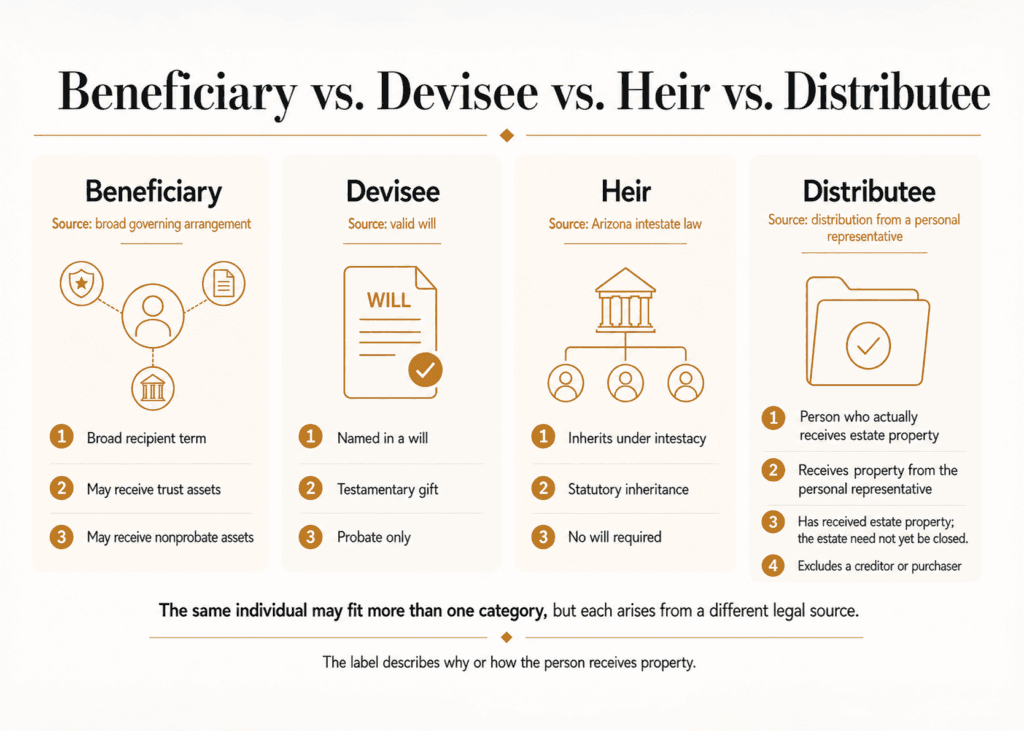
These terms are related, but they are not interchangeable.
Beneficiary
A beneficiary is a broad category. It may include someone receiving property under a:
- Will
- Trust
- Beneficiary designation
- Deed
- Insurance policy
- Retirement plan
- Other governing instrument
Devisee
A devisee is a person or organization designated in a will to receive a testamentary gift.
Heir
An heir is a person entitled to receive property under Arizona’s intestate succession laws.
Distributee
A distributee is someone who has actually received estate property from the personal representative, other than as a creditor or purchaser.
One person may fit more than one category.
For example, a daughter may be:
- A devisee because the will names her
- An heir because she would inherit if there were no will
- A beneficiary of a retirement account
- A distributee after she receives probate property
Those rights should not be combined without first identifying the document or statute controlling each asset. Arizona defines these terms separately in A.R.S. § 14-1201.
How Arizona Estate Division Works Under a Valid Will
When a valid will has been admitted to probate, the personal representative should read the entire document before calculating anyone’s share.
Review:
- Defined terms
- Specific gifts
- Cash gifts
- Percentage gifts
- Survivorship requirements
- Alternate beneficiaries
- Trust provisions
- Residuary provisions
- Directions concerning taxes and expenses
- Any stated order for reducing gifts
- Provisions concerning later marriages, births, or adoptions
One sentence should not be read in isolation when another part of the will changes its effect.
The personal representative has a fiduciary duty to settle and distribute the estate under the effective will, Arizona law, and applicable court orders. When the language is genuinely unclear or interested persons disagree, seeking a court determination may be safer than choosing one interpretation and distributing property immediately. A.R.S. § 14-3703 describes the representative’s general duty to settle and distribute the estate.
Begin with the assets—not the family tree
The first question is not who inherits.
The first question is what property belongs to the probate estate.
Arizona defines an estate, as it relates to a married decedent, as the decedent’s separate property and the decedent’s share of community property. A personal representative should therefore determine the decedent’s actual ownership interest before placing an asset on a distribution schedule.
Review:
- Deeds
- Vehicle titles
- Account registrations
- Beneficiary-designation forms
- Trust records
- Retirement-plan documents
- Insurance contracts
- Business agreements
- Marital-property agreements
- Payable-on-death and transfer-on-death arrangements
- Other ownership records
An asset should not be divided through probate merely because the decedent used it, mentioned it in a will, or treated it informally as family property.
A will does not control every asset
A will generally controls property that belongs to the probate estate and is effectively disposed of by the document.
Property not effectively disposed of by a will passes through Arizona intestate succession.
Many written transfer arrangements operate outside the will, including certain:
- Trust provisions
- Insurance designations
- Payable-on-death accounts
- Transfer-on-death arrangements
- Retirement plans
- Account agreements
- Survivorship provisions
- Deeds and other written transfer instruments
Arizona characterizes these written nonprobate transfers as nontestamentary.
For example, a will may state that the estate is divided equally among three children.
If a bank account has a valid payable-on-death designation naming only one child, that account may transfer outside probate to that named recipient. The remaining probate estate would then be divided under the will.
The personal representative should not add the nonprobate account to the probate distribution merely to make the overall family outcome appear more equal.
Beneficiaries, devisees, heirs, and distributees
These terms are related but are not interchangeable.
Beneficiary
“Beneficiary” is a broad term that can include someone receiving property under a will, trust, beneficiary designation, deed, insurance policy, retirement plan, or another governing instrument.
Devisee
A devisee is a person designated in a will to receive a testamentary gift.
Heir
An heir is a person entitled to receive property under Arizona’s intestate succession statutes.
Distributee
A distributee is a person who has actually received estate property from the personal representative, other than as a creditor or purchaser.
Arizona defines these terms separately because the legal source of the person’s rights affects how the inheritance is determined.
A daughter could be:
- A devisee because she is named in the will
- An heir because she would inherit under intestacy
- A beneficiary under a retirement account
- A distributee after receiving probate property
The same person may occupy more than one category, but those rights should not be combined without analyzing the controlling document and ownership of each asset.
Specific Gifts
A specific gift identifies particular property for a particular devisee.
Examples include:
- A named residence
- A particular vehicle
- Identified jewelry
- A collection
- A specified business interest
- A particular financial account
- A specifically described parcel of land
Before distributing a specifically devised asset, confirm that:
- The decedent owned it at death.
- It belongs to the probate estate.
- The will’s description matches the property.
- The property has been protected and insured.
- Liens and secured debts have been identified.
- The estate has enough other property to satisfy superior obligations.
- The required transfer documents can be completed.
Being named to receive a specific asset does not automatically give the beneficiary an immediate right to possess it.
What if the Property Changed Before Death?
A specific gift becomes more complicated when the asset was:
- Sold
- Condemned
- Damaged
- Replaced
- Mortgaged
- Transferred by an agent or conservator
- Converted into an unpaid right to receive money
Depending on what happened, the specific devisee may have rights to remaining property, unpaid sale proceeds, a condemnation award, insurance proceeds, or another statutorily recognized replacement. The result depends on the transaction, what the decedent still owned at death, and who completed the transfer.
The personal representative should not assume either that the gift automatically failed or that the beneficiary automatically receives the asset’s former value. A.R.S. § 14-2606 addresses several forms of changed specifically devised property.
General Gifts
A general gift usually directs the payment of money or value without limiting payment to one specific asset.
Examples include:
- “I leave $25,000 to my niece.”
- “I leave ten percent of my estate to charity.”
- “I leave the value of my vehicle to my brother.”
The estate must have enough distributable property to satisfy the gift after legally superior obligations have been addressed.
A will cannot require the personal representative to ignore:
- Administration expenses
- Valid creditor claims
- Taxes
- Statutory family protections
- Court orders
- Other superior obligations
When the estate does not have enough property, a general gift may be reduced under Arizona’s abatement rules.
The Residuary Estate
The residue is what remains after the estate has addressed:
- Specific gifts
- General gifts
- Debts and claims
- Taxes
- Administration expenses
- Statutory allowances
- Other required payments and adjustments
A residuary clause may leave the remainder:
- To one person
- In percentages to several people
- To a trust
- To a charity
- To descendants by representation
For example, a will might leave a vehicle to one child, $10,000 to a charity, and “all the rest, residue, and remainder” equally to three children.
Those three children are residuary devisees.
Their final shares usually cannot be calculated from the original inventory alone. The residue may change as the estate earns income, pays expenses, resolves claims, sells property, and makes earlier distributions.
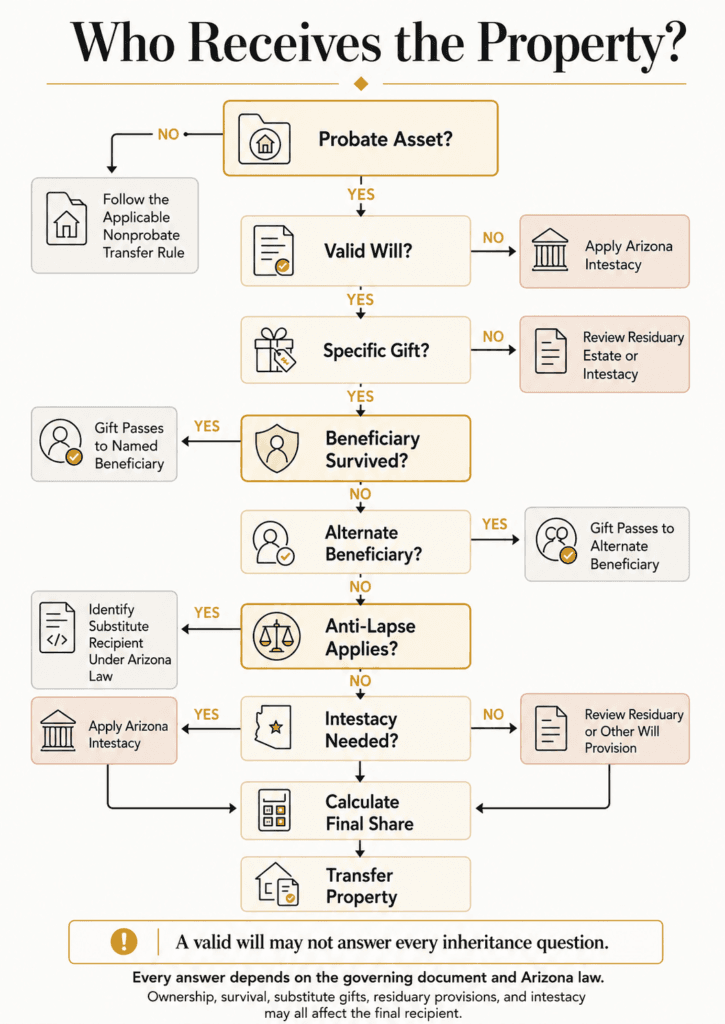
What Happens When a Gift Fails?
A gift may fail because the recipient died, a condition was not satisfied, or the gift cannot otherwise take effect.
The personal representative should review:
- Alternate-beneficiary language
- Survivorship requirements
- Arizona’s substitute-gift statute
- The residuary clause
- Whether the failed gift was itself residuary
- Whether the deceased recipient’s descendants may take the gift
A nonresiduary gift that fails and is not preserved by Arizona’s substitute-gift rule generally becomes part of the residue.
When a residuary gift to one of several residuary devisees fails and no substitute gift applies, that share generally passes proportionally to the remaining residuary devisees. A.R.S. § 14-2604 governs these failed testamentary provisions.
Do not automatically divide a failed gift among the surviving named beneficiaries. The result depends on the type of gift, the will’s language, and Arizona law.
What if the Estate Cannot Satisfy Every Gift?
An estate may not have enough property to pay all obligations and satisfy every gift.
This can happen when:
- The decedent left substantial debt.
- Property declined in value.
- Administration became expensive.
- Taxes were larger than expected.
- A business lost value.
- A property sale produced less than anticipated.
- The will attempted to give away more value than the estate ultimately held.
Arizona uses abatement to determine which shares are reduced.
Unless the will or testamentary plan requires a different result, shares generally abate in this order:
- Property not disposed of by the will
- Residuary devises
- General devises
- Specific devises
Reductions within the same category are generally proportional.
This means a residuary beneficiary may receive less—or nothing—before a specific devise must be reduced.
The personal representative cannot decide who bears the loss based on personal closeness, financial need, family pressure, or who helped the decedent. The will and Arizona law control.
A.R.S. § 14-3902 establishes the default abatement order and permits a different result when the will or testamentary plan requires one.
The Will May Change the Default Order
The statutory order does not apply mechanically when:
- The will states a different order.
- The default order would defeat the testamentary plan.
- The purpose of a particular gift requires a different result.
For example, a will may direct that expenses be paid from a particular account or that a specific gift bear a stated share of taxes.
The entire will must be reviewed before the default order is applied.
Community and Separate Debts Also Matter
When the estate contains both community and separate property, Arizona’s abatement statute generally provides that:
- Community debts are charged against community property.
- Separate debts are charged against separate property and the remaining balance of the decedent’s half of community property.
- Administration expenses are charged proportionally against separate property and the decedent’s half of community property, subject to special expenses attributable to managing community property.
These classifications can change the amount left for the spouse and other recipients.
When a Named Beneficiary Dies Before the Testator
A gift does not always fail merely because the named beneficiary died before the person who made the will.
Start with the will. Look for:
- An alternate beneficiary
- A survivorship condition
- A common-disaster provision
- A class-gift provision
- Language directing the gift to the beneficiary’s descendants
When the will creates a controlling alternate gift, that language may determine who receives the property.
Arizona’s Substitute-Gift Rule
Arizona’s substitute-gift statute may protect the surviving descendants of certain deceased devisees.
The statute may apply when the deceased devisee was:
- A grandparent of the testator
- A descendant of the testator’s grandparent
- A qualifying stepchild of the testator
If that person left surviving descendants, the descendants may receive the gift by representation, subject to the will’s language and statutory exceptions.
This may include:
- Children
- Grandchildren
- Siblings
- Nieces and nephews
- Other descendants of a grandparent
It does not mean that every deceased beneficiary’s children automatically inherit.
The personal representative must analyze:
- The beneficiary’s relationship to the testator
- Whether descendants survived
- Whether the gift was individual or made to a class
- Whether the will names an alternate recipient
- Whether the survivorship language shows a contrary intent
Arizona Law Note: Language such as “if she survives me” or “to my surviving children” may show an intent contrary to the statutory substitute gift. See A.R.S. § 14-2603.
The 120-Hour Survival Requirement
Arizona generally requires an heir to survive the decedent by at least 120 hours—five days—for intestate succession.
Arizona applies a similar default rule to devisees and other beneficiaries under governing instruments. When survival by 120 hours cannot be established by clear and convincing evidence, the person may be treated as having died first.
This rule can matter when family members die close together, after:
- A vehicle collision
- A natural disaster
- A shared medical event
- Another common incident
Evidence may include:
- Death certificates
- Medical records
- Coroner or medical-examiner information
- Other reliable evidence of the time of death
The Governing Document May Change the Rule
The 120-hour default may not apply when the governing instrument:
- Expressly addresses simultaneous deaths
- Contains an operative common-disaster clause
- States that no survival period is required
- Requires a different survival period
Other statutory exceptions may also apply.
Read the will, trust, account agreement, deed, or beneficiary designation before applying the five-day rule automatically. A.R.S. § 14-2702 states the default rule and its exceptions.
What if the Beneficiary Dies During Probate?
A different analysis applies when the beneficiary survived the decedent for the required period but died before receiving the distribution.
Relevant questions include:
- Did the beneficiary’s interest become fixed at the decedent’s death?
- Did the will impose another condition?
- Does a trust control the gift?
- Does the beneficiary’s own estate now receive the interest?
- Did a disclaimer or other event change the result?
Do not automatically divide that person’s expected share among the remaining beneficiaries.
How Property Is Divided When There Is No Will
When no valid will controls probate property, Arizona’s intestate succession statutes identify the heirs.
Intestacy may apply when:
- The decedent left no will.
- The will is invalid.
- The will does not dispose of all probate property.
- A gift fails and does not pass through the residue.
- A will may expressly exclude or limit an intestate heir. Under A.R.S. § 14-2101(B), the affected intestate share passes as though the excluded person disclaimed that share.
Intestacy is a statutory plan. It does not depend on:
- Verbal promises
- Who was emotionally closest to the decedent
- Who provided the most care
- Who needs the inheritance most
- What family members believe would be fair
The Surviving Spouse’s Arizona Intestate Share
The spouse’s share depends on whether the decedent left surviving descendants and whether those descendants are also descendants of the surviving spouse.
No Surviving Descendants
If the decedent left no surviving descendants, the surviving spouse generally receives the entire intestate estate.
All Descendants Are Also Descendants of the Surviving Spouse
If every surviving descendant of the decedent is also a descendant of the surviving spouse, the spouse generally receives the entire intestate estate.
At Least One Descendant Is Not a Descendant of the Surviving Spouse
When one or more surviving descendants of the decedent are not descendants of the surviving spouse, the spouse generally receives:
- One-half of the decedent’s intestate separate property
- No intestate share of the decedent’s one-half of community property
The remaining intestate property passes under the rules governing descendants.
Arizona Law Note: This distinction is especially important in blended families. A child from an earlier relationship can materially change the surviving spouse’s share. See A.R.S. § 14-2102.
Separate the Spouse’s Property From the Inheritance
The spouse’s own community-property interest is not inherited from the decedent.
Before calculating the intestate estate, determine:
- Which property was community property
- Which property was separate property
- The decedent’s ownership percentage
- Whether a marital agreement changes the analysis
- Whether separate and community funds were commingled
- Whether title accurately reflects the property’s marital character
Title alone may not resolve every community-property question.
A classification mistake can affect:
- The surviving spouse’s ownership
- Creditor rights
- Abatement
- Tax reporting
- The intestate estate
- Other beneficiary shares
What Descendants Receive Under Arizona Intestacy Law
Any intestate property that does not pass to the spouse first generally passes to the decedent’s descendants by representation.
If all the decedent’s children survive, the calculation is usually simple.
For example, if three children survive and no spouse receives the property, each child generally receives one-third.
The calculation changes when a child died before the decedent but left surviving descendants.
What “By Representation” Means
Arizona begins with the nearest generation to the decedent that contains at least one surviving descendant.
The estate is divided into shares for:
- Each surviving descendant in that generation
- Each deceased descendant in that generation who left surviving descendants
Each surviving person in that generation receives one share.
The shares assigned to deceased descendants are combined and divided among their surviving descendants using the same method.
Example
Assume the decedent had three children:
- Child A survives.
- Child B survives.
- Child C died earlier and left two children.
The property is first divided into three shares:
- One share for Child A
- One share for Child B
- One share for Child C’s branch
Child C’s share is then divided between Child C’s two surviving children.
A.R.S. § 14-2106 explains Arizona’s division by representation.
Who Inherits When There Are No Surviving Descendants?
When there is no surviving spouse—or when part of the estate does not pass to the spouse—Arizona generally follows this order:
- Descendants by representation
- Parents
- Descendants of the decedent’s parents, such as siblings, nieces, and nephews
- Grandparents or descendants of grandparents on the paternal and maternal sides
Arizona has specific rules for dividing property between maternal and paternal relatives at the grandparent level. A.R.S. § 14-2103 states this order.
The personal representative should prepare a reliable family history supported by records, such as:
- Birth certificates
- Death certificates
- Marriage records
- Adoption records
- Parentage records
- Family affidavits
- Other credible evidence
The closest relative known to the personal representative is not necessarily the person legally entitled to inherit.
Adopted Children and Intestate Inheritance
For Arizona intestate succession, an adopted person is generally treated as the child of the adopting parent or parents and not of the natural parents.
Arizona provides special treatment for stepparent adoption. Adoption by the spouse of a natural parent does not sever the child’s relationship with that natural parent or the child’s right to inherit from or through the other natural parent.
Additional review may be necessary when:
- The adoption occurred in another jurisdiction.
- Records are incomplete.
- A stepparent was involved.
- The adoption was finalized after a relevant death.
- Parentage is disputed.
- More than one legal-parent relationship is asserted.
See A.R.S. § 14-2114.
Children Conceived Before Death but Born Later
A child in gestation at the relevant time may be treated as living at that time if the child survives for at least 120 hours after birth.
The personal representative may need to delay a final heirship determination when:
- A surviving spouse or partner is pregnant.
- A child may have been conceived through assisted reproduction.
- Parentage is uncertain.
- The potential child’s existence would change other heirs’ shares.
Questions involving assisted reproduction or disputed parentage may require separate legal analysis.
A Spouse Who Married the Decedent After the Will
A spouse who married the testator after the will was signed may have statutory rights even if the will does not adequately provide for that spouse.
The surviving spouse may receive a calculated intestate-type share from specified portions of the estate unless:
- The will was made in contemplation of the marriage.
- The will states that it remains effective despite a later marriage.
- The decedent provided for the spouse outside the will with the intent that the transfer replace a testamentary gift.
The statute also protects certain gifts involving children from before the later marriage when the spouse’s share is calculated and satisfied.
Do not assume that an unmentioned later spouse receives nothing. Also do not assume that the spouse automatically receives the full ordinary intestate share. The statutory calculation is more specific. See A.R.S. § 14-2301.
A Child Born or Adopted After the Will
Arizona also protects certain children born or adopted after the will was signed.
The result depends partly on whether the testator had other children when the will was executed and whether those children received gifts.
An omitted later child may receive:
- An intestate-equivalent share in some circumstances, or
- A proportionate share of gifts made to children who were living when the will was signed
The statute generally does not apply when:
- The omission appears intentional, or
- The decedent provided for the child outside the will intending that transfer to replace a testamentary gift
Arizona also addresses a child omitted because the testator mistakenly believed the child was dead.
These statutory rights may reduce gifts already made to other beneficiaries. See A.R.S. § 14-2302.
Not Every Omitted Relative Receives a Share
Arizona’s omitted-spouse and omitted-child statutes apply to specific situations.
They do not create a general right for every family member excluded from a will.
For example, an adult child who was alive and known when the will was signed does not automatically receive a share merely because the will omitted that child.
Identify the statute that applies before changing the will’s stated distribution.
Beneficiaries and Heirs May Disclaim Property
A beneficiary or heir may be able to disclaim all or part of an inherited interest, but the right can be barred or limited if the person has already waived the right, accepted the interest, transferred or encumbered it, or another statutory bar applies. Any disclaimer should be reviewed before the beneficiary acts with respect to the property.
To be effective under Arizona law, a disclaimer generally must:
- Be in writing or another record
- Declare the disclaimer
- Describe the interest or power being disclaimed
- Be signed by the person making it
- Be delivered or filed as required by statute
A disclaimer may cover all or part of an interest. It becomes irrevocable under the statutory timing rules and is not treated as a transfer, assignment, or release. See A.R.S. § 14-10005.
A verbal statement such as “Give my share to my sister” is not necessarily a valid disclaimer.
It may instead be:
- An assignment
- A gift
- An attempted instruction to the representative
- An ineffective direction
Those alternatives may produce different legal and tax consequences.
Who Receives Disclaimed Property?
First, review the governing instrument. It may state what happens when an interest is disclaimed.
If no controlling provision applies and the disclaimant is an individual, the property generally passes under Arizona’s statutory disclaimer rules as though the person died immediately before the time of distribution. Special rules may apply when the disclaimant’s descendants would take by representation.
The person disclaiming the property does not ordinarily get to choose the replacement recipient.
Estate Obligations Come Before Final Shares
Beneficiaries and heirs receive what remains after the estate’s superior obligations have been addressed.
Those obligations may include:
- Administration costs
- Funeral expenses
- Preferred federal debts and taxes
- Last-illness expenses
- Preferred Arizona debts and taxes
- Other creditor claims
When the estate cannot pay every claim in full, Arizona generally requires payment in this order:
- Costs and expenses of administration
- Reasonable funeral expenses
- Debts and taxes with preference under federal law
- Reasonable and necessary expenses of the decedent’s last illness
- Debts and taxes with preference under Arizona law
- All other claims
Claims within the same class generally do not receive preference over one another. See A.R.S. § 14-3805.
Before final distribution, the personal representative may also need to provide for:
- Homestead allowance
- Exempt property
- Family allowance
- Claims presented but not yet allowed
- Appealed claims
- Unbarred claims that may still be presented
- Administration expenses
- Taxes
- A reasonable reserve
The amount shown on the probate inventory is not automatically the amount available for beneficiaries.
Rahnema Law’s Arizona Probate Inventory Checklist explains the difference between identifying estate property and determining what will ultimately be available for distribution.
Consider Surviving-Spouse and Child Protections
Arizona provides statutory protections that may apply to a surviving spouse and qualifying children, including:
- Homestead allowance
- Exempt-property rights
- Family allowance
These protections may have priority over many creditor claims and may be charged against benefits passing by will, intestacy, or certain nonprobate transfers.
Eligibility and calculation should be addressed before final beneficiary shares are determined.
Property Does Not Always Need to Be Sold
Arizona generally directs the personal representative to distribute property in kind when reasonably possible unless the will shows a contrary intent.
An in-kind distribution transfers the property itself rather than selling it and distributing cash.
Examples include:
- Transferring a home to one beneficiary
- Dividing securities among several beneficiaries
- Transferring a vehicle to a named devisee
- Assigning business interests
- Dividing household property under an agreed plan
The personal representative should still consider:
- Estate liquidity
- Claims and taxes
- Liens
- Fairness among recipients
- Whether joint ownership is practical
- Tax consequences
- Whether the will directs a sale
- Whether beneficiaries object
A.R.S. § 14-3906 governs in-kind distribution and valuation.
Current Values May Be Necessary
The inventory generally begins with date-of-death values. Those values may not fairly divide property months or years later.
Arizona permits the personal representative to determine values near the proposed distribution using reasonable methods, including qualified appraisers.
For property without a readily ascertainable value, an otherwise reasonable valuation made no more than 30 days before distribution may control.
Current values may be especially important when:
- One beneficiary receives real estate.
- Another receives cash.
- Another receives investments.
- The will requires equal percentages.
- An asset changed substantially in value.
- Debt remains attached to one asset.
The calculation should identify:
- Gross value
- Encumbrances
- Net value
- Valuation date
- Valuation method
- Effect on each beneficiary’s share
A Proposed Distribution Can Reduce Disputes
After probable estate charges are known, the personal representative may deliver a proposed distribution to those entitled to object.
The proposal may explain:
- Which property each person will receive
- Assigned values
- Each calculated share
- Equalization payments
- Debt attached to property
- Property retained as a reserve
- Whether the distribution is partial or final
A distributee’s right to object based on the kind or value of the proposed property may terminate if the personal representative does not receive a written objection within 30 days after mailing or delivery of the proposal.
Arizona Law Note: This 30-day rule concerns objections to the kind or value of the proposed asset. It should not be described as eliminating every possible objection concerning ownership, accounting, fiduciary conduct, or the legal validity of the distribution.
Transfer Documents Are Still Required
Listing an asset as distributed in an accounting does not necessarily transfer legal title.
For an in-kind distribution, the personal representative must execute an instrument or deed assigning, transferring, or releasing the asset to the distributee.
A recorded instrument transferring Arizona real property must include the name and address of each distributee. See A.R.S. § 14-3907.
Other property may require:
- Vehicle-title documents
- Brokerage transfer forms
- Bank documents
- Business assignments
- Updated company records
- Intellectual-property assignments
- Physical delivery and a receipt
Possession is not always ownership.
Handing someone the keys to a home or vehicle may not complete the legal transfer.
Distributions to Minors or People Under Legal Disability
A minor or incapacitated person may be entitled to inherit but may not be legally able to receive or manage the property directly.
Arizona permits the personal representative to satisfy the distribution obligation by transferring the property to:
- The recipient’s conservator, or
- Another person authorized to provide a valid receipt and discharge
Depending on the will and circumstances, the property may instead pass to:
- A trust
- A custodial arrangement
- A conservatorship
- Another legally authorized recipient
Do not assume that a minor’s parent automatically has authority to receive a substantial inheritance for the child. See A.R.S. § 14-3915.
The Personal Representative Must Remain Neutral
The personal representative is a fiduciary.
The representative must administer and distribute the estate under:
- The effective will
- Arizona law
- Creditor rights
- Spouse and child protections
- Court orders
- The best interests of the estate’s successors
The representative should not:
- Give a favored relative first choice of property
- Use unsupported values to benefit one beneficiary
- Change shares because someone has greater financial need
- Treat verbal family expectations as amendments to the will
- Ignore an heir because the representative does not know that person
- Substitute personal ideas of fairness for the legal distribution
Neutral administration does not always produce equal distributions.
It produces the distribution required by the governing documents and law.
Document the Share Calculation
Before distributing property, prepare a schedule showing:
- Every probate asset
- Current or controlling value
- Secured debt
- Estate obligations
- Statutory allowances
- Each specific gift
- Each general gift
- The residuary estate
- Abatement adjustments
- Intestate shares
- Substitute gifts
- Disclaimed interests
- Proposed in-kind transfers
- Equalization payments
- The reserve retained
A reader should be able to trace how the estate moved from its gross property to each recipient’s final share.
Document Every Completed Distribution
For each transfer, record:
- Recipient
- Legal basis for the share
- Date
- Cash amount or property
- Assigned value
- Partial or final status
- Transfer method
- Supporting documents
Preserve:
- Cancelled checks
- Wire confirmations
- Signed receipts
- Deeds
- Assignments
- Vehicle-title records
- Brokerage confirmations
- Appraisals
- Distribution proposals
- Written objections or waivers
- Institutional forms
The final accounting should connect each asset to the person or organization that received it.
Incorrect Distributions May Have to Be Repaid
A person who improperly receives estate property may be required to return the property or its value, along with related income or gain.
Creditors may also have rights against distributees after property has been transferred, subject to statutory limits.
The personal representative may face liability for loss caused by an improper exercise of authority or breach of fiduciary duty.
That is why the share calculation should be completed before checks, deeds, titles, or other assets are released.
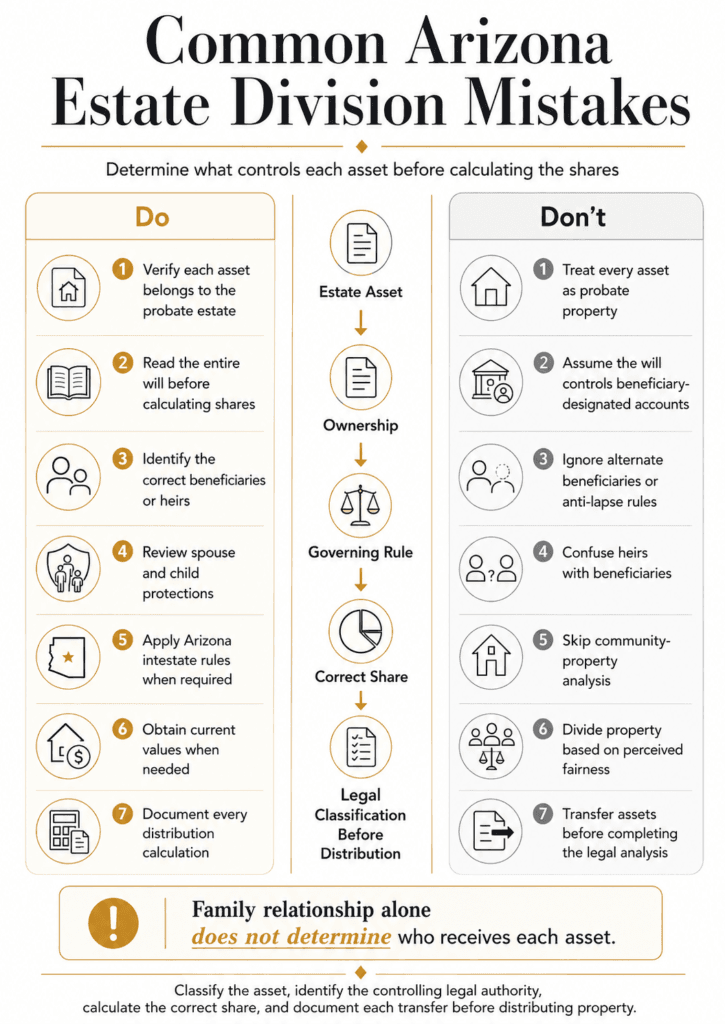
Common Arizona Estate-Division Mistakes
Common mistakes include:
- Treating every asset as probate property
- Assuming the will controls beneficiary-designated accounts
- Using “beneficiary” and “heir” as though they always mean the same thing
- Reading one will provision without reviewing the full document
- Ignoring alternate beneficiaries
- Assuming every gift to a deceased beneficiary fails
- Assuming the deceased beneficiary’s children always inherit
- Failing to apply the 120-hour survival rule
- Overlooking a child from a prior relationship
- Giving the surviving spouse the entire intestate estate in every case
- Dividing descendants’ shares at the wrong generation
- Ignoring adoption or parentage records
- Overlooking a child conceived before death
- Assuming an omitted later spouse or child receives nothing
- Treating an informal request as a valid disclaimer
- Allowing the disclaimant to choose the replacement recipient
- Misclassifying community and separate property
- Using old inventory values without reviewing current values
- Failing to apply abatement
- Favoring one beneficiary during asset selection
- Transferring property to a minor without confirming authority
- Treating possession as legal title
- Distributing before debts, taxes, and reserves are addressed
- Failing to obtain receipts and transfer records
Do-and-don’t comparison for probate assets, wills, heirs, spouse rights, intestacy, valuation, and final transfers.
Arizona Estate Division Checklist
Before dividing probate property, confirm that:
- Each asset belongs to the probate estate.
- Ownership and beneficiary records were reviewed.
- The controlling will was admitted to probate.
- Property not effectively disposed of by the will was identified.
- Beneficiaries, devisees, heirs, and distributees were classified correctly.
- The entire will was reviewed for alternate and survivorship provisions.
- Specific, general, and residuary gifts were identified.
- Changed specifically devised property and related proceeds were analyzed.
- Deceased beneficiaries were reviewed under the substitute-gift statute.
- The 120-hour survival requirement was considered.
- The surviving spouse’s intestate share was calculated correctly.
- Descendant shares were calculated by representation.
- More distant relatives were investigated when necessary.
- Adoption and legal-parent relationships were verified.
- A potential child conceived before death was considered.
- The rights of a spouse who married after the will were evaluated.
- The rights of later-born or later-adopted children were evaluated.
- Every disclaimer satisfies Arizona’s requirements.
- Disclaimed property passes to the proper replacement recipient.
- Community and separate property were classified correctly.
- Claims, taxes, expenses, and statutory allowances were paid or reserved for.
- Abatement was applied in the proper order.
- Current values were obtained when necessary.
- A proposed distribution was delivered when appropriate.
- Timely objections were reviewed.
- Minors and people under legal disability have authorized recipients.
- Deeds, titles, assignments, and institutional forms are ready.
- Every transfer will appear in the estate accounting.
- Receipts and acknowledgments will be preserved.
- An adequate reserve will remain after any partial distribution.
Divide the Estate Only After the Rules Are Clear
Arizona estate division combines:
- Ownership records
- The will
- Intestate succession
- Family relationships
- Survival requirements
- Substitute-gift rules
- Spouse and child protections
- Creditor and tax obligations
- Community-property classification
- Abatement
- Current valuations
- Proper transfer documents
A valid will ordinarily controls probate property, but its effect may change when a beneficiary died first, the decedent later married or had a child, the estate lacks enough assets, someone disclaims a gift, or statutory family protections apply.
When no will controls, Arizona law identifies the heirs and determines their shares.
The personal representative should complete this analysis before distributing property. Once money or assets have been transferred, recovering them may be difficult if the wrong person received them or the estate later needs them for a superior obligation.
Estates involving blended families, unclear wills, disputed parentage, deceased beneficiaries, adopted children, omitted relatives, minors, community property, or insufficient assets may require individual legal guidance before final shares are calculated.
Legal Disclaimer: This information is for educational purposes only and does not constitute legal advice. Arizona probate law is complex and varies based on individual circumstances. Always consult with a qualified probate attorney for guidance specific to your situation.
FAQs
An heir is someone entitled to inherit under Arizona intestate succession. A devisee receives a gift under a will. “Beneficiary” is broader and may include recipients under wills, trusts, insurance policies, retirement plans, deeds, and other nonprobate arrangements.
No. Trust property, beneficiary-designated accounts, survivorship property, insurance, retirement plans, and other valid nonprobate transfers may pass outside the will.
Property not effectively disposed of by the will generally passes to the decedent’s heirs under Arizona intestate succession.
The residuary estate is what remains after the estate addresses superior obligations and earlier gifts. Its value may change throughout administration.
The gifts may abate. Unless the will or testamentary plan requires another result, Arizona generally reduces intestate property first, followed by residuary, general, and specific devises.
Review the will’s alternate and survivorship provisions first. Arizona’s substitute-gift statute may allow descendants of certain deceased relatives or qualifying stepchildren to receive the gift by representation.
Generally, an heir must survive the decedent by at least 120 hours for intestate succession unless an exception applies.
Arizona applies a similar 120-hour default to governing instruments. The instrument may establish a different rule, and statutory exceptions may apply.
The spouse generally receives the entire intestate estate when there are no surviving descendants or when all surviving descendants are also descendants of the spouse. A different rule applies when the decedent has a descendant who is not also the surviving spouse’s descendant.
When at least one surviving descendant of the decedent is not a descendant of the surviving spouse, the spouse generally receives one-half of the intestate separate property and no intestate share of the decedent’s one-half of community property.
Arizona distributes applicable property to descendants by representation, beginning with the nearest generation containing a surviving descendant.
Generally, yes. An adopted child is treated as the child of the adopting parent or parents for intestate succession, subject to special rules involving stepparent adoption.
A child in gestation at the relevant time may be treated as living at that time if the child survives for at least 120 hours after birth.
A spouse who married the testator after the will was executed may receive a statutory share unless an exception applies. The calculation depends on the will, children from before the marriage, and any outside provision made for the spouse.
A child born or adopted after the will was executed may receive a statutory share, subject to the existing family structure, the testamentary plan, intentional-omission rules, and outside transfers.
Yes. An Arizona disclaimer may be barred or limited if the beneficiary has already waived the right, accepted the interest, transferred or encumbered it, or another statutory bar applies. If a disclaimer remains available, it generally must be written or recorded, signed, describe the interest being disclaimed, and be delivered or filed as required by statute.
The governing instrument controls when it contains an applicable disclaimer provision. Otherwise, the property passes under Arizona’s statutory rules. The disclaiming person does not ordinarily choose the replacement recipient.
Yes. Arizona generally favors in-kind distribution when practicable and consistent with the will. Current valuation and proper transfer documents may still be required.
Not necessarily. The representative should transfer the property to a conservator or another person legally authorized to provide a valid receipt and discharge.
Yes. A recipient may be required to return improperly distributed property or its value, together with related income or gain. The personal representative may also face liability for an improper distribution.