

Learn what causes an Arizona personal representative appointment delay and how to address will, notice, priority, bond, and filing problems.
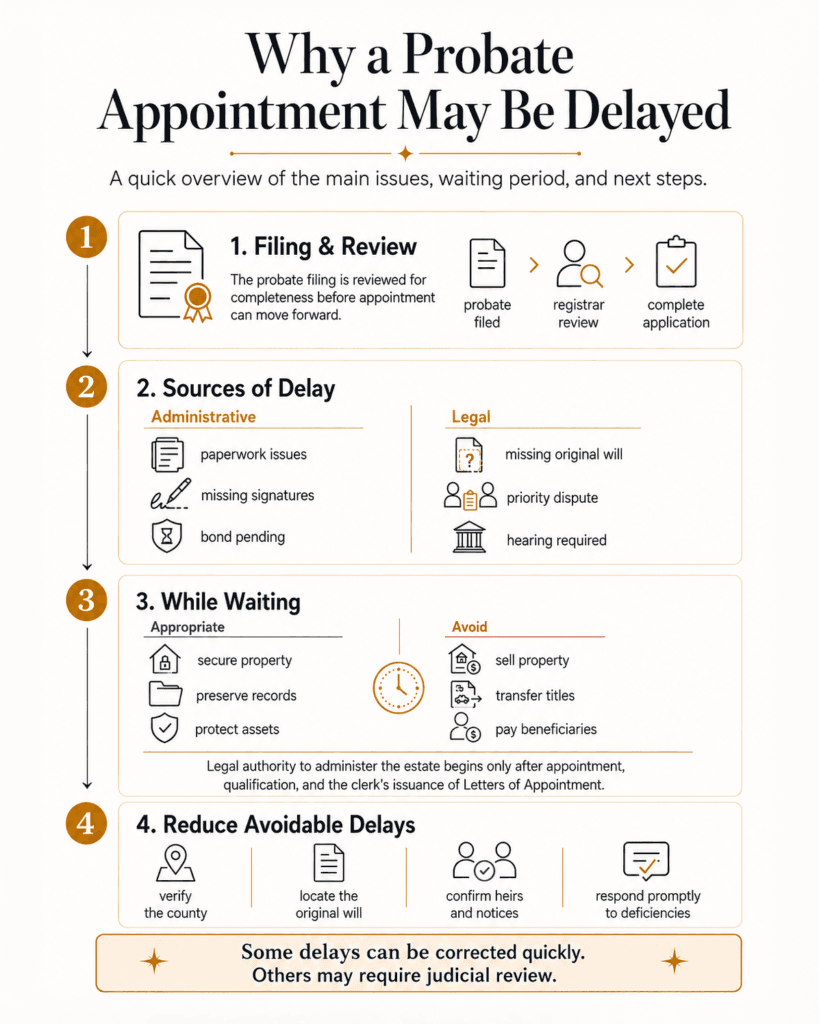
An Arizona personal representative appointment delay can happen even when an estate seems simple, and no one is fighting.
Filing the probate papers is only the first step. Before approving the appointment, the probate registrar or court may need corrected documents, the original will, signed waivers, proof of notice, a bond, or a judicial decision.
The most common reasons for delay are:
- Incomplete or inconsistent paperwork
- A missing original will
- Questions about the will
- Unresolved priority to serve
- Missing notices, waivers, or renunciations
- A bond problem
- Filing in the wrong county
- Another existing appointment
- A required formal hearing
- A filing made more than two years after death
Finding the actual cause of the delay is the fastest way to decide what must happen next.
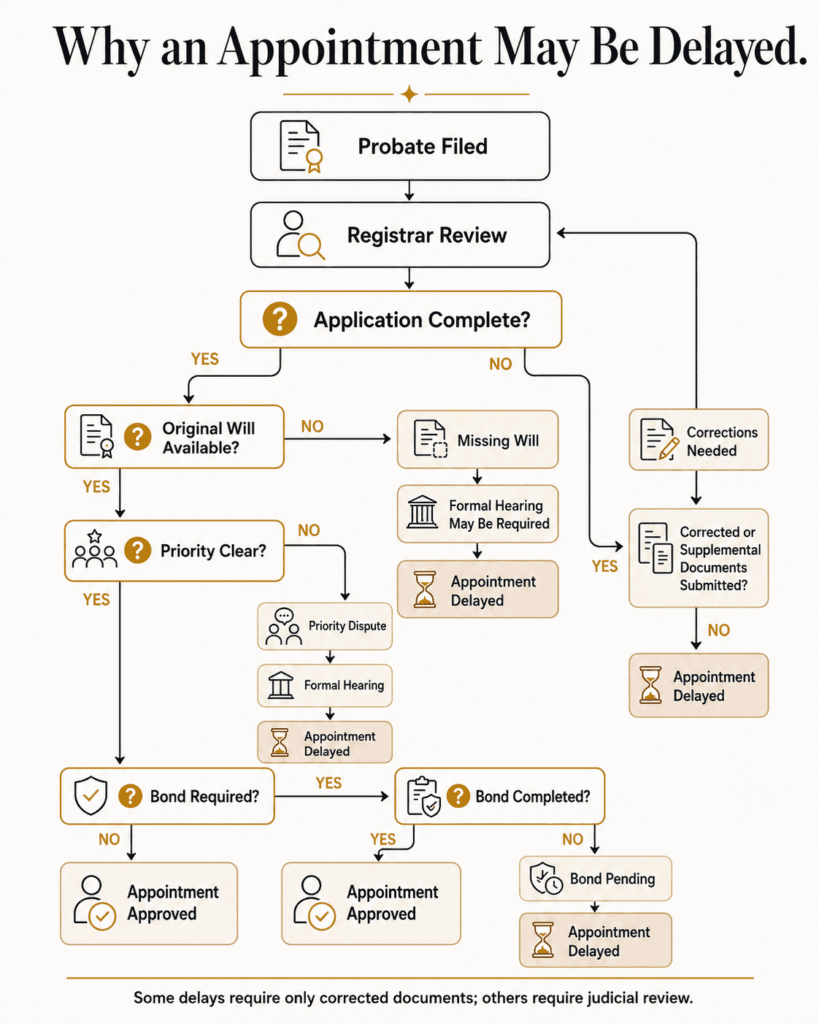
Filing does not create authority
Arizona calls the person authorized to administer a probate estate the personal representative. People often use the word executor, but Arizona law uses the broader term personal representative.
Being named in a will does not provide immediate authority.
The person generally must:
- Be appointed.
- File any required bond.
- Accept the duties of the office.
- Receive Letters.
Letters are the official court documents showing that the person has been appointed and qualified to act for the estate.
Arizona Law Note: A.R.S. § 14-3103 provides that a person generally must be appointed, qualify, and receive Letters before acquiring the powers and duties of a personal representative. A.R.S. § 14-3601 requires any necessary bond and acceptance before Letters are issued.
For a closer look at this document, see Rahnema Law’s guide to Letters of Appointment in Arizona probate.
Informal probate still requires legal review
Many uncontested estates begin through informal probate.
“Informal” usually means the appointment may occur without an initial judicial hearing. It does not mean that approval is automatic or that legal requirements disappear.
Before approving an informal appointment, the registrar must determine whether:
- The application is complete.
- The applicant verified the required statements.
- The applicant may apply.
- Venue is proper.
- Any related will has been or is being probated.
- Required notice was given.
- The proposed representative has priority.
- The will requires supervised administration.
- No existing appointment or other statutory issue prevents approval.
If the registrar cannot make the required findings, the application may be declined, corrected, or moved into a formal proceeding.
A declination of informal appointment is not a final ruling that the applicant can never serve. It means the appointment could not be approved through the informal application as presented.
Arizona Law Note: A.R.S. § 14-3308 lists the findings required for informal appointment. A.R.S. § 14-3309 explains that a declination does not prevent appointment through formal proceedings.
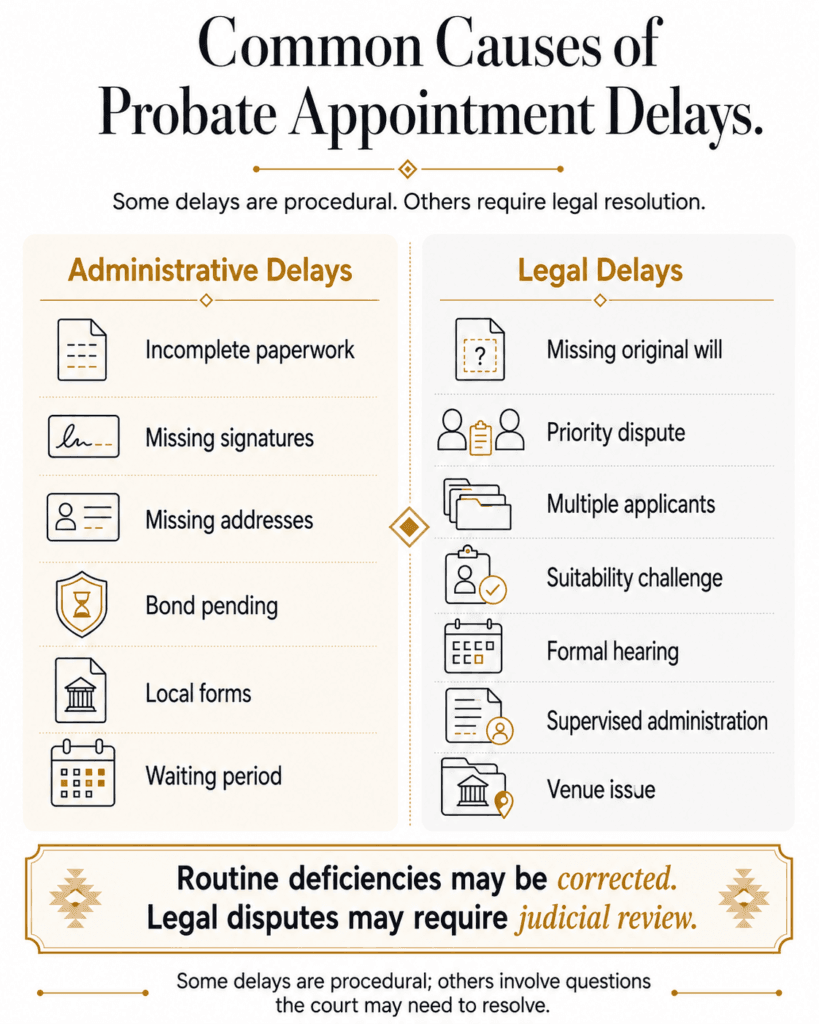
1. The paperwork is incomplete or inconsistent
Paperwork problems are among the most avoidable causes of delay.
An informal application generally must include information about:
- The applicant and the applicant’s interest
- The decedent’s name, age, date of death, and domicile
- The surviving spouse
- The decedent’s children
- Heirs and devisees
- Any existing personal representative
- Any demand for notice
- The basis for filing in that county
- The applicable filing deadline
- The proposed representative’s priority to serve
Additional statements may be required depending on whether the person died with a will and whether the application requests probate, appointment, or both.
Common problems include:
- Different spellings of the same name
- An incorrect date of death
- Missing addresses
- An incomplete family history
- Unanswered questions
- Missing signatures
- Missing verification
- An incorrect statement of priority
- Conflicting proposed documents
- Failure to disclose another probate case
- Failure to disclose a demand for notice
The court clerk’s acceptance of a filing does not mean the registrar has approved its substance.
Before submitting a probate packet, compare every document. Names, dates, addresses, relationships, and legal statements should match throughout the filing.
2. The original will is missing
Informal probate of a will generally requires an original, duly executed, apparently unrevoked will in the registrar’s possession.
The application must generally state that the original:
- Is already held by the court,
- Accompanies the application, or
- Is represented by a qualifying certified copy of a will probated in another jurisdiction.
A photocopy of an Arizona will ordinarily does not satisfy the original-will requirement for routine informal probate.
Arizona Law Note: A.R.S. § 14-3303 requires the registrar to determine that an original, duly executed, apparently unrevoked will is in the registrar’s possession before approving original informal probate. A.R.S. § 14-3301 addresses the application and certain wills probated elsewhere.
Can a copy of a missing will be used?
Possibly, but a court may need to make additional findings.
When an original will was last seen in the decedent’s possession but cannot be found after death, Arizona law presumes that the decedent destroyed it intending to revoke it.
That presumption may be overcome by a preponderance of the evidence.
If the will is found to be valid and unrevoked:
- A copy and testimony from at least one credible witness may establish its contents.
- If no copy exists, clear and convincing evidence is required to establish the contents.
Finding only a copy does not necessarily end the case. It often means the matter cannot continue as a routine informal probate.
Arizona Law Note: A.R.S. § 14-3415 governs lost and missing wills, the revocation presumption, and the evidence required to establish a missing will’s contents.
3. There are questions about the will
Appointment may also be delayed when the will appears incomplete, altered, damaged, or inconsistent with another document.
Questions may arise when:
- A signature is missing.
- Witness signatures appear incomplete.
- Pages appear to have been removed or replaced.
- Someone added handwritten changes after signing.
- More than one will has been found.
- A later document may have revoked an earlier will.
- Someone alleges incapacity, undue influence, fraud, or duress.
- Part of the document is unreadable.
Arizona recognizes several forms of wills, including qualifying paper, holographic, and electronic wills. The requirements are not identical for every type.
If the registrar cannot make the findings required for informal probate, the registrar may decline the application. That does not finally decide whether the will is valid.
The applicant may need formal probate so a judicial officer can consider notice, evidence, and objections.
4. Priority to serve has not been resolved
Arizona law establishes an order of priority for appointment as personal representative.
The principal order includes:
- A person given priority by a probated will
- A surviving spouse who is a devisee
- Other devisees
- The surviving spouse
- Other heirs
- The Arizona Department of Veterans’ Services in qualifying cases
- A qualifying creditor after 45 days
- The public fiduciary
A person with higher priority may need to sign a renunciation, waiver, or nomination before someone with lower priority can be appointed.
When two or more people share the same priority, those who do not renounce generally must agree on the nomination or appointment.
Arizona Law Note: A.R.S. § 14-3203 establishes appointment priority, renunciation and nomination rules, basic qualifications, and circumstances requiring formal proceedings.
5. More than one person wants to serve
A registrar generally cannot resolve a dispute over who should administer the estate through routine informal review.
The court may need to determine:
- Who has statutory priority
- Whether someone waived or renounced priority
- Whether people sharing priority agreed on a nominee
- Whether each proposed representative is qualified
- Whether a proposed representative is suitable
- Whether estate administration is necessary
A formal proceeding concerning priority or qualification pauses pending informal appointment proceedings until the court decides who is entitled to serve.
The rest of the estate may be uncontested. Still, notice, hearing availability, objections, and evidence can delay Letters.
Arizona Law Note: A.R.S. § 14-3414 governs formal proceedings concerning the priority or qualification of a proposed personal representative.
6. Someone claims the applicant is unsuitable
Having priority does not guarantee appointment.
Arizona law disqualifies:
- A person who is under the age of majority
- A foreign corporation
- A person the court finds unsuitable in a formal proceeding
An informal registrar cannot decide a contested suitability issue.
An objection might involve alleged misconduct, a serious conflict, inability to perform the work, or another circumstance the objecting person believes could interfere with administration.
An allegation does not automatically disqualify the applicant. The court must decide the issue.
7. Required notices or waivers are missing
A person with a financial or property interest in an estate may file a demand for notice of certain filings or orders.
When a valid demand exists, the applicant may need to provide notice before the requested action can be approved.
Delay may occur when the applicant:
- Fails to identify a demand for notice
- Uses the wrong address
- Does not provide required notice
- Does not allow the required response period
- Fails to file proof of notice
- Does not obtain necessary waivers or renunciations
- Fails to notify an existing personal representative
Formal proceedings also require notice to the people entitled to participate.
Depending on the issue, that group may include the surviving spouse, children, other heirs, devisees, executors named in relevant wills, and an existing personal representative.
8. A probate bond must be filed
A probate bond provides financial protection if the personal representative mishandles estate property.
Arizona generally requires a bond unless an exception applies.
Possible exceptions include:
- The will expressly waives bond.
- All required heirs or devisees file written waivers.
- The proposed representative is a qualifying institution or public fiduciary.
- A qualifying statutory summary-procedure exception applies.
Even when bond would otherwise be waived, the court may require one if an interested person provides reasonable proof that an estate interest is in danger.
Arizona Law Note: A.R.S. § 14-3603 establishes the general bond requirement and its principal exceptions.
How can a bond delay Letters?
Delay may occur when:
- The applicant has not applied for the bond.
- The amount remains unresolved.
- The surety requests more information.
- The applicant cannot qualify.
- The required bond documents have not been filed.
A person may receive an appointment decision but still be unable to receive Letters until the bond and acceptance requirements are complete.
Addressing the bond early can prevent a second delay after the appointment request is otherwise ready.
9. The case was filed in the wrong county
Venue means the proper county for the proceeding.
For an Arizona resident, the first probate or appointment proceeding is generally filed in the county where the decedent was domiciled at death.
If the decedent was not domiciled in Arizona, venue may be proper in an Arizona county where the decedent owned property.
Domicile may be unclear when the person:
- Recently moved
- Maintained more than one residence
- Lived in assisted living or another care facility
- Owned property in several counties
- Had inconsistent address records
If cases concerning the same estate are opened in more than one Arizona county, the courts may need to determine the proper venue before the matter continues.
Arizona Law Note: A.R.S. § 14-3201 addresses venue for estate proceedings. A.R.S. § 14-1303 addresses multiple proceedings and transfer when venue is disputed.
10. Another personal representative already exists
An informal appointment application generally must be denied when an Arizona personal representative has already been appointed, and that appointment remains active.
This can happen when:
- Relatives do not know another case exists.
- Cases are opened in different counties.
- Someone files in Arizona after an appointment in another state.
- The prior representative has not completed a resignation or termination.
Extra rules apply when the decedent lived outside Arizona, and a personal representative already serves in the state of domicile.
Before filing, check whether another probate proceeding or active appointment exists.
11. The estate requires supervised administration
Supervised administration places the estate under the court’s continuing authority until the court approves distribution and discharges the personal representative, or otherwise ends the proceeding.
A will may direct supervised administration. An interested person or personal representative may also request it.
The request can affect appointment because the court may need to resolve questions about:
- Whether there is a valid will
- Who has priority
- Whether the proposed representative is qualified
- Whether ongoing court supervision is necessary
A supervised personal representative may not make distributions without a prior court order, and all sales of real property are subject to court confirmation under A.R.S. § 14-3504.
Arizona Law Note: A.R.S. § 14-3501 explains the nature of supervised administration. A.R.S. § 14-3502 addresses petitions and orders for supervision.
12. The case was started more than two years after death
Arizona generally requires an original probate, testacy, or appointment proceeding to begin within two years after the decedent’s death.
The statute contains exceptions.
One exception may permit a later proceeding when no court proceeding concerning succession or administration occurred during the two-year period. But the representative’s authority under that exception is generally limited to what is necessary to confirm title in the rightful successors.
Under that exception, claims other than expenses of administration may not be presented against the estate.
A late filing must identify the statutory basis that allows the case to proceed.
Arizona Law Note: A.R.S. § 14-3108 establishes the general two-year limit, its exceptions, and restrictions that may apply to a late appointment.
13. A required waiting period has not ended
Some delays are mandatory and do not indicate a filing problem.
An informal appointment generally cannot occur until at least 120 hours—five days—have passed since death.
For a decedent who was not an Arizona resident, the registrar generally must wait 30 days after death, unless:
- The applicant is the personal representative appointed in the decedent’s state of domicile, or
- The decedent’s will directs that the estate be governed by Arizona law.
These are minimum waiting periods. The registrar still must make every other required finding.
Arizona Law Note: A.R.S. § 14-3307 establishes the 120 hours and the additional rule for nonresident decedents.
14. A formal hearing is necessary
Formal proceedings usually take longer because they require notice and a judicial decision.
A hearing may be necessary when:
- The original will is missing.
- The validity or revocation of a will is disputed.
- Several people seek appointment.
- A higher-priority person has not waived the right to serve.
- People sharing priority do not agree.
- Someone challenges the applicant’s suitability.
- The heirs are uncertain.
- Supervised administration is requested.
- A late filing requires judicial findings.
- Another legal issue requires a court order.
The court must allow time for notice, responses, objections, evidence, and hearing availability.
A formal hearing is not always evidence of a major family dispute. Sometimes a judge simply must decide one issue before administration can begin.
15. Local court procedures create an extra step
Arizona probate law applies statewide, but forms and filing practices may vary by county.
A court may require a particular:
- Cover sheet
- Proposed order
- Waiver
- Notice
- Proof of mailing
- Confidential-information form
- Checklist
- Supporting document
The Arizona Judicial Branch provides official probate forms and resources. It also explains that some documents and reports may depend on the particular court.
Do not assume a packet prepared for one county will satisfy another county’s procedures without review.
How long can an appointment delay last?
There is no single timeline.
A missing signature may be corrected quickly. A contested will, missing original document, priority dispute, or formal hearing can take much longer.
Timing may depend on:
- The reason for the delay
- How quickly corrections are filed
- Whether notice is required
- Whether a bond must be obtained
- Whether anyone objects
- Hearing availability
- Court workload
- The county’s procedures
- The amount of evidence required
The best question is not:
“How many days should this take?”
It is:
“What requirement is still preventing appointment or issuance of Letters?”
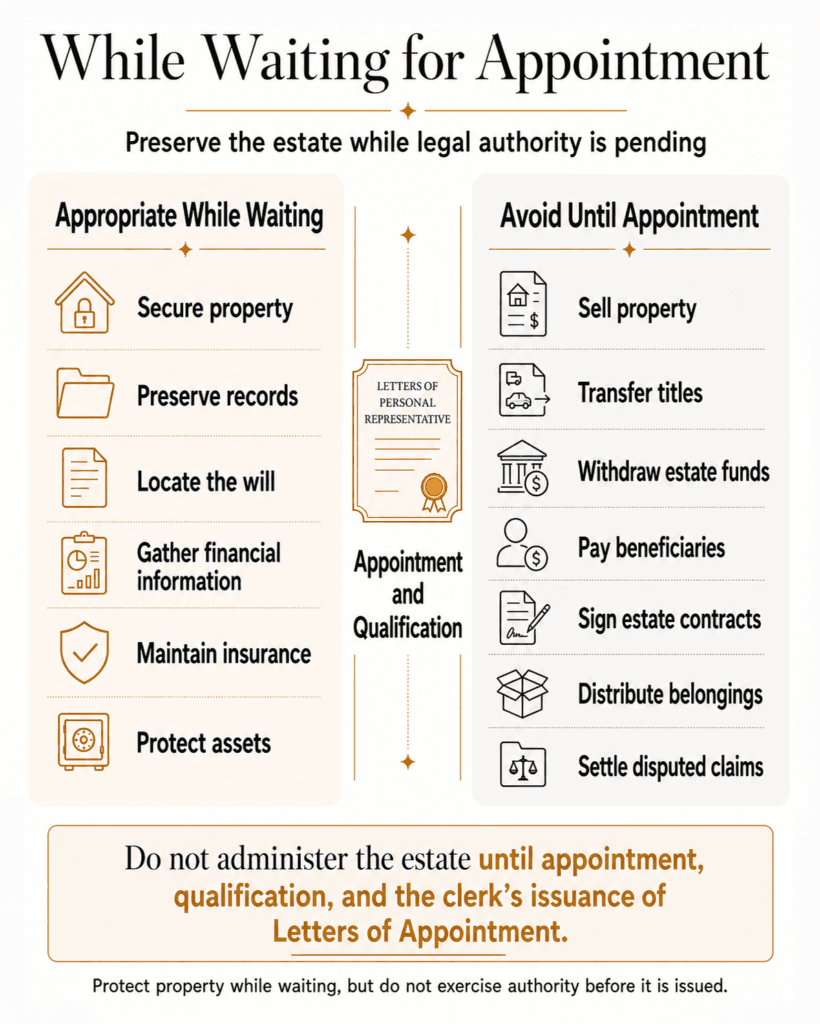
What can the applicant do while waiting?
A delayed appointment does not give the applicant permission to administer the estate.
Until legal authority is established, focus on preservation and preparation.
Appropriate steps may include:
- Securing the home
- Maintaining necessary insurance and utilities
- Collecting and preserving records
- Protecting property from theft or damage
- Gathering asset and debt information
- Locating the original will
- Identifying heirs and devisees
- Preparing information needed after appointment
Generally avoid:
- Withdrawing estate money
- Selling or transferring property
- Changing titles
- Signing major estate contracts
- Paying beneficiaries
- Distributing belongings
- Settling disputed claims
Arizona law may give certain beneficial pre-appointment acts legal effect after the person is appointed. But that rule is not general permission to administer the estate in advance.
Arizona Law Note: A.R.S. § 14-3701 addresses the beginning of a personal representative’s powers and the possible effect of certain beneficial acts taken before appointment.
For a detailed preservation checklist, see Rahnema Law’s guide to what should happen before appointment as an Arizona personal representative.
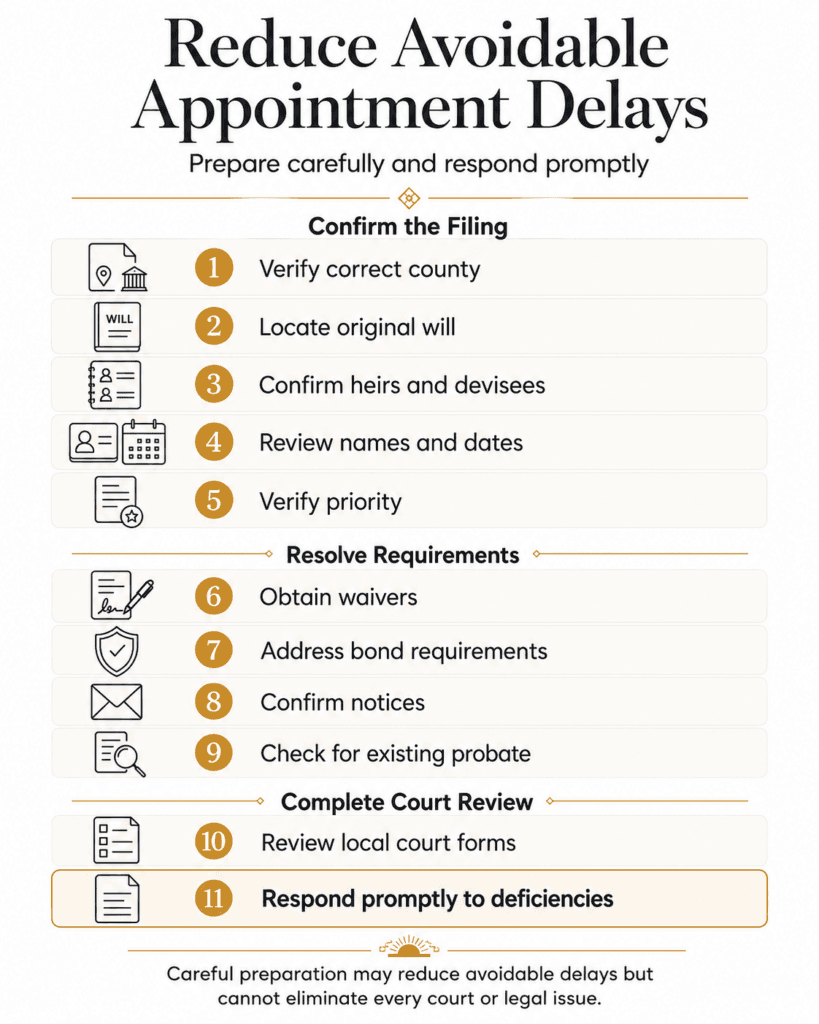
How to reduce avoidable appointment delays
Not every delay can be prevented. A missing will or real dispute may require formal court involvement.
Still, careful preparation can reduce paperwork problems.
Before filing or responding to the court:
- Confirm the correct county.
- Locate the original will.
- Identify all heirs and devisees.
- Verify names, addresses, dates, and relationships.
- Determine who has priority to serve.
- Obtain required waivers, nominations, or renunciations.
- Identify all notice requirements.
- Determine whether a bond is required.
- Check for another probate case or active appointment.
- Review whether the will requests supervised administration.
- Confirm that mandatory waiting periods have passed.
- Use the forms and instructions required by the local court.
- Respond promptly to deficiency notices.
- Calendar hearings and response deadlines.
Keep copies of:
- Filed documents
- Corrected documents
- Court notices
- Waivers
- Renunciations
- Proof of notice
- Bond documents
- Orders
- Letters
Organized records help show what has been completed and what remains unresolved.
For a broader explanation of what follows appointment, see Rahnema Law’s Arizona probate administration guide.
Move the appointment forward carefully
A delayed appointment does not always mean something is seriously wrong.
The registrar or court may only need:
- A corrected form
- A missing address
- The original will
- A signed waiver
- Proof of notice
- A required bond
- Evidence showing priority to serve
More significant delays arise when people disagree, the original will cannot be found, qualification is challenged, or a judicial decision is required.
Keep the three stages separate:
Filing requests authority.
Appointment creates the office and begins the statutory powers and duties.
Qualification must be completed before Letters are received.
Accurate paperwork, complete information, and prompt responses can prevent avoidable delays and move the estate into administration.
For more plain-English answers about Arizona probate appointments, Letters, deadlines, and estate administration, visit Rahnema Law’s Arizona Probate FAQs.
Legal Disclaimer: This information is for educational purposes only and does not constitute legal advice. Arizona probate law is complex and varies based on individual circumstances. Always consult with a qualified probate attorney for guidance specific to your situation.
FAQs
Common reasons include incomplete documents, a missing original will, unresolved priority, absent waivers, required notice, a bond problem, improper venue, an existing appointment, supervised administration, or the need for a formal hearing.
No. Filing requests probate or appointment. The personal representative’s duties and powers generally begin upon appointment, and applicable qualification requirements must be completed before Letters are issued.
Usually not. The probate registrar reviews an informal application. A hearing may become necessary when the registrar cannot make the required findings or a disputed issue requires a judicial decision.
For original informal probate of an Arizona will, the registrar generally must possess an original, duly executed, apparently unrevoked will. A qualifying certified copy of a will probated in another jurisdiction may be used in the circumstances allowed by statute.
Potentially. If the will is found to be valid and unrevoked, its contents may be established through a copy and testimony from at least one credible witness. If no copy exists, clear and convincing evidence is required.
A person given priority by a probated will generally comes first. Arizona law then gives priority to specified devisees, the surviving spouse, heirs, and others in a statutory order.
A dispute over priority or qualification must generally be resolved through a formal proceeding. The formal proceeding pauses the informal appointment process until the court decides who is entitled to serve.
No. Arizona generally requires a bond, but a statutory exception or valid waiver may apply. The court can still require a bond in certain cases when an estate interest appears to be at risk.
An informal appointment generally cannot occur until at least 120 hours after death. For a nonresident decedent, a 30-day period generally applies unless a statutory exception is satisfied.
Arizona recognizes limited exceptions. However, a late appointment may involve restricted authority and additional legal findings.
The applicant may generally gather information and, if the applicant already has lawful access, take limited, non-distributive steps to protect property and maintain necessary insurance or utilities. The filing does not authorize entry, exclusion of occupants, control over co-owned or trust property, or possession of disputed assets. Significant transactions should wait until legal authority is established.