

Learn Arizona probate asset valuation for real estate, accounts, vehicles, businesses, personal property, liens, and date-of-death values.
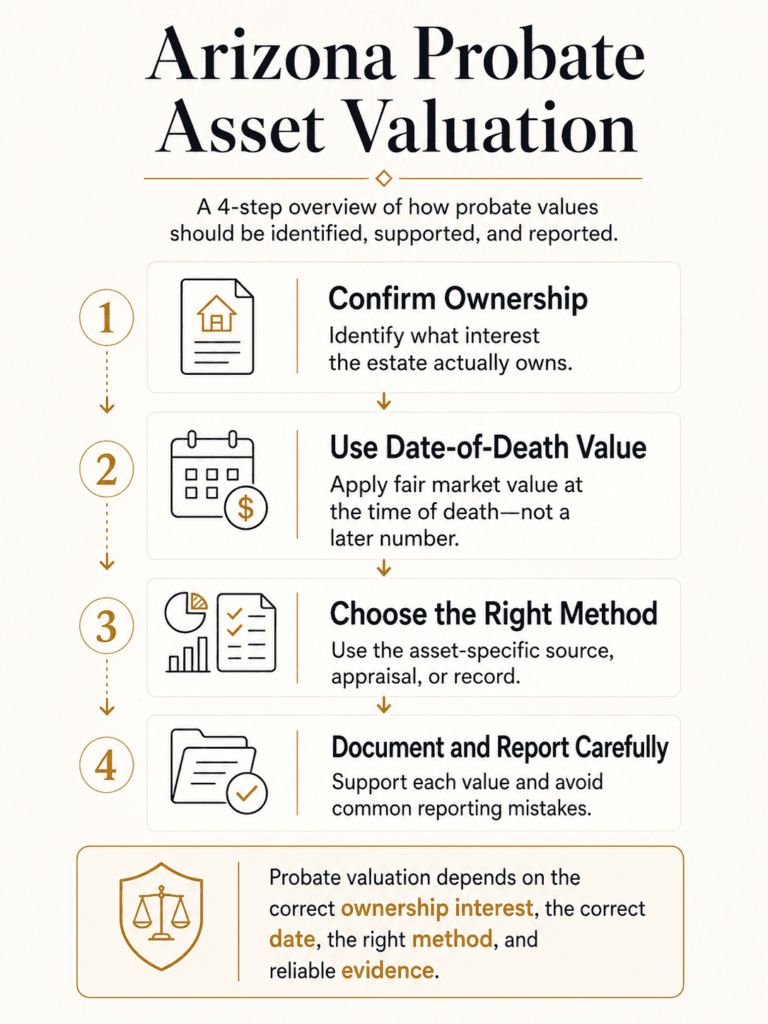
Arizona probate asset valuation usually begins with one question: What was the decedent’s probate interest in each asset reasonably worth on the date of death?
The answer helps establish the estate’s financial starting point. It supports the probate inventory, guides decisions about sales and distributions, helps beneficiaries understand the estate, and preserves information that may later matter for taxes.
A qualifying personal representative generally must prepare the inventory within 90 days after appointment. For each probate asset, the inventory must identify:
- The asset with reasonable detail
- Its fair market value as of the date of death
- Whether it was community or separate property
- The type and amount of any mortgage, lien, or other encumbrance
Arizona allows the personal representative either to file the inventory with the court or, when the statute permits, distribute it privately to the required heirs, devisees, and requesting interested persons.
Arizona Law Note: A.R.S. § 14-3706 establishes the general 90-day deadline and the information the inventory must contain.
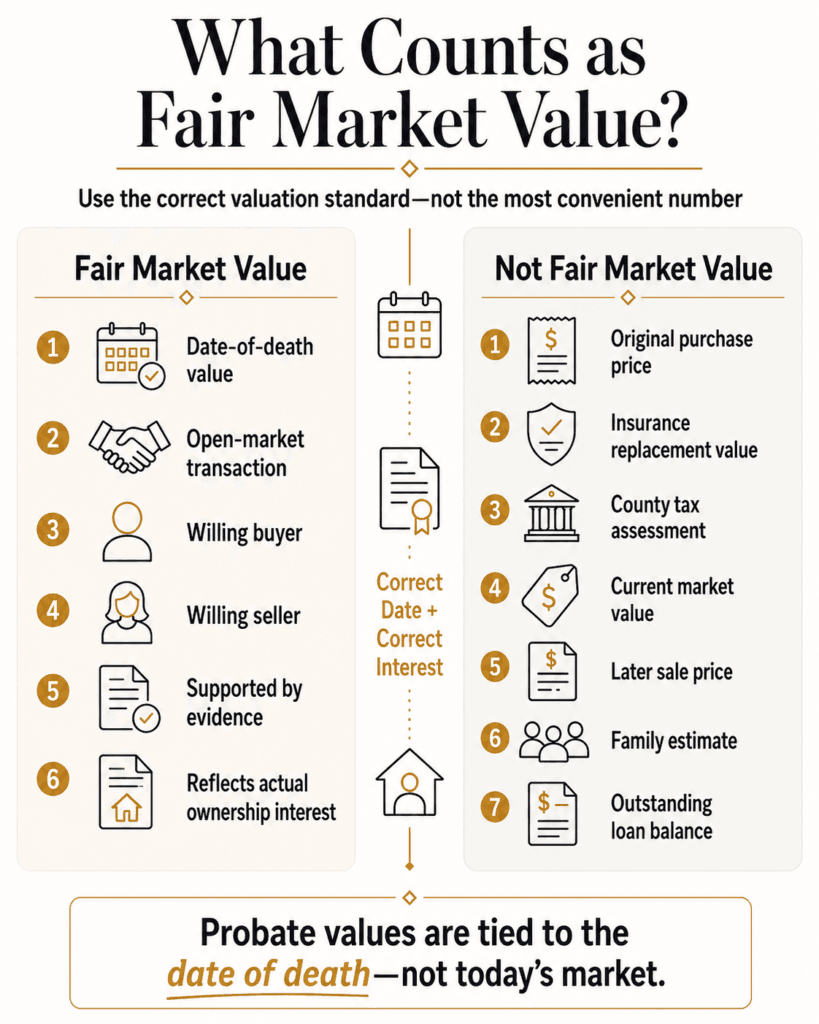
What does fair market value mean?
Fair market value generally means the price property would bring in an open market between a willing buyer and a willing seller when neither is forced to act, and both understand the relevant facts.
The value should reflect the property’s actual condition, ownership, restrictions, market, and other facts that affected it on the valuation date.
Fair market value is not necessarily:
- The original purchase price
- Replacement cost
- Insurance coverage
- A property-tax assessment
- An asking price
- A beneficiary’s personal opinion
- The amount of secured debt
- The price received in a later sale
For example, a home purchased for $150,000 many years ago may have been worth $425,000 when the owner died.
The inventory generally reports the reasonable date-of-death value—not the historical purchase price.
The date of death controls the original inventory value
Arizona’s inventory statute requires the fair market value of each listed asset as of the decedent’s date of death.
That remains the valuation date even when:
- The inventory is prepared months later
- The appraisal is completed after appointment
- The market changes during probate
- Repairs are made after death
- A business gains or loses customers
- An investment account rises or falls
- The asset later sells for a different amount
An appraiser may therefore prepare a report months later while using the date of death as the report’s effective valuation date.
Keep these four dates separate:
- Date of death: Generally controls the original probate inventory value.
- Appraisal date: The date the valuation report is prepared.
- Sale date: The date the estate sells the property.
- Distribution date: The date property is transferred to a beneficiary or heir.
Those values can be different without any of them automatically being wrong.
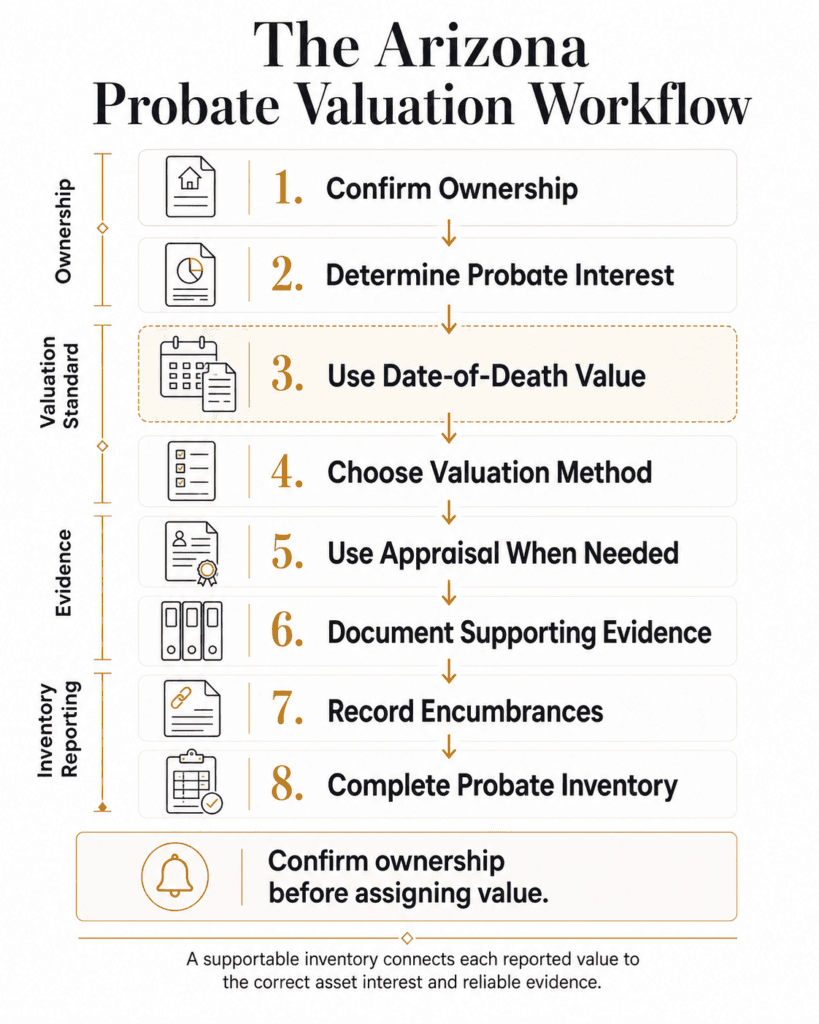
Confirm ownership before assigning a value
Before valuing an asset, determine what interest the decedent actually owned.
The full value of a property and the value of the decedent’s probate interest may not be the same.
Examples include:
- A one-half interest in real estate
- Shares in a jointly owned business
- A partial partnership interest
- A joint account with disputed contributions
- The decedent’s share of community property
- Property subject to survivorship rights
- Property legally owned by a trust
Review:
- Deeds
- Account agreements
- Titles
- Trust records
- Business agreements
- Beneficiary designations
- Marital agreements
- Ownership certificates
If the decedent owned only 50% of a parcel, the inventory should not automatically state that the probate estate owns the entire property.
The valuation records should identify:
- The full property
- The legal ownership form
- The decedent’s interest
- The method used to value that interest
- Any restriction affecting transfer or marketability
Partial ownership can affect value. A 25% interest in a business or parcel of land is not automatically worth exactly 25% of the full property’s value.
For help locating ownership records and overlooked property, see Rahnema Law’s guide to finding assets during Arizona probate.
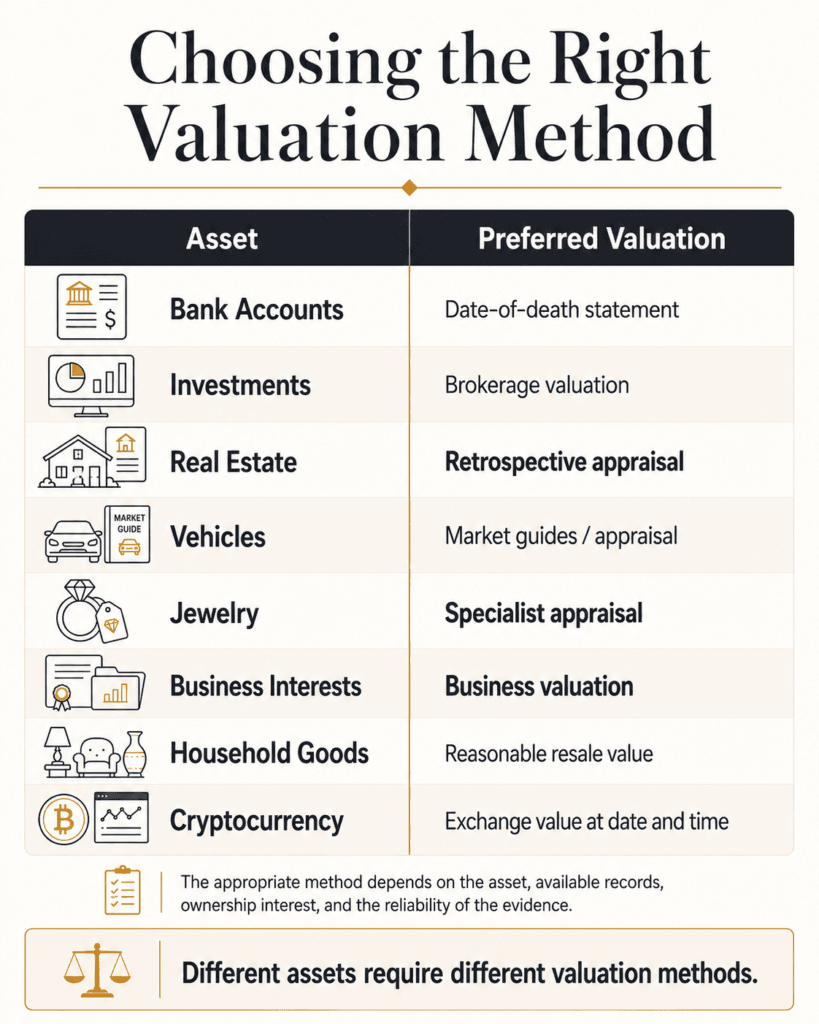
How bank accounts are valued
Checking, savings, money-market, and certificate-of-deposit accounts are commonly valued using the amount attributable to the decedent on the date of death.
Request a date-of-death statement or written confirmation from the financial institution.
A current balance may include later activity, such as:
- Interest credited after death
- Automatic payments
- Bank fees
- Post-death deposits
- Withdrawals
- Returned checks
- Transfers made during administration
The personal representative should also review outstanding checks and pending deposits that may affect the proper opening balance.
For a jointly titled account, determine the decedent’s ownership interest and transfer rights before listing a value. Do not assume that the full balance belongs to the estate—or to the surviving account holder—merely because two names appear on a statement.
Preserve:
- The date-of-death statement
- Account agreement
- Ownership records
- Beneficiary records
- Supporting calculations
The final inventory figure should reflect the probate interest the decedent owned at death.
How stocks and investment accounts are valued
A brokerage firm may be able to provide an official date-of-death valuation showing:
- Cash
- Securities
- Number of shares or units
- Market values
- Accrued income
- Total account value
That report is usually more useful than a statement produced weeks or months later.
When securities must be valued individually, relevant questions may include:
- What was the market price on the date of death?
- Was the market open?
- Was the security actively traded?
- Were there restrictions on its sale?
- Did the decedent own a controlling or minority interest?
- Had interest or dividends accrued?
- Was a reliable public price available?
Additional help may be appropriate when an account contains:
- Restricted securities
- Closely held stock
- Options
- Thinly traded investments
- Complex financial products
- Assets without a reliable public market
Preserve the brokerage valuation, security descriptions, transaction history, and the source used for each material value.
How Arizona real estate is valued
Real estate is often one of the largest assets in an Arizona probate estate.
A reliable valuation becomes especially important when the property will be:
- Sold
- Distributed to a beneficiary
- Used to satisfy a beneficiary’s share
- Retained for an extended period
- Involved in a family dispute
- Purchased by the personal representative or a relative
A qualified retrospective appraisal is often useful because it evaluates the property using the date of death as the effective valuation date.
The appraiser may consider:
- Location
- Lot and building size
- Condition
- Improvements
- Comparable sales
- Zoning
- Current use
- Rental income
- Deferred maintenance
- Access
- Marketability
- Ownership percentage
- Restrictions affecting use or sale
The appraisal may be prepared months after death. Its effective valuation date should still be the date of death.
Comparative market analyses and online estimates
A comparative market analysis from a real estate professional may provide useful information in a straightforward estate.
However, it may not provide the same independence, retrospective analysis, or detail as a formal appraisal.
Use county assessments and automated online estimates carefully. They may not account for:
- The property’s actual condition
- Unrecorded damage
- Deferred maintenance
- Partial ownership
- Access limitations
- Unusual improvements
- Market conditions on the date of death
The personal representative should choose a method appropriate for the property’s value, complexity, intended use, and risk of disagreement.
Account for repairs and post-death changes
A property may change significantly between the date of death and the appraisal or sale.
The estate may:
- Repair a roof
- Replace an air-conditioning system
- Remove damaged property
- Complete deferred maintenance
- Improve landscaping
- Remodel a room
- Allow deterioration to occur
The local market may also rise or fall.
The original inventory value should reflect the property’s condition and market on the date of death—not its improved or deteriorated condition months later.
Give the appraiser records such as:
- Date-of-death photographs
- Inspection reports
- Repair estimates
- Contractor invoices
- Insurance records
- Descriptions of later improvements
- Evidence of later damage
These records help separate the original value from changes that occurred during administration.
Show mortgages and liens separately
Arizona requires the inventory to show both:
- The asset’s fair market value
- The type and amount of any encumbrance
Suppose a home had:
- Fair market value: $500,000
- Deed-of-trust balance: $190,000
The inventory should generally show both figures.
It should not simply state that the home is worth $310,000 without identifying the full property value and secured debt separately.
Common encumbrances include:
- Mortgages
- Deeds of trust
- Vehicle loans
- Tax liens
- Judgment liens
- Security interests
- Secured business loans
- Recorded assessments
Obtain a balance reasonably connected to the date of death.
A later payoff statement may include:
- Post-death interest
- Penalties
- Late charges
- Payments made during probate
- Foreclosure-related expenses
Keeping the gross value and secured debt separate makes the estate’s financial position easier to understand.
How vehicles are valued
Cars, trucks, motorcycles, boats, recreational vehicles, and similar property should be valued according to their actual condition and relevant market on the date of death.
Possible sources include:
- Recognized valuation guides
- Dealer information
- Comparable listings or sales
- Auction data
- A professional appraisal
Consider:
- Year
- Make and model
- Mileage
- Mechanical condition
- Cosmetic condition
- Optional equipment
- Accident history
- Whether the vehicle was operational
- Ownership percentage
Do not automatically choose the highest retail figure in a valuation guide.
A vehicle requiring major repairs may be worth much less than the guide value for a similar vehicle in excellent condition.
List any vehicle loan separately as an encumbrance.
How ordinary household property is valued
Furniture, clothing, appliances, kitchenware, electronics, tools, and similar household items are generally valued at reasonable resale value.
That amount may be far lower than:
- Original cost
- Replacement cost
- Retail price
- Insurance coverage
Age, condition, style, use, and actual market demand can all affect value.
Ordinary items may sometimes be grouped into reasonable categories, such as:
- Household furniture and furnishings
- Kitchenware and appliances
- Clothing and personal effects
- Ordinary tools and equipment
Items with meaningful individual value should generally be listed separately.
Photographing the property before it is sold, moved, or distributed can help support both the description and the assigned value.
Jewelry, artwork, antiques, and collectibles
Specialized property may require a professional appraisal.
Examples include:
- Jewelry
- Watches
- Artwork
- Antiques
- Coins
- Stamps
- Rare books
- Firearms
- Musical instruments
- Sports memorabilia
- Precious metals
- Specialized collections
The right appraiser depends on the asset.
A jeweler may be qualified to value jewelry but not fine art. A general auctioneer may not be qualified to evaluate rare coins.
Also confirm that the appraiser is determining fair market value, not insurance replacement value.
A useful appraisal should identify:
- The property
- Its condition
- Relevant characteristics
- Effective valuation date
- Valuation method
- Comparable information
- Resulting fair market value
When should a probate appraiser be used?
Arizona permits the personal representative to hire a qualified and disinterested appraiser when an asset’s fair market value is subject to reasonable doubt.
Different appraisers may be used for different types of property.
When an appraiser is used, the appraiser’s name and address must appear on the inventory with the property that person valued.
Arizona Law Note: A.R.S. § 14-3707 governs the employment of qualified and disinterested appraisers.
An appraisal may be especially helpful when:
- The property has substantial value
- No active public market exists
- Beneficiaries disagree about value
- A beneficiary will receive the property in kind
- The personal representative or a relative wants to buy it
- The asset is unusual or specialized
- Tax reporting may depend on the value
- The decedent held only a partial interest
- The property is difficult to sell
A disinterested appraiser should not have a personal or financial interest in producing a particular result.
Preserve:
- Appraisal report
- Engagement letter
- Appraiser’s qualifications
- Invoice
- Effective valuation date
- Supporting data
- Material assumptions
How business interests are valued
A closely held corporation, partnership, limited liability company interest, sole proprietorship, or professional practice can be difficult to value.
The amount in the company’s bank account does not establish the value of the decedent’s ownership interest.
A business valuation may consider:
- Assets and liabilities
- Historical earnings
- Cash flow
- Goodwill
- Customer relationships
- Intellectual property
- Contracts
- Industry conditions
- Marketability
- Control rights
- Ownership percentage
- Transfer restrictions
- Dependence on the decedent
- Company debt
Review:
- Tax returns
- Financial statements
- Ownership records
- Operating agreements
- Partnership agreements
- Shareholder agreements
- Buy-sell agreements
- Redemption provisions
- Employment contracts
A governing agreement may prescribe a valuation method or require the interest to be sold, redeemed, or offered to other owners.
A qualified business-valuation professional may be appropriate when the interest is substantial, illiquid, disputed, or subject to contractual restrictions.
How money owed to the decedent is valued
A right to collect money can be a probate asset even when the estate has not yet received payment.
Examples include:
- Promissory notes
- Personal loans
- Unpaid wages
- Commissions
- Business receivables
- Court judgments
- Installment obligations
- Tax refunds
- Settlement proceeds
The face amount does not always equal fair market value.
Consider:
- Principal balance
- Accrued interest
- Payment history
- Collateral
- Debtor solvency
- Disputes or defenses
- Collection costs
- Time required to collect
- Applicable limitations periods
A secured debt owed by a reliable borrower may be worth close to the amount due.
A disputed or uncollectible debt may be worth much less.
Preserve the note, contract, judgment, correspondence, and calculations supporting the value.
How digital assets and cryptocurrency are valued
Digital property may include:
- Cryptocurrency
- Nonfungible tokens
- Exchange accounts
- Domain names
- Monetized websites
- Digital businesses
- Intellectual property
- Other electronic assets
For an asset traded on an established market, document:
- Asset type
- Number of units
- Exchange or valuation source
- Date
- Time
- United States dollar value
- Wallet or account records
Digital-asset prices can change substantially within one day.
IRS guidance for digital-asset transactions recognizes exact-date-and-time information from reliable exchanges or blockchain explorers as valuation evidence in applicable circumstances.
Other digital assets may require analysis of:
- Income
- Audience size
- Transferability
- Contracts
- Platform restrictions
- Intellectual-property rights
- Access credentials
- Market demand
Ownership and access are separate issues. A person who knows a password does not necessarily own the asset or have authority to transfer it.
Preserve devices, wallet information, account records, and valuation data. Avoid experimental transfers that could compromise the property or its records.
Identify community and separate property
Arizona requires the inventory to identify whether each listed asset was community or separate property.
Property acquired by either spouse during marriage is generally community property, subject to statutory exceptions. Property acquired by gift, devise, or descent is excluded from the general community-property rule.
Property owned before marriage, and property acquired during marriage by gift, devise, or descent, is generally separate property.
Classification may require reviewing:
- Acquisition date
- Source of purchase funds
- Deeds and account records
- Marital agreements
- Refinancing history
- Commingling of funds
- Changes in title
- Contributions made during marriage
The name on an account or deed may not fully resolve its marital-property character.
Classification can affect:
- The decedent’s probate interest
- The surviving spouse’s interest
- Inventory values
- Creditor rights
- Distributions
- Potential tax consequences
For probate purposes, the decedent’s estate generally includes the decedent’s separate property and share of community property.
When classification is uncertain, do not guess.
Preserve the records supporting every value
The personal representative should be able to explain how each material value was determined.
Supporting records may include:
- Date-of-death statements
- Brokerage reports
- Appraisal reports
- Comparable-sales information
- Vehicle valuations
- Photographs
- Business records
- Loan statements
- Institution correspondence
- Ownership documents
- Valuation worksheets
For each significant asset, document:
- The property valued
- The decedent’s ownership interest
- The valuation date
- The valuation method
- The source of information
- The appraiser or professional involved
- Any lien or encumbrance
- Any material assumption
- The records preserved
The inventory may not contain every supporting document.
The estate file should.
Rahnema Law’s probate administration overview explains how inventory, financial records, creditor work, accounting, and distribution fit into the larger estate process.
What if the asset later sells for a different amount?
A later sale for more or less than the inventory value does not automatically mean the original valuation was wrong.
The later price may reflect:
- Market changes
- Repairs
- Deterioration
- Carrying costs
- Commissions
- Negotiation
- Urgency
- New information
- A uniquely motivated buyer
- Changes in the business or property
The inventory asks what the asset was reasonably worth on the date of death.
A later sale shows what a particular buyer paid under the circumstances existing on the sale date.
The accounting should preserve:
- Gross sale price
- Commissions
- Closing expenses
- Debt payoff
- Repairs
- Net proceeds
- An explanation for any significant difference
A supplemental inventory is required when the original value was erroneous or misleading—not merely because the asset later sold for another amount.
Property may need to be valued again before distribution
The inventory value is not always the value used when the estate later distributes property in kind.
Arizona’s distribution statute applies current fair market valuation in certain situations.
For example, property used to satisfy a stated amount of money may be valued as of the distribution date. For property without a readily ascertainable value, a reasonable valuation dated no more than 30 days before distribution may control.
The personal representative may use a reasonable method, including another qualified appraisal, even if the property was previously appraised.
Arizona Law Note: A.R.S. § 14-3906 addresses distributions in kind and the applicable valuation methods.
A new valuation may matter when:
- One beneficiary receives a house
- Another receives investments
- A stated monetary gift is satisfied with property
- Values changed materially
- Beneficiaries receive different assets from the residue
Suppose a home was worth $400,000 at death but is worth $455,000 when distributed one year later.
The $400,000 value may remain correct for the original inventory. The later value may matter when dividing the estate or satisfying a monetary gift.
Correcting a missing or inaccurate value
Arizona requires a supplementary inventory or appraisement when:
- Previously omitted property comes to the personal representative’s attention
- An original value was erroneous or misleading
- An original description was erroneous or misleading
The supplement must provide the corrected date-of-death information and identify the appraisers or other information relied upon when applicable.
If the original inventory was filed with the court, the supplement must also be filed. If the original was not filed, the personal representative must provide the new information to people interested in it.
Arizona Law Note: A.R.S. § 14-3708 governs supplementary inventories and appraisements.
Preserve:
- The original information
- Newly received records
- The reason for the correction
- Revised value
- Valuation source
- Filing or delivery records
Correct the inventory promptly after reliable new information becomes available.
Probate valuation and inherited-property tax basis
Date-of-death values may also matter for federal income-tax purposes.
As a general federal rule, the basis of inherited property is often its fair market value on the date of death.
However, exceptions and alternative rules may apply, including:
- An elected alternate valuation date
- Values finally determined for estate-tax purposes
- Certain jointly owned property
- Income in respect of a decedent
- Special-use valuation
- Other specialized federal rules
The probate inventory value does not automatically determine a beneficiary’s federal tax basis in every case.
Probate and federal tax rules serve different purposes. The correct tax treatment may depend on the property, how it was owned, whether an estate-tax return was required, and other circumstances.
The IRS explains the general inherited-property basis rules in Publication 559.
Preserve valuation records even when no federal estate tax is expected.
A beneficiary may need them years later when inherited property is:
- Sold
- Exchanged
- Depreciated
- Donated
- Transferred into a business
- Reported on a tax return
Substantial or unusual assets should be reviewed with a qualified tax professional.
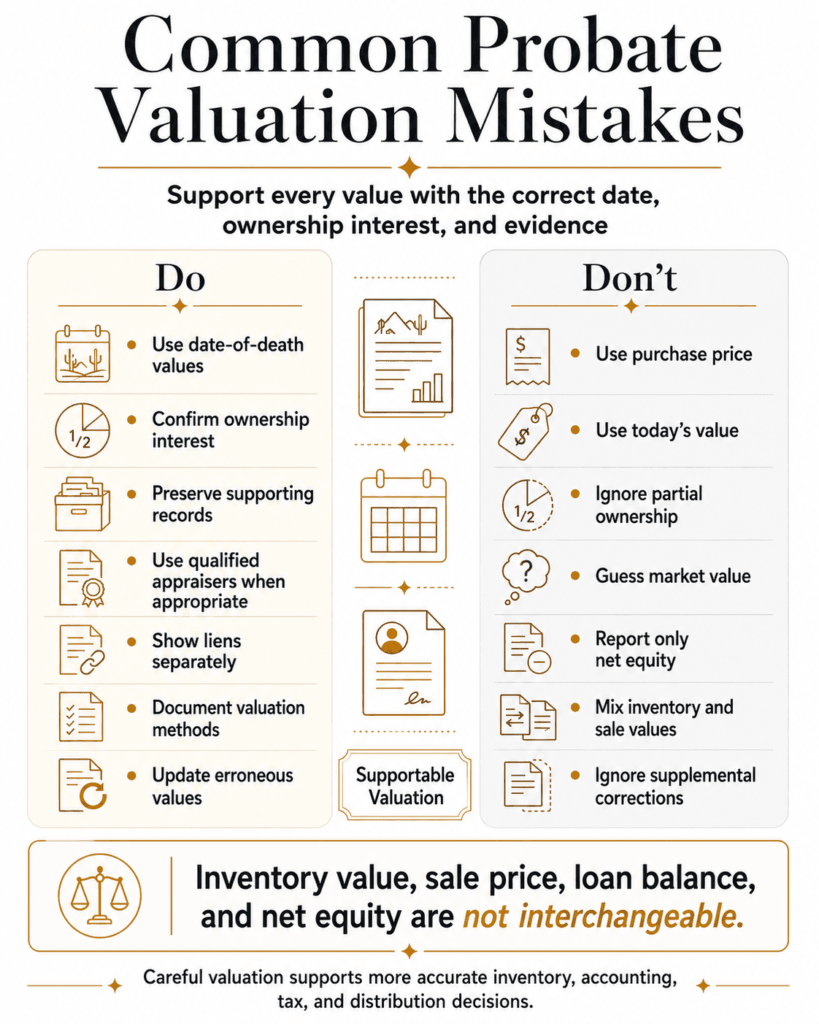
Common Arizona probate asset valuation mistakes
Common mistakes include:
- Using the original purchase price
- Using a current value instead of a date-of-death value
- Valuing the entire asset when the decedent owned only part
- Relying solely on an online real estate estimate
- Using insurance replacement value for jewelry or collectibles
- Reporting only net equity
- Failing to identify secured debt separately
- Ignoring community-property classification
- Using an interested or unqualified appraiser
- Failing to preserve supporting records
- Treating a later sale as automatic proof that the inventory was wrong
- Distributing property based on an outdated value
- Failing to supplement an erroneous or misleading inventory
- Assuming the probate value always controls federal tax basis
A supportable value based on reliable information is more useful than a precise-looking number with no documented foundation.
Arizona probate asset valuation checklist
Before completing the valuation work, confirm that:
- The asset belongs to the probate estate.
- The decedent’s ownership percentage has been identified.
- The date-of-death valuation date is being used.
- The asset’s condition at death is documented.
- Reliable statements or market information support the value.
- A qualified and disinterested appraiser was used when appropriate.
- The appraiser used the correct effective date.
- Community or separate property status was reviewed.
- Mortgages, liens, and other encumbrances are shown separately.
- Post-death repairs and market changes are separated from the original value.
- The valuation source and method are documented.
- Appraiser names and addresses are included when required.
- Sale records are kept separately from the original valuation.
- Property will be valued again before distribution when required or appropriate.
- Missing or misleading values will be corrected through a supplement.
- Records needed for beneficiary tax basis are retained.
- Legal or tax guidance will be obtained for complicated assets.
Build a reliable financial record
Arizona probate asset valuation is not about finding the highest or lowest possible number.
The goal is to establish a reasonable and supportable fair market value for the decedent’s probate interest as of the correct date.
Reliable valuations help the personal representative:
- Complete the probate inventory
- Understand estate liquidity
- Make informed sale decisions
- Divide property fairly
- Explain transactions to beneficiaries
- Prepare the estate accounting
- Preserve tax information
- Reduce disputes
Begin gathering records early.
Use qualified specialists when value is uncertain. Document the source of every material figure. Keep asset value and secured debt separate. Correct the inventory when reliable new information shows that the original description or value was incomplete or misleading.
Legal Disclaimer: This information is for educational purposes only and does not constitute legal advice. Arizona probate law is complex and varies based on individual circumstances. Always consult with a qualified probate attorney for guidance specific to your situation.
FAQs
The inventory generally must report the fair market value of probate property as of the decedent’s date of death.
A qualifying personal representative generally must prepare it within 90 days after appointment.
Fair market value generally means the open-market price agreed upon by a willing buyer and willing seller when neither is forced to act, and both understand the relevant facts.
No. Arizona permits the personal representative to use a qualified and disinterested appraiser when an asset’s value is subject to reasonable doubt.
The appropriate method depends on the asset, its value, the available market, and the risk of disagreement.
Yes. When an appraiser is used under A.R.S. § 14-3707, the appraiser’s name and address must appear on the inventory with the property that person valued.
A retrospective appraisal using the date of death as its effective valuation date is often useful. The appraiser may consider comparable sales, condition, location, income, restrictions, access, ownership percentage, and other market factors.
Do not report only the net equity. The inventory should generally show the home’s full fair market value and separately identify the type and amount of the mortgage, deed of trust, or other encumbrance.
Ordinary household property is generally valued according to reasonable resale value. That amount may be much lower than its original cost, retail price, or replacement cost.
Jewelry should be valued using fair market value rather than insurance replacement value. Specialized or valuable pieces may require a qualified appraiser.
A different sale price does not automatically make the inventory wrong. Market changes, repairs, sale expenses, negotiations, urgency, and other post-death circumstances may explain the difference.
Sometimes. A.R.S. § 14-3906 applies distribution-date valuation rules in certain circumstances and allows reasonable updated valuation methods, including a new appraisal when appropriate.
The personal representative must prepare a supplementary inventory or appraisement when the original value or description was erroneous or misleading.
Not automatically. Inherited-property basis is often connected to date-of-death fair market value, but federal exceptions and alternative valuation rules may apply.
Document:
· The type of asset
· Number of units
· Exact date and time
· Exchange or price source
· United States dollar value
· Wallet or account records
Because digital-asset prices can change quickly, preserve the exact valuation data and the source used.