

Learn how to complete an Arizona probate inventory, identify probate assets, determine date-of-death values, disclose liens, and meet the 90-day deadline.
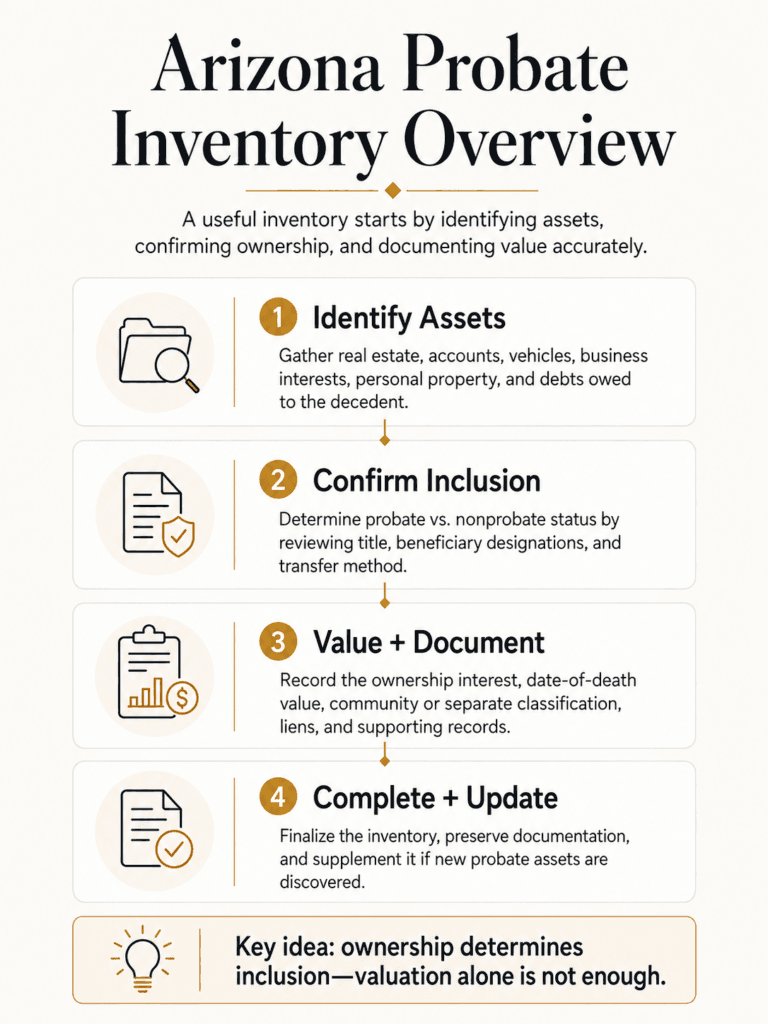
The Arizona probate inventory records the probate property owned by the person who died and establishes the estate’s financial starting point.
For each listed asset, the personal representative generally must identify:
- What the asset is
- Its fair market value on the date of death
- Whether it is community or separate property
- The type and amount of any mortgage, lien, or other encumbrance
A personal representative who is subject to the inventory requirement generally must prepare it within 90 days after appointment.
The inventory is not a list of what each beneficiary will eventually receive. It is also not the final accounting of everything that happens during probate.
It shows what the probate estate owned at the beginning.
What is an Arizona probate inventory?
Arizona law calls the document an inventory and appraisement.
The inventory must list the property the decedent owned at death with enough detail to identify it. For each asset, it must show:
- Fair market value as of the date of death
- Whether the property was community or separate
- The type of any encumbrance
- The amount of that encumbrance
The decedent is the person who died.
Arizona Law Note: A.R.S. § 14-3706 establishes the inventory requirements and the general 90-day deadline.
A reliable inventory helps the personal representative:
- Understand what the estate owns
- Protect and manage property
- Evaluate whether the estate has enough available money
- Review creditor and tax issues
- Decide whether property may need to be sold
- Prepare the estate accounting
- Explain distributions
- Show what happened to each probate asset
For a broader explanation of the personal representative’s responsibilities from appointment through closing, see Rahnema Law’s Arizona probate administration guide.
When is the Arizona probate inventory due?
The personal representative generally must prepare the inventory within 90 days after appointment.
That timing point matters.
The 90 days do not begin:
- On the date of death
- When someone first contacts the court
- When the probate papers are submitted
- When the personal representative begins collecting documents
The deadline generally runs from the appointment date.
The statutory inventory requirement does not apply to:
- A special administrator
- A successor personal representative when the prior representative already completed the inventory duty
Identify the appointment date immediately and calendar the deadline.
Do not wait until the last few weeks. Information can take time to obtain, especially when:
- A bank must produce historical statements
- Real estate needs an appraisal
- A business interest must be valued
- Ownership records are incomplete
- Community-property classification is unclear
- Property is located in another state
- An institution requires additional documents
The inventory itself is due within 90 days, but the information-gathering process should begin much earlier.
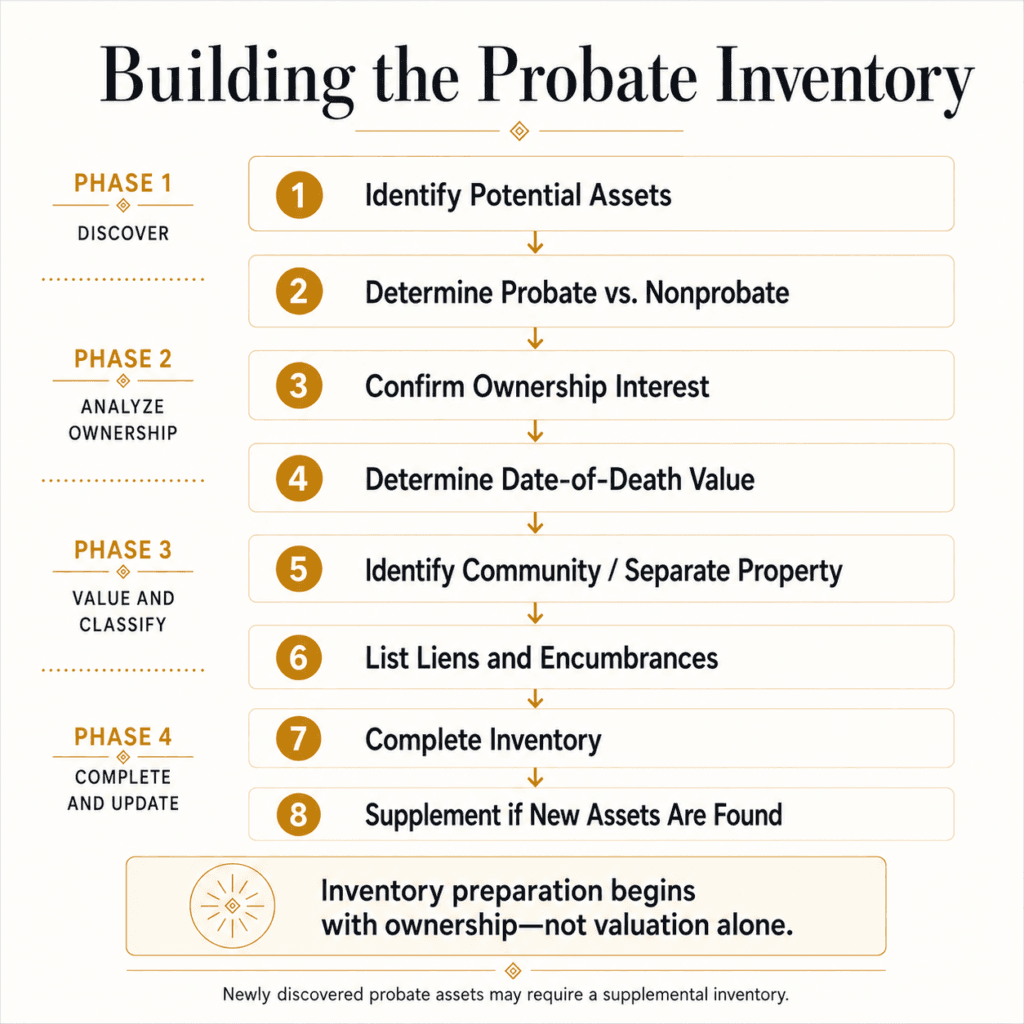
Step 1: Build a broad working asset list
Start by listing everything the decedent may have owned or had a financial interest in.
At this stage, the list can be broad. You can remove or reclassify items after you confirm ownership and transfer instructions.
Review:
- The decedent’s home
- Mail and email
- Tax returns
- Bank statements
- Investment records
- Deeds
- Vehicle titles
- Insurance records
- Retirement records
- Business documents
- Loan agreements
- Digital files
- Safe-deposit-box information
Information may also come from:
- Family members
- Accountants
- Financial advisers
- Employers
- Business partners
- Property managers
- Banks
- Brokerage firms
- Insurance companies
- Government agencies
Common assets to investigate
Potential assets may include:
- Real estate
- Bank accounts
- Brokerage accounts
- Vehicles
- Business interests
- Household belongings
- Jewelry
- Artwork
- Collections
- Money owed to the decedent
- Tax refunds
- Legal claims
- Digital assets
- Cryptocurrency
Frequently overlooked property may include:
- Unpaid wages or commissions
- Security deposits
- Refunds and rebates
- Promissory notes
- Mineral or royalty interests
- Intellectual property
- Unclaimed property
- Safe-deposit-box contents
- Membership interests
- Closely held stock
- Pending insurance claims
- Funds held by an attorney or escrow agent
Do not assume an asset is unimportant merely because it is difficult to find or does not currently produce income.
One forgotten asset can change the inventory.
Step 2: Determine which assets belong to the probate estate
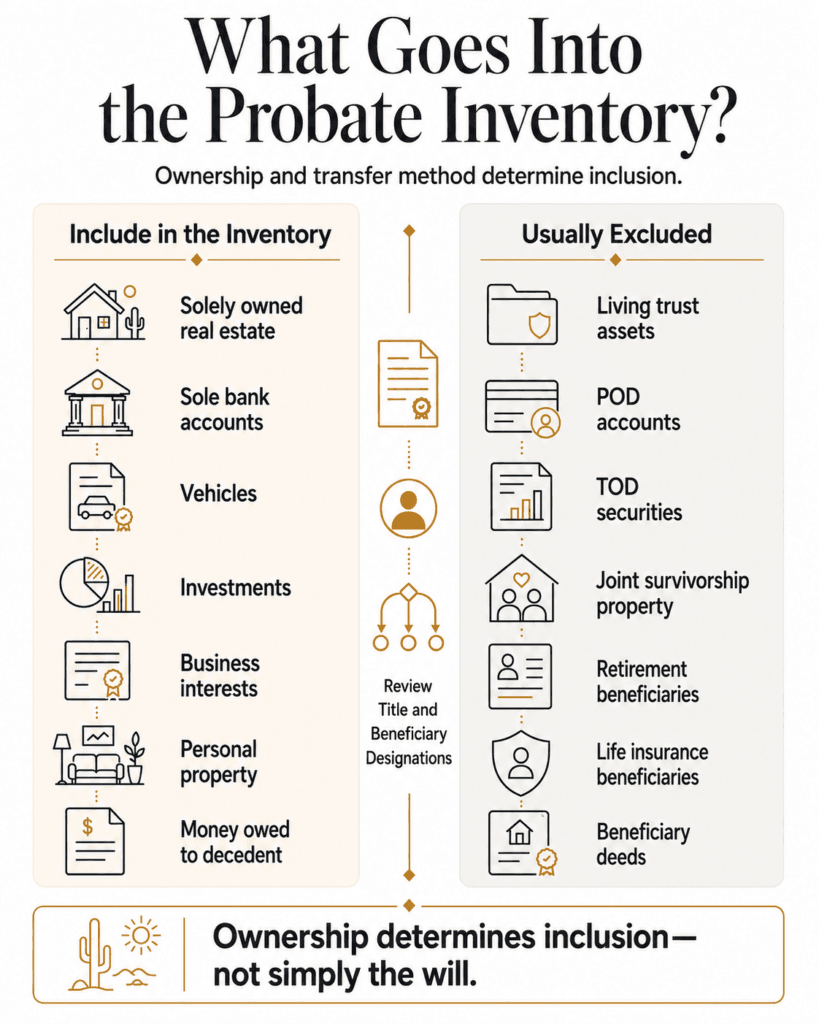
Not every asset connected to the decedent belongs in the Arizona probate inventory.
Some property transfers outside probate through a governing document or ownership arrangement, such as:
- A trust
- Life insurance
- A retirement plan
- A beneficiary designation
- A payable-on-death account
- A transfer-on-death registration
- A beneficiary deed
- A survivorship provision
Arizona recognizes many transfers created through written instruments as nonprobate transfers.
Arizona Law Note: A.R.S. § 14-6101 recognizes nonprobate transfers created through insurance policies, account agreements, retirement plans, trusts, deeds, and other written instruments.
For each potential asset, ask:
- Who owned it on the date of death?
- How was it titled?
- Did another owner survive?
- Was a beneficiary named?
- Was the asset held in a trust?
- Did the decedent own the entire asset or only part of it?
- Did it transfer automatically at death?
- Does an agreement control or restrict the transfer?
Do not assume the will decides whether an asset belongs in probate.
A will generally controls probate property. It does not automatically override a valid trust, beneficiary designation, account agreement, or survivorship right.
Example: A jointly owned bank account
For certain Arizona multiple-party accounts, the account terms help determine whether the funds pass to a surviving party, a payable-on-death beneficiary, or the decedent’s estate.
A single-party account without a payable-on-death designation generally becomes part of the decedent’s estate. A multiple-party account without survivorship rights may also leave the decedent’s interest in the estate.
Arizona Law Note: A.R.S. § 14-6212 addresses rights in multiple-party, payable-on-death, and single-party accounts after a party dies.
When ownership is unclear, review the account agreement and other governing records instead of guessing.
Step 3: Identify the decedent’s actual ownership interest
The decedent may have owned only part of an asset.
Examples include:
- A percentage interest in real estate
- A partnership interest
- Membership units in a limited liability company
- Shares in a closely held corporation
- A joint account without survivorship
- A partial beneficial interest
- The decedent’s share of community property
The inventory should identify the interest attributable to the decedent or probate estate.
For example, if the decedent owned a 50% interest in a parcel of real estate, do not automatically list the estate as owning the entire property.
The supporting records should show:
- The full asset
- The form of ownership
- The decedent’s percentage or share
- The value assigned to that interest
- Any restriction or valuation adjustment considered
Partial ownership can affect both the description and the value. A 25% interest in a business or parcel of land is not automatically worth exactly 25% of the value of the whole asset.
Professional valuation may be appropriate when ownership restrictions, lack of control, or limited marketability affect the interest.
Step 4: Describe each asset with reasonable detail
Arizona requires the inventory to describe property with reasonable detail.
The description should allow an interested person to understand what the asset is and distinguish it from similar estate property.
Real estate
A real estate description may include:
- Street address
- County
- Property type
- Parcel information when appropriate
- Decedent’s ownership interest
Bank accounts
A financial account description may include:
- Institution
- Account type
- Limited identifying digits
- Decedent’s ownership interest
Vehicles
A vehicle description may include:
- Year
- Make
- Model
- Limited vehicle-identification information
- Ownership percentage
Investments
An investment description may include:
- Financial institution or issuer
- Account type
- Security or fund
- Number of shares or units
- Limited account-identification information
Business interests
A business-interest description may include:
- Entity name
- Entity type
- Percentage owned
- Class of ownership
- Applicable transfer restrictions
Descriptions such as “bank account,” “property,” or “personal belongings” may be too vague when the estate owns several similar assets or an individual asset has significant value.
At the same time, do not expose sensitive information unnecessarily.
Avoid including:
- Full account numbers
- Social Security numbers
- Passwords
- Complete login credentials
- Digital wallet keys
Maintain a separate confidential worksheet with full identifiers and supporting information.
Step 5: Use fair market value as of the date of death
The Arizona probate inventory must state each asset’s fair market value as of the decedent’s date of death.
Fair market value generally means the price the property would bring in an open-market transaction between a willing buyer and willing seller when neither is forced to act, and both understand the relevant facts.
The correct inventory value is not necessarily:
- The original purchase price
- The insured value
- Replacement cost
- Sentimental value
- The current account balance
- A later sales price
- The amount still owed on the asset
- A county tax assessment
- An unsupported online estimate
The valuation should reflect the property and market conditions that existed on the date of death.
An asset may rise or fall in value during probate. Those later changes generally belong in the estate accounting and tax analysis. They do not automatically replace the date-of-death inventory value.
Keep the valuation date consistent
Use the date of death for every inventory asset.
Do not combine:
- A date-of-death bank balance
- A current brokerage value
- A later real estate sales price
- A vehicle value from a different month
Mixing valuation dates can create a misleading picture of the estate’s starting value.
For each asset, preserve:
- Valuation date
- Valuation source
- Method used
- Important assumptions
- Supporting documents
- Name of the person who prepared the valuation
A working valuation sheet can help confirm that every figure uses the correct date.
How to value bank and investment accounts
Bank accounts
For checking, savings, money-market, and certificate-of-deposit accounts, request a statement or written confirmation showing the balance on the date of death.
A current online balance may include activity that occurred later, such as:
- Interest posted after death
- Fees
- Deposits
- Withdrawals
- Automatic payments
- Returned items
Review:
- The official date-of-death balance
- Outstanding checks
- Pending deposits
- Accrued interest
- Ownership percentage
- Survivorship or payable-on-death terms
- Restrictions or early-withdrawal penalties
If the account was jointly owned, first determine whether any portion belongs to the probate estate.
Keep the institution’s written confirmation with the inventory records.
Investment accounts
For brokerage accounts, stocks, bonds, mutual funds, and similar assets, obtain a date-of-death valuation from the financial institution when available.
The records should identify:
- Cash balance
- Number of shares or units
- Security names
- Date-of-death market values
- Accrued interest
- Declared dividends
- Ownership interest
- Transfer-on-death designation, if any
Additional analysis may be needed when:
- The date of death fell on a weekend or market holiday
- A security was thinly traded
- The account held restricted stock
- No reliable market price was available
- The decedent owned a controlling or minority interest
- The account contained complex financial products
A financial or valuation professional may be appropriate when the institution cannot provide a reliable figure.
How to value Arizona real estate
Real estate is often one of the largest assets in a probate estate.
A qualified appraisal may be appropriate when:
- The property has substantial value
- Its condition is unusual
- It is expected to be sold
- Beneficiaries disagree about value
- The decedent owned only a partial interest
- Title, access, zoning, or environmental problems exist
- Tax consequences may depend on the valuation
The valuation should consider the property as it existed on the date of death.
Relevant facts may include:
- Location
- Size
- Condition
- Improvements
- Comparable sales
- Deferred maintenance
- Occupancy
- Access
- Ownership percentage
- Restrictions affecting use or sale
A county property-tax value is not automatically fair market value.
An automated online estimate may also miss important information about the property’s condition, ownership, access, or marketability.
If the decedent owned only part of the property, value that ownership interest rather than automatically listing the value of the entire property.
How to value vehicles and personal belongings
Vehicles
A vehicle’s date-of-death value may be supported by:
- Recognized market guides
- Dealer information
- Comparable listings or sales
- A professional appraisal
- Records of condition and mileage
Record:
- Year
- Make
- Model
- Mileage
- Condition
- Equipment
- Relevant accident history
- Ownership percentage
- Loan balance
Photographs and maintenance records may help support the value.
The original purchase price and remaining loan balance do not establish fair market value.
Household property
Ordinary household goods generally should be valued at reasonable resale value, not replacement cost.
Used furniture, clothing, kitchenware, and electronics may have much lower resale values than their original purchase prices.
Grouping ordinary items may be reasonable when:
- No single item has substantial value
- The items are similar
- The group description remains understandable
- A supporting worksheet contains more detail
Items that may need separate identification or appraisal include:
- Jewelry
- Artwork
- Antiques
- Firearms
- Coins
- Precious metals
- Collectibles
- Musical instruments
- Professional equipment
- Luxury goods
- Valuable furniture
Sentimental value is not the same as fair market value.
Photograph significant items and document their condition before they are sold, moved, or distributed.
How to value a business interest
A closely held company, partnership interest, professional practice, or limited liability company interest may require a professional valuation.
The money in the company’s bank account does not, by itself, establish the value of the decedent’s ownership interest.
The analysis may need to consider:
- Assets
- Liabilities
- Earnings
- Cash flow
- Contracts
- Customer concentration
- Goodwill
- Intellectual property
- Marketability
- Control rights
- Ownership percentage
- Transfer restrictions
- Buy-sell provisions
Review:
- Operating agreements
- Partnership agreements
- Shareholder agreements
- Buy-sell agreements
- Financial statements
- Tax returns
- Capital-account records
- Ownership certificates
A governing agreement may require the interest to be sold, restrict its transfer, or establish a contractual valuation method.
Because business values can affect taxes, distributions, and beneficiary disputes, preserve the valuation report and supporting records.
How to value money owed to the decedent
The estate may own a right to receive money.
Examples include:
- Promissory notes
- Personal loans made by the decedent
- Unpaid wages
- Commissions
- Royalties
- Accounts receivable
- Settlement proceeds
- Refund claims
- Legal claims
The amount written on the note or invoice may not equal fair market value.
Consider:
- Payment history
- Interest
- Collateral
- Debtor solvency
- Collection costs
- Statute-of-limitations issues
- Disputes or defenses
- Likelihood of collection
Describe the right to payment clearly and preserve the note, contract, correspondence, or other supporting records.
When should the personal representative use an appraiser?
Arizona allows the personal representative to hire a qualified and disinterested appraiser when an asset’s fair market value is subject to reasonable doubt.
Different appraisers may value different kinds of property.
When an appraiser is used, the inventory must identify the appraiser’s name and address with the property that person valued.
Arizona Law Note: A.R.S. § 14-3707 authorizes qualified and disinterested appraisers and permits different appraisers for different asset categories.
An appraiser may be appropriate for:
- Real estate
- Business interests
- Artwork
- Jewelry
- Antiques
- Coins
- Collectibles
- Intellectual property
- Unusual equipment
- Partial ownership interests
The appraiser should be:
- Qualified for the type of asset
- Independent
- Disinterested
- Instructed to use the correct date of death
Preserve:
- Appraisal report
- Appraiser’s qualifications
- Engagement letter
- Invoice
- Supporting data
- Effective valuation date
- Material assumptions
Identify community and separate property
The Arizona probate inventory must indicate whether each listed asset is community or separate property.
This can be especially important when the decedent was married.
For probate purposes, the decedent’s estate generally includes the decedent’s separate property and the decedent’s share of community property. Arizona law also provides that the surviving spouse’s share may remain subject to administration for a period in connection with community claims.
Separate property generally includes property a spouse owned before marriage and property acquired during marriage by gift, devise, or descent.
Classification may not be clear from the account title or deed alone.
Questions may arise when:
- Separate and community funds were mixed
- Property was refinanced
- Title changed during marriage
- Community funds improved separate property
- One spouse operated a business
- The spouses previously lived in another state
- A marital agreement applies
- A dissolution or separation proceeding was pending
When classification is uncertain, do not guess.
Review:
- Acquisition history
- Source of funds
- Marital agreements
- Deeds
- Account statements
- Refinancing records
- Applicable Arizona law
List encumbrances separately
For every listed asset, the inventory must state the type and amount of any encumbrance.
An encumbrance is a debt or legal interest attached to property.
Examples include:
- Mortgage
- Deed of trust
- Vehicle loan
- Judgment lien
- Tax lien
- Home-equity loan
- Secured business loan
- Recorded assessment
- Security interest
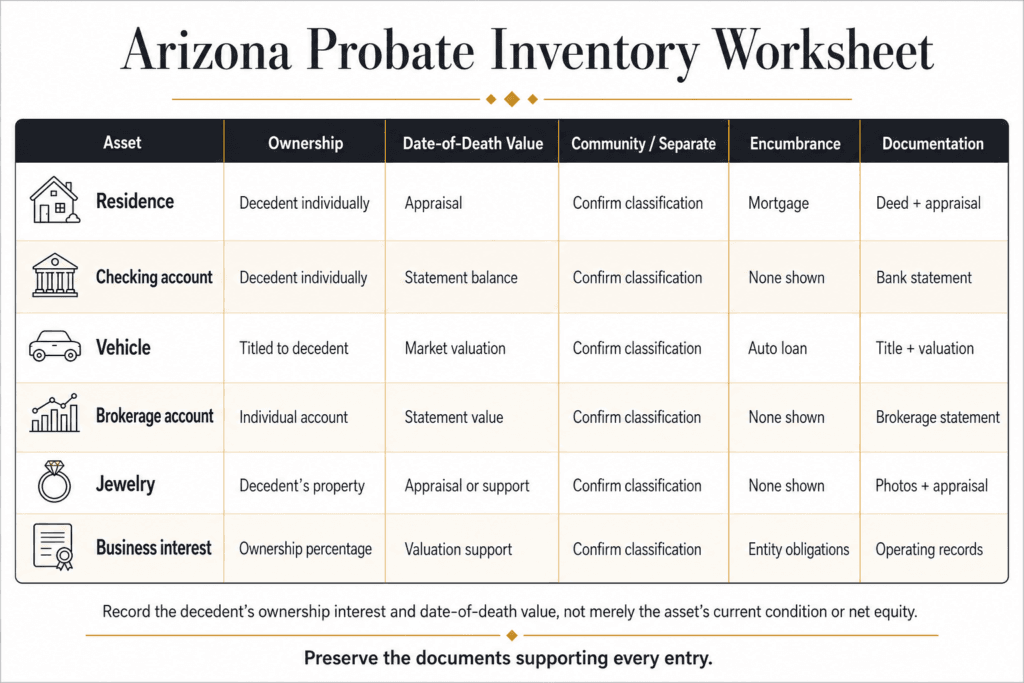
The inventory should generally show the asset’s full fair market value and then list the encumbrance separately.
For example:
- Residence fair market value: $450,000
- Encumbrance: Deed of trust
- Encumbrance amount: $175,000
Listing only the estimated equity of $275,000 does not provide all the information required by the statute.
Do not confuse asset value with estate equity
The asset’s value and the debt against it answer different questions.
The fair market value shows what the asset itself was worth on the date of death.
The encumbrance shows the debt or secured obligation affecting it.
Keeping those figures separate helps interested persons understand:
- Gross asset value
- Secured debt
- Approximate equity
- Estate liquidity
- Possible consequences of a sale
The loan balance does not determine the asset’s fair market value.
Investigate and document the asset and the debt separately.
Decide whether to file the inventory with the court
Arizona gives the personal representative two options under A.R.S. § 14-3706.
Option 1: File the inventory
The personal representative may file the original inventory with the court.
If that option is selected, the representative must send a copy to interested persons who request it.
Option 2: Do not file the inventory
If the personal representative elects not to file the inventory, a copy must be delivered or mailed to:
- Each heir in an intestate estate
- Each devisee when a will has been probated
- Any other interested person who requests it
A devisee is a person or organization named in a will to receive property.
Choosing not to file the inventory does not eliminate the inventory requirement. It changes how the completed document must be distributed and maintained.
Before the deadline, decide which option will be used and preserve records showing:
- Completion date
- Filing date, if applicable
- Delivery or mailing date
- Names and addresses of recipients
- Delivery method
- Requests received
- Copies provided
- Returned mail
The Arizona Judicial Branch probate forms page provides generic forms that may be accepted statewide. Individual courts may use preferred forms or procedures, so review the instructions for the Superior Court handling the estate.
Protect sensitive information
The inventory needs enough information to identify each asset without exposing unnecessary confidential information.
Avoid including complete:
- Social Security numbers
- Bank-account numbers
- Brokerage-account numbers
- Credit-card numbers
- Passwords
- Login credentials
- Digital wallet keys
Use limited identifying digits when they are enough to distinguish one account from another.
Maintain a private supporting worksheet with:
- Complete identifiers
- Institution contact information
- Ownership documents
- Beneficiary records
- Valuation sources
- Appraisal details
- Encumbrance statements
Before filing an inventory or supporting document, review the applicable court rules and county instructions concerning confidential information and redaction.
Preserve the records supporting each value
The personal representative should be able to explain how every material inventory value was determined.
Supporting records may include:
- Date-of-death bank statements
- Brokerage valuations
- Appraisal reports
- Vehicle-value reports
- Real estate records
- Comparable-sales information
- Business financial statements
- Loan statements
- Photographs
- Institution correspondence
- Ownership agreements
- Beneficiary-designation records
Create a supporting file for each major asset.
That file should answer:
- Why is the asset included?
- What interest did the decedent own?
- What date was used for valuation?
- How was fair market value determined?
- What encumbrance existed?
- How was community or separate status determined?
- Who prepared the valuation?
- Where are the supporting documents?
Good documentation makes later sales, distributions, taxes, and accountings easier to explain.
What if another asset is discovered?
Finding another asset after completing the original inventory does not necessarily mean the personal representative did something wrong.
Estate information often arrives gradually.
Later-discovered property may include:
- A tax refund
- An old bank account
- An investment account
- Unclaimed property
- Mineral rights
- A payment owed to the decedent
- A legal claim
- Intellectual property
- A business interest
Arizona requires a supplementary inventory or appraisement when:
- Omitted property comes to the personal representative’s attention
- An original value was erroneous or misleading
- An original description was erroneous or misleading
The supplement must include the new or corrected information, including the date-of-death value and the valuation information relied upon when applicable.
If the original inventory was filed with the court, the supplement must also be filed. If the original was not filed, the representative must provide the supplement or information about it to people interested in the new information.
Arizona Law Note: A.R.S. § 14-3708 establishes the duty to prepare a supplementary inventory when property was omitted or an original description or value was erroneous or misleading.
A later sale price does not automatically make the inventory wrong
An asset may later sell for more or less than its inventory value.
That difference does not automatically mean the date-of-death valuation was incorrect.
The later sales price may reflect:
- Market changes
- Repairs
- Deterioration
- Negotiation
- Urgency
- Commissions
- Carrying costs
- New information
- A different group of buyers
The question is whether the inventory used a reasonable fair market value as of the date of death based on the information available.
The later sale belongs in the estate accounting, together with:
- Gross sales price
- Selling expenses
- Debt payoff
- Net proceeds
- Applicable gain-or-loss information
Supplement the inventory when the original value was erroneous or misleading—not merely because the property later sold for a different amount.
Connect the inventory to the estate accounting
The inventory identifies the estate’s opening assets.
The accounting explains what happened to those assets afterward.
Each inventory item should eventually be traceable to an outcome such as:
- Retained
- Sold
- Collected
- Transferred
- Distributed
- Lost or damaged
- Determined to be nonprobate
- Used to satisfy an obligation
- Corrected through a supplemental inventory
For example, if the inventory lists a bank account, the accounting should show how the estate collected or transferred the balance.
If the inventory lists real estate, the records should show whether the property was:
- Retained
- Sold
- Distributed in kind
- Used to satisfy an estate obligation
A clear connection between the inventory and the accounting reduces questions about missing property and unexplained value changes.
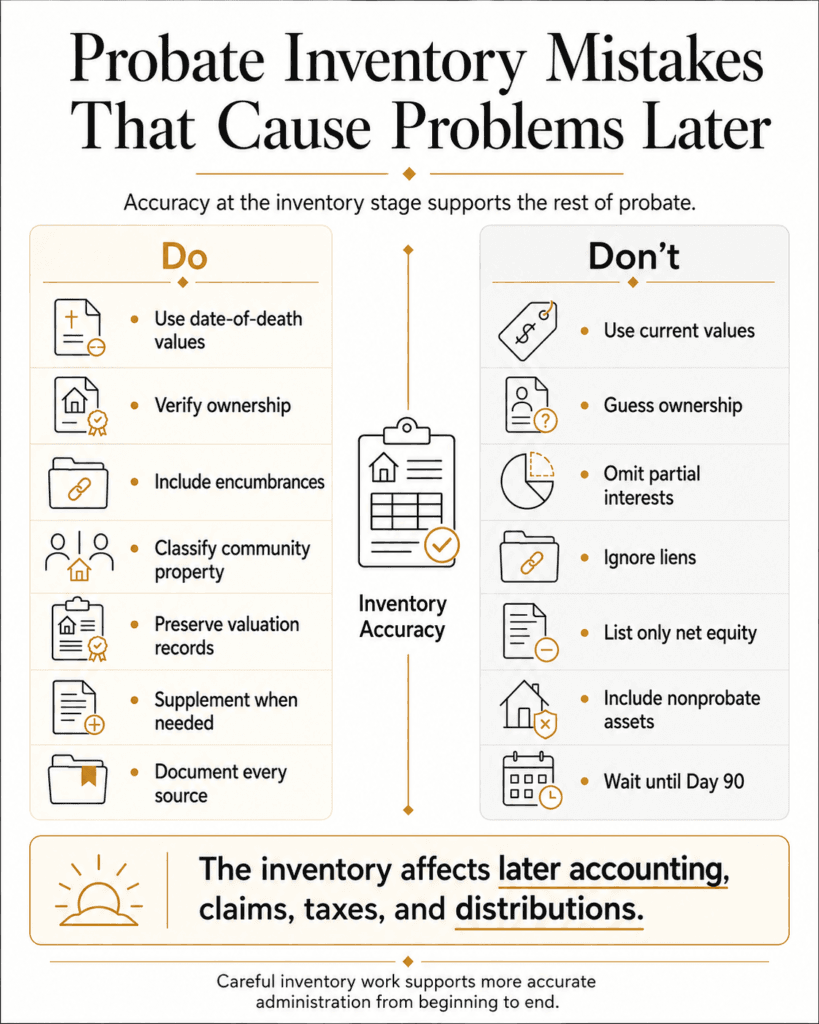
Common Arizona probate inventory mistakes
Common mistakes include:
- Waiting too long to begin
- Missing the 90-day deadline
- Using current values instead of date-of-death values
- Listing nonprobate assets without reviewing ownership
- Omitting partial ownership interests
- Listing an entire jointly owned asset without analysis
- Using vague descriptions
- Listing only net equity
- Failing to disclose liens separately
- Failing to classify property as community or separate
- Relying on unsupported estimates
- Failing to identify an appraiser when required
- Disclosing unnecessary confidential information
- Failing to preserve valuation records
- Failing to supplement the inventory
- Distributing property before ownership and value are established
Another common mistake is assuming that the will determines which assets belong to the probate estate.
It does not.
The will generally governs probate property, but a valid trust, beneficiary designation, payable-on-death arrangement, or survivorship right may control another asset.
Arizona probate inventory checklist
Before completing the inventory, confirm that:
- The appointment date has been identified.
- The 90-day deadline has been calendared.
- Financial, tax, title, and ownership records have been reviewed.
- A broad preliminary asset list has been created.
- Probate and nonprobate property have been distinguished.
- The decedent’s ownership percentage has been determined.
- Each probate asset is described with reasonable detail.
- Every value reflects the date of death.
- The source of each material value has been preserved.
- Community or separate status is identified.
- Mortgages, liens, and encumbrances are listed separately.
- Qualified and disinterested appraisers were used when appropriate.
- Appraiser names and addresses are included when required.
- Sensitive information has been limited.
- The court-filing or private-delivery option has been selected.
- Proof of filing, mailing, or delivery will be preserved.
- Supporting valuation records are organized.
- A process exists for identifying later-discovered assets.
- A supplementary inventory will be prepared when required.
- Every inventory asset can later be traced through the accounting.
Build the foundation for the rest of probate
The Arizona probate inventory is more than an early paperwork requirement.
It establishes the estate’s financial starting point.
A careful inventory helps the personal representative:
- Understand what the estate owns
- Identify ownership questions
- Evaluate liquidity
- Protect assets
- Review creditor needs
- Plan possible sales
- Address tax questions
- Communicate with interested persons
- Prepare the accounting
- Complete distributions
Begin early.
Use date-of-death values. Document the source of every material valuation. List encumbrances separately. Correct the inventory when new or better information becomes available.
Estates involving business interests, substantial real estate, community-property questions, uncertain ownership, valuable collections, unusual investments, or disputed assets may require legal, tax, or appraisal assistance before the inventory is finalized.
Rahnema Law’s Arizona probate FAQs provide additional answers about the larger probate process.
Legal Disclaimer: This information is for educational purposes only and does not constitute legal advice. Arizona probate law is complex and varies based on individual circumstances. Always consult with a qualified probate attorney for guidance specific to your situation.
FAQs
The personal representative generally must prepare the inventory within 90 days after appointment. A special administrator and a successor personal representative whose predecessor already completed the inventory duty are excluded from that statutory requirement.
It must list the decedent’s probate property with reasonable detail and identify each asset’s:
· Fair market value as of the date of death
· Community or separate character
· Type of encumbrance
· Amount of the encumbrance
No. The inventory generally covers probate property owned by the decedent at death. Assets passing through a trust, beneficiary designation, account agreement, or survivorship provision may transfer outside probate.
It depends on the account terms and the decedent’s ownership interest. Some accounts pass to a surviving party or beneficiary. Other accounts, or a portion of them, may belong to the probate estate.
Use fair market value as of the decedent’s date of death. Do not substitute the current value or a later sales price automatically.
No. Arizona allows the personal representative to hire a qualified and disinterested appraiser when an asset’s fair market value is subject to reasonable doubt. An appraisal may be especially useful when the property is valuable, unusual, disputed, partly owned, or expected to be sold.
List the asset’s full fair market value. Then identify the mortgage, deed of trust, lien, or other encumbrance separately, including its type and amount. Do not list only the estimated equity.
Yes. Arizona requires the inventory to indicate whether each listed asset is community or separate property.
Not always. The personal representative may file the inventory and provide copies to interested persons who request it. Alternatively, the representative may elect not to file it and instead deliver or mail copies to the heirs or devisees and other requesting interested persons as required by A.R.S. § 14-3706.
The personal representative must prepare a supplementary inventory or appraisement that includes the newly discovered property and its fair market value as of the date of death.
A supplementary inventory is required when the original value or description was erroneous or misleading.
Not automatically. The inventory uses fair market value as of the date of death. A later sale may reflect different market conditions, repairs, deterioration, costs, or negotiations. The later transaction generally belongs in the estate accounting.
Useful records include:
· Date-of-death account statements
· Brokerage valuations
· Appraisal reports
· Vehicle-value reports
· Title documents
· Loan statements
· Photographs
· Business records
· Ownership agreements
· Institution correspondence