

Learn the Arizona probate process from appointment and creditor notices through inventory, distribution, accounting, and closing.
Probate can feel complicated when you do not know what happens next. Court filings, creditor notices, estate accounts, property transfers, and unfamiliar deadlines may all become part of the process.
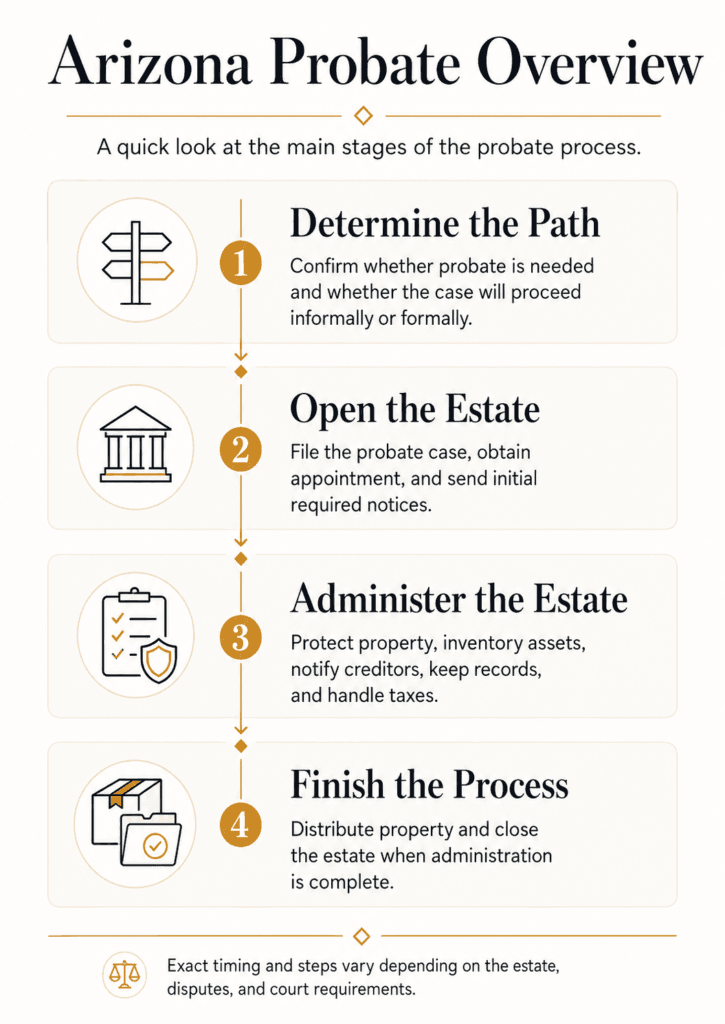
Although every estate is different, most cases follow the same basic path: open the case, appoint a personal representative, identify property and debts, handle claims and taxes, distribute what remains, and close the estate.
You do not need to solve everything at once.
The process is easier to understand when you take it one stage at a time.
The Arizona probate process in 9 steps
Most Arizona probate cases follow this general sequence:
- Determine whether probate is necessary.
- Open the appropriate probate proceeding.
- Obtain appointment and Letters.
- Send the required notices.
- Protect and inventory estate property.
- Address creditors and taxes.
- Manage the estate and keep financial records.
- Distribute property to the proper recipients.
- Complete the closing requirements.
The details can vary. Still, this roadmap helps explain what usually needs to happen before the estate can move forward.
What does probate mean in Arizona?
Probate is the legal process used to handle certain property and obligations after someone dies.
The process may be used to:
- Determine whether a will is valid
- Appoint someone to manage the estate
- Address creditor claims
- Transfer probate property to the people entitled to receive it
Arizona calls the person responsible for administering the probate estate the personal representative. People often use the word executor, but Arizona law uses the broader term personal representative.
The personal representative is a fiduciary. In simple terms, that means the representative must manage the estate for the benefit of the people who have an interest in it, while following the will, Arizona law, and applicable court orders.
Arizona Law Note: A.R.S. § 14-3703 provides that a personal representative is a fiduciary and must settle and distribute the estate as efficiently and promptly as is consistent with the estate’s best interests.
Probate does not necessarily control everything the person owned.
Property in a trust, an account with a surviving beneficiary, or certain jointly owned property may pass outside probate. The probate process generally focuses on assets that do not already have another effective way to transfer.
For a broader overview of probate administration, Rahnema Law explains the process from opening the estate through distribution and closing.
Probate Administration in Arizona — Rahnema Law
Probate with a will vs. probate without a will
An estate is called testate when the person left a valid will.
The will may:
- Name beneficiaries
- Explain how probate property should be distributed
- Nominate someone to serve as personal representative
An estate is called intestate when the person did not leave a valid will. In that situation, Arizona’s intestate succession laws determine who inherits probate property.
Having a will does not automatically avoid probate.
If the person owned probate assets, someone may still need to open a case and obtain authority to transfer them.
Likewise, having no will does not automatically make an estate difficult. An uncontested intestate estate with clear heirs and straightforward property may still qualify for informal appointment.
Informal vs. formal probate in Arizona
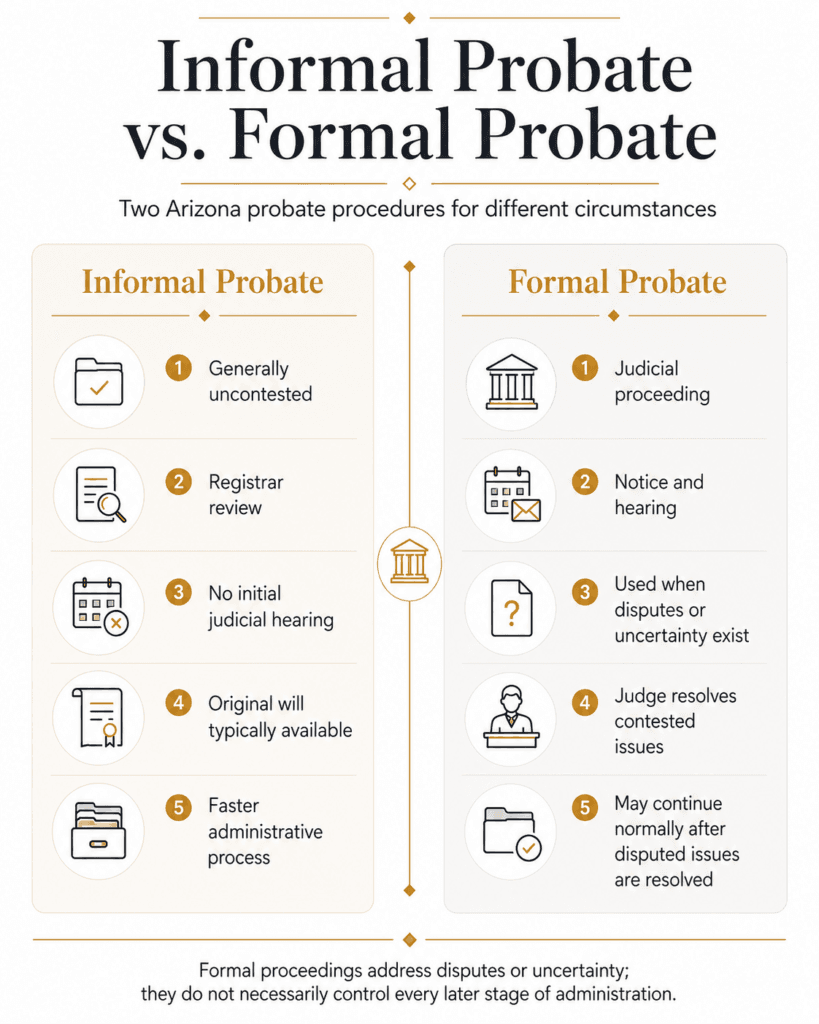
Arizona probate can involve informal or formal proceedings.
The difference is mainly about how the legal issue is handled and whether a judicial decision is required.
Informal probate
Informal probate is generally available when the necessary statutory requirements can be established through an application and the matter does not require a judge to decide a dispute.
The probate registrar reviews matters such as:
- Whether the application is complete
- Whether the applicant may apply
- Whether the filing is in the proper county
- Whether the proposed personal representative has priority to serve
- Whether the required notices were given
- Whether an original, apparently valid will is available when a will is being admitted
When the requirements are satisfied, the registrar may approve informal probate or appointment without a judicial hearing.
Informal does not mean unregulated.
The personal representative must still follow Arizona law, creditor procedures, notice requirements, fiduciary duties, the will, and applicable court orders.
Arizona Law Note: A.R.S. § 14-3303 and A.R.S. § 14-3308 identify findings the registrar must make for informal probate and informal appointment.
Formal probate
Formal probate involves a petition asking the court to enter a judicial order after notice and a hearing.
It may be needed when:
- Family members or other interested people disagree
- The original will is missing
- The heirs are uncertain
- Someone challenges the validity of the will
- There is a dispute over who should serve
- Another issue requires a judge’s decision
A formal proceeding does not necessarily mean the entire estate will be heavily contested.
Sometimes the court only needs to resolve one issue before the rest of the administration can continue.
Formal probate is also different from supervised administration. A formal proceeding asks the court to decide a particular issue. Supervised administration places the estate under continuing court authority during administration.
Arizona Law Note: A.R.S. § 14-3401 and A.R.S. § 14-3402 address formal testacy and appointment proceedings, including petitions requesting a judicial order after notice and hearing.
Step 1: Determine whether probate is actually needed
Before opening a case, identify what the person owned and how each asset transfers after death.
Some property may already have another transfer method, such as:
- A trust
- A beneficiary designation
- Survivorship rights
- A beneficiary deed
- An Arizona small-estate procedure
One estate can contain both probate and nonprobate property.
That is why the question should be answered asset by asset, not by looking only at the will or the estate’s total value.
Step 2: Open the probate case
If probate is needed, the process begins by filing an application or petition in the appropriate Arizona Superior Court.
The filing generally includes information about:
- The person who died
- The date and place of death
- The heirs
- Beneficiaries named in the will
- The person seeking appointment
- That person’s priority to serve
- Whether the person died with or without a will
If there is a will, the original will is ordinarily submitted to the court.
If there is no will, the filing may ask the registrar or court to recognize that the person died intestate and appoint a personal representative.
The Arizona Judicial Branch provides probate forms and resources. Its forms are generic and may be accepted statewide, but individual courts may have their own preferred forms or procedures.
Step 3: Obtain appointment and Letters
Filing a probate case does not automatically give the applicant authority to manage the estate.
The person must be appointed, complete the required qualification and acceptance process, and receive Letters before beginning estate administration.
The court then issues Letters of Personal Representative, commonly called Letters.
Letters provide official evidence of the appointment and the personal representative’s authority to act for the estate.
Banks, title companies, insurance companies, government agencies, and other institutions may ask for a certified copy before allowing the representative to act.
After appointment, the personal representative may be able to:
- Collect estate property
- Communicate with financial institutions
- Open an estate bank account
- Protect and insure property
- Manage or sell assets when appropriate
- Address creditor claims
- Complete property transfers
But Letters are not a blank check.
The representative must still follow the will, Arizona law, fiduciary duties, court orders, and the rights of creditors and beneficiaries.
Rahnema Law has a separate guide explaining what Letters mean and why institutions may require them.
Letters of Appointment in Arizona Probate — Rahnema Law
Step 4: Send the required notices
Appointment triggers important notice requirements.
A personal representative, other than a special administrator, generally must send information about the appointment to heirs and devisees within 30 days after appointment.
A devisee is a person or entity named in a will to receive property.
The notice generally includes:
- The personal representative’s name and address
- The court where the estate papers are filed
- Whether a bond has been filed
- Information showing that the recipient has or may have an interest in the estate
Arizona Law Note: A.R.S. § 14-3705 establishes the general 30-day requirement for providing appointment information to heirs and devisees.
What if the will was admitted through informal probate?
The applicant generally must also send heirs and devisees information about the admission of the will, together with a copy of the will, within 30 days.
A recipient who receives that information generally has four months from receipt to begin a formal proceeding contesting the informal probate. A separate rule applies to a later-discovered will.
Arizona Law Note: A.R.S. § 14-3306 addresses notice after informal probate and the four months following receipt of the required information.
Keep copies of notices and proof that they were sent.
Step 5: Protect and organize estate property
After appointment, the personal representative should take reasonable steps to protect property that must be administered.
That may include:
- Securing real estate
- Reviewing insurance
- Collecting mail
- Locating financial accounts
- Protecting valuable belongings
- Redirecting estate income
- Maintaining necessary utilities
The representative should also create a recordkeeping system immediately.
Keep:
- Bank statements
- Invoices
- Receipts
- Appraisals
- Correspondence
- Tax records
- Sale documents
- Deposit records
- Payment confirmations
- Distribution receipts
Estate money and personal money should not be mixed.
Good records matter because the representative may later need to explain every dollar that entered or left the estate.
Step 6: Prepare the Arizona probate inventory
The personal representative generally must prepare an inventory within 90 days after appointment.
The inventory identifies property the decedent owned at death and must include, for each listed item:
- A reasonable description
- Fair market value as of the date of death
- Whether it is community or separate property
- The type and amount of any mortgage, lien, or other encumbrance
The inventory may include:
- Real estate
- Bank accounts
- Investment accounts
- Vehicles
- Business interests
- Personal belongings
- Money owed to the decedent
- Tax refunds
- Digital assets
- Other probate property
Arizona Law Note: A.R.S. § 14-3706 requires the inventory within 90 days after appointment and identifies the information it must contain.
The personal representative may file the original inventory with the court and send a copy to interested persons who request it. If the inventory is not filed, the representative must deliver or mail a copy to each heir in an intestate estate, or to each devisee if a will has been probated, and to any other interested person who requests it.
Alternatively, the representative may elect not to file it. In that case, the statute requires the inventory to be delivered or mailed to the heirs in an intestate estate, or the devisees when a will has been probated, as well as other interested persons who request it.
What if another asset is discovered later?
Prepare a supplemental inventory when:
- Property was left out of the original inventory, or
- An important value or description was wrong or misleading
Arizona Law Note: A.R.S. § 14-3708 addresses supplemental inventories and appraisals.
Step 7: Give notice to creditors
Creditor administration is a major part of the Arizona probate process.
Unless notice has already been given, the personal representative generally must publish notice to creditors once a week for three successive weeks in a newspaper of general circulation in the county.
The notice tells creditors to present claims within four months after the first publication.
Known creditors must also receive written notice.
For a known creditor, the notice generally gives the later of:
- Four months after the first publication, or
- 60 days after written notice is mailed or delivered
Arizona Law Note: A.R.S. § 14-3801 establishes the published and direct creditor-notice requirements.
The personal representative should look for possible obligations in:
- Account statements
- Tax records
- Medical bills
- Loan documents
- Pending lawsuits
- Business records
- Other evidence of debt
A claim does not automatically need to be paid simply because someone submits it.
The representative should determine whether it is timely, properly presented, documented, enforceable, already paid, covered by insurance, secured by property, or subject to an objection.
Arizona law also contains additional limits on when claims may be presented.
A.R.S. § 14-3803 — Arizona Legislature
Can the personal representative reject a claim?
A timely presented claim may be disallowed in whole or in part.
After notice of disallowance is mailed, the claimant generally has 60 days to petition the court for allowance or begin a proceeding against the personal representative.
Arizona Law Note: A.R.S. § 14-3806 addresses allowance and disallowance of claims.
This is one reason not to distribute estate property too soon.
The estate may still need money for claims, administration expenses, taxes, statutory allowances, and other obligations.
Step 8: Manage the estate
Probate often lasts several months or longer.
During that time, the personal representative may need to:
- Maintain real estate
- Pay necessary expenses
- Collect income
- Resolve insurance claims
- Sell property
- Manage investments
- Handle contracts
- Operate or close a business
- Communicate with beneficiaries
Arizona law gives personal representatives authority to complete many transactions when they act reasonably for the benefit of interested persons, subject to the will, statutory rules, applicable priorities, and court orders.
Arizona Law Note: A.R.S. § 14-3715 identifies many transactions a personal representative may undertake while administering an estate.
Some decisions deserve extra care.
Selling a home, continuing a business, borrowing money, making an early distribution, or settling a disputed claim may affect creditors and multiple beneficiaries.
Keep an accounting throughout probate
The personal representative should always be able to explain:
- What property entered the estate
- What money came in
- What expenses and claims were paid
- What assets were sold
- What property was distributed
- What remains in the estate
Think of the accounting as the estate’s financial story from beginning to end.
Start with the inventory. Then record every transaction that follows.
The ending balance should match the money and property still held by the estate.
Address tax matters
Probate can also involve tax responsibilities.
Depending on the estate, the personal representative may need to address:
- The decedent’s final individual income tax return
- An estate income tax return
- Property taxes
- Business tax obligations
- Other federal or Arizona filings
An estate may also need its own Employer Identification Number (EIN) even though it has no employees.
The IRS directs executors and administrators to use Form SS-4 to apply for an EIN for a decedent’s estate and identifies Publication 559 as a resource for personal representatives.
Tax obligations depend on the estate’s assets, income, transactions, deductions, and beneficiaries. Individual tax advice may be appropriate before final distribution.
Step 9: Distribute property
Distribution generally comes after the personal representative has:
- Identified the proper recipients
- Addressed claims or reserved enough property for them
- Paid administration expenses
- Addressed tax obligations
- Completed necessary sales or transfers
- Determined that the estate can safely distribute property
A valid will controls probate property when it applies.
If the will does not effectively dispose of property, Arizona intestate succession law may determine who receives it.
Some property can be transferred directly.
Other assets, such as real estate, vehicles, securities, or business interests, may require deeds, titles, assignments, or other transfer documents.
Keep a written record of every distribution, including:
- What was transferred
- Its value
- The transfer date
- Who received it
Partial distributions may sometimes be appropriate. But the estate must retain enough property to cover its remaining obligations.
Do not empty the estate before you know what is still owed.
Close the Arizona probate estate
Once administration is complete, the estate can move toward closing.
Before closing, confirm that:
- Estate property has been collected and transferred.
- The applicable creditor period has expired.
- Claims and administration expenses have been addressed.
- Tax matters have been handled, or adequate funds have been reserved.
- Required distributions are complete.
- The affected recipients received the accounting.
- Estate records are complete.
In a qualifying unsupervised estate, the personal representative may close the case by filing a verified closing statement.
The statement cannot be filed earlier than four months after the original appointment of a general personal representative.
Among other requirements, it confirms that the estate has been administered, the creditor-claim period has expired, claims and expenses have been addressed, assets have been distributed, the required accounting has been provided, and copies of the statement have been sent to the required recipients.
If no proceeding involving the personal representative is pending, the appointment generally ends one year after the closing statement is filed.
Arizona Law Note: A.R.S. § 14-3933 establishes the requirements for closing a qualifying unsupervised estate by verified statement.
A formal closing may be appropriate when court approval is needed or desired, including when disputes or unresolved issues remain.
How long does the Arizona probate process take?
There is no single timeline for every estate.
Arizona’s creditor procedures and closing rules create minimum timing requirements, but they do not mean probate will be finished in four months.
Probate can take longer because of:
- A missing or disputed will
- Difficulty locating heirs or beneficiaries
- Real estate that must be repaired or sold
- Complicated valuations
- Business interests
- Creditor disputes
- Tax issues
- Litigation
- Family disagreements
- A beneficiary who is a minor or incapacitated
- Property in another state
- Missing or incomplete records
- Missed notices or deadlines
The personal representative cannot control every delay.
But careful organization can prevent many avoidable ones.
Important Arizona probate deadlines
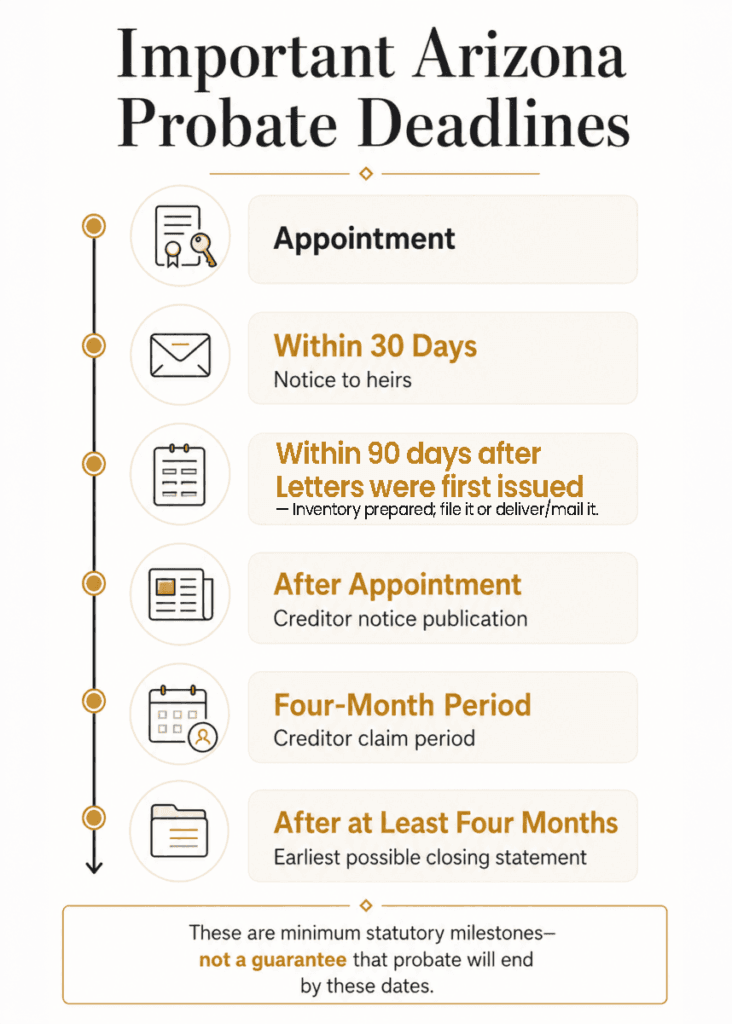
Several deadlines appear repeatedly during the process:
Within 30 days after appointment: Appointment information generally must be sent to heirs and devisees.
Within 30 days after informal probate of a will: The applicant generally must send heirs and devisees information about the probate and a copy of the will.
Within 90 days after appointment: The personal representative generally must prepare the estate inventory.
Once a week for three successive weeks: Notice to creditors generally must be published.
Four months after the first publication: The general published creditor-claim period expires, subject to applicable statutes and exceptions.
Later of the published period or 60 days after direct notice: This is the general period stated in notice to a known creditor.
No earlier than four months after original appointment: A verified closing statement may be filed in a qualifying unsupervised estate.
These are not the only deadlines that may apply.
Will contests, rejected creditor claims, tax filings, formal proceedings, and court orders may have separate deadlines.
What should a personal representative expect?
Serving as personal representative involves much more than handing out property.
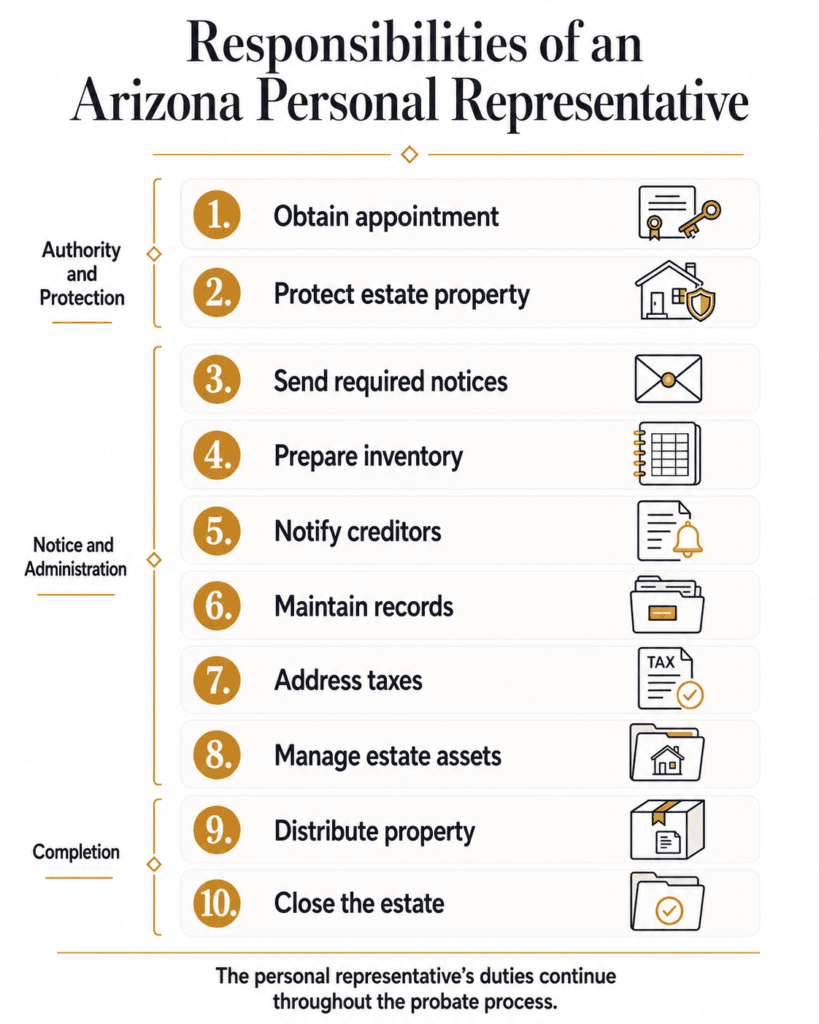
The job may require you to:
- Gather information
- Protect property
- Communicate with heirs and beneficiaries
- Track deadlines
- Maintain financial records
- Address creditors
- Handle taxes
- Make decisions affecting the estate
- Complete transfers
- Close the administration
The process usually makes more sense when you follow the stages in order:
Authority → notice → property → creditors → records → distribution → closing.
Trying to skip ahead can create problems.
For example, distributing property before claims and taxes are resolved may leave the estate without enough assets to pay what it owes.
Move through probate one stage at a time
The Arizona probate process is easier to understand when you stop viewing it as one enormous legal task.
At the beginning, focus on authority, notice, and protecting property.
In the middle, focus on inventory, creditors, management, records, and taxes.
At the end, focus on accounting, distribution, and closing.
The question at each stage is simple:
What needs to be finished before the estate can safely move to the next step?
Estates involving contested wills, blended families, substantial debt, businesses, missing beneficiaries, unclear ownership, or litigation may require individual legal guidance.
Even in an uncontested estate, guidance from an Arizona probate attorney may help the personal representative understand the applicable requirements and avoid mistakes that delay closing.
For additional plain-English answers about probate, Rahnema Law maintains an Arizona Probate FAQ.
Legal Disclaimer: This information is for educational purposes only and does not constitute legal advice. Arizona probate law is complex and varies based on individual circumstances. Always consult with a qualified probate attorney for guidance specific to your situation.
FAQs
The general steps are to determine whether probate is necessary, open the proceeding, obtain appointment and Letters, send required notices, protect and inventory property, address creditors and taxes, maintain an accounting, distribute property, and close the estate.
Informal probate generally uses an application reviewed by the probate registrar and may proceed without a judicial hearing when the statutory requirements are met. Formal probate involves a petition asking the court to enter a judicial order after notice and a hearing.
No. A formal proceeding asks the court to decide a particular probate or appointment issue. Supervised administration places the estate under continuing court authority during administration until distribution and discharge or another order ends the proceeding.
Filing an application or petition alone does not provide authority. The person must be appointed, complete the required qualification and acceptance process, and receive Letters before beginning estate administration. In an informal proceeding, the status, powers, and duties of the office become established through appointment.
Letters are official court documents showing the fiduciary appointment. Banks, title companies, government agencies, and other organizations may request a certified copy before allowing the personal representative to act for the estate.
Appointment information generally must be sent to heirs and devisees within 30 days after appointment. When a will is admitted through informal probate, additional information and a copy of the will generally must also be sent within 30 days.
The personal representative generally must prepare the inventory within 90 days after appointment. The inventory includes the property, date-of-death value, community or separate character, and applicable encumbrances.
These are general notice periods, and additional claim limitations or exceptions can apply. The personal representative generally publishes notice once a week for three successive weeks. The published notice gives creditors four months from the first publication to present claims. Known creditors receive direct notice and generally receive the later of the published period or 60 days after the notice is mailed or delivered.
An early distribution can leave the estate without enough property to pay claims, taxes, expenses, or statutory allowances. Partial distributions may sometimes be appropriate, but only after considering the estate’s remaining obligations.
A qualifying unsupervised estate may be closed through a verified closing statement after administration is complete. The statement generally cannot be filed earlier than four months after the original appointment and must address the statutory closing requirements, including claims, expenses, distributions, notices, and accounting.
There is no single timeline. Creditor and closing rules create minimum timing requirements, but real estate sales, disputes, taxes, litigation, missing beneficiaries, and incomplete records can make the process take longer.