

Learn how Arizona probate taxes work, including final returns, estate income, EINs, Forms 1041 and 141AZ, K-1s, sales, and reserves.
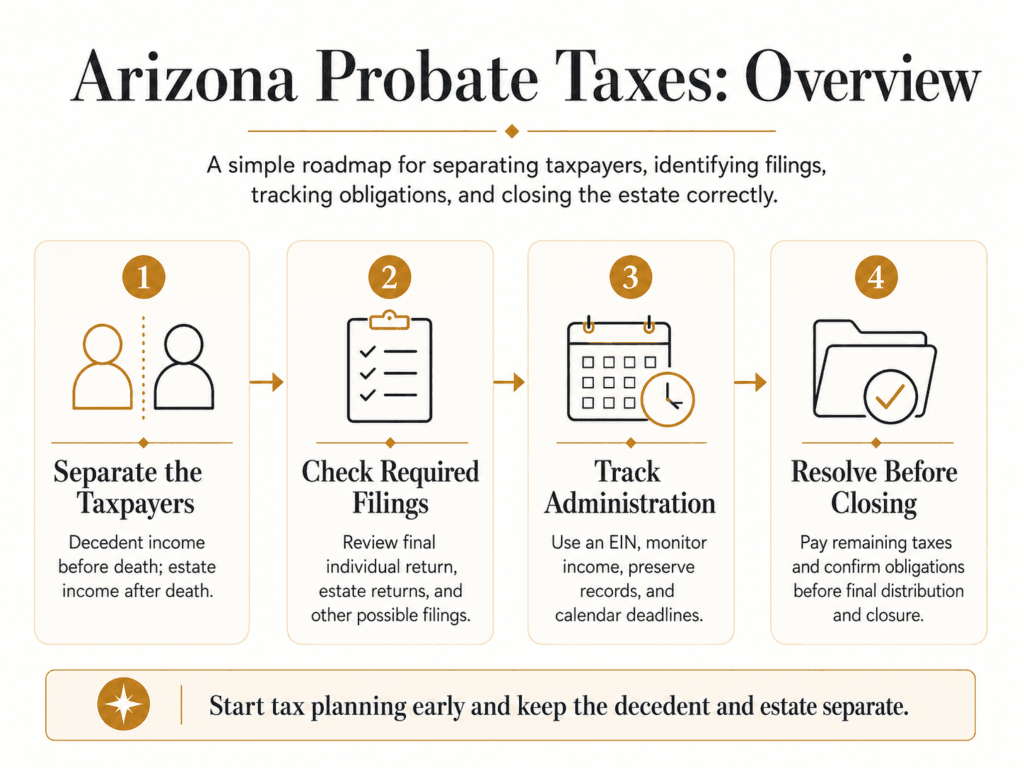
Arizona probate taxes may involve several different returns, taxpayers, deadlines, and sources of income. The personal representative may need to address the decedent’s final tax returns, income earned by the estate, property sales, beneficiary tax documents, and possible federal estate-tax reporting.
The work should begin early.
Waiting until the estate is ready to close can lead to:
- Missed filing deadlines
- Incorrect tax documents
- Unexpected liabilities
- Delayed distributions
- An estate account without enough money to finish the work
The personal representative does not need to become a tax expert. However, the representative should identify possible filings, preserve reliable records, and seek qualified tax help when the estate’s income, ownership, transactions, or beneficiaries create uncertainty.
The decedent and the estate are separate taxpayers
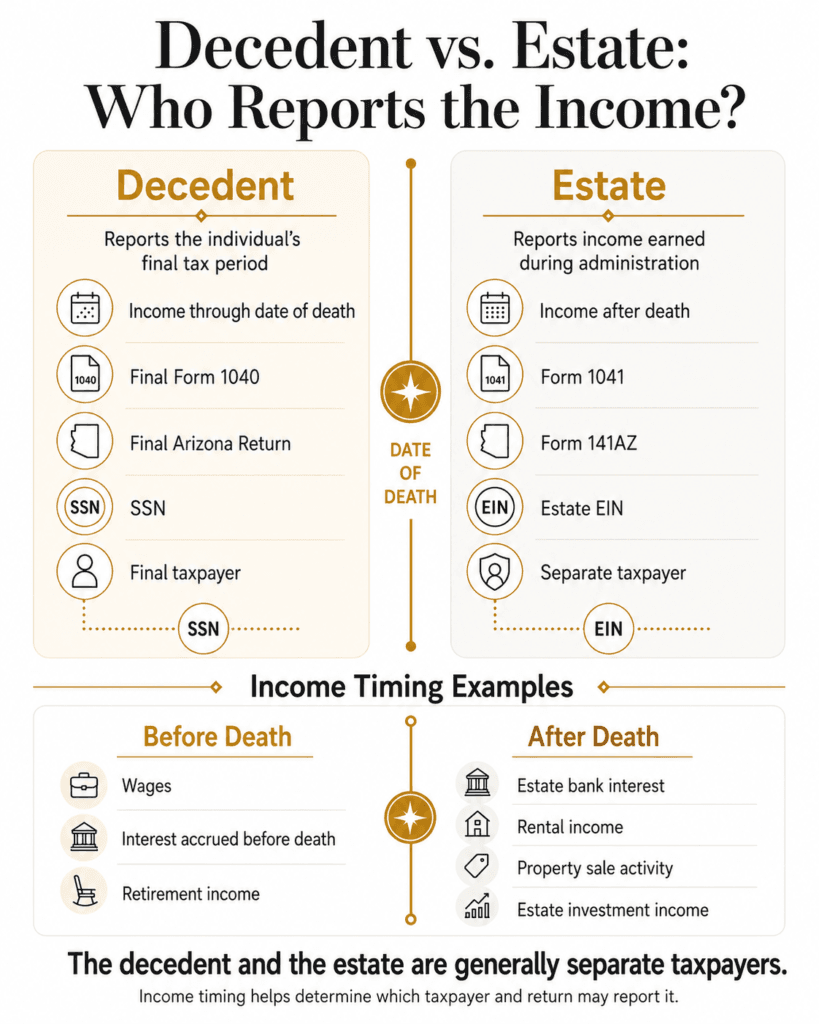
A central Arizona probate tax concept is that the decedent and the probate estate are generally separate taxpayers.
The decedent’s final individual income-tax return covers the applicable period ending on the date of death.
The estate’s fiduciary income-tax return covers income, gains, losses, deductions, and distributions arising during administration.
For example:
- Interest attributable to the period before death may belong on the decedent’s final return.
- Interest earned later in the estate account may belong on the estate’s return.
- Rent earned before death may receive different treatment from rent earned while the estate owns the property.
- A delayed payment earned by the decedent may be income in respect of a decedent.
Do not place every tax document on one return merely because the estate eventually received the money.
The IRS’s Publication 559 explains the federal tax responsibilities of personal representatives, including final returns, estate income, beneficiaries, and property received after death.
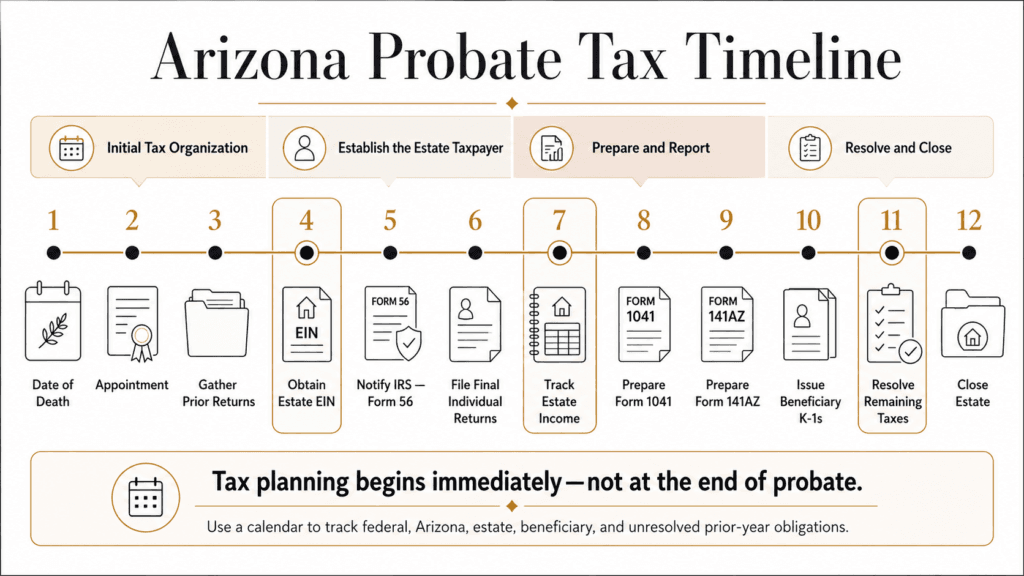
Create an Arizona probate tax calendar
Soon after appointment, create a calendar containing:
- Date of death
- Decedent’s prior filing history
- Due date for the final federal return
- Due date for the final Arizona return
- Estate tax-year ending date
- Federal Form 1041 deadline
- Arizona Form 141AZ deadline
- Estimated-tax dates, when applicable
- Property-sale dates
- Beneficiary distribution dates
- Schedule K-1 delivery
- Any possible Form 706 deadline
- Extension requests
- Response dates for tax notices
The decedent’s final federal income-tax return generally follows the same filing deadline that would have applied if the person had remained alive.
For a calendar-year taxpayer, the final return is generally due on the ordinary individual filing date following the year of death. Weekends, holidays, extensions, disaster relief, and changes in tax law can affect the exact deadline.
An estate using a fiscal year generally files Form 1041 by the fifteenth day of the fourth month after that tax year ends.
Always confirm deadlines for the actual tax year.
Gather prior tax records
Collect the decedent’s recent federal, state, business, and property-tax records.
Useful documents may include:
- Prior Forms 1040
- Prior Arizona income-tax returns
- Forms W-2 and 1099
- Brokerage tax statements
- Retirement-account statements
- Partnership and S corporation Schedules K-1
- Rental-property records
- Business returns
- Estimated-tax payment confirmations
- Property-tax statements
- Depreciation schedules
- Capital-loss carryforward records
- IRS correspondence
- Arizona Department of Revenue correspondence
- Audit or installment-agreement records
Prior returns can reveal:
- Financial accounts
- Business interests
- Rental properties
- Income sources
- Carryforwards
- Unpaid tax balances
- Returns that were never filed
If the decedent failed to file a prior-year return, the obligation may continue after death. The personal representative may need to address those returns in addition to the final return for the year of death.
File the decedent’s final federal income-tax return
The decedent’s final federal return is generally prepared much like an ordinary individual return.
It may include income attributable to the decedent through the date of death, such as:
- Wages
- Retirement income
- Taxable Social Security benefits
- Interest
- Dividends
- Business income
- Rental income
- Capital gains or losses
- Other pre-death income
The authorized filer should follow the IRS instructions for identifying the taxpayer as deceased and signing the return.
The final return generally is due when the decedent’s return would have been due if death had not occurred. The personal representative may request an extension when appropriate.
Coordinate with a surviving spouse
A surviving spouse may be eligible to file a joint federal return for the year of death.
The spouse and personal representative should coordinate before filing because the correct procedure may depend on:
- Whether a court-appointed representative exists
- Filing status
- Community income
- Refund rights
- Deductions
- Outstanding liabilities
- Who has authority to sign
Avoid filing inconsistent returns or reporting the same income twice.
Arizona community-property principles may also affect the allocation of income, deductions, basis, and tax responsibility. Tax guidance may be especially useful when the decedent was married, operated a business, or held substantial jointly owned property.
File the decedent’s final Arizona income-tax return
A final Arizona individual income-tax return may also be required.
The Arizona return should be coordinated with the federal return so that both address consistently:
- Filing status
- Date of death
- Income period
- Community-property allocation
- Deductions
- Payments
- Refunds
The Arizona Department of Revenue provides specific instructions for filing for a deceased taxpayer.
A federal return does not replace a required Arizona return.
Claim an Arizona refund correctly
Arizona Form 131 is used to claim an Arizona income-tax refund on behalf of a deceased taxpayer.
Depending on the claimant, the form may require proof of authority.
A court-appointed personal representative is generally instructed to include a court certificate showing the appointment. A copy of the will alone does not establish court appointment for this purpose.
The current form and instructions are available on the Arizona Department of Revenue’s Form 131 page.
Preserve:
- Final Arizona return
- Form 131
- Proof of appointment
- Refund correspondence
- Deposit or check record
- Calculation showing who is entitled to the refund
A refund received after death is not automatically unrestricted estate money. Filing status, community-property rights, prior payments, and the source of the overpayment may affect ownership.
Separate income earned before and after death
A financial institution may issue one Form 1099 covering the entire calendar year, even though the taxpayer died during that year.
The document may combine:
- Income attributable to the decedent
- Income earned by the estate
- Income belonging to a surviving owner
- Income belonging to a designated beneficiary
Review:
- Payment and accrual dates
- Account ownership
- Date the account was retitled
- Taxpayer identification number used
- Whether the institution should issue a corrected document
Do not report an entire information statement under the decedent’s Social Security number without determining who earned the income and when.
Understand income in respect of a decedent
Some income received after death comes from a right the decedent had before death but that was not properly included on the final return.
This is called income in respect of a decedent, often shortened to IRD.
Examples may include:
- Unpaid wages
- Certain retirement-plan distributions
- Deferred compensation
- Accrued interest
- Installment-sale payments
- Commissions
- Other rights to income
IRD is generally reported by the estate, beneficiary, or other person who receives the income or the right to receive it.
Its tax character generally remains the same as it would have been in the decedent’s hands.
An amount does not become tax-free merely because the payment arrived after death.
Obtain an EIN for the estate
A probate estate commonly needs a federal employer identification number, or EIN.
The name can be confusing. An estate does not need employees to require an EIN.
The estate may use its EIN to:
- Open an estate bank account
- File Form 1041
- Report post-death income
- Provide tax information to institutions
- Identify the estate on federal filings
The estate should not use the personal representative’s Social Security number as its taxpayer identification number.
The IRS instructs executors to use Form SS-4 to apply for an estate EIN. Qualifying applicants can obtain one directly from the IRS without paying a fee. See the IRS’s information for executors and EIN application page.
Preserve the EIN confirmation with the estate’s permanent records.
Update banks and other payors
After obtaining the EIN, contact institutions that will issue post-death tax documents.
These may include:
- Banks
- Brokerage firms
- Property managers
- Business entities
- Tenants
- Employers
- Other payors
Confirm:
- Estate’s legal name
- EIN
- Fiduciary mailing address
- Date the estate became entitled to the account or income
- Whether separate pre-death and post-death records can be issued
- Whether corrected Forms 1099 are needed
Failing to update taxpayer information can cause estate income to remain reported under the decedent’s Social Security number.
That can lead to mismatched returns and tax notices.
Notify the IRS of the fiduciary relationship
IRS Form 56 notifies the IRS that a fiduciary relationship has been created or terminated.
Depending on the representative’s responsibilities, notices may be needed for the decedent, the estate, or both.
Form 56 does not replace:
- The final Form 1040
- Form 1041
- Form 706
- A tax return extension
- A response to an IRS notice
- A power of attorney when separately required
The current form and instructions are available through the IRS’s Form 56 page.
A successor personal representative should also review whether the IRS needs an updated notice.
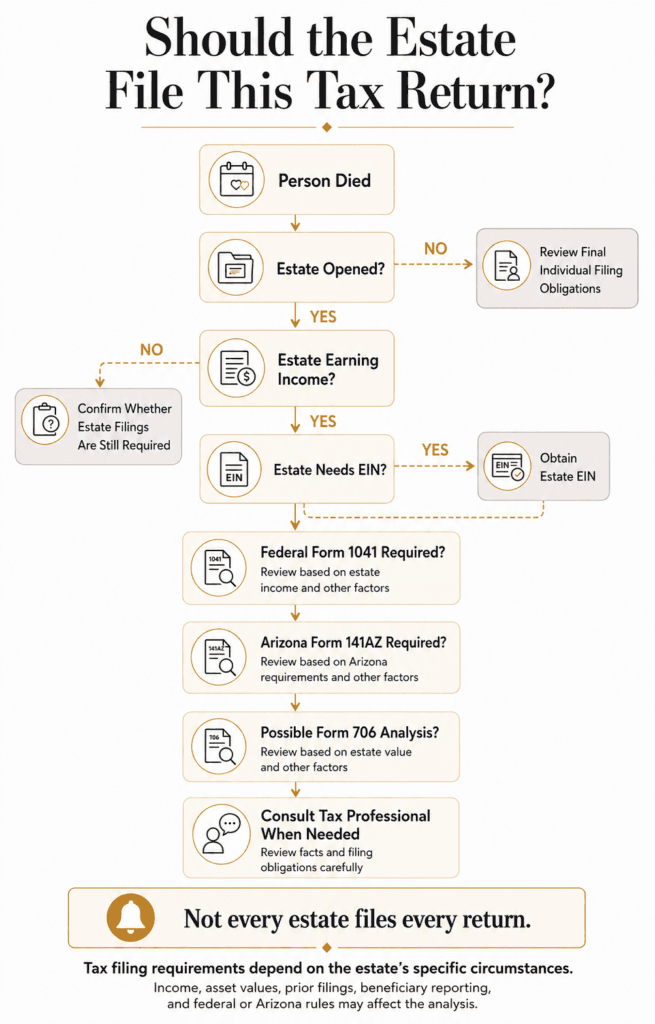
Determine whether federal Form 1041 is required
A domestic decedent’s estate generally must file Form 1041 when it has one of the common filing triggers below, or another filing trigger in the instructions for that tax year, such as certain qualified-opportunity-fund reporting:
- Gross income of at least $600 during the tax year, or
- A beneficiary who is a nonresident alien
Other specialized filing rules may apply.
Potential estate income includes:
- Bank interest
- Dividends
- Rental income
- Business income
- Capital gains
- IRD
- Other taxable post-death receipts
Gross income is not the money left after expenses.
An estate may have a filing requirement even when deductions or distributions reduce its taxable income.
The current form and instructions are available through the IRS’s Form 1041 page.
Do not confuse estate principal with income
Property entering the estate because the decedent owned it at death is generally estate principal, not newly earned income.
For example, transferring $80,000 from the decedent’s probate account into an estate account does not ordinarily create $80,000 of new estate income.
Interest earned afterward may be income.
Similarly:
- Gross sales proceeds are not automatically taxable gain.
- A beneficiary distribution is not automatically deductible in full.
- Paying a creditor does not automatically create an income-tax deduction.
- Every probate expense is not automatically deductible on Form 1041.
- Appreciation after death may create gain when property is sold.
The probate accounting and tax return should be coordinated, but they answer different questions.
Choose the estate’s tax year carefully
An estate may generally use a calendar year or a qualifying fiscal year.
A calendar year ends on December 31.
A fiscal year may end on the last day of another permitted month. The first estate tax year cannot exceed 12 months.
The personal representative selects the accounting period when filing the first Form 1041.
The choice may affect:
- Filing deadlines
- Timing of deductions
- Timing of distributions
- Schedule K-1 reporting
- Administration planning
- Period covered by the first return
For a fiscal-year estate, Form 1041 is generally due by the fifteenth day of the fourth month after the tax year ends.
Review the choice before filing the first return because it establishes the estate’s tax-reporting pattern.
Determine whether Arizona Form 141AZ is required
Arizona uses Form 141AZ for fiduciary income-tax reporting by qualifying estates and trusts.
An estate generally files Form 141AZ when it has:
- Any Arizona taxable income for the year, or
- Gross income of $5,000 or more, regardless of its Arizona taxable income
The Arizona threshold differs from the federal Form 1041 threshold.
An estate may therefore have:
- A federal filing requirement but no Arizona filing requirement
- An Arizona filing requirement but no federal requirement
- Both requirements
- Neither requirement
Review the instructions for the actual tax year because forms, filing systems, due dates, and extension procedures may change.
Current forms are available through the Arizona Department of Revenue’s Form 141AZ page.
Track income and deductions throughout administration
Create separate accounting categories for:
- Interest
- Dividends
- Rent
- Business income
- Capital gains and losses
- IRD
- Tax refunds
- Fiduciary fees
- Legal fees
- Accounting fees
- Property expenses
- Beneficiary distributions
- Estimated-tax payments
- Federal tax payments
- Arizona tax payments
For each item, preserve:
- Date
- Source or payee
- Gross amount
- Taxpayer identification number used
- Estate-account entry
- Supporting statement
- Related beneficiary or property
- Tax treatment provided by the preparer
Do not wait until a return is due to reconstruct a year of transactions from bank statements.
Rahnema Law’s probate administration overview explains how taxes fit with the inventory, estate account, creditor work, distributions, and closing.
Preserve date-of-death values and basis records
Date-of-death values can matter for both probate and tax reporting.
Inherited property generally receives a basis connected to fair market value at death. However, alternate valuation, IRD, community-property rules, jointly owned property, and other exceptions may change the result.
Preserve:
- Real estate appraisals
- Brokerage date-of-death statements
- Vehicle valuations
- Business valuations
- Ownership-percentage records
- Debt and lien information
- Capital-improvement records
- Depreciation schedules
- Selling expenses
- Settlement statements
The probate inventory value and income-tax basis may be related. Do not assume they are always identical.
Beneficiaries may need those records years after probate ends.
Rahnema Law’s Arizona probate inventory guide explains the importance of identifying probate assets and preserving their date-of-death values.
Report property sales correctly
An estate may sell:
- Real estate
- Stocks and other securities
- Vehicles
- Business interests
- Cryptocurrency
- Collectibles
- Other property
The taxable gain or loss is not normally calculated by treating the entire sales price as income.
The calculation may involve:
- Adjusted basis
- Selling commissions
- Closing expenses
- Capital improvements
- Depreciation
- Post-death market changes
- Ownership percentage
- Character and use of the property
For example, a home sold near its supported date-of-death value may produce little taxable gain. Selling expenses may affect the final calculation.
Preserve:
- Appraisal
- Purchase agreement
- Settlement statement
- Commission record
- Repair invoices
- Basis calculation
- Forms reporting the sale
Do not distribute all sales proceeds before the likely tax consequences are understood.
Coordinate the sale with the estate accounting
The probate accounting may show:
Opening property → gross sales price → selling costs → debt payoff → net estate proceeds
The tax calculation may show:
Gross sales price → adjusted basis → allowable adjustments → taxable gain or loss
Those calculations serve different purposes.
A $400,000 deposit into the estate account does not prove the estate earned $400,000 of taxable income.
Give the tax preparer the complete transaction file, not only the net bank deposit.
Prepare beneficiary Schedules K-1 when required
An estate may pay tax itself, or taxable income may pass to beneficiaries through estate distributions.
Schedule K-1 for Form 1041 reports a beneficiary’s share of estate income, deductions, credits, and related tax items.
The personal representative must generally prepare a Schedule K-1 for each affected beneficiary and provide it by the date Form 1041 is filed.
A beneficiary may receive a $100,000 distribution without having $100,000 of taxable income.
The distribution may contain:
- Estate principal
- Taxable income
- Both principal and income
The Schedule K-1 reports relevant tax items. It does not necessarily report the full value distributed.
Arizona fiduciary reporting may also require state beneficiary schedules when Arizona adjustments pass through to beneficiaries.
Communicate tax-document timing to beneficiaries
Beneficiaries may want to file their personal returns before the estate completes its Form 1041.
The personal representative should explain:
- Whether a Schedule K-1 is expected
- Whether the estate uses a calendar or fiscal year
- When the return is expected to be prepared
- Whether an extension may be needed
- Whether an amended return could produce a corrected K-1
Do not tell a beneficiary that no tax document will be issued until the estate’s income and distribution reporting has been reviewed.
Each beneficiary should obtain individual tax advice regarding the K-1 and any state filing obligations.
Estate income tax and federal estate tax are different
Estate income tax
Estate income tax applies to income, gains, deductions, and distributions during administration.
Relevant returns may include:
- Federal Form 1041
- Arizona Form 141AZ
Federal estate tax
Federal estate tax is a transfer tax based on the decedent’s gross estate and adjusted taxable gifts.
It is generally reported on Form 706 when the filing threshold or another filing reason applies.
An estate can fall far below the federal estate-tax threshold and still have significant federal or Arizona fiduciary income-tax obligations.
Federal estate-tax threshold for 2026
For a U.S. citizen or resident who dies during 2026, the federal estate-tax filing threshold is $15 million.
The analysis generally considers the gross estate plus adjusted taxable gifts—not only the property passing through probate.
The federal gross estate may include nonprobate property, such as:
- Certain jointly owned property
- Life insurance interests
- Retirement benefits
- Trust interests
- Lifetime taxable gifts
- Other included property
A probate inventory is not a substitute for a federal estate-tax analysis.
The threshold is tied to the year of death and should be checked for every estate.
Form 706 deadline and portability
A required Form 706 is generally due nine months after the date of death.
An automatic six-month filing extension may generally be requested through Form 4768 when filed by the original deadline. An extension to file does not automatically extend the deadline to pay all tax.
An estate below the ordinary threshold may still consider Form 706 to elect portability of a deceased spouse’s unused exclusion for the surviving spouse.
A timely filed Form 706 generally makes the portability election. Limited relief may be available in some estates that were not otherwise required to file, but the rules and deadlines require careful review.
Do not postpone this analysis until the nine-month deadline is close.
Arizona does not currently impose a separate estate or inheritance tax
Arizona does not currently impose a separate inheritance or gift tax. Its former estate-tax system was effectively repealed for deaths after 2004.
That does not eliminate:
- Arizona individual income tax
- Arizona fiduciary income tax
- Federal individual income tax
- Federal fiduciary income tax
- Federal estate tax
- Property taxes
- Business taxes
- Payroll taxes
- Prior-year tax liabilities
The Arizona Department of Revenue’s official tax summary explains that Arizona does not impose an inheritance tax and that an inheritance-tax waiver is not required for deaths after 2004.
“Arizona has no estate tax” does not mean the probate estate has no tax responsibilities.
Address business and employment taxes
Additional tax filings may exist when the decedent:
- Operated a sole proprietorship
- Owned a partnership or S corporation interest
- Employed workers
- Operated rental property
- Held depreciable business assets
- Collected transaction-based taxes
- Maintained business licenses
Possible obligations may include:
- Payroll returns
- Employment-tax deposits
- Forms W-2 and 1099
- Business tax returns
- Partnership or shareholder allocations
- Sales-related taxes
- Final business filings
- Successor-owner filings
Business deadlines may continue while probate is pending.
Partnership or S corporation income may also need to be divided between the decedent’s final period and the estate’s or successor’s period.
Continue paying and documenting property taxes
Property taxes and assessments may continue while the estate owns real estate.
Identify:
- Current payment dates
- Delinquent balances
- Tax liens
- Special assessments
- Sale prorations
- Whether the property earns income
- Which taxpayer may claim a deduction
Record property-tax payments in both the estate accounting and tax file.
When property is sold, preserve the settlement statement showing:
- Prorations
- Delinquent amounts
- Payments through escrow
- Other tax-related adjustments
Investigate federal and Arizona tax notices
Do not treat an IRS or Arizona Department of Revenue notice as an ordinary unsecured bill.
Determine:
- Taxpayer named
- Tax period
- Type of tax
- Tax amount
- Penalties and interest
- Response deadline
- Protest or appeal rights
- Whether the return was filed
- Whether prior payments were credited
- Whether the notice concerns the decedent, estate, spouse, or business
Preserve the envelope and the complete notice.
Taxing authorities may have priority rights that affect the order in which an estate pays its obligations.
Do not pay lower-priority claims or make substantial distributions before understanding a material unresolved tax liability.
Maintain a reasonable tax reserve
Do not distribute all available estate cash before the tax work is complete.
A tax reserve may need to cover:
- Final individual tax balances
- Estate income tax
- Estimated tax
- Property-sale gains
- Preparation fees
- Amended returns
- Interest and penalties
- Tax examinations
- Unfiled prior returns
- Delayed information returns
- Corrected beneficiary documents
The reserve should reflect known facts and reasonable estimates—not an arbitrary percentage.
Arizona’s informal-closing statute requires the personal representative to address estate, inheritance, and other death taxes, or disclose the arrangements made for outstanding liabilities, before representing that the estate has been fully administered. See A.R.S. § 14-3933.
The end of the ordinary creditor period does not prove that all tax obligations have been resolved.
Consider partial distributions carefully
The estate does not always need to postpone every distribution until all tax periods are permanently closed.
A partial distribution may be reasonable when:
- Known taxes have been calculated
- Required returns are substantially complete
- The estate retains a sufficient reserve
- Property needed to pay taxes is liquid
- The accounting identifies the distribution
- Beneficiaries understand that it is partial
- Any repayment arrangement is properly documented
Do not distribute nearly all estate cash while a significant tax matter remains unresolved.
Do not close the estate account too early
The estate bank account may still be needed to:
- Pay tax liabilities
- Receive refunds
- Pay preparation fees
- Handle amended-return adjustments
- Receive delayed income
- Correct beneficiary distributions
Before closing the account, confirm that:
- Expected returns were filed.
- Tax payments cleared.
- Expected refunds were received or addressed.
- Professional fees were paid or reserved.
- No significant tax correspondence remains open.
- Beneficiary tax documents were delivered.
- Statements and payment records were downloaded.
Preserve the final bank statement and account-closing confirmation.
Keep a separate probate tax file
A complete tax file may include:
- Prior federal and Arizona returns
- Final individual returns
- Forms 1041 and 141AZ
- EIN confirmation
- Forms 56 and 131
- Forms W-2 and 1099
- Partnership and shareholder Schedules K-1
- Beneficiary Schedules K-1
- Date-of-death appraisals
- Brokerage valuation statements
- Property-sale documents
- Basis calculations
- Tax payments
- Refund records
- Agency notices and responses
- Extension requests
- Accountant workpapers and invoices
- Form 706 analysis
- Proof that beneficiary documents were delivered
Store electronic files securely and maintain backups.
Tax returns and basis records may remain important long after probate closes.
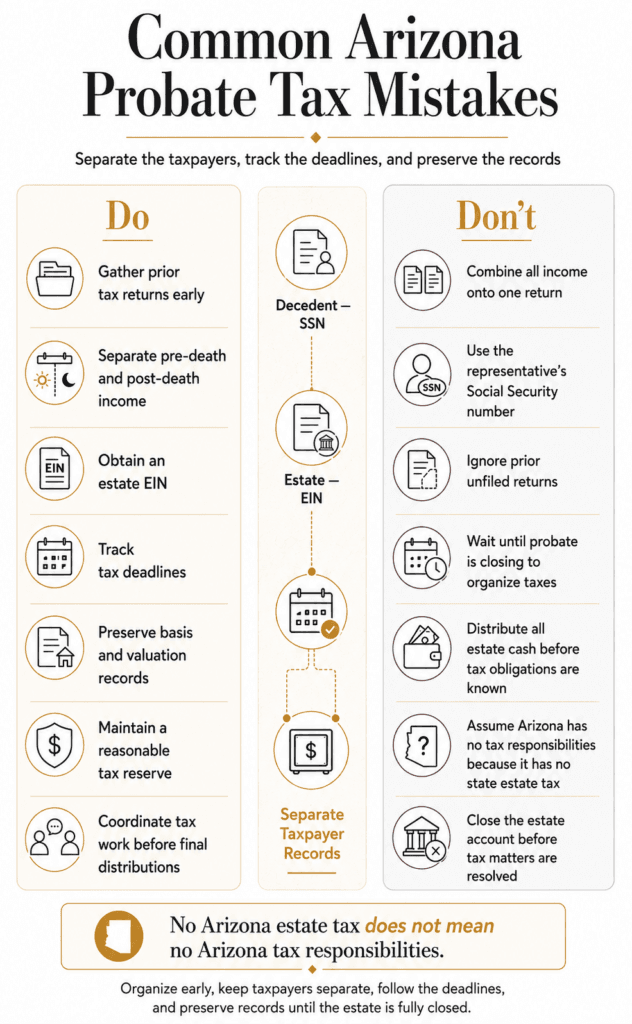
Common Arizona probate tax mistakes
Common mistakes include:
- Assuming death eliminates tax-return requirements
- Ignoring prior unfiled returns
- Reporting all income under the decedent’s Social Security number
- Failing to obtain an estate EIN
- Failing to update banks and payors
- Combining income earned before and after death
- Missing IRD
- Overlooking Form 1041
- Applying the federal threshold to Arizona Form 141AZ
- Treating every estate receipt as taxable income
- Assuming every estate payment is deductible
- Failing to preserve basis evidence
- Reporting only net sales proceeds
- Failing to provide Schedules K-1
- Confusing estate income tax with estate tax
- Assuming Arizona’s lack of an estate tax eliminates Arizona filings
- Distributing all cash before taxes are resolved
- Closing the estate account too early
- Failing to preserve records for beneficiaries
Arizona probate taxes checklist
The personal representative should generally:
- Gather prior federal and Arizona returns.
- Identify prior unfiled returns.
- Determine the decedent’s income through the date of death.
- File the final federal individual return when required.
- File the final Arizona individual return when required.
- Coordinate filing status with the surviving spouse.
- Use the correct procedure to claim refunds.
- Obtain an EIN for the estate.
- Notify banks and payors of the EIN.
- File Form 56 when appropriate.
- Separate pre-death and post-death income.
- Identify income in respect of a decedent.
- Select the estate’s tax year deliberately.
- Determine whether Form 1041 is required.
- Determine whether Form 141AZ is required.
- Track estate income, deductions, sales, and distributions.
- Preserve date-of-death valuations.
- Calculate gains or losses from complete sales records.
- Prepare beneficiary Schedules K-1 when required.
- Evaluate whether Form 706 or portability applies.
- Investigate business, payroll, and property taxes.
- Respond to tax notices before the stated deadline.
- Retain a documented tax reserve.
- Avoid final distributions until material liabilities are addressed.
- Preserve returns, appraisals, payments, and correspondence.
Handle Arizona probate taxes early
Arizona probate taxes extend beyond one final return for the person who died.
The personal representative may need to manage:
- The decedent’s final tax period
- A separate estate taxpayer
- Federal and Arizona fiduciary returns
- Pre-death and post-death income
- Property-sale reporting
- Beneficiary tax documents
- Business obligations
- A possible Form 706 or portability filing
- Tax liabilities arising throughout administration
Early planning makes those responsibilities more manageable.
Identify possible filings soon after appointment. Keep estate activity separate. Preserve reliable values and transaction documents. Retain enough estate money before making final distributions.
Estates involving businesses, rental property, retirement distributions, substantial investments, nonresident beneficiaries, prior unfiled returns, large lifetime gifts, or possible Form 706 obligations generally require coordinated guidance from probate counsel and a qualified tax professional.
Rahnema Law’s Arizona probate FAQs provide additional information about estate taxes, accounting, creditor payments, and closing.
Legal Disclaimer: This information is for educational purposes only and does not constitute legal advice. Arizona probate law is complex and varies based on individual circumstances. Always consult with a qualified probate attorney for guidance specific to your situation.
FAQs
Generally, yes. The decedent’s final return reports income attributable to the period ending at death. The estate may separately report post-death income, gains, losses, deductions, and distributions.
The surviving spouse or authorized personal representative generally files the return under the applicable IRS signature and filing rules.
It generally is due on the same date the decedent’s individual return would have been due if death had not occurred.
Extensions and other special rules may apply.
A probate estate commonly needs an EIN to open an estate account, file Form 1041, and report income under the estate’s identity. The IRS uses Form SS-4 for estate EIN applications.
Form 56 notifies the IRS of the creation or termination of a fiduciary relationship. It does not replace the decedent’s final return, Form 1041, Form 706, or other required filings.
A domestic estate generally must file Form 1041 when it has:
· At least $600 in gross income during the tax year, or
· A beneficiary who is a nonresident alien
Other specialized filing requirements may apply.
An estate generally files Form 141AZ when it has:
· Any Arizona taxable income, or
· Gross income of at least $5,000 during the tax year
Review the instructions for the applicable year.
Generally, yes. An estate may select a qualifying fiscal year instead of a calendar year. The choice affects filing deadlines and beneficiary reporting.
It is income the decedent had a right to receive but that was not properly included on the final return. The estate, beneficiary, or other recipient generally reports it when received.
Receiving inherited principal does not automatically make the entire inheritance taxable income. A beneficiary may still receive taxable estate income reported on Schedule K-1.
Arizona does not currently impose a separate state estate tax or inheritance tax. Federal estate tax and Arizona or federal income-tax obligations may still apply.
For a U.S. citizen or resident dying during 2026, the federal filing threshold is $15 million. The calculation generally considers the gross estate and adjusted taxable gifts—not only probate property.
A required Form 706 is generally due nine months after death. An automatic six-month filing extension may generally be requested through Form 4768 before the original deadline.
Yes. The personal representative should retain a reasonable reserve for expected taxes, preparation fees, amendments, notices, interest, penalties, and other unresolved tax obligations before making final distributions.