

What to do before appointment as an Arizona personal representative: protect property, gather records, and avoid using or distributing estate assets.
What should you do before appointment as an Arizona personal representative?
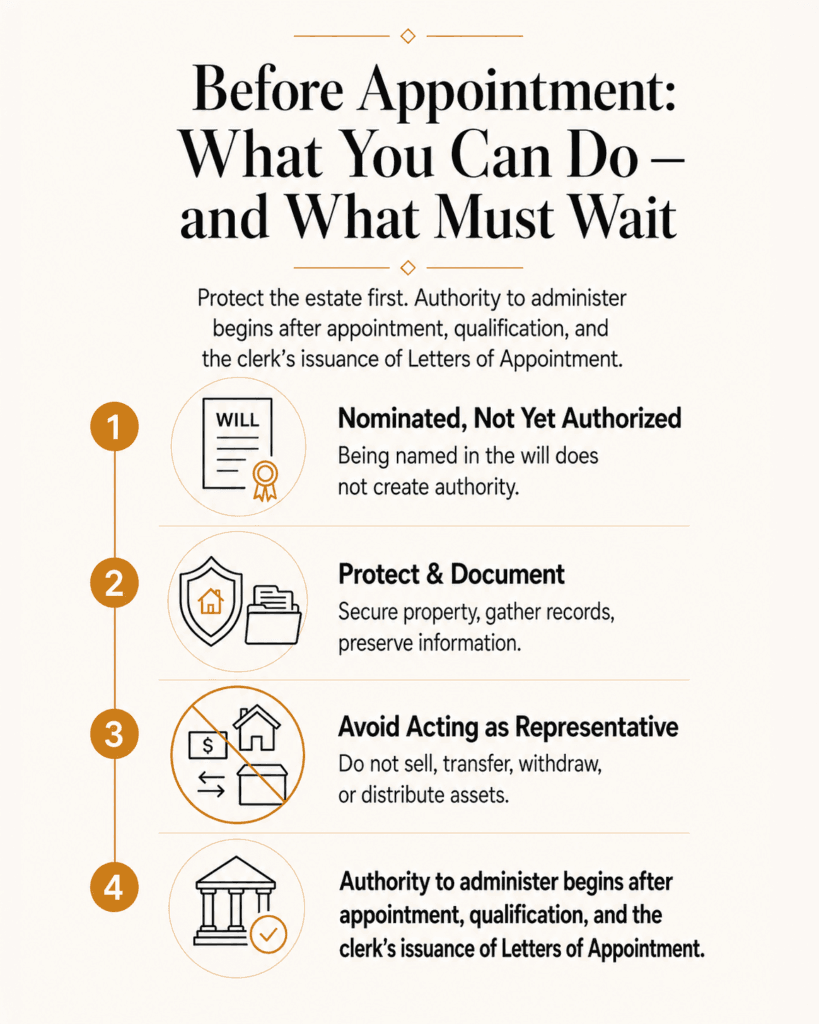
Focus on protecting property, preserving records, finding the original will, and gathering information about assets and debts.
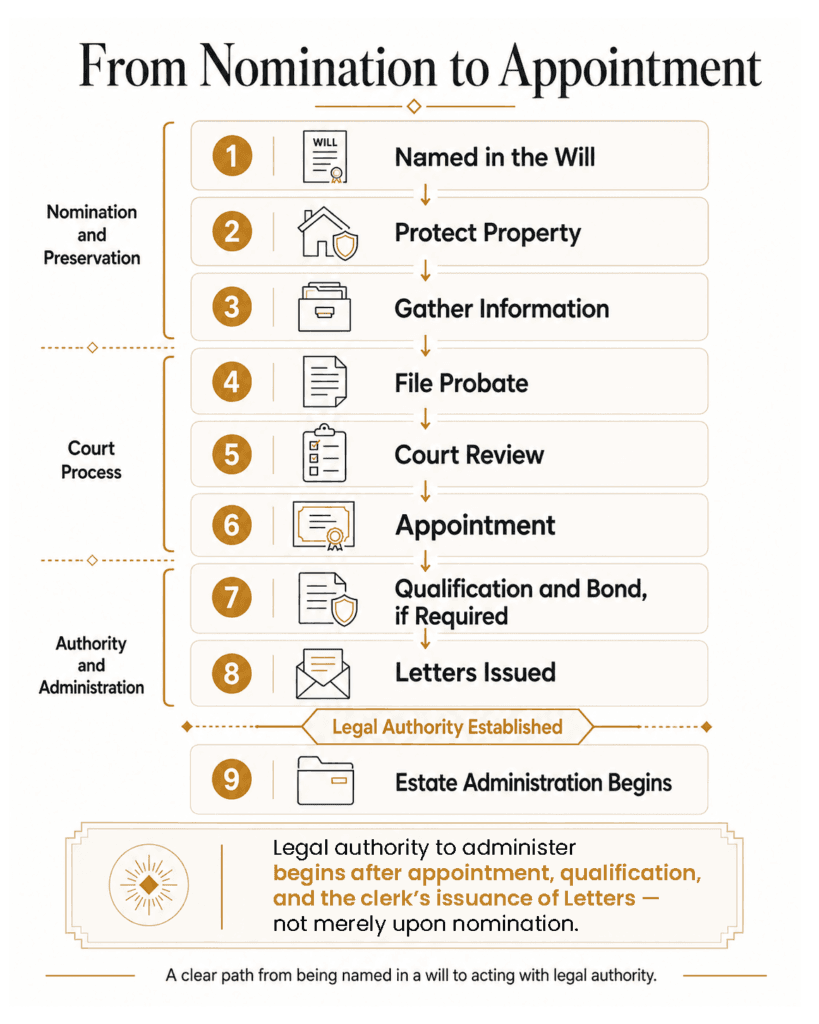
Being named in a will does not automatically give someone full authority to manage the estate. That authority generally begins with appointment, followed by the required qualification documents and issuance of Letters.
Until then, remember this distinction:
Protecting estate property may be necessary. Administering, selling, or distributing it usually should wait.
Being named in the will is not the same as being appointed
Arizona uses the term personal representative for the person responsible for administering a probate estate. People often use the word executor, but Arizona law uses the broader term personal representative.
A will may nominate someone for the role. However, that nomination alone does not provide all the powers of the office.
Before receiving Letters, the personal representative must file any required bond and a statement accepting the duties of the position.
Arizona Law Note: A.R.S. § 14-3701 provides that a personal representative’s duties and powers begin upon appointment. A.R.S. § 14-3601 requires the representative to file any required bond and an acceptance of the office before receiving Letters.
After appointment and qualification, a personal representative may have authority to:
- Collect estate property
- Manage and insure assets
- Open an estate bank account
- Address continuing contracts
- Pay legitimate estate expenses
- Sell property when appropriate
- Resolve creditor claims
- Distribute property at the proper time
Those powers remain subject to the will, Arizona law, fiduciary duties, statutory priorities, and applicable court orders.
For more information about the document that proves the appointment, see Rahnema Law’s guide to Letters of Appointment in Arizona probate.
Focus on preservation, not administration
The time before appointment is usually for protecting what exists and preparing for what comes next.
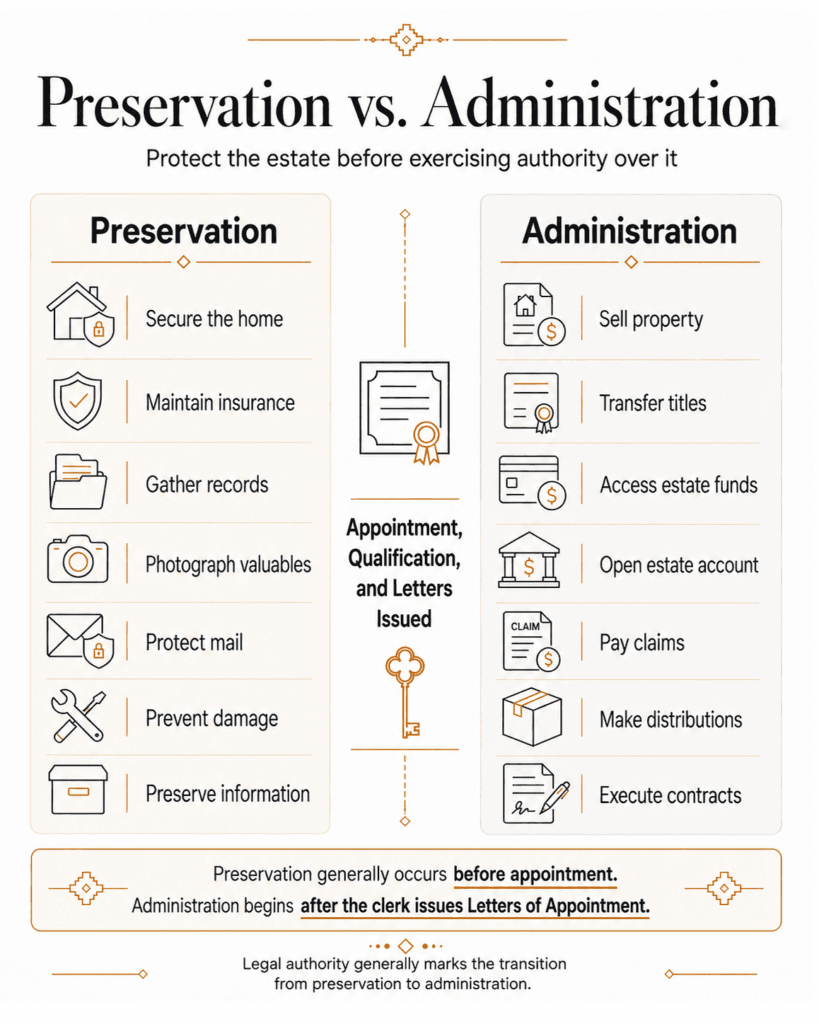
Preservation means taking reasonable steps to prevent theft, damage, waste, or loss.
Administration involves using legal authority to manage, sell, transfer, borrow against, settle, or distribute estate property.
Here is the difference:
- Locking a home protects it. Signing a contract to sell it administers it.
- Collecting bank statements preserves information. Withdrawing money uses estate property.
- Moving an item away from immediate danger may protect it. Giving it to a beneficiary distributes it.
- Maintaining necessary insurance protects property. Canceling coverage may place it at risk.
- Gathering bills preserves information. Paying disputed claims may affect other creditors.
When in doubt, ask:
Am I preventing harm, or am I making a legal or financial decision for the estate?
The second category is more likely to require formal authority.
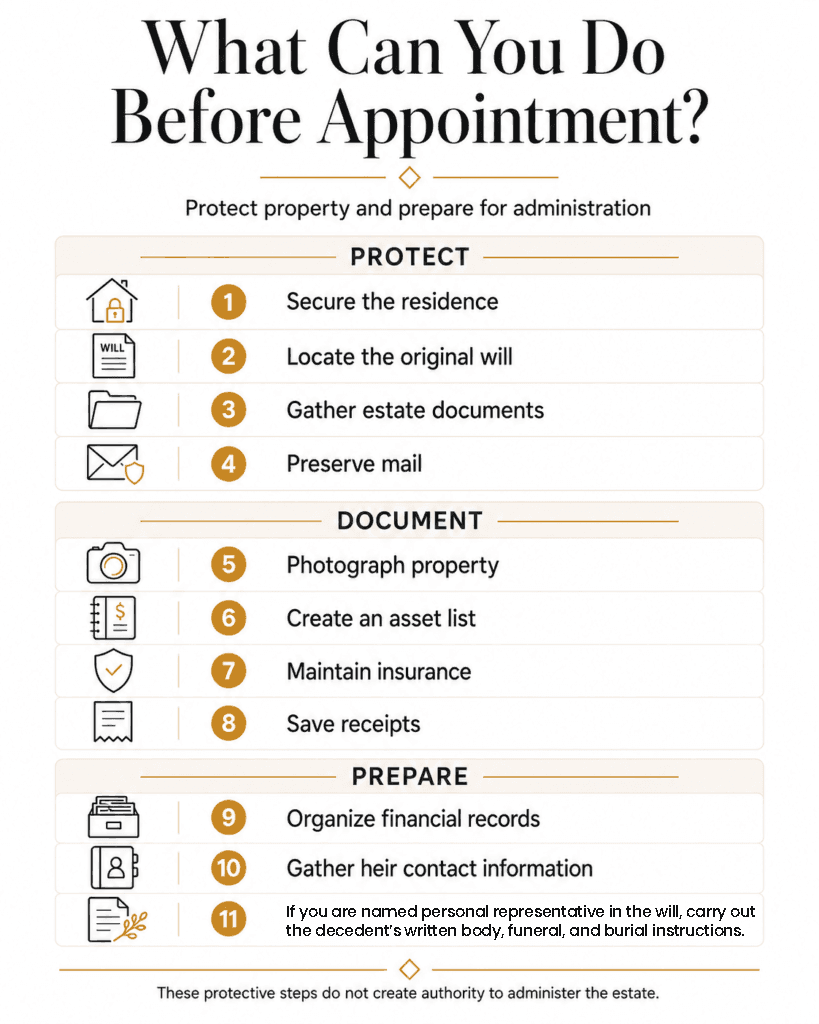
Secure the home and other property
If a residence will be vacant, make sure it is reasonably secure.
Protective steps may include:
- Locking doors and windows
- Collecting spare keys
- Securing vehicles
- Protecting valuable belongings
- Preventing unauthorized entry
- Maintaining necessary utilities
- Addressing an immediate risk of damage
- Confirming that insurance remains active
Arizona heat can damage a vacant property quickly. Depending on the home, air conditioning, electricity, water, landscaping, or pool service may need attention.
The insurance company may also need to know that the owner died or that the home is vacant. Do not cancel coverage simply because the decedent no longer lives there.
Photographs or video can document the condition of:
- The home
- Vehicles
- Furniture
- Jewelry
- Tools
- Collections
- Firearms
- Other significant belongings
Create a basic record showing:
- What property was present
- Who had access
- Whether anything was moved
- Why it was moved
- Where it is now stored
After appointment, the personal representative generally has the right and duty to take possession or control of estate property when necessary for administration.
Arizona Law Note: A.R.S. § 14-3709 addresses an appointed personal representative’s rights and duties concerning possession, management, protection, and preservation of estate property.
That statute applies to the appointed personal representative. It should not be treated as automatic authority for someone who has only been nominated.
Protect documents and financial information
Begin gathering records that may be needed later.
Useful documents may include:
- The original will
- Trust documents
- Deeds
- Vehicle titles
- Bank statements
- Investment records
- Retirement account information
- Life insurance policies
- Tax returns
- Business agreements
- Loan documents
- Unpaid bills
- Insurance records
- Beneficiary designations
Preserve the decedent’s mail. It may reveal assets, debts, insurance, subscriptions, tax obligations, or pending legal matters.
Also protect computers, phones, external drives, and other devices.
Do not erase, reset, sell, or give them away before important information has been preserved.
Protecting a device does not automatically give someone permission to access every account stored on it. Privacy laws, account agreements, passwords, and legal authority may still affect access.
Keep a written log of:
- Documents collected
- Devices secured
- Records delivered to another person
- Property moved for safekeeping
Locate and protect the original will
The original will may be needed to begin probate.
Search places such as:
- A home safe
- A filing cabinet
- A safe-deposit box
- The drafting attorney’s office
- An estate-planning folder
- Records held by a trusted relative
Once you find it, protect the original.
Do not:
- Write on it
- Remove staples
- Refasten pages
- Laminate it
- Alter it
- Mark it as a copy
- Throw away envelopes or related documents
Arizona law requires a person who has custody of a will, after the testator’s death and upon request from an interested person, to deliver it with reasonable promptness to someone able to secure probate or, if no such person is known, to the appropriate court.
Arizona Law Note: A.R.S. § 14-2516 establishes the will custodian’s delivery obligation and addresses possible liability or contempt for willful failure to comply.
The nominated person may review the will for information about:
- Funeral instructions
- Alternate personal representatives
- Beneficiaries
- Specific gifts
- Bond provisions
- Restrictions on administration
But the will does not automatically provide authority over every asset.
Property may instead pass through a trust, survivorship provision, beneficiary designation, or another nonprobate transfer method.
Follow valid written funeral instructions
Arizona law creates a limited pre-appointment rule for funeral and burial matters.
Before appointment, a person named as personal representative in the will may carry out the decedent’s written instructions concerning the body, funeral, and burial.
Look for:
- Prepaid funeral contracts
- Burial or cremation directions
- Cemetery documents
- Military discharge records
- Religious instructions
- Organ-donation information
- Letters of instruction
Save receipts for:
- Funeral services
- Burial
- Cremation
- Transportation
- Cemetery expenses
- Memorial expenses
These records may be needed later when the estate reviews expenses and claims.
This limited funeral authority is not general permission to access bank accounts, sell property, enter unrelated contracts, or distribute estate assets.
Arizona Law Note: A.R.S. § 14-3701 expressly allows the person named as personal representative in the will to carry out the decedent’s written instructions concerning the body, funeral, and burial before appointment.
Gather asset information without changing ownership
The proposed personal representative can begin making a preliminary list of assets.
The list may include:
- Real estate
- Bank accounts
- Investment accounts
- Vehicles
- Business interests
- Personal belongings
- Life insurance
- Retirement benefits
- Money owed to the decedent
- Digital assets
- Cryptocurrency
- Tax refunds
For each major asset, record:
- The name on the title or account
- The form of ownership
- Whether another owner is listed
- Whether survivorship rights apply
- Whether a beneficiary is named
- Whether the asset belongs to a trust
- Its approximate value
- Any loan, lien, or encumbrance
- Where supporting documents are located
This information can help determine which assets belong to the probate estate and which may transfer another way.
Do not change titles, close accounts, sell property, or direct an institution to transfer probate assets before legal authority is established.
For more information about the larger process, see Rahnema Law’s Arizona probate administration guide.
Gather bills without paying everything immediately
Collect and organize bills, but do not assume every bill should be paid as soon as it arrives.
Expenses that may need prompt attention include:
- Insurance premiums
- Necessary utilities
- Emergency repairs
- Costs required to prevent loss
- Expenses needed to secure property
Other bills may become creditor claims that should be handled through the probate process.
The estate may also have:
- Administration expenses
- Funeral expenses
- Taxes
- Expenses from the decedent’s last illness
- Secured debts
- General creditor claims
If the estate does not have enough property to pay everything, Arizona law establishes an order of payment.
Arizona Law Note: A.R.S. § 14-3805 gives priority to administration expenses, reasonable funeral expenses, certain preferred debts and taxes, and reasonable and necessary expenses from the decedent’s last illness before general claims.
Paying one creditor too early may reduce the money available for a higher-priority expense.
If someone personally pays an urgent expense, keep proof of:
- The amount
- The date
- The purpose
- The recipient
- The payment method
- Why the payment was necessary
Whether reimbursement is appropriate should be determined during the administration based on the circumstances and applicable legal priorities.
Do not use the decedent’s cards or accounts
Having a debit card, checkbook, password, or online banking login does not create estate authority.
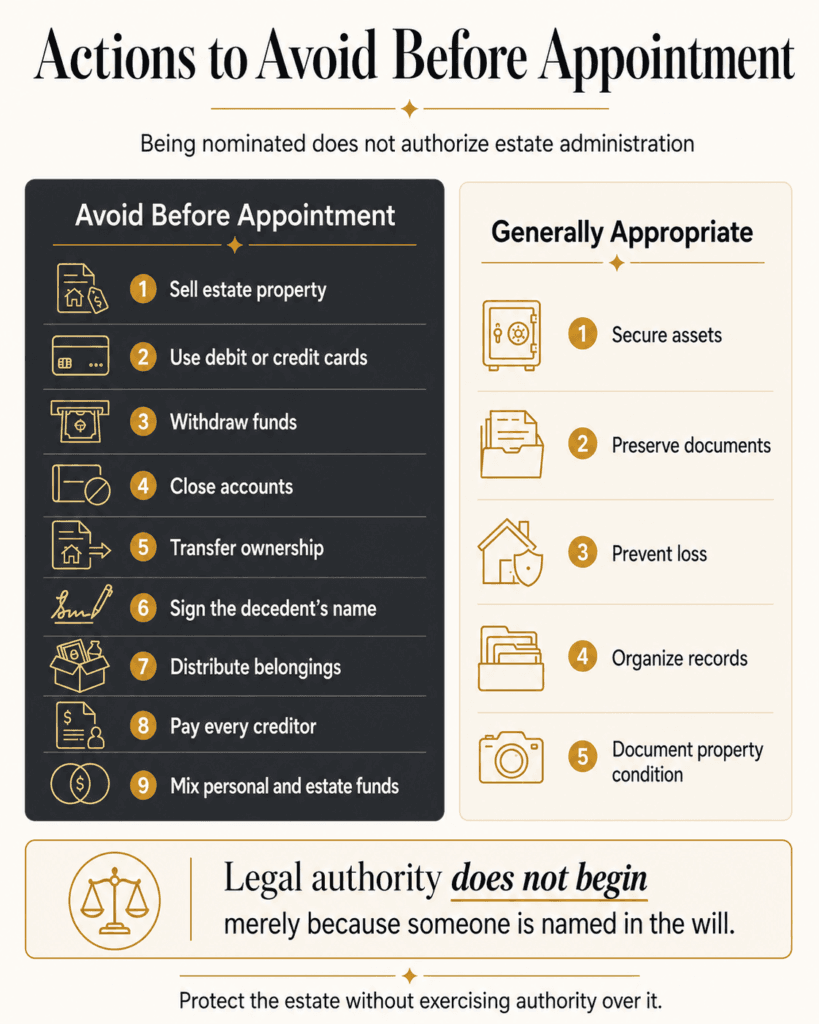
Before appointment, the proposed personal representative should generally avoid:
- Signing the decedent’s name
- Writing checks from the decedent’s account
- Using the decedent’s credit or debit cards
- Transferring funds to a personal account
- Withdrawing cash
- Closing accounts
- Changing account ownership
- Using online credentials to make transactions
After appointment and qualification, a bank may require certified Letters, identification, tax information, or its own forms before allowing access.
Until then, collect and preserve account information without moving or spending the funds.
Do not distribute personal belongings
Furniture, jewelry, vehicles, artwork, firearms, tools, collections, and ordinary household items may all be estate property.
Family members sometimes begin taking items because:
- The decedent allegedly promised the item to them
- The will appears to give them the item
- Everyone currently agrees
- The item seems to have little value
- Someone wants to hold it for safekeeping
Early distributions can still cause problems.
The property may be needed to pay estate obligations. Its value may affect an equal division. Another heir, devisee, creditor, or fiduciary may later object.
Until ownership, the proper recipient, and legal authority are clear, keep the property protected.
What if an item must be moved for safety?
If an item faces immediate risk and must be moved:
- Photograph it.
- Describe it.
- Record its condition.
- Identify who moved it.
- Explain why it was moved.
- Record where it is stored.
- Preserve any receipt or acknowledgment.
Moving an item for protection should not quietly become an early distribution.
Understand Arizona’s relation-back rule
Arizona law gives certain beneficial pre-appointment acts legal effect after the person is appointed.
An act by the person later appointed may receive the same effect as an act performed after appointment if it benefited the estate.
An appointed personal representative may also ratify certain acts performed by another person if those acts would have been proper for a personal representative.
This rule can support reasonable actions that genuinely protected or benefited the estate.
But it is not advance permission to use every power of the office.
Potentially risky actions include:
- Selling real estate
- Borrowing money
- Entering long-term contracts
- Making distributions
- Paying disputed debts
- Settling claims
- Operating a business
- Transferring ownership
- Using estate funds
There is no guarantee that a particular act will later be considered beneficial, proper, or capable of ratification.
Think of the relation-back rule as a possible legal effect after appointment, not a replacement for appointment.
Arizona Law Note: A.R.S. § 14-3701 addresses beneficial acts taken by the person later appointed and permits ratification of certain proper acts performed by others.
What if the estate cannot safely wait?
Some situations need temporary authority before the regular appointment process can be completed.
Arizona permits appointment of a special administrator when necessary to protect an estate before a general personal representative is appointed. A court may also appoint one in a formal proceeding when necessary to preserve the estate or secure its proper administration.
Temporary authority may be appropriate when:
- A vacant home faces immediate danger
- Someone is removing or concealing property
- Insurance is about to lapse
- A business needs immediate management
- Perishable property may lose value
- A legal or financial deadline threatens the estate
- No general personal representative can act in time
An informally appointed special administrator has the duty to collect, manage, preserve, and account for estate assets and later deliver them to the general personal representative.
Arizona Law Note: A.R.S. § 14-3614 authorizes special-administrator appointments in specified circumstances. A.R.S. § 14-3616 describes the duties and necessary powers of an informally appointed special administrator.
Most estates do not need this procedure.
It is generally considered when waiting could cause meaningful harm.
Prepare for the work that starts after appointment
The waiting period can be used to organize information for the next stage.
After appointment and qualification, the personal representative will generally need to:
- Notify heirs and devisees
- Protect and control probate property
- Begin addressing creditors
- Prepare the estate inventory
- Maintain financial records
- Address taxes and expenses
- Account for estate activity
- Distribute property when appropriate
- Complete the closing process
The 30-day appointment notice
A personal representative, other than a special administrator, generally must provide information about the appointment to heirs and devisees no later than 30 days after appointment.
Arizona Law Note: A.R.S. § 14-3705 establishes the general 30-day appointment-information requirement.
The 90-day inventory
The personal representative generally must prepare an estate inventory within 90 days after appointment.
The inventory identifies estate property and includes:
- A reasonable description
- Fair market value as of the date of death
- Whether the property is community or separate property
- Any mortgage, lien, or other encumbrance
Arizona Law Note: A.R.S. § 14-3706 establishes the 90-day inventory requirement and the information that must be included.
Gathering names, addresses, ownership records, bills, statements, and supporting documents now can make those deadlines easier to manage.
The Arizona Judicial Branch Self-Service Center also provides official legal information and court forms for people representing themselves. Individual courts may still require additional or preferred local forms.
Common actions to avoid before appointment
Before legal authority is established, the proposed personal representative should generally avoid:
- Selling or giving away estate property
- Withdrawing money from the decedent’s accounts
- Using the decedent’s debit or credit cards
- Signing the decedent’s name
- Closing financial accounts
- Retitling vehicles or real estate
- Paying beneficiaries
- Paying every creditor without reviewing the estate
- Settling disputed claims
- Entering major estate contracts
- Borrowing against estate property
- Mixing estate property with personal property
- Canceling necessary insurance or utilities
- Allowing relatives to remove belongings without documentation
The safest approach is usually to preserve what exists until ownership and authority are clear.
Pre-appointment checklist
Before appointment as an Arizona personal representative:
- Secure the home, vehicles, valuables, and records.
- Locate and protect the original will.
- Gather trust, title, insurance, and financial documents.
- Follow valid written funeral and burial instructions.
- Preserve mail, statements, computers, and digital devices.
- Make preliminary lists of assets and debts.
- Record how major assets are titled.
- Confirm that necessary insurance and utilities remain active.
- Photograph significant property.
- Document anything moved for safekeeping.
- Save receipts for urgent protective expenses.
- Gather contact information for heirs and devisees.
- Avoid selling, transferring, or distributing estate property.
- Consider temporary court authority if delay threatens the estate.
- Prepare for the deadlines that begin after appointment.
Move forward carefully
The period before appointment is generally not the time to fully administer the estate.
It is the time to prevent harm and prepare.
The person nominated in the will can secure property, preserve information, organize records, locate the original will, and carry out valid written funeral instructions.
More significant actions—such as accessing funds, selling property, settling claims, entering major contracts, or making distributions—should ordinarily wait until appointment and qualification are complete.
When urgent action cannot wait, Arizona’s special-administrator procedures may provide temporary authority.
Otherwise, careful documentation and a clear distinction between preservation and administration can help the future personal representative begin with better records and fewer complications.
For additional plain-English answers about appointment, Letters, estate property, and probate responsibilities, see Rahnema Law’s Arizona Probate FAQs.
Legal Disclaimer: This information is for educational purposes only and does not constitute legal advice. Arizona probate law is complex and varies based on individual circumstances. Always consult with a qualified probate attorney for guidance specific to your situation.
FAQs
No. A nomination in a will does not complete the appointment process. The person must be appointed and complete the applicable qualification and acceptance requirements before receiving Letters.
A.R.S. § 14-3701 states that the duties and powers of a personal representative begin upon appointment. The representative must also complete applicable qualification requirements before receiving Letters.
Before appointment, a nominated person may gather information and, if the person already has lawful access, take limited, non-distributive steps to prevent immediate loss or damage. The nomination does not authorize entry, exclusion of occupants, control over jointly owned or trust property, or possession of disputed assets. More significant estate transactions should wait until legal authority is established.
Possession of a card, checkbook, password, or account statement does not establish estate authority. Transactions should generally wait until the appointment, qualification, and completion of the financial institution’s requirements.
Urgent protective expenses may need attention, but not every bill should be paid immediately. Arizona establishes payment priorities when estate property is not sufficient to pay all claims. Document any urgent payment carefully.
Generally, they should remain protected until ownership, the proper recipient, and legal authority are clear. Early distributions may affect creditors, beneficiaries, and the future administration.
A person named as personal representative in the will may carry out the decedent’s written instructions concerning the body, funeral, and burial before appointment. That is limited authority. It does not create general authority to administer the estate.
The rule may give certain beneficial pre-appointment acts by the person later appointed the same effect as acts taken after appointment. It may also allow ratification of certain proper acts by others. It is not general advance permission to administer the estate.
A special administrator may be appointed when temporary authority is necessary to protect or preserve the estate before a general personal representative can act, or when proper administration otherwise requires it.
Important early deadlines include the general 30-day notice to heirs and devisees and the 90-day inventory requirement. The personal representative must also begin the creditor-notice process.