

Learn how to close probate in Arizona through creditor review, taxes, distributions, accounting, and informal or formal closing.
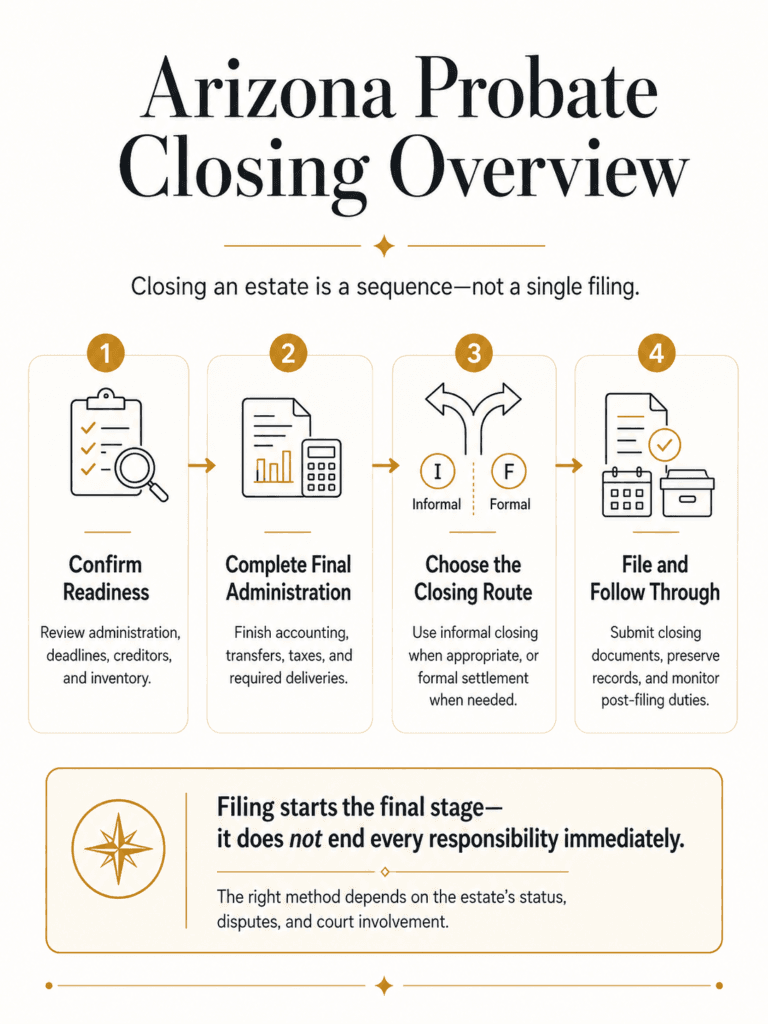
To close probate in Arizona, the personal representative must finish the estate’s substantive work, choose the correct closing procedure, prepare a complete accounting, deliver the required documents, and file the appropriate closing papers with the court.
Closing is not simply a matter of waiting several months and submitting a form.
Before the estate closes, the personal representative should be able to explain:
- What property belonged to the probate estate
- What happened to every inventory asset
- How creditor claims were handled
- Which taxes and administration expenses were addressed
- Who received each distribution
- Whether all deeds, titles, and assignments were completed
- How the final accounting reconciles
- Whether any liability remains outstanding
- Why informal or formal closing is appropriate
The closing document should confirm work that has already been completed. It should not promise that unfinished administration will be completed later.
Closing Probate Is a Process, Not a Calendar Date
Arizona allows an eligible personal representative to file an informal closing statement no earlier than four months after the original appointment of a general personal representative.
That four-month period is only a minimum filing condition.
The personal representative must also determine that:
- The creditor-claim period expired.
- Presented claims and administration expenses were paid, settled, or otherwise addressed.
- Applicable estate, inheritance, and other death taxes were addressed.
- Estate property was distributed to the people entitled to receive it.
- Any remaining liability was disclosed and accommodated.
- The required closing documents and accounting were delivered.
These requirements appear in A.R.S. § 14-3933.
The fourth month after appointment is not an automatic closing date.
An estate involving real estate, tax returns, a business, disputed claims, missing beneficiaries, title problems, or litigation may properly remain open much longer.
How to Close Probate in Arizona: The Main Steps
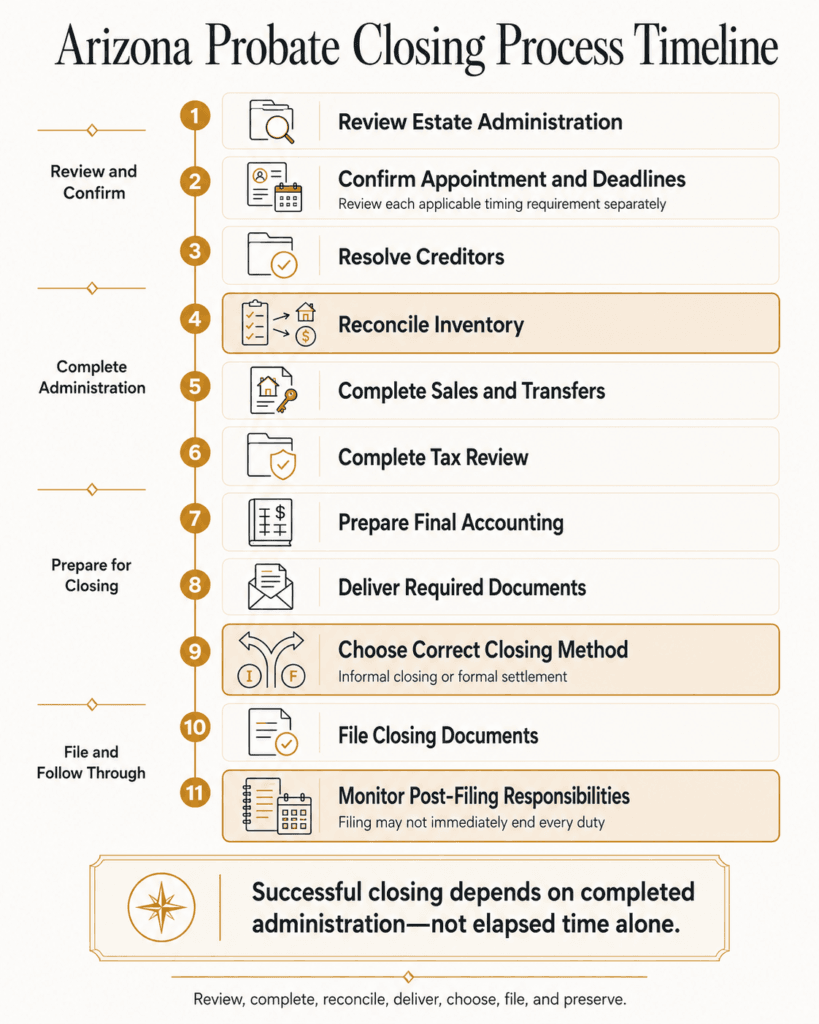
A typical closing process includes these steps:
- Review the personal representative’s current authority.
- Choose the correct closing procedure.
- Verify the original appointment date.
- calculate every creditor deadline.
- Resolve or accommodate every estate obligation.
- Reconcile the inventory and search for overlooked property.
- Complete sales, distributions, and legal title transfers.
- Finish tax work, expenses, compensation, and reimbursements.
- Prepare and reconcile the final accounting.
- Complete and deliver the closing documents.
- File the correct document with the proper court.
- Preserve the file and monitor post-filing responsibilities.
The exact process depends on whether the estate is unsupervised or supervised, whether the will and distributions are disputed, and whether the personal representative needs a court order approving the final settlement.
Choose the Correct Arizona Probate Closing Method
Arizona provides several ways to complete probate administration.
Informal Closing Statement
An eligible unsupervised estate may generally close by filing a verified closing statement under Arizona’s informal-closing statute.
This approach is often appropriate when:
- Administration is complete.
- The proper beneficiaries and heirs are known.
- The accounting is not disputed.
- No significant claim remains unresolved.
- No court order requires supervised or formal administration.
- The representative does not need an immediate judicial approval order.
The personal representative makes verified factual statements about the completed administration. The filing is not the same as obtaining a court order approving every estate transaction.
Formal Order of Complete Settlement
The personal representative or another interested person may petition for an order of complete settlement.
The petition may ask the court to:
- Determine testacy when necessary
- Determine heirs
- Review or compel an accounting
- Interpret a will
- Approve a settlement
- Direct or approve distributions
- Discharge the personal representative
The personal representative may petition after the period for presenting claims arising before death has expired. Another interested person generally must also wait until one year after the original personal representative’s appointment.
Formal settlement requires notice to interested persons and a hearing. The court may then approve the settlement and distribution and discharge the representative under the terms of its order. See A.R.S. § 14-3931.
Formal settlement may be appropriate when:
- A beneficiary objects to the accounting.
- Heirship remains uncertain.
- The will requires interpretation.
- Compensation or professional fees are disputed.
- Property ownership is contested.
- A major creditor issue remains unresolved.
- The representative wants judicial approval and discharge.
Formal Settlement Under an Informally Probated Will
A personal representative administering an estate under an informally probated will may also petition for formal settlement without necessarily reopening the decedent’s testacy status.
A devisee may petition after one year from the original appointment. No petition under this procedure may be heard before the period for presenting claims arising before death has expired.
The court may consider the accounting and distribution, interpret the will, approve the settlement, and discharge the representative from claims by participating devisees and those they represent. If part of the estate is intestate, the proceeding must instead be dismissed or amended to proceed under the broader complete-settlement statute. See A.R.S. § 14-3932.
Supervised Estates Require Court Control
The ordinary informal closing-statement procedure is not available for an estate under supervised administration.
A supervised personal representative may not distribute estate property without a prior court order. A sale of real property during supervised administration is also subject to court confirmation.
Before choosing a closing procedure, review:
- Letters of Personal Representative
- Appointment order
- Order to Personal Representative
- Will
- Supervision orders
- Orders limiting authority
- Pending petitions
- Bond requirements
- Orders concerning settlement or distribution
An estate that began informally may later become subject to restrictions that change how it must close.
Step 1: Review the Entire Administration
Before preparing a closing document, review the estate file from beginning to end.
Organize the review into five categories:
Assets and Inventory
Confirm what the estate owned, what it received, and what happened to every asset.
Creditors and Liabilities
Confirm that each claim and obligation has a documented result.
Taxes and Administration Expenses
Determine which returns, payments, invoices, compensation, and reimbursements remain outstanding.
Distributions and Title Transfers
Confirm that each beneficiary or heir received the correct property and that legal ownership changed.
Accounting and Court Documents
Make sure the financial records reconcile and the correct local forms are being used.
The purpose of this review is to identify unfinished work before the personal representative verifies under oath that the closing requirements have been satisfied.
For a broader overview of the representative’s authority, see Rahnema Law’s guide to Letters of Appointment in Arizona probate.
Step 2: Confirm the Original Appointment Date
An informal closing statement may not be filed earlier than four months after the original appointment of a general personal representative.
Use the date of the original general appointment—not:
- The date of death
- The date the probate application was filed
- The date the will was admitted
- The date the representative began gathering records
- The date a successor representative was appointed
- The date a special administrator was appointed
Preserve the original appointment order and Letters with the closing records.
The passage of four months satisfies only the minimum appointment requirement. It does not establish that the estate’s creditor, tax, distribution, or accounting work is complete.
Step 3: Calculate Every Creditor Deadline
Arizona generally requires the personal representative to publish notice to creditors once a week for three successive weeks.
Creditors covered by publication are instructed to present their claims within four months after the first publication.
The operative date is the first publication date—not:
- The third publication
- The newspaper affidavit date
- The date the newspaper invoice was paid
- The date the notice was drafted
Preserve:
- A copy of the notice
- Each publication date
- The newspaper affidavit
- Proof of payment
- The written deadline calculation
Known Creditors May Have Later Deadlines
Known creditors generally must receive direct written notice.
Their deadline is ordinarily the later of:
- Four months after the first published notice, or
- Sixty days after direct notice was mailed or otherwise delivered
A known creditor who receives direct notice near the end of the publication period may therefore have a deadline extending beyond the estate’s general four-month date. See A.R.S. § 14-3801.
Calculate the deadline creditor by creditor. Do not rely on one date for the entire estate.
For practical guidance on locating records and documenting claims, see Rahnema Law’s article on finding assets and creditor information during Arizona probate.
Some Obligations Remain Relevant After the Ordinary Claim Period
The ordinary creditor deadline does not resolve every possible estate obligation.
The closing review should also consider:
- Mortgages and other secured debts
- Contracts entered into during administration
- Property repairs and utilities
- Storage and insurance
- Legal and accounting fees
- Litigation expenses
- Tax liabilities
- Personal representative compensation
- Reimbursement of administration expenses
- Claims limited to available insurance
An estate should not be closed merely because the published creditor period expired.
Step 4: Resolve Every Presented Claim
The claim log should show a clear outcome for each creditor claim.
A claim may be:
- Paid
- Settled
- Partially allowed
- Disallowed
- Withdrawn
- Barred
- Covered by insurance
- Secured by estate property
- Reserved for
- Addressed through another documented arrangement
Preserve:
- The creditor’s demand
- Supporting documents
- Date received
- Estate response
- Allowance or disallowance notice
- Proof of mailing
- Settlement agreement
- Payment confirmation
- Court order when applicable
A claim should not disappear from the closing review merely because the creditor stopped communicating.
Account for the Disallowance Period
When the personal representative disallows all or part of a claim, the claimant generally has 60 days after the notice of disallowance is mailed to petition for allowance or begin a proceeding against the representative.
The statute also provides that if the personal representative fails to notify the claimant of action on a properly presented claim for 60 days after the original presentation period expires, the failure may have the effect of a notice of allowance. See A.R.S. § 14-3806.
Before closing, confirm:
- When the claim was presented
- When the disallowance was mailed
- Whether the claim was fully or partially disallowed
- Whether a court proceeding was started
- Whether the response period expired
- Whether the claim was later allowed or settled
Mailing a disallowance notice is not necessarily the final step.
Calendar the 60-day period and confirm what happened before treating the claim as barred.
Step 5: Make Provision for Unresolved Obligations
Before paying allowed claims, Arizona requires the personal representative to make provision for:
- Homestead, exempt-property, and family allowances
- Claims presented but not yet allowed
- Claims whose allowance is being appealed
- Unbarred claims that may still be presented
- Costs and expenses of administration
These risks should also be addressed before final distributions and closing. See A.R.S. § 14-3807.
A reserve may be necessary for:
- Disputed claims
- Tax balances
- Final professional invoices
- Recording charges
- Property expenses
- Litigation exposure
- Delayed refunds or income
- Final accounting corrections
The reserve should have:
- A stated amount
- A documented purpose
- A reasonable calculation
- A plan for payment
- A method for distributing any unused balance
Do not distribute every available dollar while the estate still faces a material unpaid obligation.
Can Probate Close With an Unpaid Claim?
Potentially, but the liability cannot be ignored.
When a claim remains undischarged, the informal closing statement must explain either:
- That the estate was distributed subject to possible liability with the agreement of the distributees, or
- What other arrangements were made to accommodate the outstanding liability
The closing file should identify:
- The claimant
- Nature of the claim
- Amount or estimated exposure
- Reason it remains unresolved
- Reserve or other payment source
- Agreement of affected distributees when applicable
- Relevant legal, tax, or financial advice
A substantial unresolved liability may make formal settlement safer than informal closing.
Step 6: Reconcile the Probate Inventory
Arizona generally requires the personal representative to prepare the estate inventory within 90 days after appointment.
The inventory should identify probate property with reasonable detail and state:
- Fair market value as of the date of death
- Whether the property was community or separate property
- The type and amount of any encumbrance
The representative may file the inventory with the court or follow the statutory delivery requirements when choosing not to file it. See A.R.S. § 14-3706.
Before closing, compare the inventory with:
- Bank statements
- Brokerage statements
- Deeds
- Vehicle titles
- Appraisals
- Tax records
- Sale documents
- Distribution records
- The final accounting
Every inventory asset should have a documented final outcome.
Rahnema Law’s Arizona Probate Inventory Checklist explains how the inventory creates the starting record for administration.
Prepare a Supplemental Inventory When Necessary
A supplemental inventory or appraisal is required when the representative discovers:
- Property omitted from the original inventory
- An erroneous or misleading value
- A materially inaccurate description
The supplemental inventory should state the date-of-death value or corrected description and identify the appraisal or other supporting data.
If the original inventory was filed with the court, the supplemental inventory must also be filed. Otherwise, the new information must be furnished to interested persons affected by it. See A.R.S. § 14-3708.
Do not hide a material inventory problem through an unexplained adjustment in the final accounting.
Trace Every Asset to Its Outcome
Each inventory item should be shown as:
- Collected
- Sold
- Distributed
- Used to pay an estate obligation
- Transferred through another proper procedure
- Corrected through a supplemental inventory
- Determined not to belong to the probate estate
- Retained temporarily under a documented arrangement
For each material asset, the records should answer:
- What did the estate own?
- What value was originally assigned?
- What happened to the asset?
- What money or replacement property did the estate receive?
- Who received the asset or proceeds?
- What document proves the result?
An asset should not disappear between the inventory and final accounting.
Conduct a Final Search for Overlooked Property
Review:
- Recent mail
- Prior tax returns
- Forms W-2 and 1099
- Bank and investment records
- Insurance correspondence
- Business and rental records
- Unclaimed-property records
- Tax refunds
- Replacement checks
- Pending legal claims
- Money owed to the decedent
- Digital financial accounts
Closing before collecting known property may require additional administration later.
Step 7: Complete Sales and Property Transfers
When estate property was sold, confirm that:
- The transaction closed.
- Net proceeds were deposited.
- Liens were paid or otherwise addressed.
- Commissions and closing expenses were recorded.
- Escrow holdbacks were resolved or documented.
- Tax records were provided to the preparer.
- The final accounting explains the sale.
Preserve:
- Purchase contracts
- Amendments
- Settlement statements
- Appraisals
- Loan-payoff records
- Repair invoices
- Commission records
- Proof of deposited proceeds
A sale price that differs from the inventory value does not automatically mean the original inventory was incorrect. However, the final accounting should clearly explain what the estate received and paid.
Complete Every In-Kind Distribution
An in-kind distribution transfers the asset itself instead of selling it and distributing cash.
When property is distributed in kind, the personal representative must execute an instrument or deed assigning, transferring, or releasing the property as evidence of the distributee’s title.
For Arizona real property, a recorded instrument of distribution must include the name and address of each distributee. See A.R.S. § 14-3907.
Depending on the asset, the closing file may require:
- Recorded deed or instrument of distribution
- Vehicle-title confirmation
- Brokerage transfer confirmation
- Bank transfer records
- Business-interest assignment
- Updated ownership ledger
- Trust-funding document
- Receipt for tangible personal property
Signing a transfer document does not always complete the transfer.
Confirm that the county recorder, financial institution, title authority, company, or other responsible entity accepted and processed it.
Verify Every Real-Estate Transfer
Before closing an estate that owned real estate, confirm that:
- The correct instrument was prepared.
- The legal description is accurate.
- The recipient and ownership interest are correct.
- The document was properly acknowledged.
- It was recorded in the correct county.
- A recorded copy was obtained.
- Mortgage and lien treatment is documented.
- Insurance responsibility changed at the appropriate time.
- Property taxes and association charges were allocated.
If probate property remains titled in the decedent’s name, the estate may not be ready to close.
Step 8: Complete the Tax Review
The estate’s tax work may include:
- The decedent’s final federal income-tax return
- The decedent’s final Arizona income-tax return
- Federal fiduciary income-tax returns
- Arizona fiduciary income-tax returns
- Property-sale reporting
- Business or employment taxes
- Property taxes
- Beneficiary tax schedules
- A federal estate-tax return when applicable
- Prior unfiled returns
The IRS uses Form 1041 to report an estate’s income, deductions, gains, losses, distributions, and income-tax liability. Arizona uses Form 141AZ for estates and trusts that meet the state filing requirements.
Before closing, confirm:
- Which returns were required
- Which returns were filed
- Whether tax payments cleared
- Whether a refund remains expected
- Whether an amended return may be needed
- Whether a tax notice remains unresolved
- Whether beneficiaries received required tax information
- Whether the tax preparer’s final invoice was paid
Closing the probate case does not prevent a taxing authority from later pursuing a valid tax obligation.
Step 9: Finish Expenses, Compensation, and Reimbursement
Before final distribution, identify every remaining administration expense.
These may include:
- Court charges
- Publication costs
- Legal fees
- Accounting fees
- Appraisal expenses
- Property expenses
- Storage
- Insurance
- Recording charges
- Real-estate commissions
- Tax-preparation fees
- Final bank or transfer fees
Ask estate professionals whether another invoice is expected.
A small reserve may remain for a genuinely unfinished final expense, but the amount, purpose, and plan for distributing any unused balance should be documented.
Separate Compensation From Reimbursement
Reimbursement records should identify:
- Expense
- Date
- Amount
- Estate purpose
- Receipt or invoice
- Proof that the personal representative paid personally
Compensation records should identify:
- Services performed
- Dates
- Time spent
- Benefit to the estate
- Calculation method
- Amount paid
Compensation and reimbursement should appear as separate accounting categories.
A disputed compensation request may need to be resolved before informal closing or addressed through a formal proceeding.
Step 10: Prepare the Final Accounting
The final accounting should tell the estate’s complete financial story.
It should show:
- Opening estate property
- Later receipts
- Income
- Refunds
- Sale proceeds
- Creditor payments
- Administration expenses
- Taxes
- Compensation
- Reimbursements
- Cash distributions
- Noncash distributions
- Property or reserves remaining
A clear accounting answers four questions:
- What did the estate begin with?
- What did the estate receive?
- What did the estate pay or distribute?
- What remained at the end?
Every material transaction should have supporting documentation.
Reconcile Every Estate Account
Before finalizing the accounting:
- Compare every bank statement.
- Confirm every deposit.
- Confirm every check and electronic payment.
- Investigate stale or outstanding checks.
- Record final interest.
- Verify brokerage transfers.
- Confirm refunds.
- Explain adjustments.
- Match the ending balance.
The accounting should agree with the estate’s bank, investment, sale, tax, and transfer records.
The Accounting and Closing Statement Are Different
The closing statement is the verified document filed with the court to complete an eligible informal administration.
The final accounting is the detailed financial record furnished to distributees whose interests were affected by the administration.
Arizona’s informal-closing statute requires a full written account to be furnished to affected distributees. It does not state that the accounting must always be filed with the informal closing statement. Local procedures and formal proceedings may require different treatment. (azleg.gov)
Step 11: Obtain Receipts and Close the Estate Account Carefully
A distribution receipt may identify:
- Recipient
- Property or money received
- Assigned value
- Date
- Partial or final status
- Related deed, title, or assignment
Receipts are particularly useful for:
- Cash
- Vehicles
- Jewelry
- Artwork
- Collections
- Household property
- Business records
A receipt supplements the legal transfer document. It does not replace a deed, title, assignment, or institutional confirmation.
Close the Estate Bank Account at the Proper Time
The estate bank account should remain open until it is no longer needed.
Before closing it, confirm that:
- Expected deposits were received.
- Checks and electronic payments cleared.
- Automatic payments stopped.
- Taxes were paid or reserved for.
- Professional invoices were addressed.
- Final distributions were completed.
- Refunds and delayed income were considered.
- The ending balance agrees with the accounting.
Preserve:
- Final bank statement
- Account-closing confirmation
- Final reconciliation
- Proof of final payments and distributions
Closing the account too early may make it difficult to deposit a refund or pay a final expense. Keeping it open unnecessarily may create additional fees and recordkeeping.
Complete the Informal Closing Statement
The verified closing statement generally confirms that:
- The creditor-claim period expired.
- Presented claims were paid, settled, or otherwise addressed.
- Administration expenses were addressed.
- Applicable estate, inheritance, and other death taxes were addressed.
- Estate property was distributed to the people entitled to receive it.
- Remaining liabilities were disclosed and accommodated.
- Copies of the closing statement were sent to the required recipients.
- A full written account was furnished to affected distributees.
These are factual representations made by the personal representative.
Before signing, compare the statement with:
- Appointment records
- Creditor deadlines
- Claim log
- Tax file
- Inventory and supplements
- Distribution schedule
- Transfer documents
- Final accounting
- Bank reconciliation
Do not sign while a required task remains unfinished merely because the representative expects to complete it later.
Deliver the Required Documents
Arizona requires a copy of the closing statement to be sent to:
- All estate distributees
- Known creditors or other claimants whose claims remain unpaid and unbarred
The personal representative must also provide a full written account to distributees whose interests were affected by the administration. (azleg.gov)
Preserve:
- Recipient names
- Addresses
- Documents sent
- Mailing or delivery dates
- Delivery method
- Returned mail
- Corrected addresses
- Proof of mailing or delivery
Local court instructions may identify additional recipients.
Use the Current Forms for the Correct County
Arizona’s statewide probate forms are generic. Individual superior courts may use preferred local forms and procedures.
Before filing:
- Confirm the county where the case is pending.
- Obtain the current closing packet.
- Check the form revision date.
- Review signature and verification requirements.
- Confirm the filing method.
- Review local mailing requirements.
- Determine whether the accounting is filed or retained.
- Preserve proof of submission.
The Arizona Judicial Branch probate forms page warns that individual courts may have preferred forms.
Do not assume that a closing packet from one Arizona county applies unchanged in another.
How one county handles it: Maricopa County’s current process (and why you must check yours)
The current Maricopa County closing packet applies when, among other conditions:
- The person was appointed personal representative.
- The final accounting and deed of distribution were completed.
- At least four months passed after appointment.
- At least four months passed after the first publication of notice to creditors.
- Estate property was collected and distributed.
- Valid creditor claims were paid.
The packet directs the representative to:
- Complete the final accounting.
- Complete the closing statement.
- Keep copies of both.
- Mail the accounting to distributees and heirs.
- Mail the closing statement to the listed recipients.
- File the original closing statement.
The current Maricopa form states that its final-accounting form is not filed with the court and should instead be sent to distributees or heirs. That is a local instruction and should not automatically be applied to every Arizona county or formal proceeding.
Maricopa County also warns that its forms are continually revised. Check the court’s website immediately before filing.
File the Closing Statement and Preserve Proof
File the closing statement in the Arizona Superior Court where the probate case is pending.
Preserve:
- Signed closing statement
- Verification or notarization
- Proof of mailing
- Court-stamped copy
- Electronic filing confirmation
- Exact filing date
The filing date affects:
- Termination of the personal representative’s appointment
- Certain limitation periods
- Later administration
- Record-retention planning
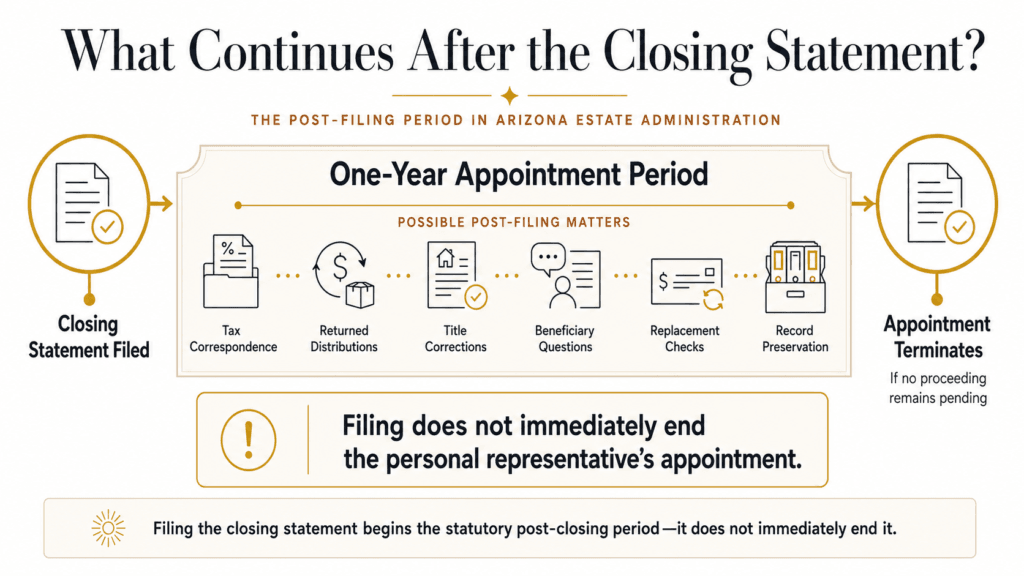
Filing Does Not Immediately End the Appointment
An informal closing statement does not immediately discharge the personal representative.
If no proceeding involving the personal representative remains pending, the appointment terminates one year after the closing statement is filed.
During that year, the representative may still need to address:
- Returned distributions
- Tax correspondence
- Replacement checks
- Title corrections
- Beneficiary questions
- Clerical errors
- Residual account activity
- A proceeding involving the administration
Informal filing and formal discharge are not the same event.
A formal order closing the estate terminates the appointment as provided by Arizona law.
Certain Claims Against the Representative Have a Six-Month Period
Unless already barred and subject to the closing statement’s terms, certain successor and creditor claims against the personal representative for breach of fiduciary duty must generally be started within six months after the closing statement is filed.
This limitation does not include claims seeking recovery for fraud, misrepresentation, or inadequate disclosure related to settlement of the estate. See A.R.S. § 14-3935.
The rule does not excuse an incomplete accounting or misleading closing statement.
Separate Limits May Apply to Distributees
Arizona separately limits certain claims to recover improperly distributed property from a distributee.
Subject to the statute’s qualifications, the later of three years after the decedent’s death or one year after the distribution may apply to specified claims by heirs, devisees, successor representatives, and other noncreditor claimants.
Creditor claims against distributees follow separate creditor-claim rules, and fraud remains an exception. See A.R.S. § 14-3936.
Preserve:
- Distribution dates
- Recipient information
- Assigned values
- Receipts
- Deeds and assignments
- Institutional confirmations
- Mailing records
What if Property Is Discovered After Closing?
Arizona permits subsequent administration when estate property is discovered after:
- The estate was settled and the personal representative was discharged, or
- One year passed after a closing statement was filed
The same person or a successor personal representative may be appointed to administer the later-discovered property.
A claim that was already barred cannot be revived through the later administration. See A.R.S. § 14-3938.
The availability of later administration does not eliminate the need for a careful property search before closing.
Preserve the Complete Probate File
The closing file should generally include:
Court Records
- Will
- Appointment order
- Letters
- Court orders
- Inventory
- Supplemental inventory
- Closing statement
- Proof of filing
- Formal settlement order when applicable
Asset Records
- Bank and investment statements
- Deeds
- Titles
- Appraisals
- Business records
- Sale documents
- Transfer confirmations
Creditor Records
- Published notice
- Publication affidavit
- Direct notices
- Claims
- Allowance and disallowance records
- Settlements
- Payment confirmations
Tax Records
- Federal and Arizona returns
- Tax information statements
- Beneficiary schedules
- Payment confirmations
- Refund records
- Correspondence
- Basis and appraisal records
Distribution and Accounting Records
- Final accounting
- Ledgers
- Reconciliations
- Checks and electronic confirmations
- Deeds and assignments
- Distribution receipts
- Compensation records
- Reimbursement records
The appropriate retention period may depend on tax, property, fiduciary, and litigation issues.
Common Mistakes When Closing Arizona Probate
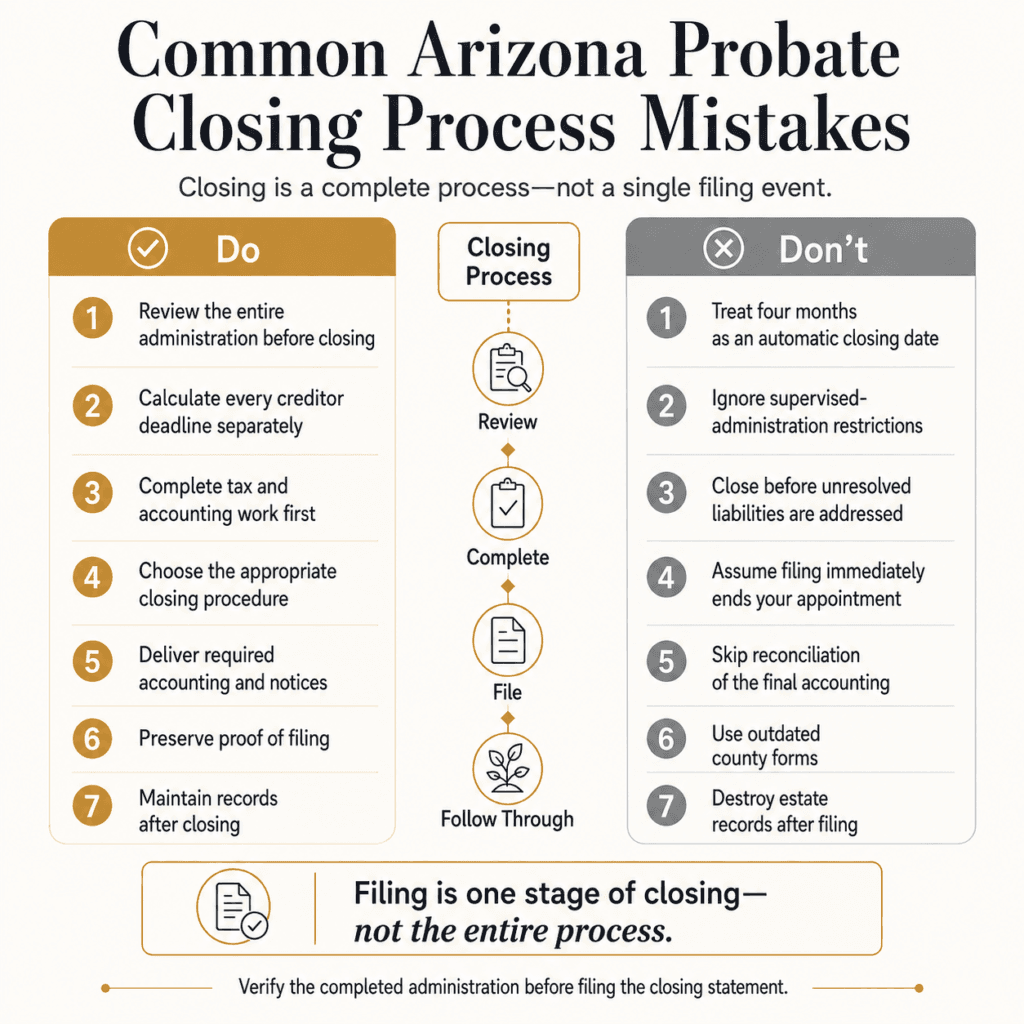
Common closing mistakes include:
- Treating four months as an automatic closing date
- Calculating the creditor period from the wrong publication
- Ignoring a known creditor’s later deadline
- Failing to calendar a disallowed claim’s 60-day response period
- Overlooking post-death or secured obligations
- Omitting an unresolved liability from the closing statement
- Failing to prepare a supplemental inventory
- Leaving an inventory asset unexplained
- Closing before a property sale is complete
- Leaving real estate titled in the decedent’s name
- Assuming a submitted transfer form was processed
- Filing before the tax work is complete
- Distributing all estate cash without a reserve
- Preparing an accounting that does not reconcile
- Mixing compensation with reimbursement
- Failing to deliver the accounting to affected distributees
- Filing an accounting contrary to local instructions
- Using an outdated county form
- Assuming filing immediately ends the appointment
- Destroying records after filing
- Using informal closing when formal settlement is needed
An improper exercise of authority may expose the personal representative to liability for resulting damage or loss.
Do-and-don’t comparison for Arizona probate deadlines, supervision, creditor liabilities, accounting, filing, local forms, and record preservation.
Practical Checklist for Closing Probate in Arizona
Before completing the estate, confirm each item below.
Authority and Closing Procedure
- The estate is unsupervised, supervised, or otherwise restricted as identified.
- Current Letters and court orders were reviewed.
- Informal or formal closing was selected for a clear reason.
- No court order prohibits the selected procedure.
- Any bond or discharge issue was addressed.
Timing and Creditor Claims
- At least four months passed after the original general appointment.
- The first publication date was verified.
- The publication-based creditor period expired.
- Every known creditor received required direct notice.
- Each known creditor’s separate deadline was calculated.
- Every presented claim has a documented status.
- Disallowance response periods were reviewed.
- Post-death and secured obligations were considered.
- Unpaid and unbarred claims are disclosed and accommodated.
Assets and Inventory
- The original inventory is complete.
- Any required supplemental inventory was prepared.
- Every inventory asset has a documented outcome.
- All known probate property was collected.
- Recent records were checked for overlooked property.
- Property sales are complete.
- Sale proceeds and expenses were recorded.
- Liens and encumbrances were addressed.
Taxes and Expenses
- Required federal returns were identified.
- Required Arizona returns were identified.
- Tax payments cleared or were reasonably reserved for.
- Expected refunds were received or addressed.
- Professional fees were paid or reserved for.
- Administration expenses were recorded.
- Personal representative reimbursements are documented.
- Personal representative compensation is documented.
- Any remaining reserve has a stated purpose and calculation.
Distributions and Transfers
- The correct beneficiaries and heirs were identified.
- Final shares were calculated.
- Cash distributions were completed.
- Noncash distributions were completed.
- Real-property instruments were recorded.
- Vehicle titles were transferred.
- Financial-account transfers were confirmed.
- Business-interest assignments were completed.
- Trust funding was completed.
- Minor or incapacitated recipients were handled through authorized arrangements.
- Distribution receipts were obtained when practical.
Accounting and Bank Records
- The accounting begins with the estate’s opening property.
- All income and receipts are recorded.
- All expenses and claim payments are recorded.
- All cash and noncash distributions are recorded.
- Every estate account was reconciled.
- Outstanding checks were resolved.
- The ending balance agrees with the accounting.
- Any remaining property or reserve is explained.
- The estate account will remain open until it is no longer needed.
- Final statements and account-closing confirmation will be preserved.
Closing Documents and Filing
- The closing statement agrees with the accounting.
- Remaining liabilities are disclosed.
- The statement is signed and verified as required.
- The accounting was delivered to affected distributees.
- The closing statement was delivered to all required recipients.
- Proof of mailing or delivery was preserved.
- The current county forms were used.
- The document was filed with the correct court.
- A court-stamped or electronically confirmed copy was saved.
- Post-filing deadlines were calendared.
- The complete estate file was preserved.
Complete the Probate Administration Before Closing
An Arizona probate estate is ready to close when every material asset, obligation, distribution, and accounting entry has a documented result.
The personal representative should be able to trace the estate from the opening inventory through:
- Income and other receipts
- Property sales
- Administration expenses
- Creditor payments
- Taxes
- Cash and noncash distributions
- Final balances
Informal closing is often appropriate when administration is complete and no meaningful dispute remains.
Formal settlement may provide a safer conclusion when the accounting, will, heirs, claims, compensation, or distributions require a judicial decision.
Closing should document a completed administration—not replace one.
Legal Disclaimer: This information is for educational purposes only and does not constitute legal advice. Arizona probate law is complex and varies based on individual circumstances. Always consult with a qualified probate attorney for guidance specific to your situation.
FAQs
An eligible unsupervised estate may file an informal closing statement no earlier than four months after the original appointment of a general personal representative. The creditor period and the statute’s other closing conditions must also be satisfied.
No. Four months is a minimum filing condition. It is not a guaranteed completion date.
Informal closing uses a verified statement filed by the personal representative. Formal closing involves a petition, notice, a hearing, and a court order addressing settlement, accounting, distribution, or discharge.
No. Arizona’s informal-closing statute excludes estates under supervised administration. A supervised personal representative also needs a prior court order before making distributions.
Yes. The personal representative must determine that the applicable time for presenting creditor claims expired.
Yes. A known creditor generally receives the later of four months after the first published notice or 60 days after direct written notice was mailed or delivered.
The claimant generally has 60 days after the notice of disallowance is mailed to petition for allowance or begin a proceeding.
Potentially. The closing statement must disclose the undischarged claim and explain either the distributees’ agreement to possible liability or the other arrangement made to accommodate it.
The personal representative must be able to state that estate property was distributed to the people entitled to receive it, subject to the statute’s treatment of properly accommodated outstanding liabilities.
Arizona’s informal-closing statute requires the accounting to be furnished to affected distributees. Whether it is filed may depend on the closing procedure, court orders, and local county instructions.
All estate distributees and known creditors or claimants whose claims remain unpaid and unbarred must receive copies. Local court instructions may identify additional recipients.
The account should generally remain open until expected deposits, payments, taxes, fees, refunds, and distributions are complete. Its ending balance should agree with the accounting.
No. If no proceeding involving the representative is pending, the appointment generally terminates one year after the closing statement is filed.
The personal representative may petition under the formal-settlement statutes, but the court cannot hear the petition before the period for presenting claims arising before death has expired.
Under the general complete-settlement statute, another interested person generally must wait until one year after the original appointment. The period for presenting pre-death claims must also have expired.
Certain successor and creditor claims for breach of fiduciary duty generally must be started within six months after filing, subject to exceptions for fraud, misrepresentation, and inadequate disclosure.
Arizona permits subsequent administration under the conditions stated in the statute. The same personal representative or a successor may be appointed to administer the later-discovered property.