

Is probate required in Arizona? Learn how ownership, beneficiaries, trusts, survivorship rights, and small-estate rules affect the answer.
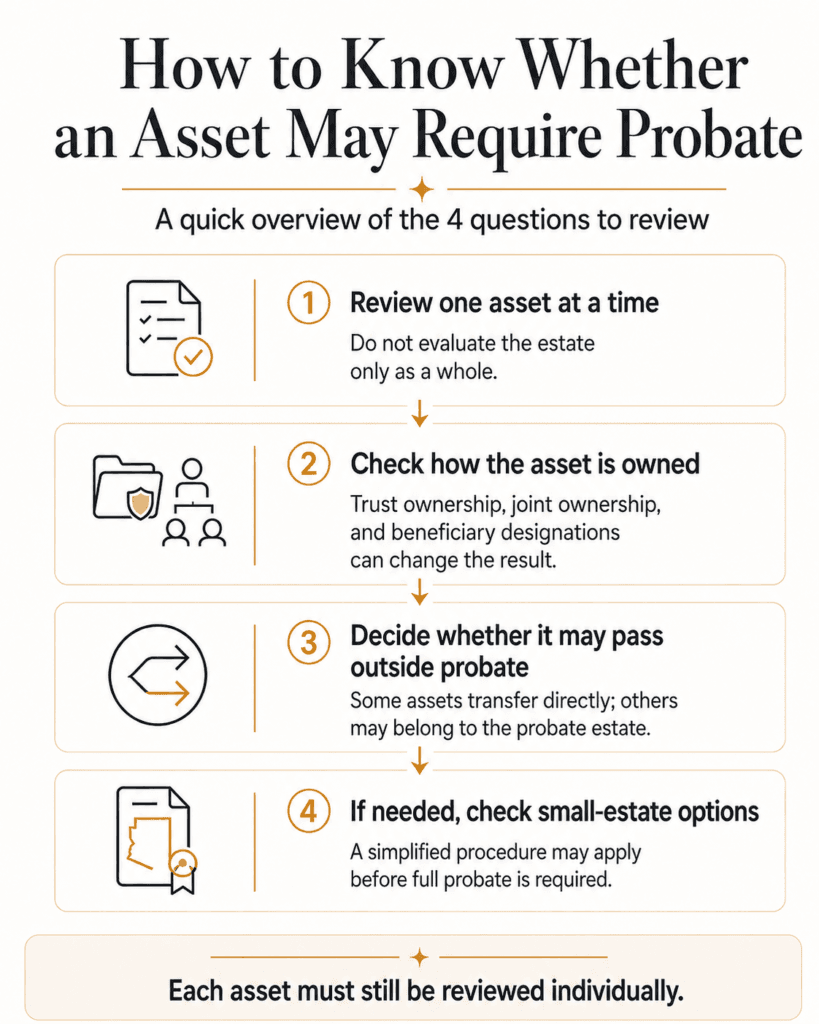
After someone dies, family members often assume probate is required. Not always. The answer usually depends on what the person owned, how each asset was titled, and whether another valid method already exists to transfer it after death.
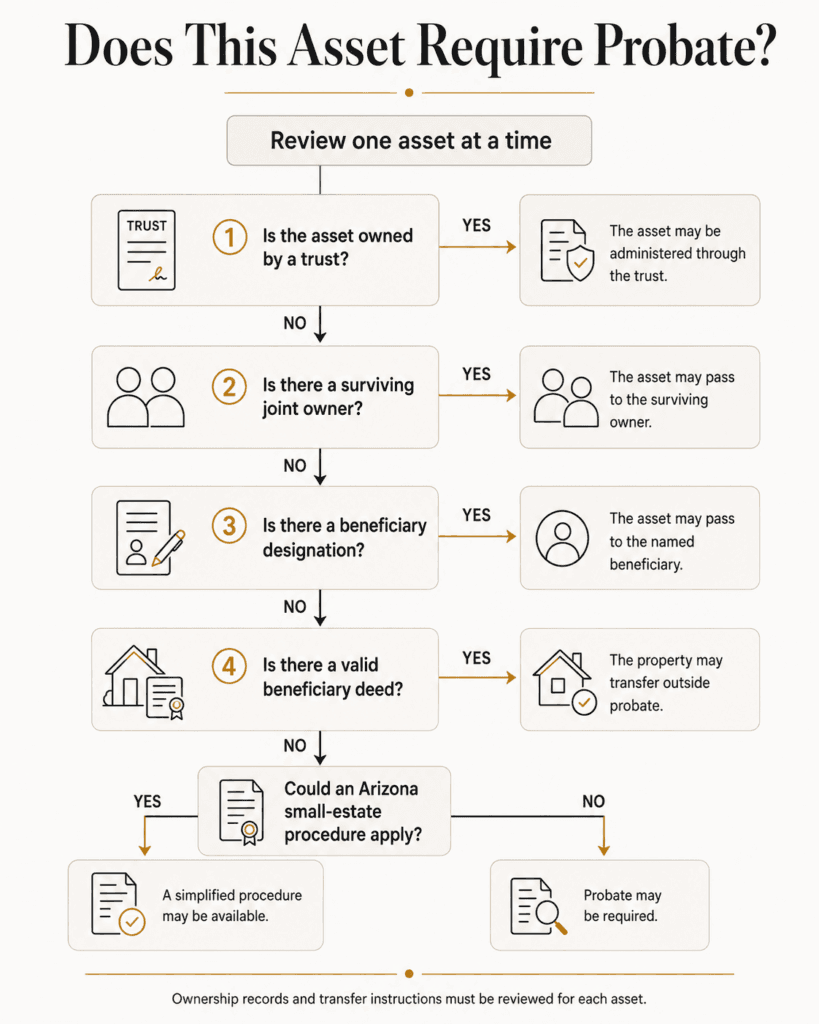
Probate is usually needed when an asset was owned only by the person who died and cannot pass through a trust, beneficiary designation, survivorship right, beneficiary deed, or qualifying small-estate procedure.
That means you should not look at the estate as one big package. Review each asset separately. A house may require probate while a life insurance policy, retirement account, or jointly owned bank account passes directly to someone else.
What is probate?
Probate is the legal process used to handle certain property after someone dies.
Through probate, the Arizona Superior Court can recognize a will, appoint a personal representative, give that person authority to manage estate property, address creditor claims, and transfer assets to the proper heirs or beneficiaries.
The personal representative is the person authorized to administer the probate estate. People sometimes use the word executor, but Arizona law uses the broader term personal representative.
Probate generally deals with property owned by the person who died, called the decedent, when that property has no other effective way to transfer to a new owner.
For a broader overview of the process, see Rahnema Law’s Probate Administration in Arizona guide.
Start with one question: Who owned each asset?
The estate’s total value matters, but it is not the first question.
Start by asking how each asset was owned immediately before the decedent died.
Review documents such as:
- Deeds
- Bank and investment account agreements
- Vehicle titles
- Beneficiary forms
- Trust records
- Business ownership documents
- Insurance policies
- Retirement account records
The exact wording can change the answer.
For example:
- A bank account titled only in the decedent’s name may become probate property.
- An account with a valid payable-on-death beneficiary may pass directly to that beneficiary.
- A home properly transferred to a trust may be managed by the successor trustee.
- A home titled only in the decedent’s name may require probate or, if every statutory requirement is met, a small-estate affidavit.
Arizona law recognizes many transfers created through insurance policies, retirement plans, account agreements, trusts, deeds, and other written instruments as nonprobate transfers.
Arizona Law Note: A.R.S. § 14-6101 recognizes many transfers created by written instruments as nonprobate transfers. Whether a particular asset passes outside probate still depends on the governing document and the facts surrounding the transfer.
When is probate required in Arizona?
Probate may be required when property was owned only by the decedent and has no valid way to transfer automatically after death.
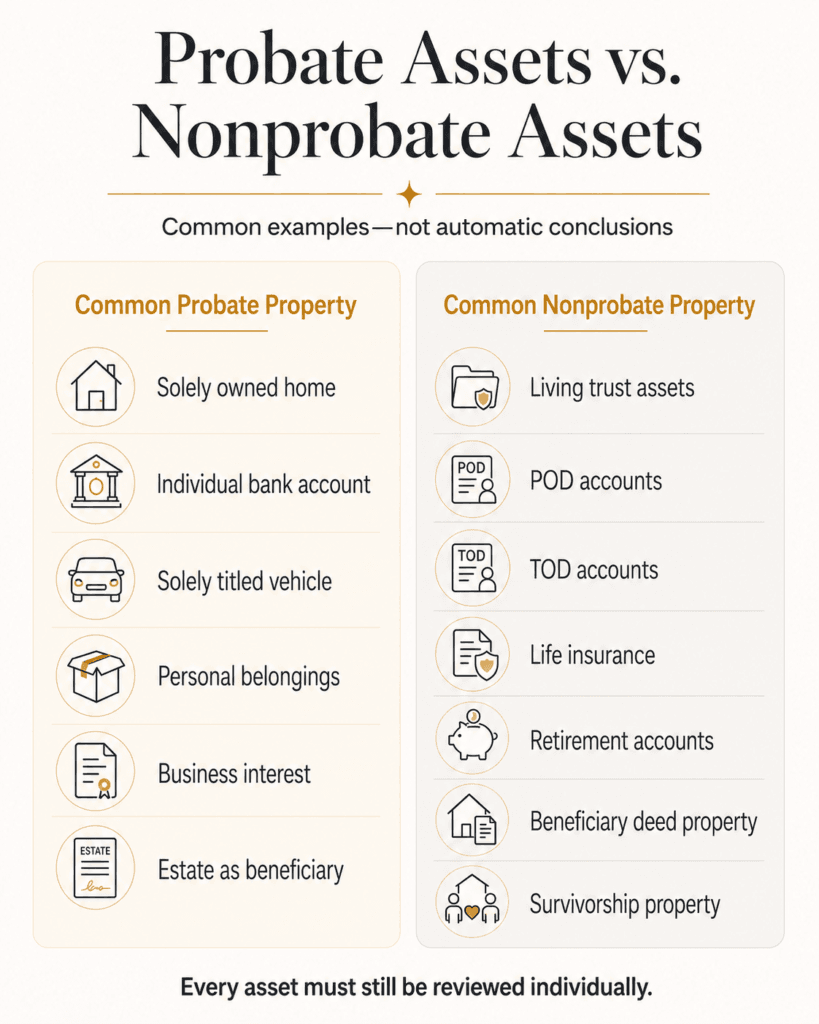
Common examples include:
- Real estate titled only in the decedent’s name
- Bank or investment accounts without a surviving beneficiary
- Vehicles titled only to the decedent
- Personal belongings
- Business interests held individually
- Money owed to the decedent
- Assets payable to the decedent’s estate
Probate may also be needed when a bank, title company, or other organization refuses to release or transfer property without court-issued Letters.
Letters are official court documents connected with a fiduciary appointment. In an informal probate proceeding, appointment establishes the personal representative’s status, powers, and duties.
Does the will decide whether probate is needed?
Not by itself.
A will usually controls probate property. It does not automatically override a title, beneficiary designation, account agreement, trust, or other document controlling a nonprobate asset.
So an asset can appear in the will and still pass another way.
Property held in a trust
Assets properly transferred into a living trust are generally managed by the successor trustee rather than a court-appointed personal representative.
But creating a trust is not enough.
The property must actually have been transferred to the trust.
For example, a home, account, or business interest that was never placed into the trust may still require probate.
A pour-over will may direct probate property into a trust after death, but it does not eliminate probate for property that remained outside the trust.
Accounts with named beneficiaries
Many financial assets can pass directly to a named beneficiary.
Examples include:
- Life insurance
- Retirement accounts
- Annuities
- Payable-on-death bank accounts
- Transfer-on-death investment accounts
For Arizona bank accounts, the account terms in effect at death help determine whether the money passes to a surviving party, a payable-on-death beneficiary, or the decedent’s estate.
A survivorship right or payable-on-death designation generally cannot be changed by a will.
An account may become probate property when:
- No beneficiary survives the decedent.
- The beneficiary designation is invalid or ineffective.
- The estate is named as beneficiary.
- The governing document does not authorize a direct transfer.
Arizona Law Note: Under A.R.S. § 14-6212 and A.R.S. § 14-6213, the terms of certain multiple-party and payable-on-death accounts generally determine who receives the funds at death. A survivorship right or payable-on-death designation generally cannot be changed by a will.
Jointly owned property with survivorship rights
Some jointly owned property passes to the surviving owner when one owner dies.
This may include:
- Bank accounts with survivorship terms
- Real property held as joint tenants with right of survivorship
- Real property held as community property with right of survivorship
But joint ownership does not always mean survivorship.
A deed or account may instead create a tenancy in common or another ownership arrangement. In that situation, the decedent’s share may become part of the estate.
For bank accounts, review the actual account agreement instead of relying only on the names shown on a statement.
Arizona beneficiary deeds
Arizona allows an owner to use a beneficiary deed to transfer real property at death.
A beneficiary deed may allow the property to pass without probate when it:
- Identifies the real property and beneficiary
- States that the transfer takes effect at the owner’s death
- Is properly executed
- Is recorded in the county where the property is located before the owner dies
Timing matters.
Under A.R.S. § 33-405, the beneficiary deed must be properly executed and recorded before the owner’s death to qualify as a beneficiary deed.
A properly executed and recorded beneficiary deed is also not revoked by a will.
The property still passes subject to mortgages, liens, deeds of trust, and other encumbrances that affect it.
Arizona Law Note: A.R.S. § 33-405 sets the requirements for Arizona beneficiary deeds, including execution and recording before the owner’s death. The transfer remains subject to mortgages, liens, deeds of trust, and other encumbrances affecting the property.
A will does not automatically avoid probate
A will is important, but it is not a probate-avoidance tool by itself.
A will can:
- Identify beneficiaries
- Nominate a personal representative
- Explain how probate property should be distributed
It does not automatically transfer property at death.
For example, suppose a will leaves a home to the decedent’s children. If the home remained titled only in the decedent’s name, someone may still need legal authority to transfer the title.
That authority may come through probate or, if every statutory requirement is satisfied, an Arizona small-estate affidavit.
The opposite can also happen.
A will may leave everything to one person, while a bank account has a valid payable-on-death beneficiary naming someone else. In that situation, the account designation generally controls.
Can Arizona small-estate procedures avoid full probate?
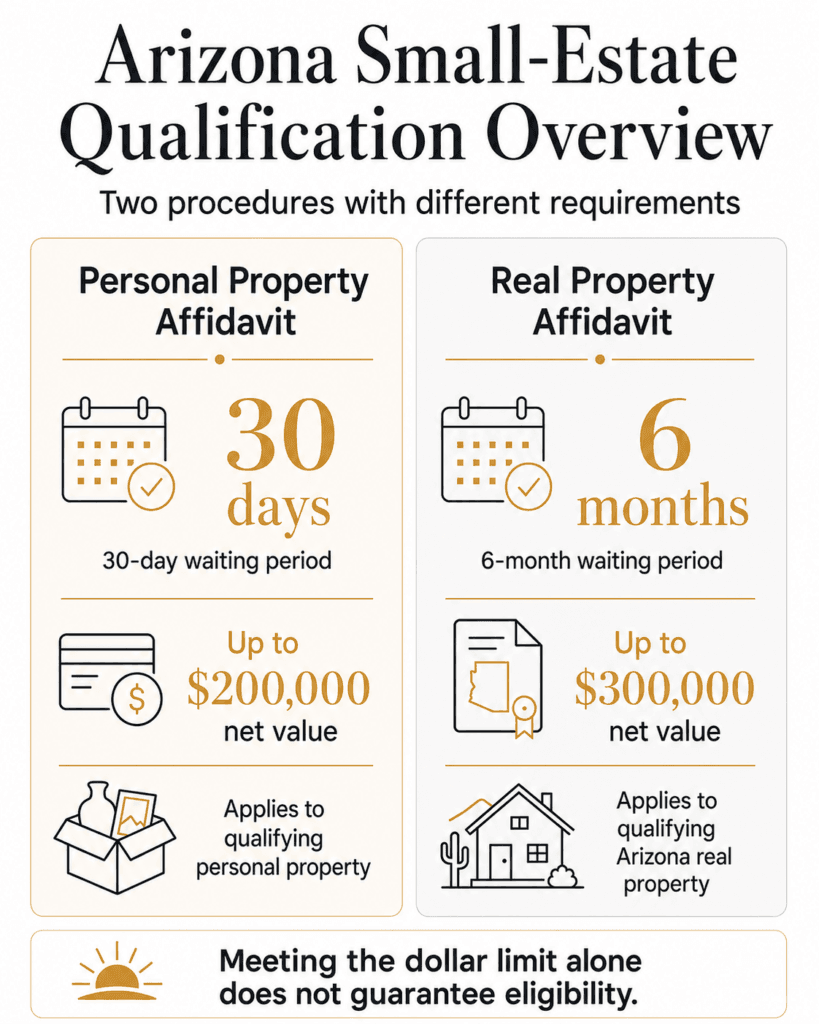
A successor may be able to collect qualifying personal property by affidavit after at least 30 days have passed since the death.
Under A.R.S. § 14-3971, when the statute’s ordinary conditions apply, the net value of all personal property in the decedent’s estate, wherever located, cannot exceed $200,000. Liens and encumbrances are subtracted when calculating that amount.
The affidavit must also state, among other requirements, that:
- At least 30 days have passed since the death.
- The person presenting the affidavit is entitled to the property.
- Funeral expenses have been paid.
- Expenses from the decedent’s last illness have been paid.
Ordinarily, no application or petition for a personal representative may be pending, and a personal representative must not already have been appointed.
Different statutory provisions apply when a personal representative has been discharged or more than one year has passed since a closing statement was filed.
Personal property may include:
- Bank funds
- Vehicles
- Securities
- Tangible personal belongings
- Certain debts or amounts owed to the decedent
The affidavit does not automatically collect the property.
It must be presented to the bank, agency, company, transfer agent, Motor Vehicle Division, or other person holding the asset. That organization may also require additional documents.
Small-estate affidavit for Arizona real property
Arizona has a separate affidavit process for certain real property.
The affidavit cannot be filed until at least six months after the death.
When no personal representative has been appointed, the net value of the decedent’s Arizona real property cannot exceed $300,000.
For that situation, the statute generally measures the property using the full cash value shown on the county assessment rolls for the year in which the decedent died, minus liens and encumbrances.
That number may be different from:
- An appraisal
- An estimated sale price
- A real estate agent’s market analysis
- An online home-value estimate
The affidavit must also establish, among other requirements, that:
- Funeral expenses have been paid.
- Expenses of the last illness have been paid.
- All unsecured debts of the decedent have been paid.
- The person signing is legally entitled to the property.
- No other person has a right to the decedent’s interest.
- No federal estate tax is due.
A certified copy of the death certificate must be attached.
The affidavit must be filed with the appropriate Arizona Superior Court. After the registrar issues a certified copy, that copy must be recorded in the county where the property is located.
Because these statements are made under oath, confirm every requirement before filing.
Arizona Law Note: A.R.S. § 14-3971 contains separate rules for personal-property and real-property affidavits, including waiting periods, value limits, debt requirements, valuation methods, and procedural conditions.
A small estate may still require probate
Being under the small-estate limits does not guarantee that an affidavit will work.
Probate may still be necessary or appropriate when:
- Someone is already seeking appointment as personal representative.
- A personal representative has already been appointed.
- Heirs or beneficiaries disagree.
- The original will is missing or disputed.
- It is unclear who legally owns the property.
- An asset must be sold before it can be distributed.
- A business or lawsuit must be managed.
- Creditor claims need to be formally addressed.
- A financial institution refuses to accept an affidavit.
- Real property exceeds the statutory value limit.
- Unpaid debts prevent use of the affidavit.
- A beneficiary is a minor or incapacitated person.
- The required affidavit statements cannot truthfully be made.
A court appointment can give one person authority to collect information, communicate with institutions, manage property, sign documents, and complete transfers.
How does Arizona community property affect probate?
Arizona is a community property state.
Property acquired by either spouse during marriage is generally community property unless an exception applies, including certain property received by gift, devise, or descent.
When a married person dies, the decedent’s estate includes the decedent’s separate property and the decedent’s share of community property.
Arizona law also provides that the surviving spouse’s share of community property remains subject to administration until the time for presenting claims expires and, after that, to the extent needed to pay community claims.
That does not mean a surviving spouse automatically becomes the owner of every asset simply because the couple was married.
The answer can depend on:
- Whether the asset was community or separate property
- Whether the title included survivorship rights
- How and when the asset was acquired
- Whether inherited or gifted funds were involved
- Whether a marital agreement applies
- Whether community and separate funds were mixed
Title matters, but it may not answer every community-property question.
Arizona Law Note: A.R.S. § 14-1201 defines community property for purposes of Arizona’s probate code and provides that a decedent’s estate includes the decedent’s separate property and share of community property. A.R.S. § 14-3101 addresses how those interests pass at death and the administration of the surviving spouse’s share of community property.
Can nonprobate property still matter to estate debts?
Yes, in some situations.
An asset passing outside probate is not necessarily irrelevant to the estate’s financial obligations.
If the probate estate does not have enough property to pay allowed creditor claims and statutory allowances for a surviving spouse or children, Arizona law may impose limited liability on certain recipients of nonprobate transfers.
That liability generally cannot exceed the value of the covered nonprobate property the recipient received or controlled.
The statute also contains rules about priority, enforcement, demands, deadlines, and which transfers are covered.
This does not mean every beneficiary must return property. It means that passing outside probate does not necessarily place every transferred asset beyond all estate obligations.
Arizona Law Note: A.R.S. § 14-6102 addresses possible liability for certain nonprobate transferees when the probate estate is not sufficient to pay allowed claims and statutory allowances.
Review the estate one asset at a time
The easiest way to determine whether probate may be needed is to make a list of every significant asset.
For each one, record:
- The name on the title or account
- The form of ownership
- The approximate value
- Any loan, lien, or encumbrance
- Whether a beneficiary is named
- Whether that beneficiary survived the decedent
- Whether the property was transferred to a trust
- Whether a beneficiary deed applies
- Whether survivorship rights apply
- Whether the institution will accept an affidavit
Then review each asset separately.
For example, one estate might contain:
- A home owned by a trust
- A payable-on-death bank account
- A vehicle titled only to the decedent
- Personal belongings
The house and bank account may pass without probate. The vehicle or other property may require an affidavit or probate case.
One forgotten asset can change the answer.

Ask these questions before deciding probate is necessary
To determine whether probate is required in Arizona, start with these questions:
- What did the decedent own?
- How was each asset titled?
- Is there a surviving beneficiary or joint owner?
- Does the ownership document include survivorship rights?
- Was the asset properly transferred to a trust?
- Was a beneficiary deed properly recorded?
- Does the estate satisfy every requirement for an Arizona small-estate affidavit?
- Are there debts, disputes, missing documents, or title problems that require court involvement?
The estate’s value matters.
But in many cases, ownership and transfer instructions matter first.
Determine the right next step
Determining whether probate is required in Arizona is rarely as simple as checking whether there is a will or adding up the estate’s value.
Instead, review the deeds, account agreements, beneficiary forms, trust records, debts, and family circumstances.
That review can show which assets transfer automatically and which require additional legal authority.
Some estates can be handled entirely through nonprobate transfers and affidavits. Others require appointment of a personal representative and a formal or informal probate proceeding.
The Arizona Judicial Branch probate forms page provides statewide probate forms and resources. Individual courts may also have their own preferred forms or procedures.
Rahnema Law also maintains an Arizona Probate FAQ covering common questions about the probate process.
When ownership is unclear, debts remain unpaid, an affidavit’s requirements cannot be satisfied, or family members disagree, guidance from an Arizona probate attorney may help prevent an incorrect transfer or an unnecessary court filing.
Legal Disclaimer: This information is for educational purposes only and does not constitute legal advice. Arizona probate law is complex and varies based on individual circumstances. Always consult with a qualified probate attorney for guidance specific to your situation.
FAQs
No. Probate may not be necessary when every asset passes through a trust, beneficiary designation, survivorship right, beneficiary deed, or qualifying small-estate affidavit. Review each asset separately.
No. A will controls property that passes through the probate estate. It does not automatically transfer property or override a valid beneficiary designation, survivorship provision, beneficiary deed, or other governing document
Common examples include solely titled real estate, financial accounts without surviving beneficiaries, individually held business interests, vehicles titled only to the decedent, personal belongings, and property payable to the estate. Whether a specific asset requires probate depends on its ownership and transfer instructions.
The net value of all personal property in the decedent’s estate, wherever located and less liens and encumbrances, generally cannot exceed $200,000 when the ordinary statutory conditions apply. At least 30 days must have passed since the death, and the other requirements in A.R.S. § 14-3971 must also be satisfied.
The net value of the decedent’s qualifying Arizona real property generally cannot exceed $300,000, and at least six months must have passed. The statute also includes debt, entitlement, filing, valuation, and recording requirements.
It may. The deed, account agreement, or other governing document must create a valid right of survivorship for the decedent’s interest to pass that way. Joint ownership without survivorship rights may leave the decedent’s share subject to probate.
Property properly transferred to a trust can generally be administered by the successor trustee. But property that was never transferred into the trust may still require probate or another authorized transfer procedure.
Yes, when the deed satisfies Arizona law and was properly executed and recorded before the owner’s death. An unrecorded beneficiary deed does not qualify as an effective beneficiary deed under A.R.S. § 33-405.
Yes. Probate may still be needed because of disputes, unpaid debts, missing documents, unclear ownership, a rejected affidavit, an asset that must be sold, or an inability to satisfy every statutory affidavit requirement.
Certain recipients of covered nonprobate transfers may face limited liability when the probate estate is insufficient to pay allowed claims and statutory allowances. That liability generally cannot exceed the value of the covered transfer the recipient received or controlled.