
When a loved one passes away, families often feel lost in complex legal procedures. Probate in Arizona involves paperwork, deadlines, and difficult decisions during an already emotional time.
But every successful journey begins with a clear roadmap.
This guide shows you the six essential steps of Arizona probate. Each step brings you closer to what matters most: family peace, legal closure, and honoring your loved one’s wishes.
Two Routes Through the Probate Territory
Arizona law offers two main paths:
Route 1:The Express Trail (Informal Probate)
Best for: Families traveling together in harmony
Benefits:
- Simpler process
- No court hearings required
- Faster completion
- Lower costs
Requirements for the Express Trail:
- All heirs and beneficiaries agree on the Will’s validity.
- No disputes about who should serve as Personal Representative.
- The Will is clear and unambiguous.
- No creditor disputes are expected.
- All interested parties are cooperative.
Route 2:The Guided Expedition (Formal Probate)
What it involves:
- Full court oversight
- Required hearings with a judge
- Longer timeline
- Higher costs
Required when:
- Someone is fighting about the Will
- There is no Will,
- Or there are disputes about who should handle the estate.
Lost your original map? If the original Will can’t be located, expect to set up base camp for an additional 6-12 weeks while the court validates your backup documentation. Additional costs may include extra attorney fees, court filing fees for special procedures, and publication costs, which can range from $1,500 to $3,500 depending on your specific situation.
Important: Families don’t get to choose just because they want the easier path. The law decides which type fits the situation.
Your Six-Waypoint on Your Probate Map
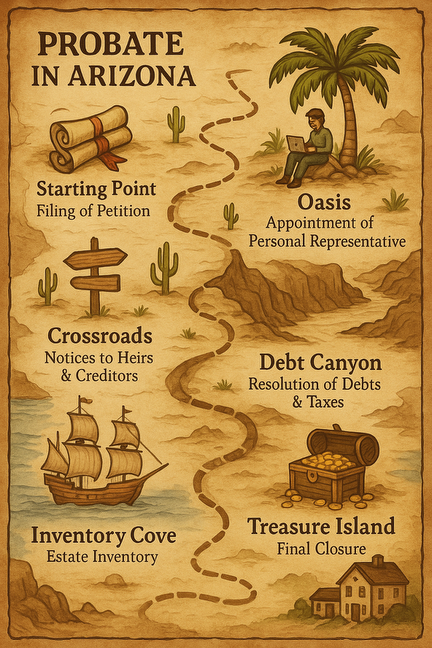
Think of probate as following an ancient treasure map through Arizona’s desert landscape. Here’s what awaits you at each crucial waypoint:
Waypoint 1: Starting Point – Filing of Petition
- Your desert journey begins when someone files the initial paperwork at the courthouse – your official “treasure hunting license.”
What happens at this waypoint:
Submit your application or petition to the probate Court:
- File the petition and the Will (if one exists).
- Pay a filing fee.
- The Court officially opens the case.
Navigator’s note: Just like early prospectors needed proper permits, you can’t begin handling estate business until you’ve registered with the Court authorities.
Waypoint 2: The Oasis – Appointment of Personal Representative
At this refreshing oasis, the Court appoints your expedition leader – the Personal Representative who will guide your group through the remaining waypoints.
- The Court appoints an expedition leader (Personal Representative).
- They receive:
- Legal authority to act for the estate
- Access to accounts and property
- Responsibility to protect the estate and all heirs
Desert wisdom: No one else can legally manage estate property until this step is complete.
Waypoint 3: The Crossroads – Notices to Heirs & Creditors
Sending smoke signals across the territory to announce your expedition
At this critical junction, your expedition leader, a.k.a. Personal Representative must send word far and wide about your treasure hunt.
The Personal Representative must send notices to:
- All heirs and beneficiaries.
- Creditors (people or businesses owed money).
- The public (through a newspaper notice).
Why this crossroads matters: These notices start the legal countdown for creditor claims and ensure no rightful treasure seekers are left behind.
Waypoint 4: Debt Canyon – Resolution of Debts & Taxes
Before any treasure can be distributed, you must settle all outstanding debts.
This includes:
- Funeral expenses
- Court and attorney fees
- Final medical bills
- Taxes
- Other valid debts
Prospector’s code: Just as honest miners paid their debts before keeping their gold, heirs typically aren’t responsible for debts beyond what treasure the estate contains.
Waypoint 5: Inventory Cove – Estate Inventory
At this detailed waypoint, your expedition leader creates a comprehensive treasure manifest for the Court.
Everything gets catalogued:
- Real estate claims and mining rights
- Bank deposits and investment certificates
- Personal valuables and family heirlooms
- Business interests and ongoing ventures
- Any other assets discovered along the journey
This official inventory gives everyone a clear picture of the total treasure discovered and ensures nothing gets lost in the desert like “X” marks the spot.
Waypoint 6: Treasure Island – Final Closure
Reaching your destination and distributing the family treasure
The final step: distributing the estate and closing the case. At this final celebration point:
What happens:
- Final shares are given to each family member according to the map
- A closing petition celebrates the successful expedition
- The Court reviews your entire journey and approves your work
- An official proclamation declares your quest complete
Victory celebration: The estate is legally settled, your expedition leader’s duties are complete, and your family has successfully navigated the probate desert together.
Desert Survival Tips for Your Probate Journey
Essential wisdom for desert travelers:
- Never travel alone – An attorney can guide you safely through the process.
- Expect mirages – Build in extra time and money for unexpected delays.
- Trust your compass – Court steps exist to protect families.
How Long Does It Take:
- Express trail (informal): 6-9 months from start to completion
- Guided expedition (formal): 12-18 months with full court supervision
- If the Will is missing: Add 6-12 weeks for validation procedures
Expert Desert Guides Make All the Difference
Even the most detailed treasure map can’t replace an experienced desert guide. While our roadmap shows you the route, every family’s expedition faces unique challenges:
Why Hire a Probate Guide?
- Route optimization to avoid common pitfalls and delays
- Navigation expertise through complex legal terrain
- Desert survival skills for handling family disputes and creditor challenges
- Emergency assistance when unexpected storms arise
Need help on your probate journey?
Contact our experienced Arizona probate guides today. We’ve led hundreds of families safely through these desert passages, and we know exactly how to get you from confusion to closure.
Whether you’re just starting or already facing obstacles, we can:
- Review your case and explain your options clearly
- Handle court filings and deadlines on your behalf
- Resolve disputes with creditors or family members
- Keep the process as smooth and stress-free as possible
Remember: Every great treasure hunt starts with a single step into the desert. But with the right map and experienced guides, you’ll find that the path to family peace is clearer than you ever imagined.
Summary: Your Arizona Probate Roadmap
The Process: Arizona probate follows six essential steps, from filing the initial petition to final distribution and closure.
Two Paths Available:
- Streamlined (Informal): 6-8 months, no court hearings, requires family agreement
- Supervised (Formal): 12+ months, court oversight, required for disputed cases
Key Steps:
- File petition/application and open probate case
- Court appoints Personal Representative
- Send required notices to heirs and creditors
- Pay all debts and taxes
- Create complete asset inventory
- Distribute assets and close estate
Timeline: Most cases take 6-12 months, depending on complexity and family cooperation.
Important: Professional legal guidance helps navigate requirements, meet deadlines, and avoid costly mistakes during this emotional time.
Next Step: Contact an experienced Arizona probate attorney to review your specific situation and guide you through the process with confidence.
Legal Disclaimer: This information is for educational purposes only and does not constitute legal advice. Arizona probate law varies based on individual circumstances. Always consult with a qualified probate attorney for guidance specific to your situation.