

Learn when to reopen an Arizona probate estate, who may apply, how later assets are handled, and which claims remain barred.
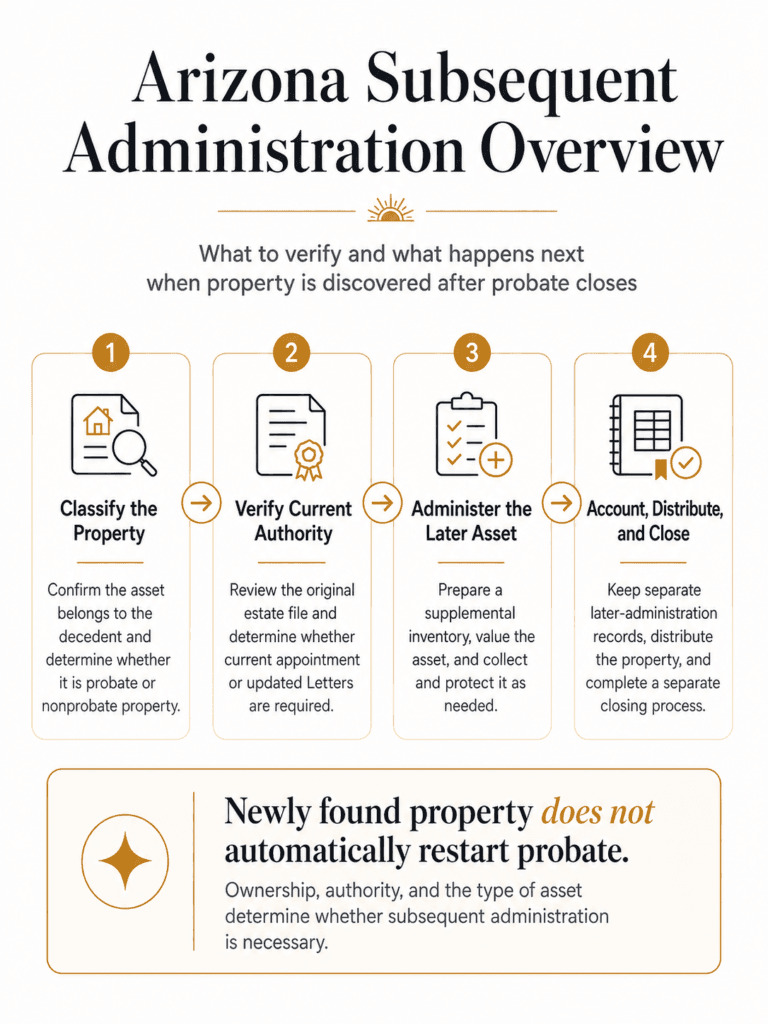
You may need to reopen an Arizona probate estate when property belonging to the decedent appears after the original administration has ended.
Common examples include:
- An unknown bank or investment account
- Unclaimed property
- Omitted real estate
- A mineral or royalty interest
- Delayed settlement proceeds
- Insurance proceeds payable to the estate
- A tax or escrow refund
- Money owed to the decedent
People often call this process “reopening probate.” Arizona law generally calls it subsequent administration.
Subsequent administration usually does not require repeating the entire original probate. Instead, it gives a personal representative current authority to collect, protect, value, account for, and distribute property that the original administration did not address.
Before filing anything, determine:
- Whether the property actually belongs to the probate estate
- Whether the property was already included in the original administration
- How the estate was closed
- Whether the former representative’s appointment remains active
- Whether the original proceeding was informal, formal, or supervised
- Who may request a new appointment
- Who is legally entitled to the later property
- Whether a valid liability remains unresolved
- Whether the asset creates additional tax obligations
The first step is to identify the property and its ownership, not to file a petition automatically.
Arizona Calls the Process Subsequent Administration
Arizona’s subsequent-administration statute applies when additional estate property is discovered after either:
- The estate was settled, and the personal representative was discharged, or
- One year passed after an informal closing statement was filed
An interested person may then apply or petition for appointment of the same personal representative or a successor to administer the newly discovered property.
The required notice must also be provided.
See A.R.S. § 14-3938.
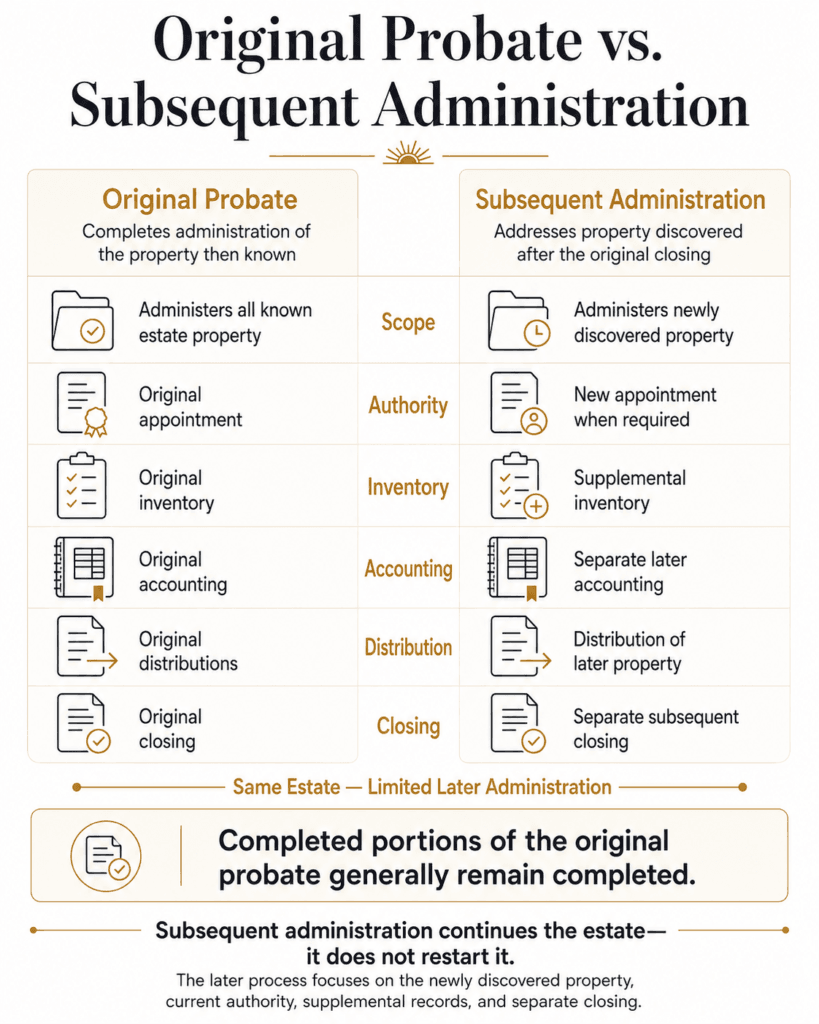
This framework preserves the completed portions of the original administration. The earlier estate is not treated as though it never closed.
Instead, the later proceeding focuses on:
- The newly discovered property
- Related income and expenses
- Valid liabilities affecting that property
- Additional tax work
- The correct recipients
- Transfer documents
- A separate accounting
- Closing the later appointment
A previously barred creditor claim does not become valid merely because another asset was found.
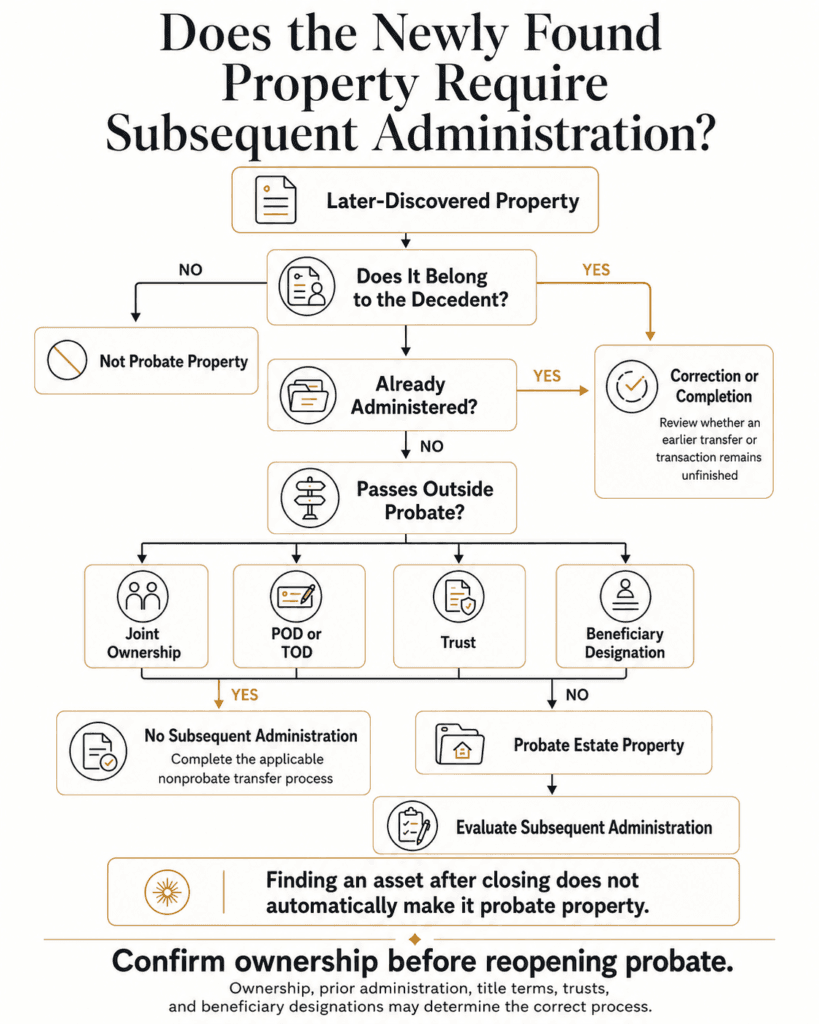
Reopening and Correcting an Unfinished Transfer Are Different
Not every post-closing problem requires subsequent administration.
Sometimes the estate already identified, accounted for, and distributed the property, but a clerical or institutional problem prevented completion.
Examples include:
- A recorder rejected a deed because of formatting.
- A beneficiary’s distribution check was returned.
- A brokerage approved a transfer but did not complete it.
- A title application needs another signature.
- A stale check must be replaced.
- An expected refund arrived after the closing statement.
- An institution requests another copy of an authorized document.
These situations differ from discovering an asset that the original inventory and accounting never addressed.
The former representative should determine whether the issue involves:
- Completing an already authorized transaction
- Correcting a clerical or institutional problem
- Collecting property disclosed in the original accounting
- Administering property that was never identified or distributed
That distinction may determine whether a new appointment is necessary.
The Original Closing Method Matters
An Arizona estate may close through an informal closing statement or a formal court order.
Those procedures affect when the personal representative’s authority ends.
After an Informal Closing Statement
If no proceeding involving the personal representative remains pending, the appointment generally terminates one year after the closing statement is filed.
An asset discovered during that year may present a different procedural issue from one discovered after the year expires.
Review:
- Filing date of the closing statement
- Current court docket
- Pending petitions or objections
- Existing Letters
- Appointment order
- Orders restricting authority
- Description of the asset in the original accounting
The continued appointment does not mean the representative may conduct substantial work that should have been completed before filing the closing statement.
The closing statement represented that the estate had been fully administered, except for any undischarged liability that was expressly disclosed and accommodated.
After a Formal Closing Order
A formal order closing the estate terminates the personal representative’s appointment through the court’s order.
When property appears after formal discharge, the former representative should not rely on the prior appointment as current authority.
Subsequent administration may be necessary even when the same person is willing to serve again.
For a broader explanation of the two closing methods, see Rahnema Law’s guide to informal and formal Arizona probate closing.
Do Not Rely on Expired Letters
A person acquires the powers and responsibilities of an Arizona personal representative through appointment, qualification, and issuance of Letters.
After the appointment terminates, an old certified copy of the Letters does not automatically provide current authority.
Current authority may be necessary to:
- Endorse or deposit a check
- Collect a bank or investment account
- Sell or transfer real property
- Sign a deed
- Execute a business assignment
- Resolve an institutional claim
- File a fiduciary tax return
- Distribute property
- Open or reactivate an estate account
Using expired authority may create:
- Title defects
- Institutional rejection
- Delays
- Questions about enforceability
- Personal liability
A bank or title company’s willingness to accept an old document does not establish that the authority remains legally valid.
Rahnema Law’s guide to Letters of Appointment in Arizona probate explains why current Letters matter when someone acts for an estate.
First Determine Whether the Item Is Probate Property
Not every asset discovered after closing belongs to the probate estate.
Property may pass outside probate through:
- Joint ownership with survivorship rights
- Community property with right of survivorship
- Payable-on-death designation
- Transfer-on-death designation
- Life insurance beneficiary designation
- Retirement-account beneficiary designation
- Trust ownership
- Contractual beneficiary rights
- Another governing instrument
Arizona recognizes many written nonprobate transfers at death. See A.R.S. § 14-6101.
Before seeking subsequent administration, review:
- Account title
- Deed
- Beneficiary form
- Contract
- Trust agreement
- Payee name
- Original inventory
- Final accounting
- Distribution records
- Correspondence from the institution holding the property
A check issued after death is not automatically probate property merely because it bears the decedent’s name.
For help distinguishing probate and nonprobate property, see Is Probate Required in Arizona?.
A Later Payment May Belong Directly to Someone Else
A later payment may legally belong to:
- A surviving joint owner
- A designated beneficiary
- A trustee
- A surviving spouse
- A business entity
- Someone who acquired the underlying right during the original administration
The payment may also replace money that was already administered.
For example, an institution might:
- Reissue an uncashed distribution
- Replace a stale check
- Refund an estate fee
- Correct an earlier payment
- Reissue proceeds already listed in the accounting
Review the underlying right, not only the name on the replacement payment.
Opening subsequent administration for property that already belongs to a nonprobate recipient can create unnecessary expense and confusion.
Common Later-Discovered Assets
Property that may require subsequent administration includes:
- Unknown bank account
- Investment account
- Unclaimed-property payment
- Omitted real estate
- Mineral, oil, gas, or royalty interest
- Business ownership interest
- Promissory note
- Loan repayment
- Intellectual-property royalty
- Insurance proceeds payable to the estate
- Settlement or lawsuit proceeds
- Escrow refund
- Utility or care-facility refund
- Tax refund
- Replacement check
- Digital financial asset
- Money owed to the decedent
Document the asset before anyone attempts to collect it.
Preserve:
- Correspondence from the institution
- Account statement
- Check
- Title report
- Deed
- Contract
- Ownership ledger
- Unclaimed-property record
- Settlement document
- Evidence connecting the property to the decedent
The evidence should show both the existence of the property and why it belongs to the probate estate.
Who May Request Subsequent Administration?
Arizona permits an interested person to apply or petition for the new appointment.
Depending on the proceeding, an interested person may include:
- Trustee
- Heir
- Devisee
- Child
- Spouse
- Creditor
- Beneficiary
- Person holding a power of appointment
- Person with a property right in or claim against the estate
- Person with priority for appointment
- Fiduciary representing an interested person
Arizona defines “interested person” according to the particular proceeding and issue involved. See A.R.S. § 14-1201.
The person requesting appointment should be able to explain:
- What property was discovered
- Why the property belongs to the estate
- Why current authority is necessary
- How the original estate closed
- Who should serve
- Who must receive notice
- What administration the later asset requires
The Former Personal Representative May Serve Again
Arizona permits appointment of:
- The same personal representative, or
- A successor personal representative
Reappointing the former representative may be practical because that person may already have:
- The original will
- Court orders
- Inventory
- Creditor file
- Tax file
- Final accounting
- Beneficiary contact information
- Knowledge of earlier distributions
However, the former representative must obtain a valid new appointment when the prior appointment has terminated.
Familiarity with the estate does not substitute for current Letters.
A Successor May Be More Appropriate
A different person may need to serve when the former personal representative:
- Is deceased
- Is incapacitated
- Cannot be located
- Declines to serve
- Is no longer eligible
- Has a conflict involving the new property
- Was removed
- Is disputed by interested persons
The successor should receive the original probate records before beginning the later administration.
Without those records, the successor may be unable to determine:
- Who inherited
- Which obligations were resolved
- What property was already distributed
- Which tax returns were filed
- Whether a claim was barred
- How the later asset fits into the original distribution plan
Informal Application or Formal Petition?
Arizona’s subsequent-administration statute ties the appointment procedure to the type of original proceeding that was used or legally could have been used.
The registrar may make the appointment when the original application was, or could have been, brought through Arizona’s informal-proceeding provisions.
The court makes the appointment when the original petition had to proceed under the formal or supervised-administration provisions.
This distinction does not depend only on whether the earlier paperwork happened to use the word “informal.”
The correct path may depend on:
- Whether informal appointment remains available
- Whether testacy is contested
- Whether heirship requires determination
- Whether supervision is required
- Whether a prior court order controls
- Whether the proposed appointment is disputed
- Whether judicial findings are necessary
A contested request may require formal court involvement even if the original probate began informally.
Confirm Current County Procedures
Arizona’s statewide probate forms are generic. Individual superior courts may use their own preferred forms, filing systems, and instructions.
Before filing, confirm:
- County where the original case was administered
- Whether the original case number remains in use
- Whether a new case designation is required
- Required application or petition
- Notice form
- Acceptance of appointment
- Bond requirement
- Proposed order
- Filing fee
- Method for obtaining certified Letters
- Closing procedure for the subsequent administration
Court forms and filing systems can change. Review the current instructions immediately before filing.
Do not assume that a packet from one Arizona county applies without modification in another.
Notice Is Part of the Appointment Process
The application or petition for subsequent administration must proceed with the notice required by Arizona probate law.
Depending on the circumstances, notice may need to go to:
- Heirs
- Devisees
- Beneficiaries
- Former personal representative
- People with appointment priority
- Trustee
- Claimant
- Other people whose interests may be affected
The notice file should preserve:
- Document sent
- Recipient
- Address
- Mailing or delivery date
- Delivery method
- Proof of service or mailing
- Returned mail
- Corrected address
- Filed proof of notice
Notice can become especially important when the later property will not be divided among the same people or in the same proportions as the original estate.
Obtain Current Letters Before Collecting Property
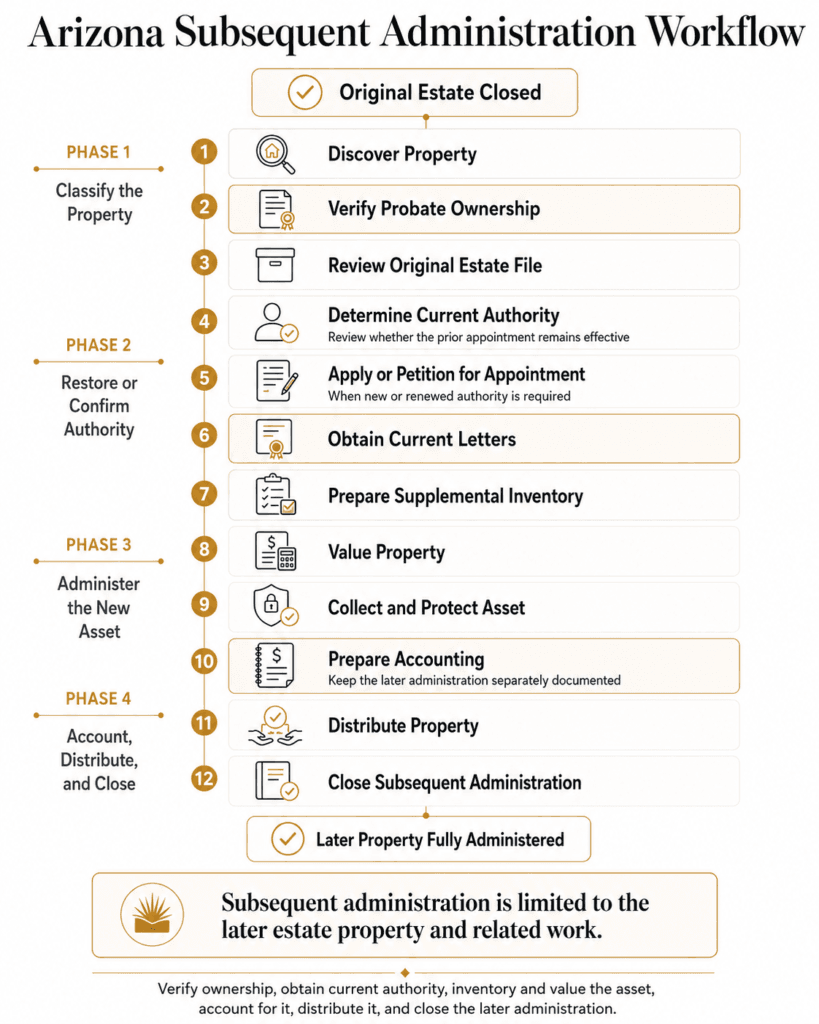
After appointment and qualification, obtain current Letters showing the personal representative’s authority.
The institution holding the asset may request:
- Certified Letters
- Death certificate
- Estate taxpayer identification number
- Court order
- Will
- Affidavit
- Transfer forms
- Signature guarantee
- Institutional claim package
Do not sign as personal representative until the authority to act has been confirmed.
The institution’s willingness to communicate about an asset does not give a former representative legal authority to collect it.
Review the Original Estate File
Before administering the new property, review:
- Will and codicils
- Heirship orders
- Appointment records
- Inventory
- Supplemental inventories
- Creditor notices
- Claim log
- Tax returns
- Final accounting
- Closing statement
- Formal closing order
- Distribution receipts
- Settlement agreements
- Records of unresolved liabilities
The original file should answer:
- Who is entitled to the new property?
- Was the property mentioned previously?
- Was a related liability already addressed?
- Did the original distributions involve equalization?
- Was part of the residue retained?
- Were any beneficiaries missing or legally disabled?
- Did a court order interpret the will?
- Did a settlement change the distribution plan?
Subsequent administration should build on the original estate rather than treat the later payment as an isolated event.
Prepare a Supplemental Inventory
When property omitted from the original inventory comes to the personal representative’s attention, Arizona requires a supplemental inventory or appraisal.
The supplement should identify:
- Description of the new property
- Market value as of the decedent’s date of death
- Revised description when appropriate
- Appraiser or other valuation data relied upon
- Liens or encumbrances
- Supporting documents
If the original inventory was filed, the supplemental inventory must also be filed.
If the original inventory was not filed, the appropriate information must be furnished to interested persons affected by the new information.
See A.R.S. § 14-3708.
Rahnema Law’s Arizona Probate Inventory Checklist explains the role of the original and supplemental inventory.
Date-of-Death and Current Values Serve Different Purposes
A later-discovered asset may have several relevant values:
- Date-of-death value
- Value when discovered
- Value when collected
- Sale price
- Value at distribution
The supplemental inventory focuses on fair market value at the decedent’s death.
The later accounting may also need to show:
- Post-death income
- Appreciation
- Depreciation
- Fees
- Losses
- Sale proceeds
- Final amount available for distribution
For example, an investment account may have:
- One date-of-death value
- Later dividends
- Market changes
- Institution fees
- A different value at distribution
Do not treat those amounts as interchangeable.
Obtain a Defensible Valuation
The valuation method should fit the asset.
Possible evidence includes:
- Date-of-death bank statement
- Brokerage statement
- Real-estate appraisal
- Business valuation
- Mineral appraisal
- Vehicle valuation
- Royalty statement
- Promissory-note calculation
- Expert opinion
- Comparable sales
When property does not have a readily ascertainable value, Arizona permits a personal representative to use a reasonable valuation method, including a qualified appraisal, in connection with distribution. See A.R.S. § 14-3906.
The valuation file should explain:
- Valuation date
- Method
- Assumptions
- Source materials
- Appraiser qualifications
- Difference between inventory and distribution values
Collect and Protect the Property
A newly appointed personal representative is a fiduciary.
The representative must settle and distribute the estate under the will, Arizona law, and applicable court orders while acting consistently with the estate’s best interests. See A.R.S. § 14-3703.
Depending on the property, the representative may need to:
- Collect funds
- Deposit money
- Secure physical property
- Insure real estate
- Obtain a title report
- Pay property taxes
- Prevent waste
- Communicate with tenants
- Protect a business interest
- Manage securities
- Enforce money owed to the estate
- Hire an appraiser, accountant, or attorney
Do not distribute the asset before ownership, authority, value, expenses, and legal entitlement are clear.
Determine Whether an Estate Account Is Needed
Later property should not be mixed with the personal representative’s own funds.
The representative may need to:
- Reopen an estate bank account
- Establish a new fiduciary account
- Use the estate’s existing taxpayer identification number
- Confirm the correct account title
- Maintain a separate ledger
The appropriate structure depends on:
- Whether an estate account remains open
- Whether the original appointment remains active
- Amount of property
- Expected expenses
- Anticipated tax filings
- Number of beneficiaries
- Length of the later administration
Every receipt and payment should remain traceable.
Real Estate Requires Immediate Attention
Omitted real property may create continuing responsibilities involving:
- Title
- Mortgage
- Deed of trust
- Tax lien
- Property taxes
- Insurance
- Occupancy
- Maintenance
- Homeowners association charges
- Rental income
- Environmental or safety conditions
Confirm:
- Correct legal description
- Decedent’s ownership interest
- Community or separate-property character
- Co-ownership
- Existing liens
- Date-of-death value
- Current condition
- Insurance status
Do not sell or distribute real property until ownership and authority are clear.
The personal representative may also need to act quickly to prevent uninsured loss, tax delinquency, waste, or damage.
Business and Mineral Interests May Need Specialized Review
Later-discovered property may include:
- Limited liability company interest
- Partnership interest
- Corporate shares
- Royalty interest
- Oil or gas lease
- Mineral right
- Patent, copyright, or royalty stream
The representative may need to review:
- Operating agreement
- Partnership agreement
- Shareholder agreement
- Buy-sell restrictions
- Transfer limitations
- Voting rights
- Management rights
- Royalty statements
- Division orders
- Tax-reporting history
The gross value of the interest may differ substantially from the amount available to beneficiaries after:
- Valuation discounts
- Transfer restrictions
- Taxes
- Administration expenses
- Secured obligations
- Contractual purchase rights
Business, mineral, and intellectual-property assets often require coordinated legal, accounting, and valuation advice.
Previously Barred Creditor Claims Do Not Return
A new appointment does not revive a creditor claim that was already barred.
Arizona’s subsequent-administration statute expressly provides that a previously barred claim may not be asserted in the later administration. (azleg.gov)
Review and preserve:
- Published notice
- Direct creditor notices
- Claim deadlines
- Claim log
- Allowance records
- Disallowance notices
- Settlement agreements
- Court orders
- Proof of payment
Finding another asset is not a second opportunity for every old creditor to begin again.
A Valid Unresolved Liability May Still Matter
The rule against reviving barred claims does not eliminate an obligation that remained valid, unbarred, secured, or expressly accommodated when the original estate closed.
A valid liability may have been:
- Timely presented
- Preserved through litigation
- Secured by the later property
- Covered by a settlement
- Reserved for
- Disclosed in the closing statement
- Subject to a court order
Before distributing the new asset, determine whether it must first satisfy:
- A valid outstanding claim
- Secured debt
- Tax liability
- Administration expense
- Court-ordered obligation
Arizona permits an unbarred and undischarged claim to be pursued against distributees under the conditions and limits described in A.R.S. § 14-3934.
Reopening Does Not Reset Every Probate Deadline
Subsequent administration generally does not:
- Restart creditor periods
- Erase prior court orders
- Reopen adjudicated claims
- Extend every objection deadline
- Undo valid distributions
- Recalculate the entire estate automatically
Arizona separately limits specified claims against distributees, generally using the later of three years after death or one year after distribution for certain noncreditor claims. Fraud receives different treatment. See A.R.S. § 14-3936.
A person who believes the original estate was mishandled should not assume that discovery of a later asset revives every possible challenge.
An Improper Distribution Is a Separate Issue
A later-discovered asset is property that the original administration did not address.
An improper distribution involves property that the estate administered but transferred:
- To the wrong person
- In the wrong amount
- Contrary to the will
- Without proper authority
- Before a controlling dispute was resolved
Arizona may require someone who improperly received estate property to return:
- The property
- Income generated by the property
- Its value at disposition when the property is no longer held
- Related income and gain
See A.R.S. § 14-3909.
An improper-distribution claim may require a separate proceeding even when no new asset has been discovered.
Determine Who Is Entitled to the Later Property
The later asset generally follows the same governing law that would have applied if it had been discovered during the original administration.
Review:
- Will
- Codicils
- Residuary clause
- Specific gifts
- Heirship orders
- Arizona intestacy law
- Disclaimer documents
- Settlement agreements
- Prior distribution orders
- Trust provisions
Do not simply divide the later property among everyone who received something during the original probate.
For example:
- A person who received a specifically devised vehicle does not automatically receive part of an omitted bank account.
- A later asset may belong entirely to the residuary beneficiaries.
- Property not disposed of by the will may pass through intestacy.
- A settlement agreement may alter the original rights.
- A prior court order may control allocation.
Document the legal basis for each recipient’s right.
Prior Distributions May Affect the Calculation
Although entitlement comes from the will, intestacy law, settlement, trust, or court order, the original distributions may still affect the calculation.
The representative may need to determine whether the later property:
- Changes percentage-based shares
- Requires an equalization payment
- Affects abatement
- Satisfies an unpaid specific gift
- Belongs to the residue
- Produces income allocated differently from principal
- Must first pay an unresolved obligation
Keep the original accounting and distribution schedule in the later calculation file.
In-Kind Distributions Require Current Valuation
Arizona generally favors in-kind distribution when consistent with the will and applicable law.
For property without a readily ascertainable value, a reasonable valuation dated no more than 30 days before distribution may control. The representative may use a qualified appraiser or another reasonable method. (azleg.gov)
The representative may also send a proposed distribution after probable estate charges are known.
A distributee’s right to object to the kind or value of the proposed property generally terminates if the representative receives no written objection within 30 days after mailing or delivery, unless the right was previously waived.
Arizona Law Note: The 30-day rule concerns objections to the kind or value of a proposed distribution. It does not eliminate every possible objection to the subsequent administration.
Use the Correct Transfer Document
When property is distributed in kind, Arizona requires the personal representative to execute an instrument or deed assigning, transferring, or releasing the property as evidence of title. See A.R.S. § 14-3907.
For recorded real property, the instrument must include the names and addresses of the distributees.
Other property may require:
- Vehicle title
- Brokerage transfer form
- Bank instruction
- Business-interest assignment
- Mineral deed
- Royalty assignment
- Intellectual-property assignment
- Promissory-note endorsement
- Institutional claim documentation
Preserve evidence that the recorder or institution completed the transfer.
A signed document alone may not prove that legal ownership changed.
Missing Recipients Require Special Handling
If an heir, devisee, or claimant cannot be located, Arizona provides a statutory method for handling that person’s share.
The personal representative generally distributes the share to the person’s conservator, if one exists. Otherwise, the representative follows the statutory deposit procedure.
See A.R.S. § 14-3914.
Preserve:
- Search efforts
- Last known address
- Returned correspondence
- Database searches
- Family inquiries
- Publication or other notice
- Conservatorship information
- Deposit records
- Court instructions
Do not divide a missing recipient’s share among the other beneficiaries merely because the person is difficult to locate.
Legally Disabled Recipients May Need an Authorized Payee
A minor or incapacitated beneficiary may be entitled to the later property but unable to receive and manage it directly.
Arizona allows the personal representative to distribute to:
- The person’s conservator, or
- Another person legally authorized to provide a valid receipt and discharge
See A.R.S. § 14-3915.
Do not transfer substantial property directly to an unauthorized parent, family member, or caregiver without confirming the proper legal arrangement.
Administration Expenses May Be Paid From the Later Property
Subsequent administration can create legitimate expenses, including:
- Filing fee
- Certified Letters
- Appraisal
- Title report
- Recording cost
- Bank charges
- Tax preparation
- Insurance
- Property maintenance
- Legal services
- Accounting services
The expenses should be:
- Reasonable
- Necessary
- Documented
- Paid from estate funds
- Separately identified in the accounting
When the later asset is small, compare its value with the expected cost of administration before initiating an unnecessarily expensive process.
The size of the asset does not eliminate legal requirements, but it may affect which lawful procedure is most practical.
Additional Tax Work May Be Necessary
A later-discovered asset may produce:
- Interest
- Dividends
- Rent
- Royalties
- Business income
- Capital gain or loss
- Taxable settlement proceeds
The fiduciary of a decedent’s estate may need to use IRS Form 1041 to report estate income, deductions, gains, losses, distributions, and income-tax liability.
Schedule K-1 reports a beneficiary’s share of estate income, deductions, credits, and related items.
An Arizona fiduciary income-tax return may also be required when the estate meets the state filing requirements.
The tax professional should determine:
- Whether another tax year began
- Whether the existing estate EIN remains appropriate
- Whether another federal or Arizona return is required
- Whether beneficiaries need tax statements
- Whether a prior return should be amended
- Whether the asset changes tax basis
- Whether a sale or in-kind distribution creates taxable income
Do not distribute the full later asset before providing for possible taxes.
A Tax Refund Requires Ownership Analysis
A delayed refund may be:
- Estate property
- Property already included in the final accounting
- Payable to the decedent
- Payable jointly
- Attributable partly to a surviving spouse
- Connected to an earlier tax allocation
- Subject to a settlement or court order
Review:
- The return that produced the refund
- Filing status
- Source of payments and withholding
- Prior accounting treatment
- Payee line on the check
- Any allocation to a surviving spouse
- Professional tax advice
Do not distribute a refund solely according to who currently possesses the check.
Prepare a Separate Later Accounting
The subsequent-administration accounting ordinarily does not need to repeat every transaction from the original estate.
It should clearly identify:
- Property discovered
- Date discovered
- Date-of-death value
- Current value when relevant
- Income received
- Amount collected
- Sale proceeds
- Administration expenses
- Taxes
- Valid liabilities
- Distributions
- Recipient of each distribution
- Final balance
The accounting should reconcile with:
- Bank statements
- Investment statements
- Sale documents
- Appraisals
- Tax records
- Transfer confirmations
Attach or cross-reference the original accounting when it is necessary to understand how the recipients’ shares were calculated.
Keep the Original and Later Records Together
The subsequent-administration file should include the original records and the new records.
Original Estate Records
- Will and codicils
- Appointment documents
- Inventory
- Original accounting
- Creditor file
- Tax returns
- Distribution records
- Closing statement or formal order
Later-Administration Records
- Evidence of the newly discovered property
- Application or petition
- Notice
- New appointment order
- Current Letters
- Supplemental inventory
- Valuation records
- Estate-account records
- Tax documents
- New accounting
- Transfer documents
- Distribution receipts
- Closing document
Together, the records should allow a later reviewer to trace the property from discovery through final distribution.
The Subsequent Administration Must Also Be Closed
A new appointment creates a new period of administration.
After the later property has been:
- Collected
- Protected
- Valued
- Accounted for
- Used to pay proper expenses or liabilities
- Distributed
the representative should complete the closing procedure appropriate to the later appointment.
The original closing statement or order does not automatically close the subsequent appointment.
The required process may depend on whether the later appointment was:
- Informal
- Formal
- Supervised
- Subject to a particular court order
Review current county forms and instructions before filing.
A Practical Timeline to Reopen an Arizona Probate Estate
Stage 1: Confirm the Property
- Secure the check, statement, deed, or ownership record.
- Determine whether the asset belonged to the decedent.
- Review beneficiary designations and survivorship rights.
- Compare the item with the original inventory and accounting.
Stage 2: Review the Original Closing
- Identify whether the closing was informal or formal.
- Record the closing-statement filing date or formal-order date.
- Determine whether the original appointment remains active.
- Check the court docket for pending proceedings.
Stage 3: Select the Appointment Procedure
- Identify an interested person who will apply or petition.
- Determine whether the registrar or court has authority to appoint.
- Identify the proposed personal representative.
- Prepare and deliver required notice.
- Obtain current Letters.
Stage 4: Administer the Later Property
- Prepare the supplemental inventory.
- Obtain a defensible valuation.
- Collect and protect the asset.
- Maintain separate financial records.
- Review valid liabilities.
- Complete the tax analysis.
- Identify the proper recipients.
Stage 5: Distribute and Close
- Prepare the later accounting.
- Transfer property with the correct instrument.
- Obtain receipts and completion evidence.
- File the appropriate closing document.
- Preserve the original and later records together.
Common Mistakes When Reopening an Arizona Estate
Common mistakes include:
- Treating every later check as probate property
- Ignoring a beneficiary designation
- Using expired Letters
- Assuming the former representative remains authorized indefinitely
- Confusing a clerical correction with a newly discovered asset
- Filing through the registrar when a court petition is required
- Filing a formal petition when informal appointment is available and appropriate
- Failing to give required notice
- Appointing someone without reviewing priority or conflicts
- Omitting the supplemental inventory
- Using only current value without documenting date-of-death value
- Distributing property before reviewing taxes
- Reviving a creditor claim that was already barred
- Ignoring a valid unresolved or secured obligation
- Dividing the asset among the wrong recipients
- Assuming every former beneficiary shares proportionately
- Failing to review the residuary clause
- Mixing estate money with personal funds
- Paying disproportionate expenses without analysis
- Failing to prepare a later accounting
- Using a receipt instead of a valid title-transfer document
- Failing to close the subsequent administration
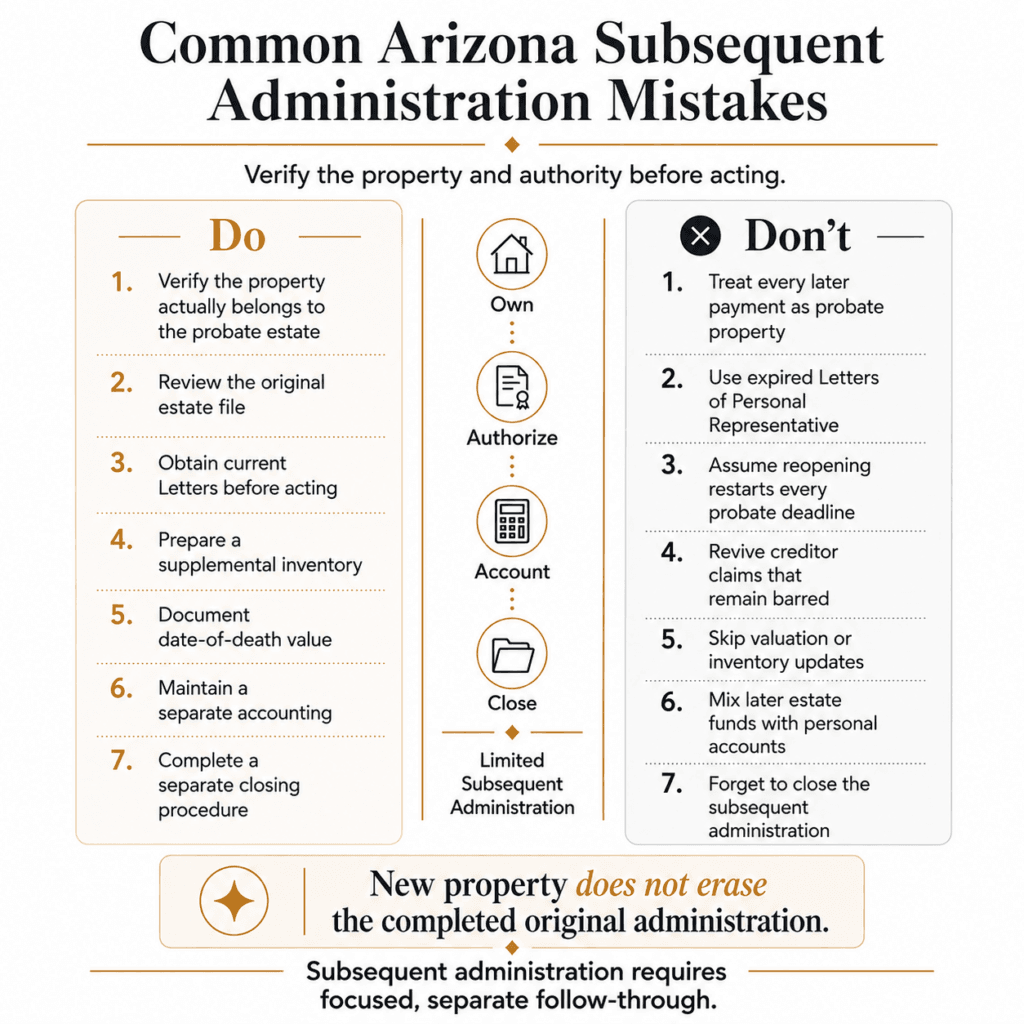
Do-and-don’t comparison covering later property, current Letters, supplemental inventory, valuation, accounting, distribution, and closing.
Practical Subsequent-Administration Checklist
Before acting on later-discovered property, confirm each item below.
Ownership
- The property belonged to the decedent.
- No survivorship ownership controls.
- No valid beneficiary designation controls.
- No trust owns the property.
- The item was not already administered.
Authority
- The original closing method is identified.
- The closing date is confirmed.
- The status of the original appointment is confirmed.
- The correct application or petition is selected.
- Required notice is provided.
- Current Letters are obtained.
Original Estate Review
- The will and codicils are reviewed.
- Heirship and settlement orders are reviewed.
- The original inventory is reviewed.
- The original accounting is reviewed.
- Prior distributions are reviewed.
- Creditor records are reviewed.
- Unresolved liabilities are identified.
Later Property Administration
- A supplemental inventory is prepared.
- Date-of-death value is documented.
- Current value is documented when relevant.
- The property is collected and protected.
- Estate money is kept separate.
- Expenses are documented.
- Tax filing requirements are reviewed.
- The proper recipients are identified.
Distribution and Closing
- Distribution calculations are documented.
- Beneficiaries receive any required notice or proposal.
- Correct deeds, titles, assignments, or institutional forms are used.
- Transfer completion is confirmed.
- A separate later accounting is prepared.
- The subsequent appointment is properly closed.
- The original and later records are preserved together.
Handle Later-Discovered Property Carefully
A closed Arizona probate estate may require subsequent administration when additional property is discovered after formal settlement and discharge or after the statutory period following an informal closing statement.
Arizona permits the registrar or court, depending on the procedural requirements, to appoint the same personal representative or a successor after an interested person applies or petitions and provides the required notice.
The process generally focuses on the later property.
It does not ordinarily:
- Restart every creditor deadline
- Reopen every prior decision
- Erase the completed administration
- Undo valid distributions
- Revive claims that were already barred
A careful process should:
- Confirm probate ownership
- Establish current authority
- Prepare a supplemental inventory
- Protect and value the property
- Review valid obligations
- Identify the proper recipients
- Complete tax reporting
- Document the transfer
- Prepare a later accounting
- Close the subsequent administration
The original probate records remain essential because they show who was entitled to inherit, how earlier property was distributed, which claims were resolved, and how the later asset fits into the estate as a whole.
Legal Disclaimer: This information is for educational purposes only and does not constitute legal advice. Arizona probate law is complex and varies based on individual circumstances. Always consult with a qualified probate attorney for guidance specific to your situation.
FAQs
Yes. Arizona permits subsequent administration when additional estate property is discovered after settlement and discharge or after one year following an informal closing statement.
Arizona’s statute calls the process subsequent administration.
Usually not. The later administration generally focuses on the newly discovered property and the related collection, expense, tax, accounting, distribution, and closing work.
The original appointment may still be active if no proceeding involving the personal representative remains pending. Confirm the filing date, court docket, Letters, and scope of the representative’s authority before acting.
Yes. An order closing the estate under Arizona’s formal-settlement statutes terminates the personal representative’s appointment through the order.
The former representative should not rely on old Letters after the appointment terminates. A current appointment, qualification, and issuance of Letters may be required.
An interested person may apply or petition. Depending on the issue, this may include an heir, devisee, spouse, child, creditor, beneficiary, trustee, person with a property claim, or person with appointment priority.
Yes. Arizona permits appointment of the same personal representative or a successor.
A successor may be appropriate when the former representative is unavailable, unwilling, ineligible, deceased, incapacitated, conflicted, removed, or disputed.
The registrar may act when the original appointment was or could have been handled informally. The court acts when the original proceeding required formal or supervised administration.
Yes. The application or petition proceeds with the notice required by Arizona probate law.
No. The payment may belong to a joint owner, beneficiary, trustee, surviving spouse, business, or another recipient under a governing instrument.
When omitted property comes to the personal representative’s knowledge, Arizona requires a supplemental inventory or appraisal with the appropriate date-of-death information.
The supplemental inventory reports fair market value as of the decedent’s date of death. Current, sale, and distribution values may also be relevant to the later accounting.
No. A creditor claim that was previously barred may not be asserted in the subsequent administration.
Potentially. A valid, unbarred, secured, preserved, or expressly accommodated liability should be reviewed before distributing the later asset.
The recipient is determined under the will, codicils, intestacy law, settlement agreements, prior court orders, trust provisions, and the legal character of the property.
Not necessarily. The asset may belong only to residuary beneficiaries, heirs, a specific devisee, a trustee, or another person entitled under the governing documents and Arizona law.
Yes, when appropriate. Arizona’s valuation, proposed-distribution, and transfer-document rules should be followed.
Arizona provides a statutory procedure for transferring the missing person’s share to a conservator or otherwise depositing it as required by law.
Yes. Income, sales, gains, losses, or distributions connected with the later property may create additional federal or Arizona fiduciary tax obligations.
The representative should prepare an accounting showing the newly discovered property, income, expenses, taxes, liabilities, distributions, and final balance.
Yes. The later appointment should be concluded through the procedure appropriate to that appointment and any controlling court orders.