
The Empty Sandbox Problem
Picture this: Mom proudly set up a family trust years ago. The binder looked impressive—tabs, signatures, even a leather cover. She thought she had spared her kids from ever dealing with probate court.
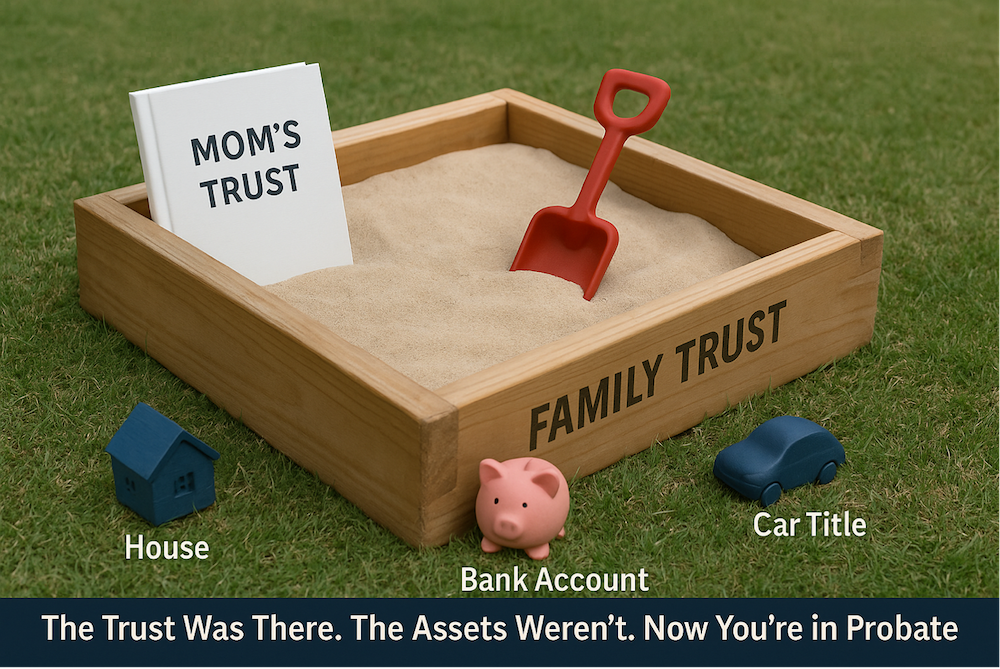
But when she passed, her children discovered the sandbox (the trust) was empty. Her house, bank accounts, and car titles were never moved inside. The sandbox was just sand, and the toys (her assets) were sitting in the yard.
That’s when probate showed up.
Funding a Trust: Toys in the Sandbox
A trust is like a sandbox. The toys—dump trucks, shovels, and toy cars—are the assets:
- House → Dump Truck
- Bank Accounts → Piggy Banks
- Vehicles → Toy Cars
- Investments → Rocket Ship
“Funding” a trust means putting the toys inside the sandbox. If you don’t, they’re left out in the yard. And in Arizona, toys left in the yard don’t just sit there peacefully—probate comes along, scoops them up, and decides who gets to play with them.
Ways of Ownership: Where Families Get Stuck
Families often believe probate has been avoided, only to learn the hard way that it hasn’t. The reason usually comes down to how assets were owned at the time of death.
1. In Your Own Name Only
If an asset was owned solely in the person’s name, it doesn’t go straight into the sandbox. It lands in probate first.
Example: Mom’s checking account was in her name only. When she died, the bank froze it until the Court appointed someone to manage her estate.
2. Joint Ownership
Adding a co-owner can work like a shortcut, automatically handing the toy to the surviving owner. But it can cause serious unintended consequences.
Example: Dad put his oldest daughter on the house deed as a joint owner “to make things easy.” When he died, she became the sole owner—cutting out her siblings, even though the trust said the house should be shared.
Joint ownership is like giving one child the toy and hoping they’ll share. Sometimes they do. Sometimes they don’t.
3. Beneficiary Designations
Many accounts—like life insurance, retirement plans, or even some bank accounts—let you name beneficiaries. If set up properly, this skips probate.
Example: A mother named her son as the beneficiary of her savings account. When she died, the account went straight to him. But if she had forgotten to update the form and it still listed her ex-husband, the ex would have walked away with the toy.
4. Trust as the Beneficiary
A safer option is to name the trust as the beneficiary. This directs the toy straight into the sandbox the moment of death.
Example (Good): A couple listed their family trust as the beneficiary of their bank accounts. When they passed, the funds flowed into the trust, and the trustee distributed them smoothly.
Example (Bad): Another family left a life insurance policy payable to “the estate.” That forced probate before the proceeds could be transferred.
5. Real Estate (The Big Dump Truck)
Houses and land are often the biggest probate triggers. If a home is titled only in the decedent’s name, probate is almost always required—unless:
- The property was deeded (transferred) into the trust, or
- A beneficiary deed was recorded naming the trust or heirs.
Example: Dad’s trust binder said his house belonged in the trust. But the deed still listed only his name. Probate court had to step in before the house could be distributed.
The Will: A Safety Net Under the Sandbox
Even with a trust, there’s almost always a Will—because the Will acts like a safety net under the sandbox.
- If a toy (asset) was left outside the sandbox, the safety net catches it when the person passes away.
- The Will gives instructions on where the toy should go. Usually, it says: “Pour this into the trust.”
- Once the toy is in the sandbox, the trust rules take over.
Bonus Info: Wills vs. Pour-Over Wills & Safe Storage
- A regular Will gives assets directly to heirs/beneficiaries but always requires probate.
- A pour-over Will acts as a backup for a trust. If some assets were left out of the trust, the Will “pours” them in. But this only works through probate, which is why proper funding matters.
- Don’t lose the original Will. In Arizona, the court needs the signed original, not just a copy.
Important: Avoid storing the Will in a bank safe deposit box (it may be sealed after death). Instead, keep it in a fireproof home safe, with your trustee, or at your attorney’s office.
Example: The Forgotten Bank Account
Dad moved his house and main accounts into the trust but forgot a savings account.
- When he dies, the account falls into the safety net (the Will).
- The Will says: “Send this into the trust.”
- But here’s the catch: emptying the safety net requires probate. The referee (the Court) has to approve before the toy can be tipped back into the sandbox.
Why the Safety Net Matters
Without a Will, assets left outside the trust risk being distributed by Arizona’s intestacy laws—meaning the Court decides who gets them, and that may not match the family’s expectations.
- The net doesn’t avoid probate.
- It just makes sure the trust eventually gets filled.
- Families should always look for both the trust binder and the Will after a loved one passes away.
How to Know If All Assets Were Moved Into the Trust
One of the biggest reasons families still end up in probate is because the trust was never fully funded. The binder may look official, but if the assets weren’t actually transferred, the sandbox is still empty.
Here’s how to check if everything is inside:
Step 1: Make an Asset Spreadsheet
Create a simple list with three sections:
- Real Property (houses, land)
- Bank Accounts (checking, savings, CDs)
- Retirement & Life Insurance Accounts
Write down every asset under the right category. Keep this list updated so you know what’s in the sandbox and what’s still outside.
Step 2: Real Property (Homes, Land, Rentals)
- Each property must be retitled into the trust with a new deed.
- The deed must be signed, notarized, and recorded with the county recorder.
- Example: If Dad’s home deed only lists his name, probate will be required. If the deed says “John Doe, Trustee of the Doe Family Trust,” then the home is in the sandbox.
Step 3: Bank Accounts
- Every bank has its own process for moving accounts into a trust.
- Some let you update ownership with an online form; others require an in-person appointment.
- Call or visit each bank and ask: “What’s your process for titling this account into my trust?”
- Once complete, your trust’s name will appear as the account holder.
Step 4: Retirement Accounts & Life Insurance
- For retirement accounts (IRA, 401(k)) and life insurance, you usually don’t retitle the account itself.
- Instead, you update the beneficiary designation to list the trust or your heirs, depending on your plan.
- Each company has its own form. Some can be done online; others require a paper form or an in-person meeting.
- If the wrong beneficiary is listed, assets may bypass the trust—or worse, go to an ex-spouse.
Pro tip: Do this review every few years or after a big life event (marriage, divorce, new child, new property). An updated spreadsheet and correct paperwork are the best way to keep your trust fully funded and avoid probate surprises.
Probate: The Worst Playground in Town
When probate gets involved, it’s less sandbox and more public playground chaos:
- The Wait: Six to twelve months (or more) before anyone can play.
- The Cost: Thousands of dollars in attorney’s fees.
- The Rules: The court referee (judge) blows the whistle on every move.
- The Drama: Siblings bicker about who gets the dump truck.
Families often tell us probate feels like waiting at the DMV: long lines, confusing forms, and expensive “snacks” (fees). By contrast, a fully funded trust is like a backyard sandbox—private, peaceful, and everyone knows whose toys are whose.
Arizona’s New Law (2025 Update)
As of September 26, 2025, Arizona raised the thresholds for “small estates” under A.R.S. § 14-3971 (HB 2116):
- Personal property: up to $200,000 (previously $75,000).
- Real estate: up to $300,000 (previously $100,000).
This means some families may now use simplified affidavits instead of a full probate.
But here’s the reality: most Arizona families still own homes, cars, and accounts worth more than those limits. If the trust wasn’t funded or beneficiary designations weren’t updated, probate is still required. And that’s where Rahnema Law helps.
Why Families Call Rahnema Law
At Rahnema Law, we don’t create trusts or handle funding. That’s estate planning.
We step in after someone has passed away—when:
- Assets were left outside the trust.
- The Will (safety net) has to be used.
- The estate is too large for the small estate procedure.
- Probate is simply unavoidable.
Our job is to:
- Guide families through probate court step by step.
- Reduce stress and confusion during an already painful time.
- Protect estates from unnecessary delays or disputes.
- Make sure assets ultimately reach the right heirs.
Final Thought: When the Sandbox Fails
A trust only works if the toys (assets) are actually placed inside. Without funding, it’s just sand. Even with Arizona’s new 2025 small estate limits, many families still end up in probate when a house, car, or account was left outside the sandbox.
That’s where Rahnema Law comes in—helping families through the probate process with clarity, compassion, and the experience of guiding hundreds of Arizona estates.
If your family has found yourselves facing probate because the sandbox was built but left empty, call us today. We’ll help you through the probate playground and make sure the toys end up where they belong.
Legal Disclaimer: This information is for educational purposes only and does not constitute legal advice. Arizona probate law varies based on individual circumstances. Always consult with a qualified probate attorney for guidance specific to your situation.