

Arizona estate property transfer requires the correct recipient, adequate reserves, proper valuation, legal documents, and complete records.
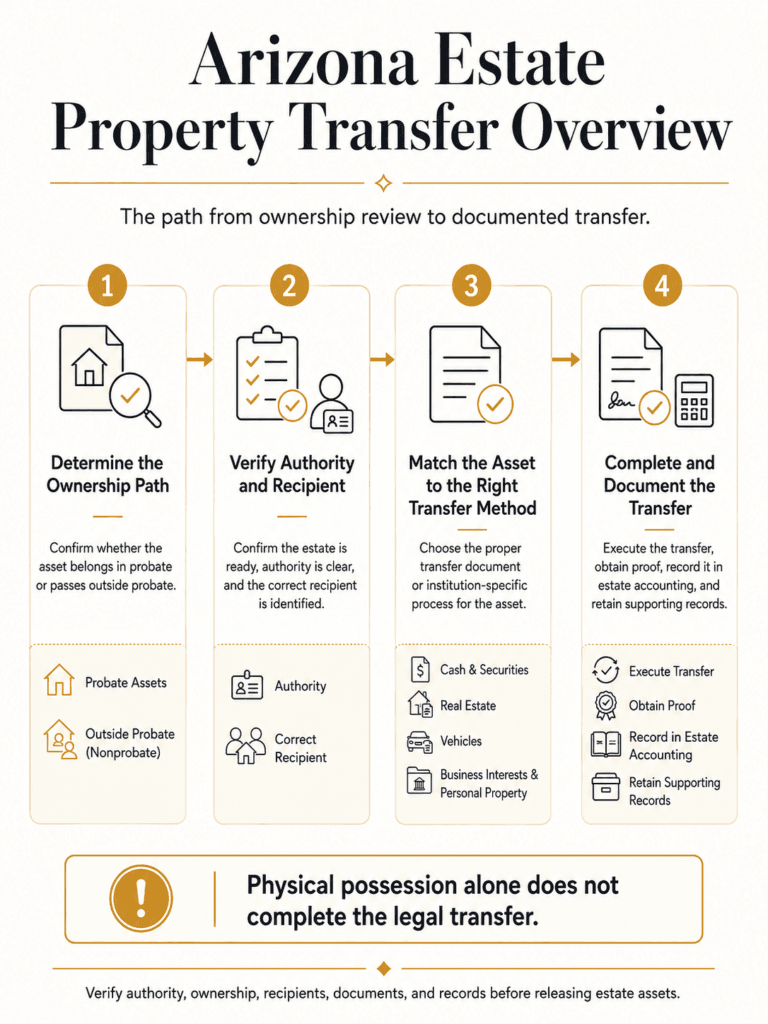
An Arizona estate property transfer involves more than handing an asset to a beneficiary or writing a check from the estate account. The personal representative must confirm that the property belongs to the probate estate, identify who is legally entitled to receive it, protect money needed for estate obligations, and use the documents required to change legal ownership.
Different assets require different transfer methods.
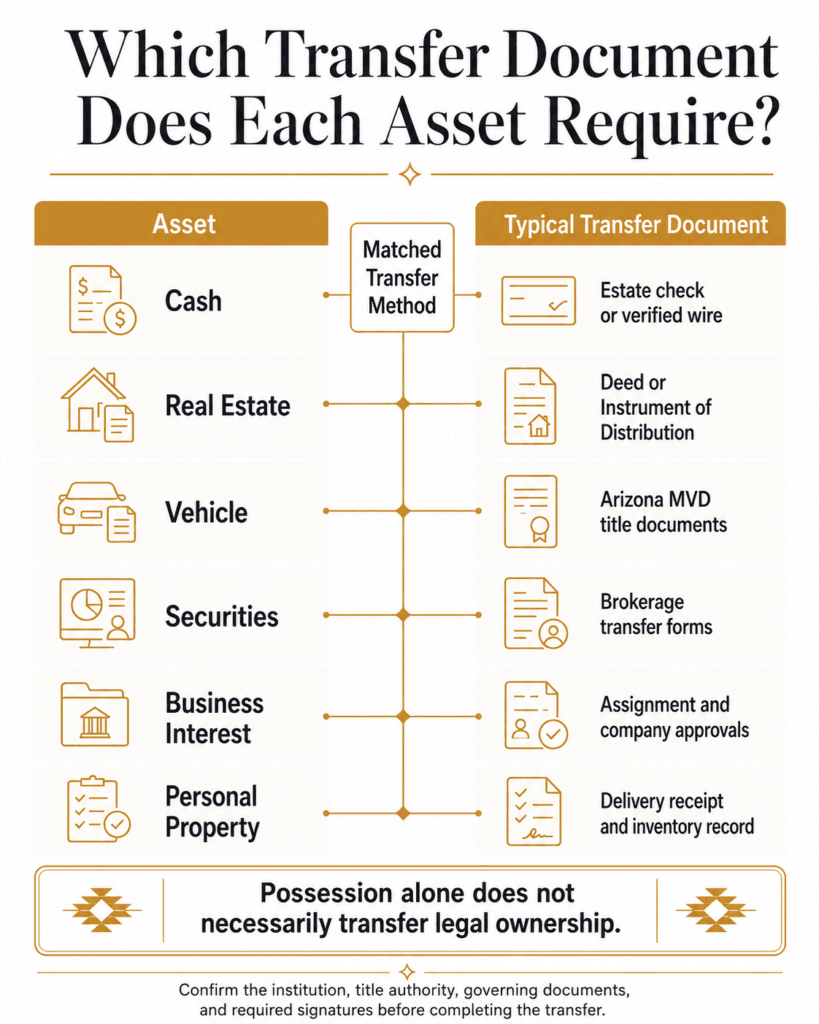
Cash may be paid from the estate bank account. Real estate generally requires a deed or instrument of distribution. Vehicles must follow current title procedures. Securities, financial accounts, and business interests may require forms, approvals, or transfer instructions from the institution or company involved.
A properly completed transfer creates a clear chain from the decedent’s ownership, through the estate, to the person legally entitled to receive the property.
Before releasing an asset, the personal representative should be able to answer four questions:
- Does the asset belong to the probate estate?
- Who is legally entitled to receive it?
- Is the estate ready to release it?
- What document or process will legally complete the transfer?
Confirm That the Estate Is Ready to Distribute
Appointment gives the personal representative authority to administer the estate. It does not necessarily mean that property should be transferred immediately.
The personal representative is a fiduciary. Arizona law requires the representative to settle and distribute the estate under the effective will, Arizona law, and applicable court orders while protecting the interests of creditors, the surviving spouse, qualifying children, beneficiaries, and heirs. A.R.S. § 14-3703 describes these general fiduciary duties.
Before releasing property, determine whether the estate still needs assets for:
- Creditor claims
- Secured debts
- Taxes
- Property expenses
- Professional fees
- Personal representative compensation
- Homestead, exempt-property, or family allowances
- Litigation
- Transfer and recording costs
- Closing expenses
- Unresolved or contingent liabilities
- A reasonable reserve
The amount in the estate bank account is not automatically the amount available for beneficiaries.
Arizona’s claim-payment statute requires the personal representative to make provision for statutory allowances, unresolved or appealed claims, unbarred claims that may still be presented, and administration expenses before paying allowed claims. Those same financial risks should be considered before substantial estate property is distributed. See A.R.S. § 14-3807.
Prepare a Distribution-Readiness Calculation
Before making a substantial partial or final distribution, prepare a current written calculation.
The calculation should show what the estate owns, what it still owes, what will be transferred, and what must remain in reserve.
Property Still Held
List the estate’s remaining:
- Cash
- Real estate
- Securities
- Vehicles
- Business interests
- Tangible personal property
- Receivables
- Refunds
- Other probate assets
Remaining Obligations
Identify:
- Allowed creditor claims
- Disputed claims
- Taxes
- Secured debt
- Property expenses
- Professional fees
- Compensation
- Litigation exposure
- Transfer expenses
- Closing costs
- Other unresolved obligations
Proposed Transfers
For each proposed transfer, record:
- Recipient
- Asset or cash amount
- Assigned value
- Governing will provision or intestate share
- Partial or final status
- Any debt or lien attached to the asset
Property Retained
Document:
- Reserve amount
- Purpose of the reserve
- Expected unfinished work
- Condition or approximate stage for releasing the remainder
This calculation helps show that the personal representative evaluated the estate as a whole rather than responding only to one beneficiary’s request.
For guidance on identifying and valuing the estate’s starting assets, see Rahnema Law’s Arizona Probate Inventory Checklist.
Check Whether Court Approval Is Required
Many Arizona estates proceed without continuous court supervision.
In an unsupervised administration, the personal representative may generally exercise the statutory powers reasonably necessary to administer and distribute the estate. Those powers remain subject to:
- The will
- Arizona law
- Formal court orders
- Creditor priorities
- Restrictions on the representative’s authority
- Fiduciary duties to interested persons
Arizona law authorizes a personal representative, subject to applicable restrictions, to retain, manage, sell, partition, transfer, and distribute estate property. See A.R.S. § 14-3715.
Supervised Estates Follow a Different Rule
A supervised personal representative may not distribute estate property without a prior court order. Sales of real property during supervised administration are also subject to court confirmation. See A.R.S. § 14-3504.
Before completing a transfer, review the current:
- Letters of Personal Representative
- Appointment order
- Order to Personal Representative
- Will
- Supervision order
- Order limiting authority
- Pending formal proceedings
- Later court orders or restraints
Arizona Law Note: Authority that existed earlier in the case may be affected by a later supervision proceeding, will contest, removal request, or court restriction. Review the current court record before completing a contested or unusually valuable transfer.
Being named in a will does not itself create authority. Rahnema Law’s guide to Letters of Appointment in Arizona probate explains why institutions often request certified Letters before working with a personal representative.
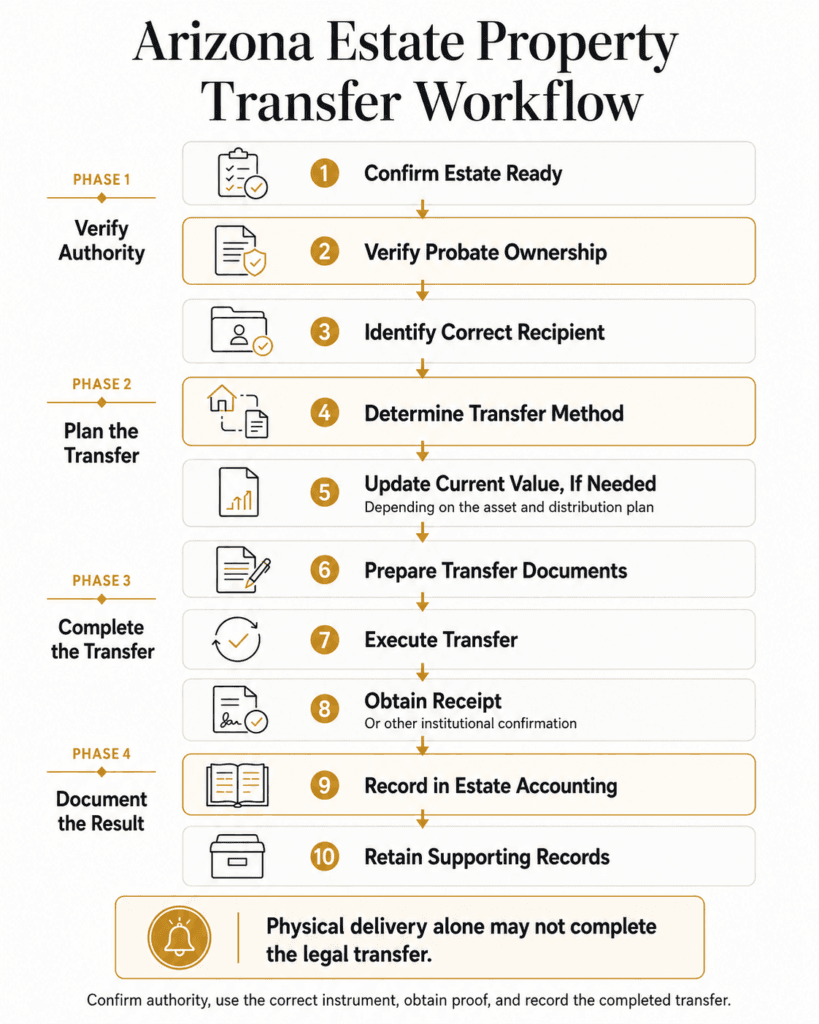
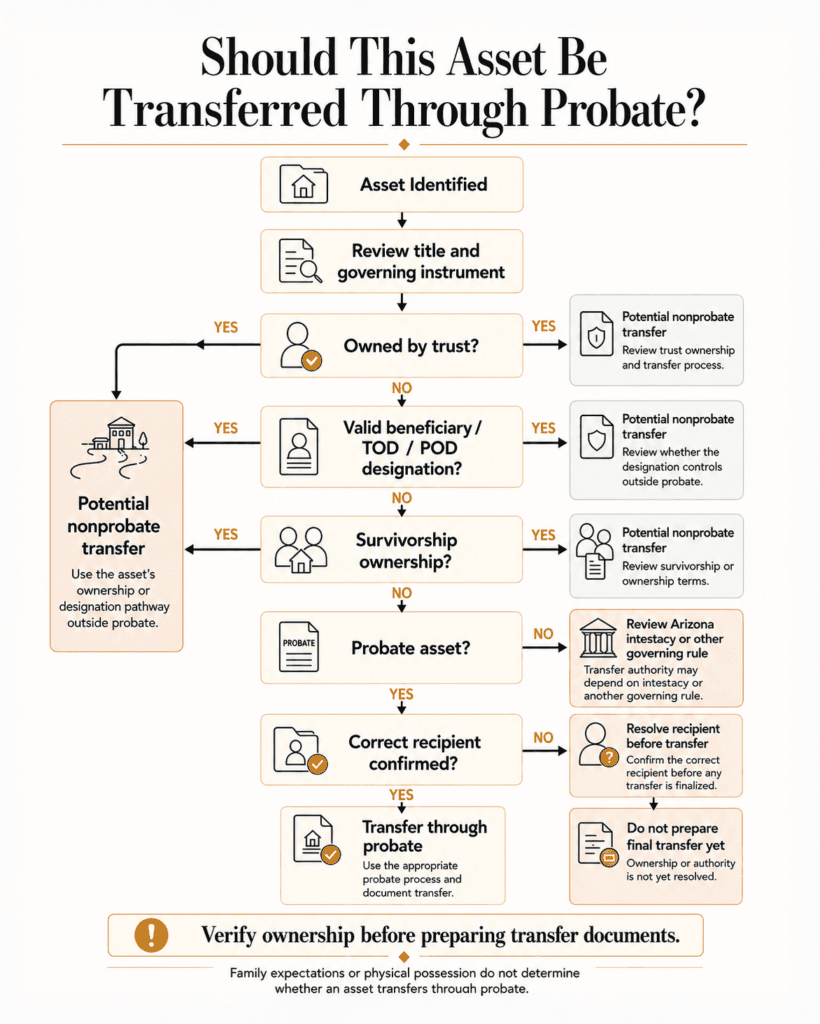
Confirm That the Asset Belongs to the Probate Estate
Only probate estate property should be transferred by the personal representative.
An asset may pass outside probate through:
- A trust
- A payable-on-death designation
- A transfer-on-death designation
- A beneficiary deed
- A survivorship provision
- A life insurance designation
- A retirement-plan designation
- Another contractual or written transfer arrangement
Arizona recognizes many written transfers at death as nontestamentary. These arrangements may control even when the will appears to give the same property to someone else.
For each asset, review:
- Legal title
- Deeds
- Account agreements
- Beneficiary-designation records
- Trust documents
- Vehicle titles
- Insurance and retirement records
- Operating, partnership, or shareholder agreements
- Other ownership instruments
When an asset is transferred directly to a surviving owner, trustee, or designated beneficiary, that person generally completes the transfer with the institution or title authority. The personal representative should not place that asset into the probate distribution merely to make the family’s overall inheritances appear more equal.
For a broader explanation of how probate and nonprobate property differ, see Is Probate Required in Arizona?.
Identify the Correct Recipient
When a valid will controls the property, the personal representative generally follows the will.
When no valid will controls the property, Arizona intestate succession identifies the heirs.
Additional analysis may be necessary when:
- A named beneficiary died before the decedent.
- A beneficiary survived the decedent but died during probate.
- The will names an alternate beneficiary.
- Arizona’s substitute-gift rules may apply.
- Someone disclaimed an interest.
- A spouse or child has statutory rights.
- The recipient is a minor or incapacitated person.
- The will directs the property to a trust.
- A beneficiary or heir cannot be located.
- The will’s language is unclear.
- Beneficiaries disagree about the proper recipient.
The distribution file should state the legal basis for each person’s right.
Examples include:
- Specific devise under Article III of the will
- One-half residuary share under Article V
- Intestate descendant by representation
- Trustee of a named testamentary trust
- Conservator for a minor beneficiary
- Substitute devisee under Arizona law
Delivering property to the wrong person does not eliminate the proper recipient’s rights. The personal representative may have to recover the property, replace its value, or compensate the estate for the resulting loss.
Follow the Type of Gift Created by the Will
A will may create several different types of gifts.
Specific Gift
A specific gift identifies particular property for a particular beneficiary.
Examples include:
- A residence
- A vehicle
- Jewelry
- A collection
- A specified account
- A business interest
A specific devisee is generally entitled to receive the specifically devised property when it remains in the estate, subject to the will, estate obligations, liens, abatement, and other applicable Arizona rules.
General Gift
A general gift usually directs the payment of money or value without requiring payment from one identified asset.
For example:
I leave $20,000 to my nephew.
The personal representative may satisfy the gift using available estate property, subject to the will, beneficiary rights, superior obligations, and Arizona’s distribution rules.
Residuary Gift
The residue is what remains after the estate addresses:
- Debts
- Taxes
- Administration expenses
- Statutory protections
- Specific gifts
- General gifts
- Other required payments
Residuary property may need to be divided among several beneficiaries by percentage.
Read the entire will before transferring any gift. The result may be changed by:
- Survivorship language
- Alternate beneficiaries
- Trust provisions
- Directions to sell
- Tax-allocation clauses
- Abatement provisions
- The residuary clause
Decide Whether to Transfer the Asset or Sell It
Not every estate asset must be sold.
An in-kind distribution transfers the asset itself to the beneficiary.
A cash distribution may be made from existing estate cash or from sale proceeds.
When an In-Kind Transfer May Make Sense
An in-kind transfer may be appropriate when:
- The will gives the asset to one person.
- The estate has enough other liquidity.
- Beneficiaries agree on the division.
- A transfer avoids unnecessary sales costs.
- The asset can be divided fairly.
- Continued joint ownership is practical.
- The asset has sentimental or strategic value to the recipient.
When a Sale May Be More Appropriate
A sale may be appropriate when:
- Cash is needed for claims, taxes, or expenses.
- The will directs a sale.
- Beneficiaries object to the proposed division.
- The asset cannot be divided practically.
- Joint ownership would create substantial risk.
- Carrying costs are high.
- A sale better protects the beneficiaries collectively.
- A lien must be paid through closing.
Arizona generally favors in-kind distribution to the extent possible unless the will shows a contrary intention. However, residuary property may be converted into cash when an in-kind division is impractical or a proper objection exists. See A.R.S. § 14-3906.
The personal representative should not choose between a transfer and a sale solely because one beneficiary prefers a particular result.
Consider Tax Consequences Before Choosing
Selling and transferring an asset may create different tax and administrative consequences.
Questions may include:
- Will the estate recognize a gain or loss if it sells?
- What basis information should be provided to the beneficiary?
- Has the asset produced post-death income?
- Will a sale create additional fiduciary income-tax reporting?
- Does a business transfer require tax elections or consents?
- How will debt attached to the property affect the recipient?
- Will giving different assets to different beneficiaries create unequal tax consequences?
- Does the asset have depreciation, built-in gain, or other tax attributes?
Before completing a substantial transfer, provide the estate’s tax adviser with the relevant:
- Date-of-death value
- Current appraisal
- Transaction history
- Income records
- Debt information
- Proposed distribution plan
Do not assume that two assets with the same gross value will create the same economic result for the recipients.
Obtain a Current Value When Necessary
The probate inventory generally reports date-of-death values.
Those values may not represent what the property is worth when it is distributed months or years later.
Arizona allows the personal representative to determine values near the proposed distribution through a reasonable method, including a qualified appraisal. For property without a readily ascertainable value, an otherwise reasonable valuation made no more than 30 days before distribution may control.
A current value is particularly important when:
- Different beneficiaries receive different assets.
- One beneficiary receives real estate and another receives cash.
- An asset changed materially in value.
- Equal percentage shares must be calculated.
- Debt remains attached to the property.
- An equalization payment will be required.
- A beneficiary disputes the proposed value.
Reliable valuation evidence may include:
- Qualified appraisal
- Brokerage statement
- Published market quotation
- Vehicle valuation
- Business valuation
- Dealer offer
- Comparable sales
- Other credible market evidence
The distribution schedule should identify:
- Gross value
- Encumbrances
- Net value
- Valuation date
- Valuation source
- Share credited to the recipient
Special Valuation Rules May Apply to Securities
Arizona provides a statutory valuation method for securities regularly traded on recognized exchanges when those securities are distributed in kind.
The statute generally uses:
- The last sale price of like securities on the business day before distribution, or
- If no sale occurred that day, the midpoint between the closing bid and offer
The personal representative should preserve:
- Brokerage statements
- Security name and symbol
- Number of shares
- Applicable trading date
- Price used
- Total value credited
- Receiving-account confirmation
Market movement after the valuation date does not automatically make the original calculation unreasonable. However, the representative should use the governing method consistently.
Consider Sending a Proposed Distribution
A written proposed distribution can help beneficiaries understand the intended division before ownership changes.
The proposal may identify:
- Assets to be distributed
- Proposed recipients
- Assigned values
- Debts or liens
- Equalization payments
- Partial or final status
- Remaining estate reserve
- Supporting appraisals or statements
- Anticipated transfer documents
After probable estate charges are known, Arizona permits the personal representative to mail or deliver a proposed distribution to people entitled to object.
A distributee’s right to object based on the kind or value of the proposed asset may terminate if the representative does not receive a written objection within 30 days after mailing or delivery.
Arizona Law Note: This 30-day provision concerns objections to the kind or value of the proposed property. It should not be described as eliminating every possible objection involving ownership, fiduciary conduct, the accounting, or the legal validity of the distribution.
Use the Required Instrument or Deed of Distribution
Physical possession alone does not necessarily transfer legal title.
When estate property is distributed in kind, Arizona requires the personal representative to execute an instrument or deed assigning, transferring, or releasing the asset to the distributee as evidence of title. See A.R.S. § 14-3907.
Depending on the asset, the document may be:
- Deed of distribution
- Assignment of personal property
- Assignment of a business interest
- Securities-transfer instruction
- Vehicle-title document
- Institutional account-transfer form
- Intellectual-property assignment
- Other written instrument
The document should clearly identify:
- The estate
- The personal representative
- The representative’s legal capacity
- The recipient
- The property
- The governing distribution
- The interest being transferred
- Any debt, lien, or limitation that should be disclosed
Keep the signed document and proof of delivery in the estate records.
Transferring Arizona Real Estate
Real estate requires particular care because the public land records must identify the new owner.
The personal representative will generally prepare and execute a deed or instrument of distribution stating:
- The name of the estate
- The personal representative’s name and representative capacity
- The distributee’s name
- The property being transferred
- The ownership interest transferred
Arizona requires the name and address of each distributee to appear in an instrument of distribution transferring real-property title that is recorded by a county recorder.
The document should use a verified legal description rather than relying only on the street address.
Before recording, confirm:
- Correct county
- Complete legal description
- Correct beneficiary name
- Correct ownership percentage
- Vesting or marital-status information when applicable
- Proper signature
- Notarial acknowledgment
- Recorder formatting requirements
- Any required accompanying document
- Applicable recording charges
Preserve the recorded copy showing the county recorder’s identifying information.
Arizona recording deadline: A.R.S. § 33-411.01 directs the transferor to record a document evidencing a transfer of Arizona real estate, or a legal or equitable interest in it, in the county where the property is located within 60 days of the transfer. If the transferor does not record within that period, the statute provides for indemnification of the transferee in an action involving the transferee’s interest.
Keys Do Not Equal Legal Ownership
Giving a beneficiary the keys to a home does not necessarily complete the real-property transfer.
Until the required instrument is signed and recorded:
- County land records may continue to show the prior ownership.
- Insurance responsibility may be unclear.
- Property-tax notices may continue going to the estate.
- A sale or refinance may be delayed.
- Maintenance and liability responsibilities may be disputed.
Possession may sometimes be coordinated before recording. When that happens, document:
- Who may occupy the property
- When possession begins
- Who pays utilities
- Who handles maintenance
- Who maintains insurance
- Whether possession is temporary
- When the title transfer is expected
Mortgages and Liens Do Not Automatically Disappear
Transferring an asset does not ordinarily eliminate an existing:
- Mortgage
- Deed of trust
- Tax lien
- Judgment lien
- Vehicle lien
- Security interest
- Other encumbrance
Depending on the circumstances, the estate may:
- Pay the debt
- Negotiate a release
- Sell the asset and satisfy the debt through closing
- Transfer the property subject to the lien
- Obtain the secured creditor’s consent
- Retain funds for unresolved secured exposure
Arizona law permits a personal representative to address encumbered property in several ways when doing so serves the estate’s best interests. Paying an encumbrance does not necessarily increase the beneficiary’s share unless the beneficiary is entitled to exoneration. See A.R.S. § 14-3814.
The recipient should be told whether the property is:
- Free of an identified lien
- Subject to an existing lien
- Conditioned on payoff
- Accompanied by an ongoing payment obligation
Do not describe title as clear or unencumbered when a recorded or contractual obligation remains.
Coordinate Insurance and Carrying Expenses
Insurance should generally remain in place until ownership changes and appropriate replacement coverage begins.
For Real Estate
Coordinate:
- Property insurance
- Mortgage payments
- Property taxes
- Homeowners association charges
- Utilities
- Security
- Maintenance
- Rental management
For Vehicles
Coordinate:
- Auto insurance
- Registration
- Storage
- Loan payments
- Physical possession
For Valuable Personal Property
Consider:
- Scheduled insurance
- Secure delivery
- Condition records
- Storage responsibility
- Photographs
The accounting should show when the estate’s responsibility ended and the beneficiary’s responsibility began.
Canceling insurance before the transfer is complete can expose both the estate and the beneficiary to avoidable loss.
Transferring Cash
Cash distributions should ordinarily come from the estate bank account through a traceable method.
Possible methods include:
- Estate check
- Cashier’s check
- Verified electronic transfer
Avoid undocumented cash payments.
For each payment, record:
- Recipient
- Amount
- Date
- Payment method
- Check or confirmation number
- Governing share
- Partial or final status
Before sending an electronic transfer:
- Obtain written instructions.
- Verify the instructions independently.
- Confirm the receiving account name.
- Use a trusted telephone number rather than relying only on email.
- Preserve the verification record.
Fraudulent changes to emailed wire instructions can cause an unrecoverable loss.
Transferring or Closing an Estate Bank Account
An account titled in the estate’s name may be closed and its proceeds distributed when the administration no longer requires the account.
Before closing it, confirm that:
- Outstanding checks have cleared.
- Taxes were paid or reserved for.
- Professional fees were paid or reserved for.
- Expected refunds and delayed income were addressed.
- Final interest was recorded.
- No distribution correction is anticipated.
- Complete statements were downloaded.
- The remaining funds were reconciled to the accounting.
A bank may require:
- Certified Letters
- Personal identification
- Estate EIN
- Bank-specific closing instructions
- Receiving-account information
- Additional documentation
Do not transfer control by giving a beneficiary the estate account’s debit card, login credentials, or online access.
Use the institution’s formal closing and distribution process.
Transferring Stocks and Investment Accounts
Securities may be:
- Sold and converted to cash
- Divided among beneficiaries
- Transferred in kind to beneficiary accounts
- Transferred to a trust
The financial institution may require:
- Certified Letters
- Letter of instruction
- Transfer forms
- Tax certifications
- Medallion signature guarantee
- Beneficiary account information
- Trust certification
- Other institution-specific documents
Preserve:
- Estate statements
- Number and type of securities
- Valuation calculation
- Transfer date
- Receiving account
- Confirmation of completion
- Date-of-death value and basis information
Submitting instructions to a brokerage does not prove that the transfer was completed. Obtain the final estate statement and receiving confirmation.
Transferring an Arizona Vehicle
Review the vehicle title before treating the vehicle as probate property.
The legal status between multiple owners—such as OR, AND, or AND/OR—affects who may transfer the vehicle after an owner’s death.
Under current Arizona Motor Vehicle Division guidance:
- OR generally gives the surviving owner authority to transfer the vehicle.
- AND reflects tenancy in common, so the deceased owner’s interest generally requires probate or a qualifying nonprobate procedure.
- AND/OR generally reflects joint tenancy with right of survivorship, with the surviving owner providing the required death documentation.
The official Arizona MVD multiple-owner guidance explains how each designation affects the transfer process.
When a vehicle belongs to the probate estate, confirm current requirements for:
- Title and registration application
- Evidence of appointment
- Existing title
- Lien release or lienholder permission
- Identification
- Odometer information when applicable
- Registration
- Insurance
MVD provides a separate Non-Probate Affidavit for qualifying transfers from a deceased vehicle owner’s estate. That procedure should not be used when an active probate or the title status requires another method.
Preserve:
- Former title
- Estate transfer instrument
- Application
- Lien release
- Valuation
- Delivery receipt
- New-title confirmation when available
Transferring Business Interests
A business interest may be subject to restrictions that do not apply to ordinary personal property.
Review:
- Operating agreement
- Partnership agreement
- Shareholder agreement
- Buy-sell agreement
- Stock certificates
- Membership ledger
- Company bylaws
- Financing agreements
- Licenses
- Regulatory records
The governing documents may:
- Restrict transfers
- Require owner approval
- Give the company or other owners a purchase option
- Require valuation under a stated formula
- Separate economic rights from voting or management rights
- Trigger dissolution or redemption
- Prohibit transfers to certain recipients
Determine whether the beneficiary will receive:
- Full ownership
- Economic rights only
- Voting rights
- Management rights
- A redemption payment
- Sale proceeds
Arizona law authorizes a personal representative, subject to applicable restrictions, to manage, sell, reorganize, or otherwise address estate business interests.
Closely held business transfers often require coordinated legal, tax, accounting, and valuation assistance.
Transferring Tangible Personal Property
Furniture, jewelry, artwork, tools, electronics, collections, and household belongings may often be delivered directly.
The transfer should still be documented.
For valuable or disputed property:
- Photograph the asset.
- Describe it specifically.
- Record its condition.
- State the assigned value.
- Identify the will provision or beneficiary share.
- Record the delivery date.
- Obtain a signed receipt.
When several beneficiaries are dividing tangible property, use a consistent method.
Possible approaches include:
- Following specific gifts in the will
- An agreed selection rotation
- Equal-value groupings
- Sale and division of net proceeds
- Distribution to one person with an equalization payment
- A court-approved method when disagreement cannot be resolved
Do not allow a beneficiary to remove estate property informally without updating the inventory, distribution schedule, and delivery records.
Dividing One Asset Among Several Beneficiaries
Some assets cannot be divided physically.
Examples include:
- A residence
- A vehicle
- A business
- A valuable collection
- Vacation property
- A mineral interest
Possible solutions include:
- Transferring undivided interests to the beneficiaries
- Transferring the asset to one beneficiary with an equalization payment
- Selling the asset and dividing the net proceeds
- Partitioning or dividing the asset when legally and practically possible
Arizona permits residuary property to be distributed in kind when no proper objection exists and dividing undivided interests is practical. Otherwise, the property may be converted to cash.
Do not create co-ownership casually.
Before transferring an asset to several people together, consider:
- Use rights
- Expense allocation
- Maintenance
- Insurance
- Management
- Rental income
- Sale rights
- Buyout procedures
- Dispute resolution
A written co-ownership agreement may be appropriate.
Distributions to Minors or Incapacitated Beneficiaries
A minor or incapacitated beneficiary may be entitled to inherit but may not be legally able to receive or manage the property directly.
Arizona allows the personal representative to satisfy the distribution obligation by transferring property to:
- The beneficiary’s conservator, or
- Another person authorized to provide a valid receipt and discharge
Depending on the will and circumstances, the property may pass to:
- A testamentary trust
- An existing trust
- A conservator
- An authorized custodian
- Another legally permitted recipient
Do not assume that a parent may receive a substantial unrestricted inheritance belonging to a minor merely because the parent has physical custody.
Confirm:
- Legal authority
- Account or trust titling
- Applicable court order
- Authority to provide a receipt
- Investment and management arrangements
See A.R.S. § 14-3915.
When a Beneficiary Cannot Be Located
The personal representative should make reasonable efforts to locate every beneficiary, heir, devisee, or claimant entitled to property.
Possible steps include:
- Reviewing family records
- Checking former addresses
- Contacting relatives
- Searching public records
- Reviewing probate filings
- Using a qualified investigator
- Checking death and marriage records
- Reviewing returned correspondence
When an heir, devisee, or claimant cannot be found, Arizona requires the personal representative to distribute the missing person’s share to that person’s conservator, if one exists. Otherwise, the representative must pay the share in cash to the Arizona Department of Revenue for the statutory deposit. See A.R.S. § 14-3914.
The missing person’s share should not be divided among the remaining beneficiaries without legal authority.
Partial Distributions
An estate does not always have to wait until every administrative task is complete before transferring any property.
A partial distribution may be appropriate when:
- The creditor process is sufficiently developed.
- Known obligations are paid or reserved for.
- Taxes can be estimated reliably.
- No court restriction prevents the transfer.
- The correct recipients are known.
- The property is not disputed.
- Enough liquid property remains to complete administration.
Before making a partial distribution, prepare a financial summary showing:
- Available assets
- Unpaid obligations
- Expected taxes
- Professional fees
- Property expenses
- Pending claims
- Remaining reserve
- Proposed payment or transfer
Clearly label the distribution as partial.
Do not state or imply that the beneficiary’s final inheritance is fixed when later claims, expenses, tax adjustments, or valuation changes could alter the result.
Maintain an Adequate Reserve
A reserve is estate property retained for unfinished work and unresolved obligations.
The appropriate amount depends on:
- Pending tax returns
- Disputed claims
- Litigation
- Property carrying costs
- Anticipated professional fees
- Personal representative compensation
- Delayed income or refunds
- Business obligations
- Possible amended filings
- Final transfer and recording costs
A reserve should reflect documented risks rather than an arbitrary percentage.
The personal representative should be able to explain:
- Amount retained
- Obligations covered
- Calculation method
- Expected duration
- Conditions for releasing the remainder
Distributing every available dollar may force the representative to request repayment from beneficiaries later.
Obtain Receipts and Acknowledgments
A receipt does not replace the deed, title, assignment, or institutional form needed to change legal ownership.
It provides additional evidence that the beneficiary received the property.
A distribution receipt may identify:
- Beneficiary
- Property or cash received
- Transfer date
- Assigned value
- Partial or final status
- Related deed, assignment, or title
- Condition of tangible property
- Any remaining expected distribution
For valuable assets, preserve together:
- Transfer instrument
- Receipt
- Delivery confirmation
- Valuation
- Photographs
- Institutional confirmation
- Accounting entry
Avoid relying only on a verbal acknowledgment.
Record Every Distribution in the Estate Accounting
Noncash property should not disappear from the estate records merely because it did not pass through the estate bank account.
For each distribution, record:
- Recipient
- Date
- Asset or cash amount
- Inventory value
- Distribution value
- Gain, loss, or valuation adjustment when relevant
- Governing share
- Partial or final status
- Transfer method
- Supporting documentation
The accounting should connect each opening inventory asset to its outcome.
Possible outcomes include:
- Sold
- Distributed
- Abandoned under proper authority
- Reduced in value with supporting records
- Retained for later transfer
- Used to satisfy an estate obligation
A complete accounting allows beneficiaries, creditors, tax professionals, and the court to follow the estate’s financial history.
Understand the Risks of an Improper Transfer
A person who improperly receives estate money or property may be required to return the property and the income received from it.
If the recipient no longer has the property, the recipient may be liable for its value when the property was disposed of, together with related income and gain. See A.R.S. § 14-3909.
An unbarred and undischarged creditor may also pursue one or more distributees after estate assets have been transferred, generally subject to limits based on the value received and statutory protections. See A.R.S. § 14-3934.
A personal representative who improperly exercises estate authority may be liable to interested persons for resulting damage or loss caused by a breach of fiduciary duty. See A.R.S. § 14-3712.
Potentially improper conduct includes:
- Transferring nonprobate property
- Paying the wrong recipient
- Ignoring a court restriction
- Releasing property needed for taxes or claims
- Using unsupported values
- Failing to disclose liens
- Giving a minor’s property to an unauthorized person
- Failing to execute title documents
- Favoring one beneficiary over another
Distribution and Closing Are Separate Stages
Estate property is generally distributed before an unsupervised estate is closed through a closing statement.
Arizona’s informal-closing statute requires the personal representative to state, among other things, that:
- The applicable creditor period expired.
- Presented claims and administration expenses were paid, settled, or otherwise addressed.
- Applicable death-tax obligations were addressed.
- Estate assets were distributed to the people entitled to receive them.
- A full written accounting was furnished to affected distributees.
The verified closing statement may not be filed earlier than four months after the original appointment of a general personal representative. See A.R.S. § 14-3933.
The four-month minimum is not a promise that every estate will be ready to distribute property or close at that time.
Real estate, tax filings, businesses, litigation, creditor disputes, and beneficiary disagreements may require additional administration.
For an overview of how distribution fits into the larger process, see Rahnema Law’s Arizona Probate Roadmap.
Common Arizona Estate Property Transfer Mistakes
Common mistakes include:
- Transferring property immediately after appointment
- Failing to retain an adequate reserve
- Treating the will as controlling every asset
- Ignoring beneficiary designations or survivorship rights
- Transferring property to the wrong person
- Failing to review alternate beneficiaries
- Ignoring current court restrictions
- Distributing from a supervised estate without an order
- Using only the original inventory value months later
- Failing to obtain a current appraisal when needed
- Giving someone possession without transferring title
- Failing to record a real-property instrument
- Ignoring mortgages and liens
- Canceling insurance too early
- Giving a beneficiary access to the estate bank account
- Sending a wire without independently verifying instructions
- Treating a brokerage instruction as proof of completion
- Misreading a multiple-owner vehicle title
- Ignoring restrictions in a business agreement
- Creating unwanted co-ownership
- Giving a minor’s inheritance to an unauthorized person
- Dividing a missing beneficiary’s share among other recipients
- Failing to obtain receipts
- Omitting noncash distributions from the accounting
- Closing the estate bank account prematurely
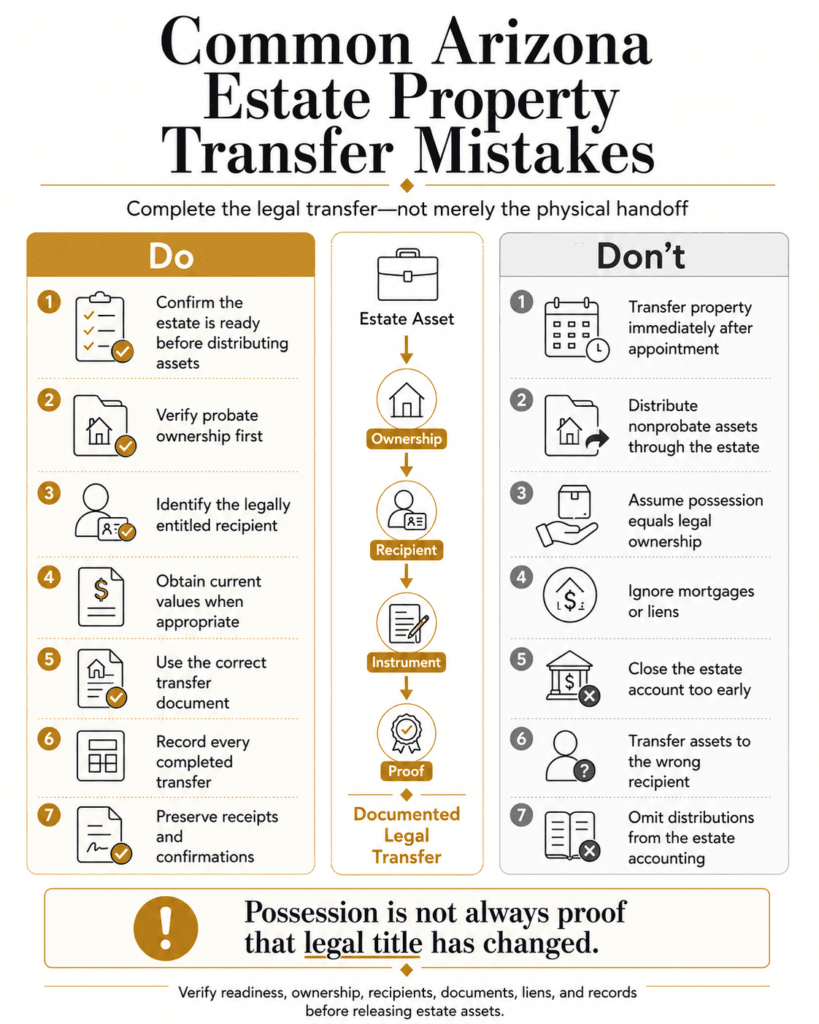
Do-and-don’t comparison covering probate ownership, proper recipients, current values, liens, transfer documents, reserves, and accounting records.
Arizona Estate Property Transfer Checklist
Before transferring an estate asset, confirm that:
- The personal representative’s appointment remains active.
- Current Letters and court orders permit the transfer.
- Required approval was obtained in a supervised estate.
- The asset belongs to the probate estate.
- Ownership and beneficiary records were reviewed.
- The correct beneficiary, heir, trustee, or other recipient was identified.
- The entire will was reviewed.
- Creditor claims and secured obligations were evaluated.
- Taxes and administration expenses were paid or reserved for.
- Statutory family protections were considered.
- An adequate reserve will remain.
- Transfer and sale alternatives were compared.
- Tax consequences were reviewed when material.
- A current value was obtained when necessary.
- The assigned value and encumbrances were documented.
- A proposed distribution was sent when appropriate.
- Any timely objection was resolved.
- The correct deed, title, assignment, or institutional form was prepared.
- Real-property recording requirements were confirmed.
- Mortgages, liens, and transfer restrictions were addressed.
- Insurance and carrying expenses were coordinated.
- Electronic payment instructions were independently verified.
- Financial-institution completion was confirmed.
- Vehicle-title status and current MVD requirements were checked.
- Business-transfer restrictions were reviewed.
- Tangible property was identified and photographed when appropriate.
- Co-ownership consequences were evaluated.
- A minor or incapacitated recipient has an authorized receiving arrangement.
- A missing recipient’s share will be handled under Arizona law.
- The beneficiary will provide a receipt or acknowledgment.
- The transfer will appear in the estate accounting.
- All signed and recorded documents will be preserved.
Complete Every Transfer Carefully
A proper Arizona estate property transfer should establish:
- The property belonged to the probate estate.
- The correct person or entity was legally entitled to receive it.
- The estate was financially and procedurally ready to release it.
- Ownership was legally transferred and fully documented.
When each point is supported by the will, Arizona law, court orders, current values, appropriate reserves, and complete transfer records, the distribution is easier to explain to beneficiaries, creditors, financial institutions, tax professionals, and the court.
Transfers involving real estate, business interests, secured property, minors, incapacitated beneficiaries, missing heirs, disputed values, or supervised administration may require individual legal, tax, valuation, or financial guidance.
Legal Disclaimer: This information is for educational purposes only and does not constitute legal advice. Arizona probate law is complex and varies based on individual circumstances. Always consult with a qualified probate attorney for guidance specific to your situation.
FAQs
Property may be transferred after the personal representative confirms probate ownership, identifies the correct recipient, reviews court restrictions, and protects money needed for claims, taxes, expenses, statutory allowances, and remaining administration.
No. Appointment creates authority to administer the estate, but the representative must still determine whether the estate is ready to release the asset.
Yes. A supervised personal representative may not distribute estate property without a prior court order. A sale of real property during supervised administration is also subject to court confirmation.
No. Trust property, beneficiary-designated accounts, survivorship property, insurance proceeds, retirement plans, and other written nonprobate arrangements may pass outside the will.
Yes. Arizona generally favors in-kind distribution when reasonably possible unless the will indicates a contrary intention or another legal or practical reason requires a sale.
A current appraisal or other valuation may be appropriate when an asset changed materially in value, beneficiaries will receive different types of property, the asset lacks a readily ascertainable value, or someone disputes the proposed value.
For property without a readily ascertainable value, an otherwise reasonable valuation made no more than 30 days before distribution may control under Arizona’s distribution statute.
A proposed distribution is a written plan identifying the property, recipients, assigned values, liens, equalization payments, and transfer method.
For Arizona real estate, the personal representative should execute the appropriate deed or instrument of distribution and arrange prompt recording in the county where the property is located. A.R.S. § 33-411.01 directs the transferor to record a real-estate transfer document within 60 days or face indemnification consequences. Recording also protects the transferee’s public-record position.
The right to object based on the kind or value of the proposed property may terminate if the personal representative does not receive a written objection within 30 days after mailing or delivery of the proposal.
No. It addresses objections to the kind or value of the proposed asset. It should not be treated as eliminating all objections involving ownership, accounting, fiduciary conduct, or legal validity.
It is a document signed by the personal representative to assign, transfer, or release an in-kind estate asset to the distributee as evidence of title.
A transfer of real-property title should generally be completed through the appropriate recorded instrument. Arizona requires the names and addresses of the distributees in an instrument of distribution recorded with a county recorder.
No. Possession is not a substitute for completing the deed or instrument. Execution and recording are separate steps, and recording protects the transferee’s public-record position.
No. A secured obligation requires separate analysis. The beneficiary may receive the property subject to the lien unless the debt is paid, released, or otherwise resolved.
Cash should generally be distributed from the estate bank account through a traceable method. The estate records should identify the recipient, amount, date, payment method, and whether the distribution is partial or final.
No. The personal representative should use the bank’s formal closing and transfer procedures. Do not give a beneficiary the estate account’s debit card, credentials, or online access.
Yes. Securities may be distributed in kind through the financial institution’s required process. The representative should document the number of shares, value, transfer date, and receiving account.
Yes. Arizona MVD states that OR, AND, and AND/OR ownership designations affect who may transfer the vehicle after an owner dies.
Potentially. However, an operating agreement, partnership agreement, shareholder agreement, or buy-sell agreement may restrict the transfer or require consent, valuation, redemption, or another process.
Yes, when the will and circumstances permit it. Before creating co-ownership, the representative should consider expenses, management, insurance, use rights, sale rights, and possible disputes.
Not automatically. The property should be transferred to a conservator or another person legally authorized to provide a valid receipt and discharge.
The missing person’s share generally must be transferred to that person’s conservator, if one exists, or otherwise paid in cash to the Arizona Department of Revenue under the statutory process.
Yes, when no court restriction prevents it and the estate retains enough property for unresolved claims, taxes, expenses, and remaining administration.
There is no single appropriate percentage for every estate. The reserve should reflect documented risks, unfinished work, expected fees, taxes, claims, property expenses, and closing costs.
Yes. A receipt helps prove delivery, but it does not replace a deed, title, assignment, or institutional document required to change legal ownership.
Yes. A recipient may be required to return improperly distributed property, its value, and related income or gain. The personal representative may also face liability for loss caused by a breach of fiduciary duty.
No. Distribution transfers estate property to the people entitled to receive it. Closing formally completes the administration after the remaining statutory requirements have been satisfied.