

What happens after filing probate in Arizona? Learn about court review, appointment, Letters, notices, inventory, creditors, and the next steps.
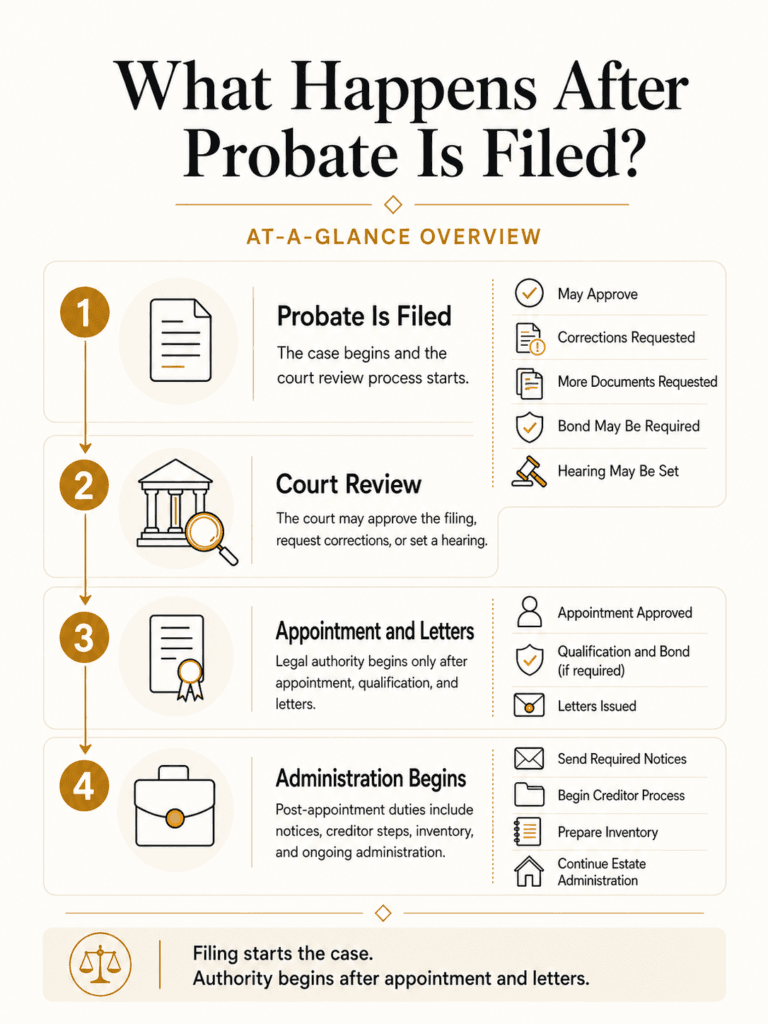
Filing starts the case, but it does not automatically give the applicant authority to manage the estate.
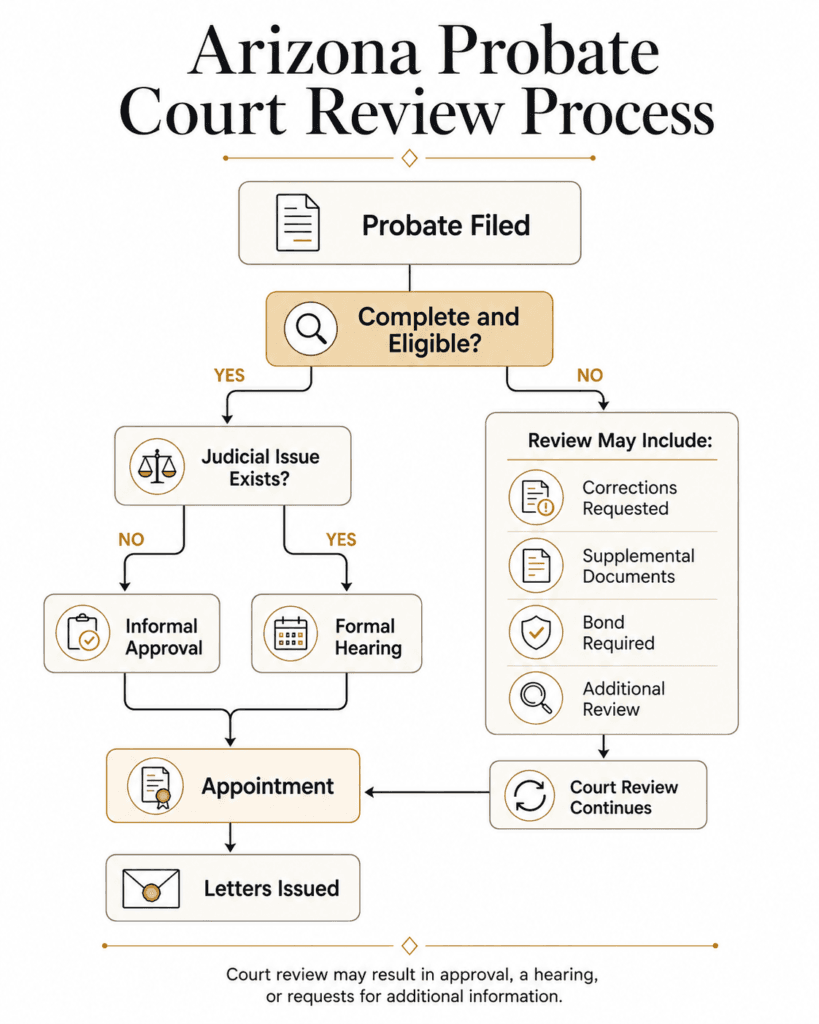
Next, the probate registrar or court reviews the filing. The case may be approved, returned for corrections, scheduled for a hearing, or moved into a different type of proceeding.
The most important thing to understand is simple:
Filing starts the process. Appointment and qualification create the authority to administer the estate.
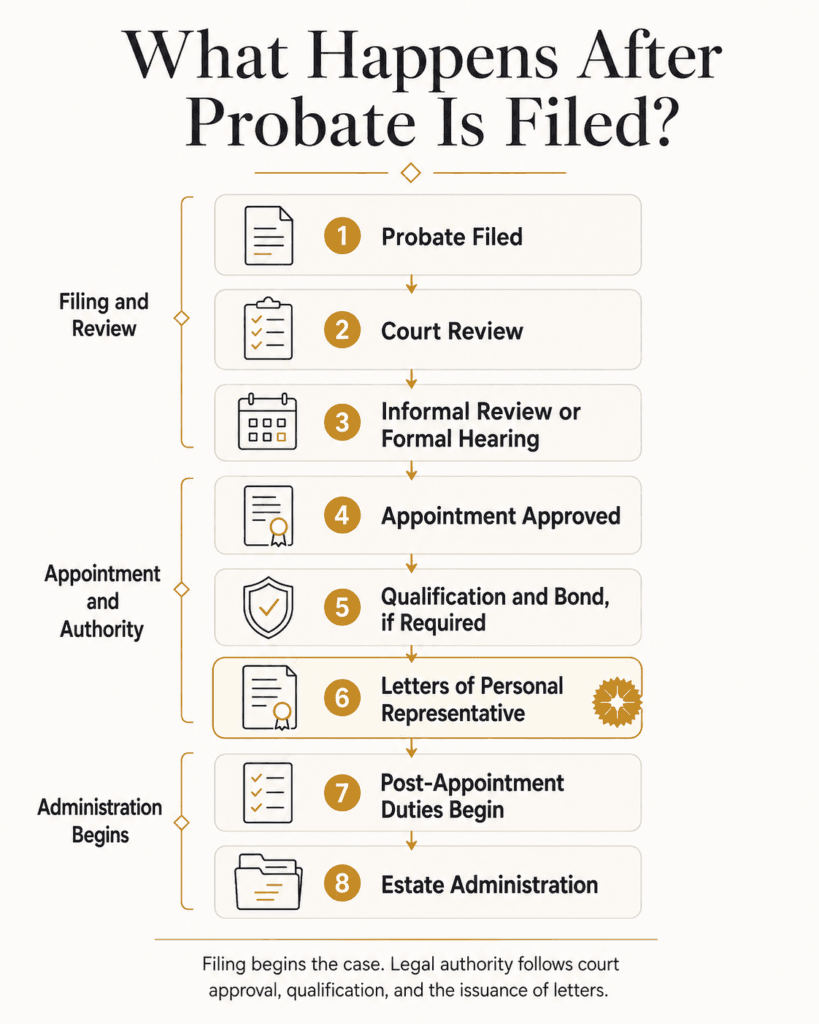
What happens immediately after filing probate in Arizona?
After the application or petition is filed, the case generally moves in one of three directions:
- An informal probate or appointment is approved.
- The registrar or court asks for corrections or additional documents.
- A formal proceeding moves forward because a judicial decision is needed.
What happens depends on how the case was filed, whether the documents are complete, whether anyone objects, and whether the legal requirements for appointment have been met.
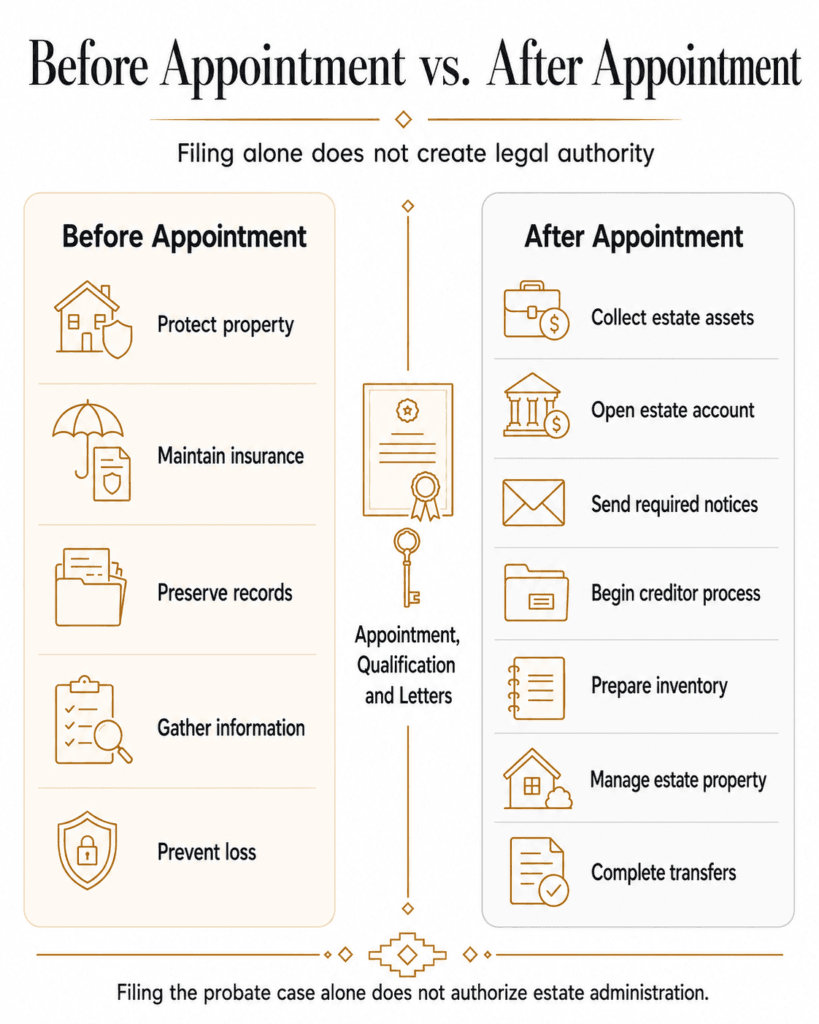
Filing does not give you authority to act
Submitting probate papers does not automatically make someone the personal representative.
The personal representative is the person legally authorized to administer the probate estate.
Before receiving that authority, the applicant generally must:
- Be appointed
- File an acceptance of the duties
- File any required bond
- Complete other applicable qualification requirements
- Receive Letters
Arizona law specifically provides that, except where another statutory procedure applies, a person must be appointed, qualify, and receive Letters to acquire the powers and duties of a personal representative.
What should you avoid before appointment?
Until authority is established, be cautious about:
- Withdrawing estate money
- Selling or transferring property
- Closing financial accounts
- Changing titles
- Signing contracts for the estate
- Settling creditor claims
- Giving belongings to beneficiaries
Protecting property is different from administering it.
For example, keeping insurance active or securing a vacant home may help prevent a loss. Selling the home is a different matter.
For a deeper explanation of the court document institutions often ask for, see Rahnema Law’s guide to Letters of Appointment in Arizona Probate.
The court reviews the probate filing
A probate filing is not approved simply because the clerk or electronic filing system received it.
The filing still must satisfy Arizona’s legal requirements.
Depending on the case, the review may involve:
- The identity of the person who died, called the decedent
- Date and place of death
- Proper county or venue
- The original will, if applicable
- Heirs and devisees
- The proposed personal representative
- Priority to serve
- Required notices
- Other probate proceedings involving the estate
A devisee is a person or organization named in a will to receive property.
What happens during the review depends largely on whether the case is informal or formal.
What happens after an informal probate filing?
Informal probate is generally used when the statutory requirements can be established without asking a judicial officer to resolve a dispute.
Instead of starting with a court hearing, the probate registrar reviews the application.
For informal probate of a will, the registrar must determine matters such as whether:
- The application is complete.
- The applicant verified the required statements.
- The applicant is permitted to apply.
- Venue is proper.
- An original, apparently valid and unrevoked will is available.
- Required preliminary notice was given.
- The time limit for original probate has not expired.
For an informal appointment, the registrar also reviews matters such as the proposed personal representative’s eligibility and priority to serve.
If the requirements are met and no issue requires a court decision, the registrar may approve the informal probate and appointment without a judicial hearing.
Is there a waiting period?
Yes.
For an original informal appointment, at least 120 hours generally must pass after the decedent’s death before the registrar appoints a personal representative.
Additional timing rules apply when the decedent was not an Arizona resident.
That 120-hour rule does not mean every informal probate will be approved five days after death. The filing still has to satisfy the applicable requirements.
What happens after a formal probate filing?
A formal proceeding asks the court to enter a judicial order after notice and, when necessary, a hearing.
Formal proceedings may be used when:
- The validity of a will is disputed
- The original will is unavailable
- The heirs are uncertain
- More than one person seeks appointment
- Priority to serve is disputed
- Qualification to serve is challenged
- Supervised administration is requested
- Another legal issue requires a judicial determination
After a formal testacy proceeding begins, the clerk sets a time and place for the hearing.
The petitioner must give notice to the people required by Arizona law. Depending on the case, that may include the surviving spouse, children, other heirs, devisees, executors named in relevant wills, and an existing personal representative.
The court can then address issues such as:
- Whether a will should be admitted to probate
- Whether the decedent died without a valid will
- Who the heirs are
- Who should serve as personal representative
- Whether another requested order should be entered
Formal probate does not always mean a family fight.
Sometimes everyone agrees, but a judicial order is still needed to resolve a particular issue.
Understand the documents that come next
Several documents may appear during the opening stage of an Arizona probate case.
They do different jobs.
Application
An application is used to request informal probate or informal appointment from the probate registrar.
Petition
A petition asks the court for an order after notice. It is used in formal proceedings.
Statement of informal probate
When the statutory requirements are satisfied, the registrar may issue a statement admitting a will through informal probate.
Appointment or court order
The appointment identifies the person authorized to serve as personal representative.
A judicial order may also resolve other matters raised in a formal proceeding.
Acceptance and bond
Before receiving Letters, the personal representative must file a statement accepting the duties of the office and any required bond.
Letters of Personal Representative
Letters are official evidence that the person has been appointed and qualified to serve.
Banks, title companies, insurers, government agencies, and other organizations may ask for certified Letters before allowing estate transactions.
What if the court finds a problem with the filing?
Not every probate filing is approved the first time.
The registrar, clerk, or court may identify a problem that must be corrected.
Examples may include:
- Missing signatures
- Incomplete verification
- Incorrect or incomplete addresses
- Missing heirs or devisees
- Failure to provide the original will
- Missing waivers or renunciations
- Questions about priority to serve
- Filing in the wrong county
- Missing bond information
- Conflicting names or dates
- Missing proposed documents
- Incomplete notice
- Missing locally required paperwork
A request for correction does not necessarily mean the probate case has been denied.
It usually means the requested action cannot yet be approved from the documents currently before the registrar or court.
Read the notice carefully and respond to the actual problem.
Is a probate bond required?
Sometimes.
Arizona generally requires a personal representative to post a bond unless a statutory exception applies.
A bond may not be required when, for example:
- The will expressly waives it.
- All required heirs or devisees file written waivers.
- The personal representative is one of the qualifying institutions or public fiduciaries identified by statute.
- The specific summary-procedure exception in A.R.S. § 14-3603 applies.
Even when bond would otherwise be waived, the court may require one if an interested person shows reasonable proof that an interest is in danger because of the estate administration.
If a bond is required, it must be filed before Letters are issued.
Can an informal case turn into a formal proceeding?
Yes.
An informal application may stop moving forward informally when the registrar cannot make the required findings or when an issue needs a court decision.
A formal proceeding may become necessary when, for example:
- Someone objects to the will
- The original will cannot be located
- Priority to serve is disputed
- The identity of an heir is unclear
- Qualification to serve is challenged
- Supervised administration is requested
- Another issue requires a judicial ruling
Objections to appointment are handled in formal proceedings. Arizona law sets an order of priority for people seeking appointment as personal representative.
What if the person died more than two years ago?
Late probate filings require additional attention.
Arizona generally imposes a two-year limit on original probate, testacy, and appointment proceedings, subject to statutory exceptions.
Even the informal probate application requires the applicant to state either that two years or less have passed since death or that circumstances exist allowing a later proceeding.
Do not assume a late case works exactly like a probate filed soon after death.
How long does appointment take after filing?
There is no single processing time for every Arizona probate case.
A complete informal application may move forward without a hearing once the registrar completes the required review.
A formal matter generally involves additional steps because notice, a hearing, evidence, or a judicial decision may be required.
Timing can also depend on:
- The county
- Court workload
- Whether the filing is complete
- Whether the original will is available
- Whether waivers are needed
- Whether a bond is required
- Whether corrections are necessary
- Whether anyone objects
- Whether priority to serve is clear
Do not make important financial commitments based on an assumed appointment date.
Even an uncontested estate can slow down because one document is missing.
What can the applicant do while waiting?
Waiting for appointment does not mean doing nothing.
Focus on preserving property and gathering information.
You may need to protect:
- The home
- Vehicles
- Valuable belongings
- Financial records
- Computers and digital devices
- Business records
- Insurance information
Necessary insurance and utilities may need to remain active to prevent loss or damage.
You can also start gathering:
- Names and addresses of heirs and devisees
- Bank statements
- Investment statements
- Property deeds
- Vehicle titles
- Insurance policies
- Debt information
- Recent tax returns
- Business records
- Account contact information
- Records showing how assets are titled
- Preliminary values
- Mortgage and lien information
This work makes the next stage much easier.
But do not distribute estate property merely because everyone expects you to be appointed.
What if the estate cannot safely wait?
Sometimes property needs protection before a general personal representative can be appointed.
Arizona allows a special administrator to be appointed when temporary authority is needed to protect or preserve an estate.
An informal special administrator may collect, manage, preserve, and account for estate assets and later deliver them to the general personal representative.
Temporary authority may be considered when:
- A vacant home is at serious risk
- Property is being removed
- A business needs immediate attention
- Insurance is about to lapse
- Delay could cause substantial financial loss
Most estates do not need a special administrator.
The procedure is for situations where waiting could cause meaningful harm.
What happens once the appointment is approved?
Once the personal representative is appointed, completes qualification, and receives Letters, the case changes.
The focus moves from getting authority to using that authority to administer the estate.
Start by reviewing:
- The appointment or court order
- The Letters
- The will
- Any bond requirement
- Any restrictions on authority
- Pending notices
- Upcoming deadlines
- Applicable court instructions
Then the personal representative can begin the next major responsibilities.
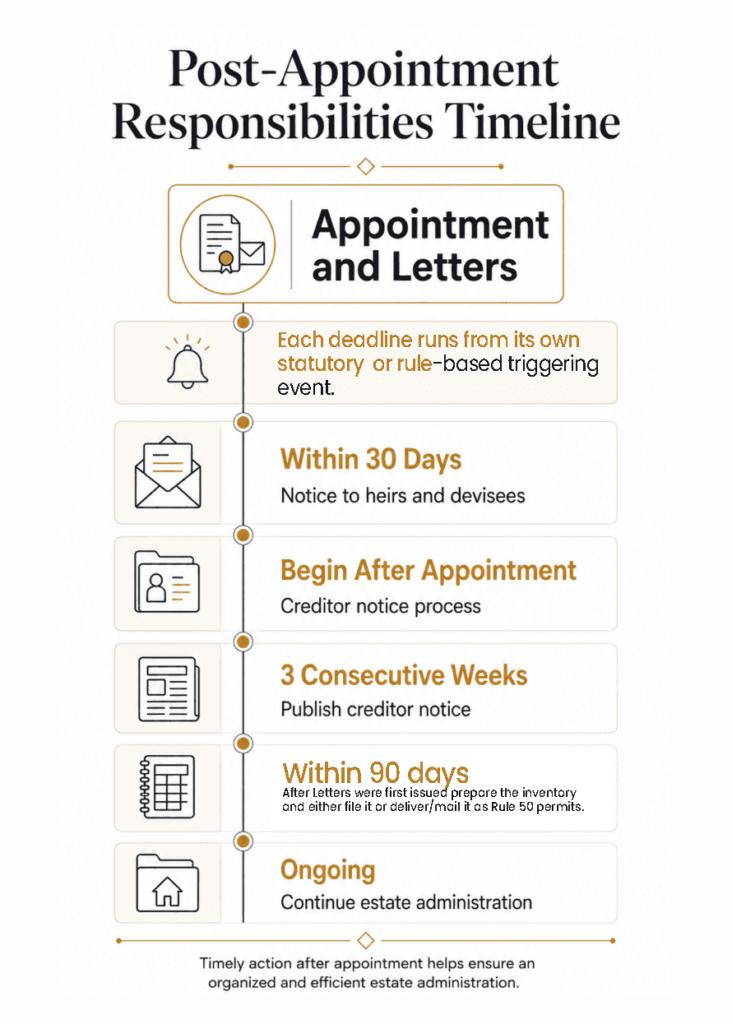
Send notice to heirs and devisees
A personal representative, other than a special administrator, generally must provide information about the appointment to heirs and devisees within 30 days after appointment.
The information includes the personal representative’s name and address, identifies the court where estate papers are filed, indicates whether a bond has been filed, and tells the recipient that the person has or may have an interest in the estate.
What if a will was informally admitted?
When a will is admitted through informal probate, the applicant generally must also give heirs and devisees written information about the probate and a copy of the will within 30 days.
A person who receives that information generally has four months from receipt to begin a formal testacy proceeding contesting the informal probate.
The statute preserves a separate rule for a later-discovered will.
Keep copies of the notices and records showing when and how they were sent.
Begin the creditor-notice process
After appointment, creditors also become an important part of the case.
Unless notice has already been given, the personal representative generally must publish notice to creditors once a week for three successive weeks in a newspaper of general circulation in the county.
The notice gives creditors four months after the first publication to present claims.
Known creditors generally must receive direct written notice.
Their deadline is generally the later of:
- Four months after the first publication, or
- 60 days after the written notice is mailed or delivered
Review:
- Bills
- Account statements
- Medical bills
- Loan documents
- Tax notices
- Pending lawsuits
- Business records
- Other evidence of possible debts
Do not assume a creditor is unknown just because no demand letter has arrived.
Once authority is established, the personal representative can begin managing probate property.
That may include:
- Communicating with banks
- Securing real estate
- Reviewing insurance
- Collecting estate income
- Safeguarding valuable property
- Obtaining account information
- Maintaining necessary property
- Opening an estate bank account
Keep estate money separate from personal money.
Also start documenting every transaction.
Save:
- Receipts
- Invoices
- Account statements
- Deposit records
- Sale documents
- Insurance correspondence
- Payment confirmations
- Property records
- Distribution records
Those records may later matter for taxes, accounting, court proceedings, or questions from beneficiaries.
Prepare the Arizona probate inventory
The personal representative generally must prepare the estate inventory within 90 days after appointment.
The inventory must describe estate property in reasonable detail and include:
- Fair market value as of the date of death
- Whether the property is community or separate property
- The type and amount of any mortgage, lien, or other encumbrance
Preparing the inventory may require:
- Date-of-death bank statements
- Brokerage statements
- Appraisals
- Real estate records
- Vehicle information
- Business valuations
- Loan statements
One timing point matters here:
The 90 days run from appointment, not from the date the probate papers were filed.
County procedures may differ
Arizona probate law applies statewide, but courts may require different local forms, documents, or procedures.
The Arizona Judicial Branch provides probate forms and resources, while also recognizing that some documents and reports may depend on the particular court.
Before filing or responding to a court request, check the instructions for the Superior Court handling the case.
Do not assume paperwork prepared for one county can be reused unchanged in another.
Post-filing checklist
After filing an Arizona probate case:
- Confirm the filing was received and a case number was assigned.
- Watch for court or registrar notices.
- Correct deficiencies promptly.
- Complete required notices and waivers.
- Obtain a bond if required.
- Attend any scheduled hearing.
- Avoid administering or distributing property before authority is established.
- If you already have lawful access, take limited, non-distributive steps to protect property and preserve records without removing occupants, overriding co-owners or trustees, or taking disputed property.
- Review the appointment documents carefully.
- Complete qualification requirements.
- Obtain certified Letters.
- Calendar post-appointment deadlines.
- Begin heir, devisee, and creditor notices.
- Start gathering information for the inventory.
Keep copies of:
- Filed documents
- Court notices
- Mailings
- Waivers
- Orders
- Bond documents
- Letters
- Proof of publication
A clean file now can prevent confusion later.
The main thing to remember after filing probate
After filing, the next question is not:
“Can I start handling everything now?”
It is:
“Has the court or registrar completed the steps needed to establish my authority?”
The case may be approved informally, sent back for corrections, or move to a formal proceeding.
Once appointment and qualification are complete and Letters are issued, the personal representative can begin the larger work of administering the estate.
That includes:
- Notices
- Asset protection
- Inventory
- Creditor claims
- Financial management
- Taxes
- Accounting
- Distribution
- Closing
Filing opens the door.
Appointment and qualification let the personal representative walk through it.
Legal Disclaimer: This information is for educational purposes only and does not constitute legal advice. Arizona probate law is complex and varies based on individual circumstances. Always consult with a qualified probate attorney for guidance specific to your situation.
FAQs
No. Filing an application or petition starts the proceeding. The person generally must be appointed, qualify for the position, and receive Letters before acquiring the powers and duties of a personal representative.
The probate registrar reviews the application and supporting documents. The registrar must make the required statutory findings about matters such as completeness, verification, eligibility, venue, the will, notice, and priority to serve before approving informal probate or appointment.
A formal testacy proceeding begins with a petition requesting a judicial order after notice. The clerk sets a time and place for a hearing, and the petitioner must give the required notice before the court resolves the issues presented.
Letters are official evidence that a person has been appointed and qualified to serve as personal representative. Banks, title companies, insurers, government agencies, and other organizations may request certified Letters before allowing estate transactions.
The registrar, clerk, or court may ask for corrections, additional documents, notice, a bond, or another type of proceeding. A request for corrections does not necessarily mean the case has been denied.
No. Arizona generally requires a bond, but several statutory exceptions may apply. The court may still require a bond in certain circumstances when an interested person shows that an interest is at risk.
There is no single timeline. Timing depends on the type of proceeding, whether the filing is complete, whether notice or a hearing is required, whether a bond is needed, whether anyone objects, and the court’s workload.
The applicant can focus on protecting property, maintaining necessary insurance and utilities, preserving records, and gathering information about assets and debts. Avoid selling, transferring, withdrawing, or distributing estate property before legal authority is established.
Yes, in appropriate circumstances. Arizona allows appointment of a special administrator when temporary authority is necessary to protect or preserve an estate before a general personal representative can act.
Important deadlines include the general 30-day appointment notice to heirs and devisees and the 90-day inventory requirement. The personal representative must also begin the creditor-notice process, which includes its own publication and claim periods.