

Learn the first legal and practical steps after a death in Arizona, including securing property, finding the will, handling bills, and assessing probate.
The first days after a death can feel overwhelming. Funeral arrangements, legal documents, property, bills, and questions about what happens next can all demand attention at once.
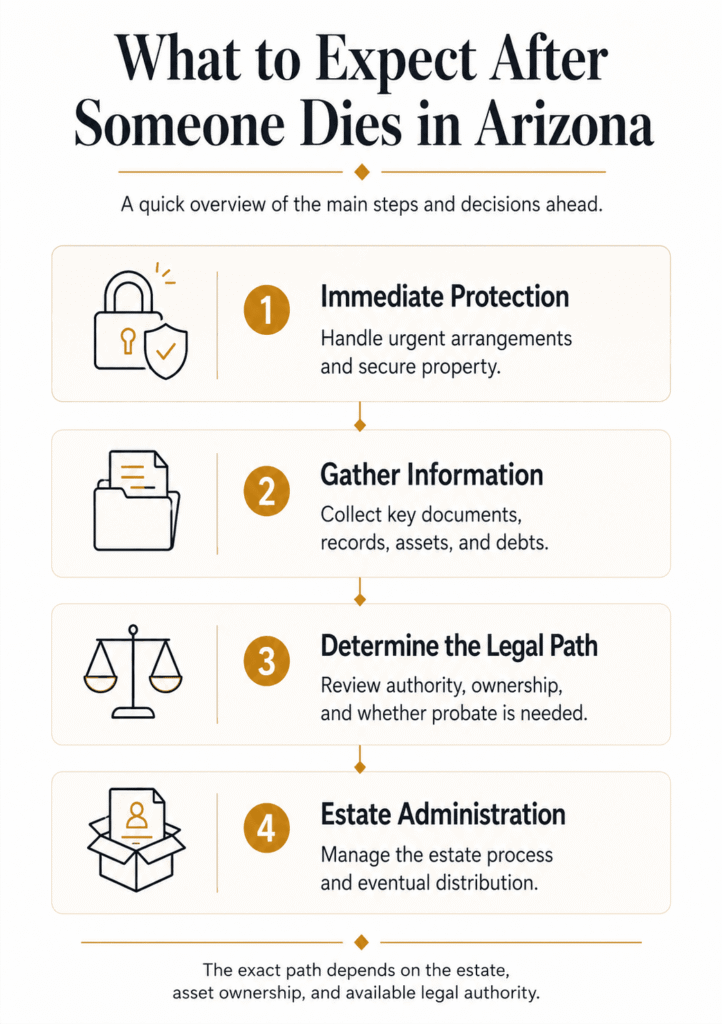
The priority is to protect property, locate important documents, gather reliable information, and avoid decisions that may be difficult to reverse.
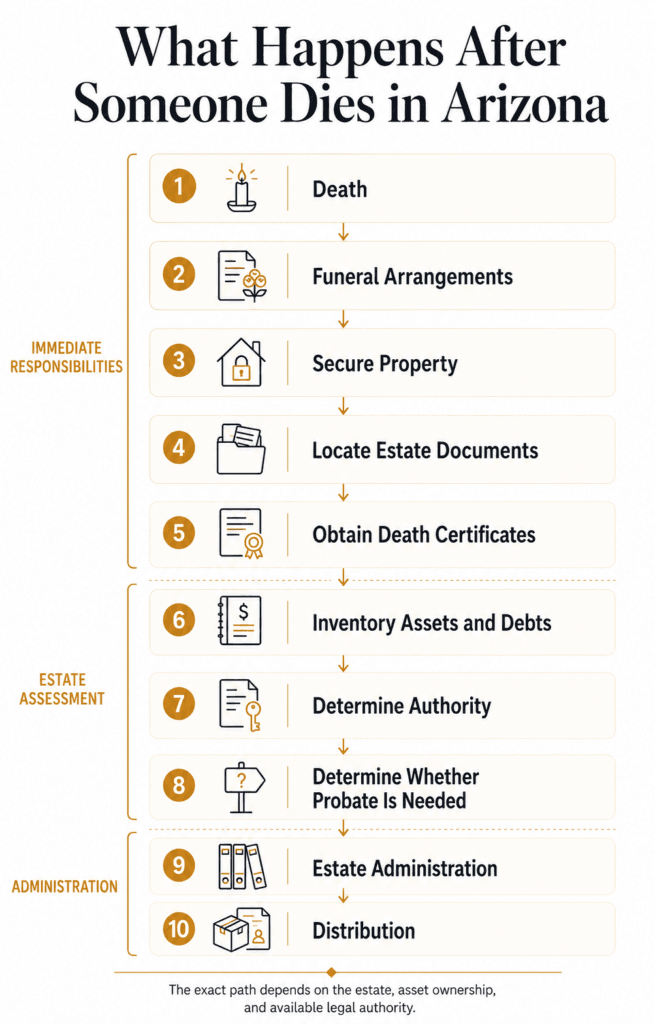
Start by following any valid funeral instructions, securing the home and valuables, locating the original will, ordering certified death certificates, and identifying major assets and debts.
Avoid rushing to sell property, close accounts, or divide belongings. Before taking those steps, you need to understand who owns the property and who has legal authority to act.
This guide walks through the practical first steps to take after someone dies in Arizona, regarding property or legal affairs.
Start with funeral and burial arrangements
Funeral, burial, cremation, and memorial decisions are often the first things that need attention.
Look for written instructions left by the person who died, also called the decedent. You may find them in:
- An estate planning folder
- A prepaid funeral agreement
- A letter of instruction
- Another signed document
Under Arizona law, a person named in a will as the future personal representative may carry out the decedent’s written instructions about the body, funeral, and burial before being formally appointed by the probate court.
Arizona Law Note: A.R.S. § 14-3701 allows a person named as personal representative in a will to carry out the decedent’s written instructions relating to the body, funeral, and burial before court appointment.
Also look for:
- Prepaid funeral contracts
- Cemetery documents
- Military discharge records
- Religious instructions
- Organ donation information
Keep receipts for funeral, burial, cremation, transportation, and memorial expenses. These costs may need to be included in the estate records later.
Secure the home and other property.
Protecting property is one of the most important early steps.
If the decedent’s home will be empty, make sure it is secure. A person who already has lawful access may take limited steps to prevent immediate loss or damage, such as locking the home or documenting what is inside.
But be careful. Do not remove an occupant, override the rights of a co-owner or trustee, or take control of disputed property without legal authority or appropriate court relief.
Some utilities may also need to stay on to prevent damage to the home.
Check whether the home, vehicles, and other valuable property are still insured. The insurance company may need to know that the owner died or that the home is now vacant.
Photographs or video can help document the condition of:
- The home
- Vehicles
- Furniture
- Jewelry
- Tools
- Collections
- Other valuable belongings
Securing property does not mean family members can start taking things.
Even ordinary household items may belong to the estate. Keep them protected until ownership and legal authority are clear.
Locate the original will and estate documents.
Look for the original will and any later amendments, called codicils.
A copy can be useful, but the original will may be needed to open an Arizona probate case.
A person holding the original will should not hide, destroy, or withhold it.
Arizona Law Note: Under A.R.S. § 14-2516, a person who has custody of a will must, when requested by an interested person, deliver it with reasonable promptness to someone able to secure its probate or, if no such person is known, to the appropriate court.
Common places to search include:
- A home safe
- A filing cabinet
- A safe-deposit box
- The drafting attorney’s office
- A digital storage account
- Records kept by a trusted relative
Also look for:
- Trust documents
- Deeds
- Vehicle titles
- Bank statements
- Life insurance policies
- Retirement account information
- Business agreements
- Tax returns
- Beneficiary designation records
What about a power of attorney?
Find any financial power of attorney, but understand its limits.
An agent generally should not keep using a power of attorney after learning that the person who gave the power has died.
Arizona law may protect certain good-faith actions taken without actual knowledge of the death. But the former agent does not automatically become authorized to manage the estate.
Arizona Law Note: A.R.S. § 14-5504 addresses the effect of a principal’s death on a durable power of attorney and protects certain good-faith actions taken without actual knowledge of the death. It does not make the agent the estate’s personal representative.
Order certified death certificates
Certified death certificates are commonly needed for legal and financial matters after a death.
They may be requested by:
- Banks
- Insurance companies
- Retirement plan administrators
- Government agencies
- Title companies
- The probate court
How many copies you need depends on the decedent’s assets and accounts.
Before sending an original certified copy, ask whether the organization will return it or accept another form of verification.
The Arizona Department of Health Services provides official information about who may order Arizona death certificates and how to request them.
Create a preliminary list of assets.
You do not need to prepare a complete probate inventory on day one.
Start with a basic list of what the decedent owned. This can help you understand the estate and whether probate may be necessary.
The list may include:
- Real estate
- Bank accounts
- Investment accounts
- Retirement benefits
- Life insurance
- Vehicles
- Business interests
- Valuable personal property
- Digital assets
- Cryptocurrency
- Tax refunds
- Money owed to the decedent
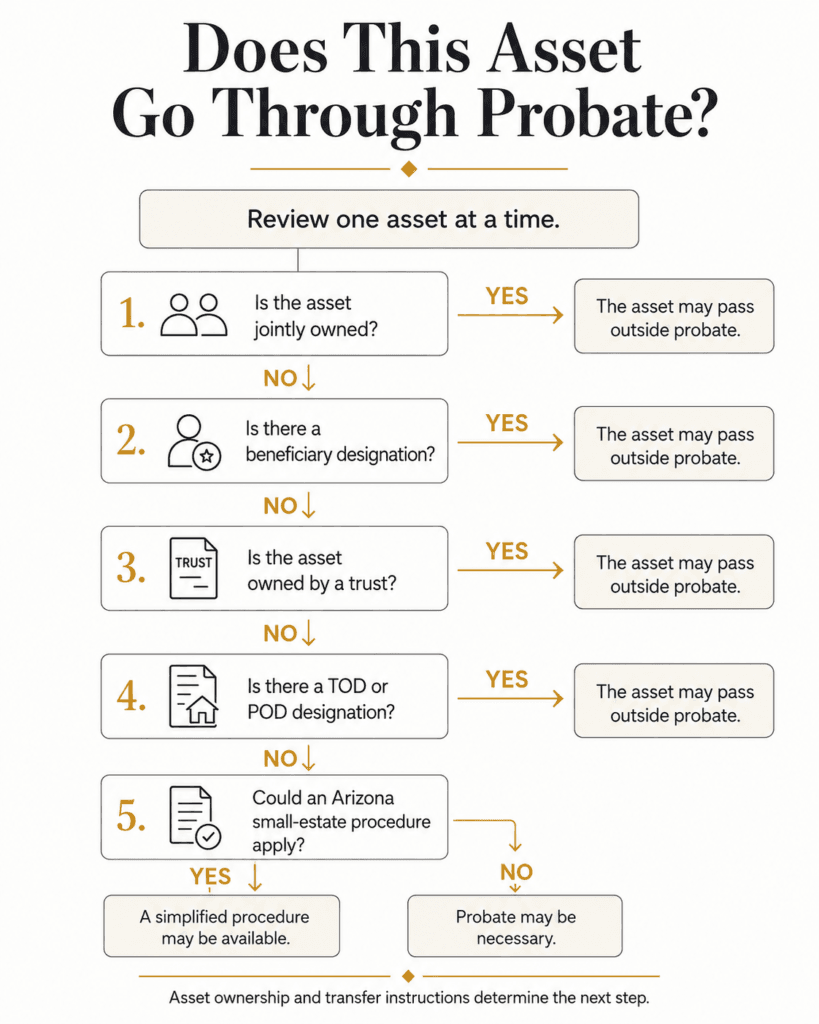
For each asset, ask:
- Whose name is on the title or account?
- Is there a joint owner?
- Is there a named beneficiary?
- Is the asset owned by a trust?
- Is there a loan, lien, or other debt attached to it?
These details matter because not every asset passes through probate.
Some property may transfer directly to a surviving owner, trust beneficiary, or named beneficiary.
Do not close an account or change a title just because you found the asset. The correct transfer process depends on what the asset is and how it was owned.
Gather bills and information about debts
Start collecting bills, statements, and information about ongoing expenses.
Examples include:
- Mortgage or rent
- Utilities
- Insurance
- Medical bills
- Credit cards
- Loans
- Property taxes
- Homeowners association charges
- Business expenses
- Funeral costs
Some expenses may need quick attention to protect estate property. Insurance, utilities, mortgage payments, or necessary repairs may need to continue.
Other bills may become creditor claims that should be handled through the Arizona probate process.
That is why paying every bill immediately can be a mistake.
If the estate does not have enough money to pay every valid obligation, Arizona law determines which expenses and claims are paid first. Paying the wrong bill too early can create problems.
Arizona Law Note: A.R.S. § 14-3805 establishes the priority for paying claims when estate assets are insufficient. Costs of administration and reasonable funeral expenses are among the claims given priority over general unsecured claims.
Preserve mail and financial records
Do not throw away the decedent’s mail.
Mail can reveal important information about:
- Bank accounts
- Debts
- Insurance
- Taxes
- Subscriptions
- Other financial matters
Keep recent bank statements, tax notices, medical bills, insurance documents, and account correspondence.
Also protect computers, phones, email accounts, and electronic records.
Do not erase, reset, give away, or sell a device until important information has been preserved.
Remember that preserving a device is different from having legal permission to access every account on it. Digital accounts may involve privacy laws, account agreements, and questions about who has authority to access them.
Who has authority to act for the estate?
In Arizona, the person legally authorized to administer a probate estate is called the personal representative.
A will may name someone for that role. But being named in the will does not automatically give that person full authority to manage the estate.
Arizona law provides that the duties and powers of the office generally begin upon appointment. The appointment and qualification process must be completed, and the court issues Letters as evidence of the personal representative’s authority.
Before that process is complete, the safer approach is usually to protect property rather than administer the estate.
Protective steps may include:
- Locking and securing a home
- Maintaining necessary insurance
- Caring for pets
- Preventing waste or damage
- Preserving records
- Protecting valuable property
Actions that may require formal authority include:
- Withdrawing money
- Selling property
- Changing titles
- Signing contracts
- Settling claims
- Distributing belongings
Arizona law may give effect to certain actions taken before appointment if the person is later appointed and the actions benefited the estate.
That does not create general permission to manage, sell, or distribute estate property before appointment.
Arizona Law Note: A.R.S. § 14-3701 provides that a personal representative’s duties and powers begin upon appointment. It also allows qualifying acts that benefited the estate before appointment to relate after the person is appointed.

What if estate property is in immediate danger?
Sometimes waiting for the normal probate appointment process could put estate property at risk.
Urgent court involvement may be appropriate when:
- A vacant home is in danger
- A business must continue operating
- Property is being removed
- Insurance coverage is about to end
- An immediate transaction is needed to prevent financial loss
Arizona law allows a special administrator to be appointed in certain situations.
A special administrator may receive temporary authority to collect, manage, and protect estate property until a general personal representative is appointed.
Arizona Law Note: A.R.S. § 14-3614 permits the appointment of a special administrator when necessary to preserve an estate or secure its proper administration. A.R.S. § 14-3616 authorizes an informally appointed special administrator to collect, manage, and preserve estate assets.
Most estates do not need emergency authority. It is usually considered when waiting could cause meaningful harm.
Keep records from the beginning
Good recordkeeping starts immediately.
Save:
- Receipts
- Account statements
- Photographs
- Correspondence
- Funeral documents
- Insurance information
- Notes from important conversations
If someone personally pays an estate-related expense and expects reimbursement later, keep proof of:
- The amount
- The date
- The reason for the payment
- How it was paid
Keep estate expenses separate from personal expenses.
Clear records will make it easier for the future personal representative to prepare the inventory, answer questions, and complete the estate accounting.
Do not divide property too soon
Families sometimes begin dividing furniture, jewelry, vehicles, tools, and other belongings soon after the funeral.
That can create problems, even when everyone seems to agree.
The will may control who receives some property. A trust, title record, joint ownership, or beneficiary designation may control other assets.
The estate may also need property or money to pay expenses, taxes, or creditor claims.
A verbal promise from the decedent does not automatically authorize a transfer.
Before property is distributed, consider the will, trust, title records, beneficiary designations, creditor obligations, and Arizona law.
Until the proper recipient and legal authority are clear, keep the property protected.
Does the estate need Arizona probate?
Maybe.
Probate is the court process used to appoint a personal representative, handle certain debts and claims, and transfer property that does not pass automatically to someone else.
Probate may be needed when the decedent owned property only in his or her name and there is no valid beneficiary designation or other transfer method.
But not every estate needs a full probate case.
Some assets may pass through:
- A trust
- Joint ownership with survivorship rights
- A payable-on-death designation
- A transfer-on-death designation
- A life insurance beneficiary
- A retirement account beneficiary
- An Arizona small-estate affidavit procedure
Review each asset separately.
Does having a will mean probate is required?
No.
A will explains how probate property should be distributed. It does not control every asset a person owned.
One account with a named beneficiary, for example, may pass directly to that beneficiary even if the will says something different about the estate generally.
Could an Arizona small-estate affidavit work?
Arizona has affidavit procedures for certain qualifying small estates.
Subject to all other statutory requirements:
- Personal property may qualify when its net value does not exceed $200,000 and at least 30 days have passed since the death.
- Arizona real property may qualify when its net value does not exceed $300,000 and at least six months have passed.
Arizona Law Note: A.R.S. § 14-3971 contains Arizona’s affidavit procedures, waiting periods, valuation limits, and other requirements for collecting qualifying personal property and succeeding to qualifying real property.
Probate may still be needed when there is:
- A dispute
- Unclear ownership
- A missing beneficiary or heir
- Creditor problems
- Real estate that cannot otherwise be transferred
- Uncertainty about which will is valid
The Arizona Judicial Branch provides statewide probate forms. Individual courts may also have their own preferred forms or procedures.
Common mistakes to avoid
During the first weeks after a death, avoid:
- Using the decedent’s debit or credit cards
- Signing the decedent’s name
- Selling or giving away estate property
- Closing financial accounts without authority
- Canceling necessary insurance
- Paying every creditor immediately
- Mixing estate money with personal money
- Throwing away tax or financial records
- Assuming the will controls every asset
- Letting relatives remove property without documentation
Some of these actions are difficult to reverse. They can also cause disagreements, financial loss, or personal liability.
First steps after someone dies in Arizona
Start with these steps:
- Follow valid funeral or burial instructions.
- Secure the home, vehicles, valuables, and records.
- Locate the original will and other estate documents.
- Obtain certified death certificates.
- Make a preliminary list of assets and debts.
- Preserve mail, statements, and digital information.
- Maintain necessary insurance and utilities.
- Avoid selling or distributing property.
- Save receipts and document expenses.
- Determine how major assets are titled.
- Consider emergency court authority if property is at risk.
- Find out whether an Arizona probate case or small-estate procedure is necessary.

Move forward carefully
The first stage after a death is mainly about protecting property and gathering information.
You do not need to solve every legal and financial issue immediately.
Focus first on preserving the estate, finding important documents, understanding what the decedent owned, and avoiding actions that may be difficult to undo.
Once those steps are underway, you can determine whether probate is required and who should seek appointment as personal representative.
An estate involving a disputed will, blended family, substantial debt, business, missing heir, unclear ownership, or urgent property concern may require individual guidance from an Arizona probate attorney.
Legal Disclaimer: This information is for educational purposes only and does not constitute legal advice. Arizona probate law is complex and varies based on individual circumstances. Always consult with a qualified probate attorney for guidance specific to your situation.
FAQs
Start by following valid funeral instructions, securing the home and other property, locating the original will, obtaining certified death certificates, and gathering information about assets, debts, insurance, and ongoing expenses. Do not sell, transfer, or distribute property until ownership and legal authority are clear.
The personal representative manages the probate estate. Arizona law distinguishes appointment from qualification and issuance of Letters. A person should not begin administering the estate until the appointment and qualification process is complete and Letters have been issued, even though A.R.S. § 14-3701 states that the office’s duties and powers commence on appointment.
No. A will controls the distribution of probate property. Some assets may pass outside probate through a trust, joint ownership, beneficiary designation, or another transfer method. Each asset must be reviewed separately.
No. A will controls the distribution of probate property, but some assets may pass outside probate through a trust, joint ownership, beneficiary designation, or another transfer method. Each asset must be reviewed separately.
Generally, no. Estate property should not be divided until ownership, the controlling estate documents, creditor obligations, and the authority to distribute property have been determined. Even an informal family agreement may conflict with a will, trust, title record, or creditor obligation.
No. Some expenses may need prompt attention to protect property. Other bills may become claims against the estate. If the estate does not have enough money to pay every claim, Arizona law establishes a payment priority.
Subject to additional statutory requirements, an affidavit may be available for personal property when at least 30 days have passed, and the net value does not exceed $200,000. For qualifying Arizona real property, at least six months generally must pass, and the net value must not exceed $300,000.
An interested person may seek appointment of a special administrator through the procedure available for the circumstances, including an informal registrar appointment or a formal court proceeding. A special administrator may receive temporary authority to protect and manage estate property while the general probate process moves forward.