

Learn when Arizona estate distribution is safe, including creditor deadlines, tax reserves, partial transfers, valuations, and closing.
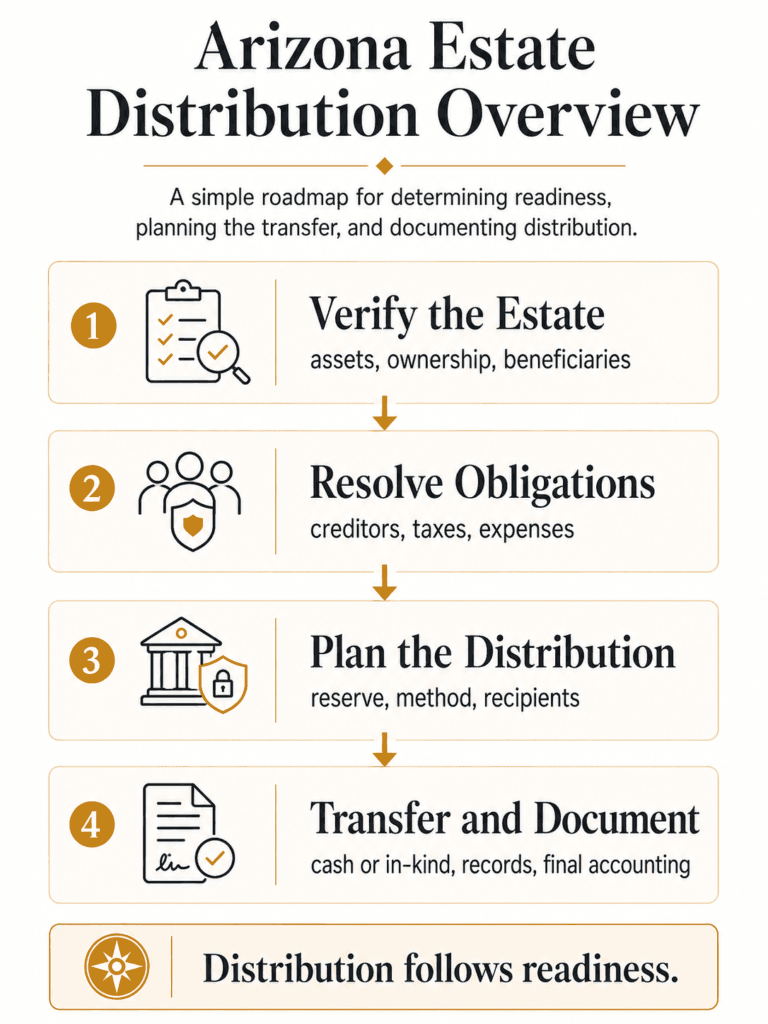
Arizona estate distribution should begin only when the personal representative can transfer property without putting creditors, taxes, expenses, family protections, or disputed interests at unreasonable risk.
Appointment does not mean the estate is immediately ready to distribute.
Before transferring cash or property, the personal representative should determine:
- What belongs to the probate estate
- Who is legally entitled to receive it
- Whether the inventory is complete
- Which creditor deadlines have expired
- Which claims remain unpaid or disputed
- Whether statutory family protections apply
- Which tax returns and payments remain outstanding
- What administration expenses are still expected
- Whether litigation or ownership disputes remain unresolved
- How much property the estate must retain as a reserve
- Whether a court order restricts the transfer
Some estates can safely make partial distributions before administration is complete.
Others should retain all property until nearly every material issue has been resolved.
The correct timing depends on the estate—not simply on how much time has passed.
What is an estate distribution?
An estate distribution is a transfer of probate property to someone legally entitled to receive it.
The recipient may be:
- A beneficiary named in a will
- An heir entitled to inherit under Arizona intestacy law
- A trust named in the will
- Another legally entitled distributee
A distributee is a person or organization that receives property from the probate estate.
A distribution may involve:
- Cash
- Real estate
- Vehicles
- Securities
- Business interests
- Household property
- Jewelry or collections
- Other probate assets
The transfer may be:
- A partial distribution during administration
- Distribution of a specific asset
- An in-kind distribution instead of cash
- A final distribution before closing
Paying a creditor, tax, administration expense, reimbursement, or personal representative compensation is not a beneficiary distribution. Those payments should appear separately in the estate accounting.
Appointment creates authority, not immediate readiness
Arizona requires the personal representative to settle and distribute the estate according to the valid will and Arizona law as efficiently as the estate’s best interests permit.
That authority remains subject to the rights of:
- Creditors
- A surviving spouse
- Minor or dependent children
- Heirs
- Devisees
- Other interested persons
A devisee is a person or organization named in a will to receive property.
These duties appear in A.R.S. § 14-3703.
Early in the administration, the representative may not yet know:
- Whether every asset has been found
- Which assets belong to probate
- Whether a later will exists
- Whether a beneficiary designation controls an account
- How much the estate owes
- Whether a tax return will produce a payment or refund
- Whether property must be sold
- Whether a creditor or beneficiary will object
- Whether the estate can satisfy every gift in full
Distributing too early can leave the estate without enough property to finish the work.
Rahnema Law’s Arizona probate administration overview explains how appointment, creditor work, inventory, accounting, distribution, and closing fit together.
Arizona does not impose one universal distribution date
Arizona law does not establish one date when every estate must begin or finish distributions.
A simple estate made up mostly of cash may become ready relatively quickly when:
- The correct recipients are known
- The creditor process is complete
- Taxes are understood
- No dispute exists
- The estate retains enough money for closing expenses
A different estate may require more time because it involves:
- Real property
- A business
- Difficult-to-value assets
- Secured debt
- Unresolved creditor claims
- Missing tax records
- Litigation
- Beneficiaries who cannot be located
- Disagreement over the will or accounting
Arizona permits an eligible unsupervised estate to file an informal closing statement no earlier than four months after the original appointment of a general personal representative.
That four-month minimum is not a distribution deadline. It does not mean the estate will be ready after four months. (A.R.S. § 14-3933)
Evaluate actual readiness instead of distributing because a calendar milestone has passed.
Review the Letters and every court order
Before transferring property, review:
- Letters of Personal Representative
- The appointment order
- The Order to Personal Representative
- Any order limiting authority
- Any supervision order
- Any restraining order
- Later petitions affecting administration
- The current court docket
Confirm that:
- The appointment remains active
- The Letters have not expired or been restricted
- The representative has authority over the particular property
- No new proceeding prevents distribution
Letters show that the personal representative has been appointed and qualified. They do not prove that every proposed distribution is safe or legally correct.
Rahnema Law’s guide to Letters of Personal Representative explains why institutions may ask to see them before accepting estate instructions.
Supervised estates require a prior court order
A supervised personal representative generally has the ordinary powers of a personal representative unless the court restricts them.
However, a supervised representative may not distribute estate property without a prior court order. Sales of real property are also subject to court confirmation. (A.R.S. § 14-3504)
Before distributing property in a supervised estate, confirm that:
- The court approved the proposed distribution
- Any required accounting was provided
- Required notice was completed
- The order covers the property being transferred
- The transfer follows the court-approved plan
Do not rely on the broader authority usually available in an unsupervised administration.
A pending supervision petition can stop distributions
An estate may begin without supervision and later become the subject of a supervision request.
After receiving notice that a petition for supervised administration has been filed, a previously appointed personal representative may not exercise the power to distribute estate property while the request is pending.
The petition does not automatically stop the representative’s other powers unless the court restricts them. (A.R.S. § 14-3503)
Check the court docket before making a substantial transfer, particularly after conflict develops.
The court may restrain a proposed distribution
An interested person may petition the court to restrain specified acts of administration, payment, or distribution.
The court may issue a temporary order when it appears that the proposed action could unreasonably jeopardize the applicant’s interest or another person’s interest in the estate. (A.R.S. § 14-3607)
Proceed cautiously when:
- A beneficiary disputes the proposed allocation
- Ownership of the asset is contested
- A creditor alleges that the estate may be insolvent
- Someone challenges the accounting
- Compensation is disputed
- A petition for supervision or removal is pending
Even without a restraining order, transferring disputed property may make the conflict harder and more expensive to resolve.
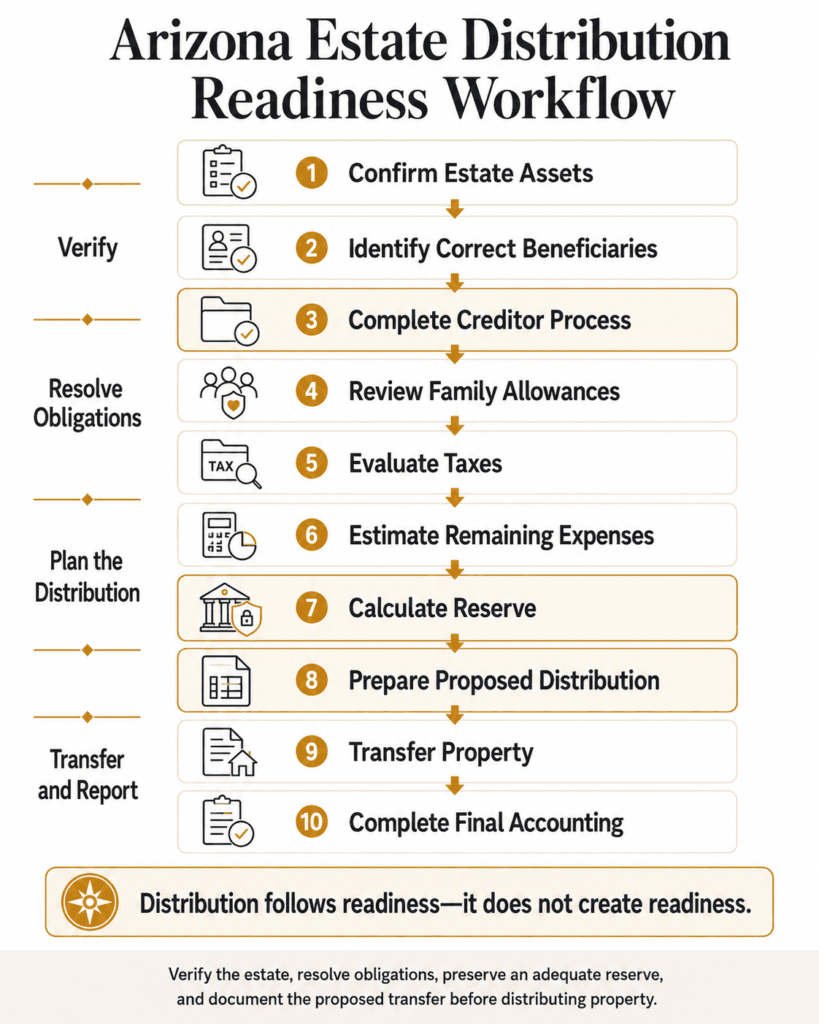
Confirm that the asset belongs to the probate estate
Only probate property should be distributed through the probate administration.
Property may transfer outside probate through:
- A trust
- A beneficiary designation
- A transfer-on-death registration
- A payable-on-death account
- A survivorship arrangement
- A beneficiary deed
- Another written nonprobate-transfer instrument
A will does not automatically control an asset merely because it mentions that property.
Before adding an asset to the distribution plan, review:
- Deeds
- Account agreements
- Beneficiary records
- Trust documents
- Vehicle titles
- Business agreements
- Retirement-plan documents
- Insurance contracts
- Other ownership records
The first question is not:
Who does the will name?
The first question is:
Does this property legally belong to the probate estate?
Rahnema Law’s guide to finding and identifying Arizona probate assets can help the representative build the estate’s complete asset list.
Trace every probate asset through the inventory
A qualifying personal representative generally must prepare an inventory within 90 days after appointment.
The inventory identifies:
- Probate property
- Date-of-death fair market value
- Community or separate character
- Mortgages, liens, and other encumbrances
Before distribution, every material inventory asset should have a documented status, such as:
- Still held by the estate
- Sold
- Collected
- Transferred
- Proposed for in-kind distribution
- Lost through an explained decline in value
- Removed after later proof showed it was nonprobate
An asset should not disappear from the estate records without an explanation.
If the representative discovers additional property or learns that an original description or value was erroneous or misleading, a supplementary inventory may be required.
Rahnema Law’s Arizona probate inventory checklist explains how the opening asset record connects to later sales and distributions.
Identify the correct recipients
When a valid will controls, distributions generally follow the will.
When no will controls a probate asset, Arizona intestacy law determines the heirs.
Questions may arise when:
- A beneficiary died before the decedent
- A beneficiary died during probate
- A gift is unclear
- A spouse or child may have been omitted
- A person disclaims an inheritance
- The intended recipient is a minor
- The intended recipient is incapacitated
- A trust is named but cannot be identified
- An heir cannot be located
- Competing wills exist
- Parentage or family relationships are disputed
Do not rely only on family expectations or informal statements the decedent made during life.
A transfer to the wrong person may have to be recovered. The correct recipient may still have a claim against the estate.
Complete the creditor-notice process
The creditor process is a major part of distribution readiness.
Arizona generally requires the personal representative to publish notice:
- Once each week
- For three successive weeks
- In a newspaper of general circulation in the county
The published notice tells creditors to present covered claims within four months after the first publication. (A.R.S. § 14-3801)
Preserve:
- The published notice
- First-publication date
- Affidavit or proof of publication
- Direct creditor notices
- Mailing or delivery records
- Creditor log
- Claims received
- Allowance or disallowance decisions
The four-month period begins with the first publication—not the final publication.
Known creditors may have a later deadline
The personal representative must also send written notice to known creditors.
A known creditor generally receives the later of:
- Four months after the first published notice, or
- 60 days after the direct notice was mailed or delivered
A known creditor who receives notice late in the general period may therefore have a deadline extending beyond the published four months.
Do not assume that every creditor deadline ends on the same day.
The ordinary creditor period does not resolve every obligation
The creditor statutes also address:
- Claims arising after death
- Contracts made by the personal representative
- Contingent claims
- Unliquidated claims
- Mortgages and other liens
- Proceedings limited to available insurance
- Compensation and expense claims by estate professionals
Arizona’s ordinary claim limitations do not prevent enforcement of a mortgage, pledge, or other lien against estate property.
They also preserve certain proceedings limited to available liability insurance. (A.R.S. § 14-3803)
Before distributing, investigate:
- Is litigation pending?
- Does a secured creditor retain rights against the property?
- Did an obligation arise during administration?
- Is a tax liability unresolved?
- Is an insurance-covered claim pending?
- Are professional fees still accruing?
- Does an estate contract remain incomplete?
The end of the published period is important. It is not the end of every possible estate obligation.
Review and resolve creditor claims
Before final distribution, determine the status of every claim.
The creditor schedule should identify:
- Creditor
- Amount requested
- Date received
- Applicable deadline
- Amount allowed
- Amount disallowed
- Settlement amount
- Priority
- Security or collateral
- Payment status
- Remaining exposure
A demand should not be treated as resolved simply because the creditor has stopped calling.
The file should show whether the claim was:
- Paid
- Settled
- Disallowed
- Withdrawn
- Barred
- Reserved for
- Submitted to the court
- Otherwise accommodated
Retain property for claims and unfinished work
After the applicable claim period, Arizona directs the representative to pay allowed claims in the proper order only after making provision for:
- Homestead allowance
- Exempt property
- Family allowance
- Presented claims not yet allowed
- Claims whose allowance is under appeal
- Unbarred claims that may still be presented
- Administration costs and expenses
These obligations also determine how much property can safely be distributed.
Do not transfer property needed to pay:
- Administration expenses
- Allowed claims
- Disputed claims
- Taxes
- Secured obligations
- Property expenses
- Professional fees
- Expected closing costs
- Other unresolved liabilities
Consider statutory family protections
Arizona provides several protections for a surviving spouse and qualifying children.
They may include:
- Homestead allowance
- Exempt property
- Family allowance
These protections can reduce what remains for creditors and other beneficiaries.
The personal representative should determine:
- Whether each protection applies
- Who is entitled to receive it
- What property or cash satisfies it
- How it affects the remaining distributive shares
Do not calculate a final inheritance without first accounting for applicable family rights.
Address taxes before final distribution
Tax work may include:
- The decedent’s final federal return
- The decedent’s final Arizona return
- Federal estate fiduciary income-tax returns
- Arizona fiduciary income-tax returns
- Property-sale reporting
- Business or employment-tax filings
- Beneficiary Schedules K-1
- A possible federal estate-tax or portability filing
Tax obligations may arise after the ordinary creditor period ends.
Identify:
- Required returns
- Filing periods
- Estimated balances
- Expected refunds
- Property-sale gains or losses
- Preparation fees
- Possible amended returns
- Pending notices or examinations
A final distribution should not leave the estate unable to pay a later tax balance or the cost of completing required returns.
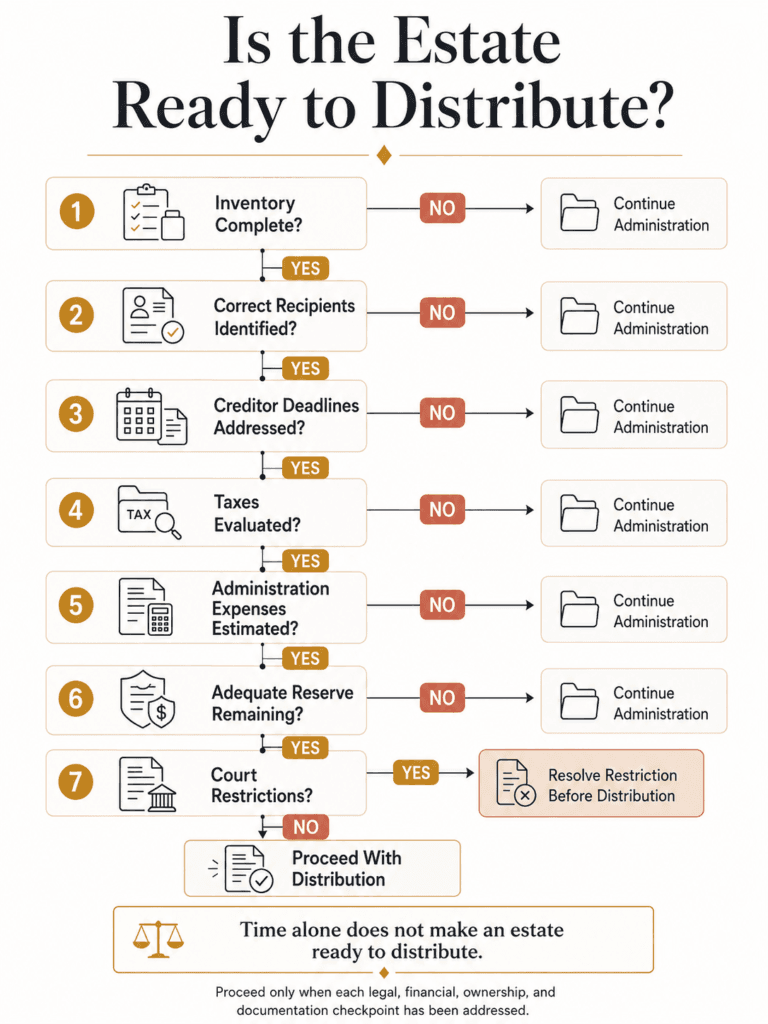
Keep the estate account open while tax work remains
The estate account may still be needed to:
- Pay tax balances
- Deposit refunds
- Pay attorneys and accountants
- Receive delayed income
- Resolve amended-return adjustments
- Correct a prior transaction
Before closing it, confirm that:
- Required returns were filed or adequately provided for
- Payments cleared
- Expected refunds were received or addressed
- Material tax notices were resolved
- Professional fees were paid or reserved
- Beneficiary tax documents were prepared when required
Preserve the final statement and account-closing confirmation.
Estimate remaining administration expenses realistically
The estate’s bank balance is not the amount automatically available for distribution.
Remaining expenses may include:
- Attorney fees
- Accounting fees
- Appraisal expenses
- Court charges
- Insurance
- Utilities
- Property taxes
- Repairs
- Storage
- Real estate commissions
- Personal representative compensation
- Recording and transfer fees
- Closing expenses
The distributable amount is what remains after known obligations are paid and a reasonable reserve is retained for unfinished work.
Pending disputes may delay distribution
Proceed cautiously while a material dispute remains unresolved.
The dispute may concern:
- Validity of the will
- Identity of an heir
- Ownership of an asset
- Meaning of a devise
- Property value
- A creditor claim
- Personal representative compensation
- The estate accounting
- Proposed allocation of property
When only one part of the estate is disputed, a partial distribution of the undisputed portion may sometimes be possible.
The decision should consider the estate’s full potential exposure—not merely the stated value of the disputed property.
What is a partial distribution?
A partial distribution transfers part of a recipient’s expected inheritance before the estate is ready for final distribution.
It may be reasonable when:
- The estate has substantial liquid property
- The creditor process is sufficiently developed
- Taxes and expenses can be estimated reliably
- No court order prevents distribution
- No ownership dispute affects the property
- The correct recipients are known
- An adequate reserve will remain
Examples may include:
- Distributing part of the estate’s cash while a house remains for sale
- Transferring undisputed household property while tax work continues
- Making a limited cash distribution after claims are resolved but before a final refund arrives
Do not make a partial distribution merely because a beneficiary requests money or the estate account appears to have excess cash.
Prepare a distribution-readiness calculation
Before a partial or final distribution, prepare a written calculation.
Property currently held
Identify:
- Estate-account balance
- Real property
- Securities
- Vehicles
- Business interests
- Other assets
Known and expected obligations
Identify:
- Creditor claims
- Secured debt
- Taxes
- Administration expenses
- Property costs
- Professional fees
- Compensation
- Litigation exposure
- Closing expenses
Proposed distribution
Identify:
- Recipient
- Cash or property
- Assigned value
- Partial or final status
Remaining reserve
Identify:
- Amount retained
- Purpose of the reserve
- Method used to calculate it
- Expected period before release
This calculation helps show that the representative considered the estate’s entire financial condition.
A reserve protects the administration
A reserve is property kept in the estate to cover obligations that remain incomplete or uncertain.
There is no single reserve amount appropriate for every Arizona estate.
The amount should reflect:
- Unfinished tax returns
- Disputed creditor claims
- Pending litigation
- Property-carrying costs
- Anticipated professional fees
- Delayed income or refunds
- Business obligations
- Possible valuation corrections
- Expected closing work
An estate with completed tax filings, no disputes, and only one final invoice may need a modest reserve.
An estate involving a business, pending lawsuit, or uncertain tax liability may need much more.
The representative should be able to explain what the reserve covers and why the amount is reasonable.
Apply consistent standards among beneficiaries
Beneficiaries do not always receive equal shares. The will may intentionally provide different gifts.
Within the governing distribution plan, however, the personal representative should act impartially.
Do not favor one person because that beneficiary:
- Is more demanding
- Has an urgent personal expense
- Is more closely related to the representative
- Threatens conflict
- Lives nearby
- Wants a particular asset
If one person receives an early distribution while another must wait, document the legal and financial reason.
Also consider whether unequal timing creates:
- Valuation differences
- Income allocations
- Interest issues
- Accounting complications
Specific gifts may not be ready immediately
A will may leave a particular asset to a named beneficiary. This is commonly called a specific devise.
Examples include:
- A residence
- A vehicle
- Jewelry
- A collection
- A particular investment
The beneficiary does not necessarily receive that property immediately after appointment.
Before transferring it, the representative may need to:
- Confirm probate ownership
- Obtain a date-of-death value
- Secure and insure the property
- Resolve a lien
- Determine whether the estate needs the property to pay obligations
- Obtain a current distribution value
- Prepare the required transfer documents
Gifts may be reduced through abatement
When the estate cannot pay its obligations and satisfy every gift, beneficiary shares may be reduced through abatement.
Unless the will or testamentary plan requires another result, Arizona generally applies abatement in this order:
- Property not disposed of by the will
- Residuary devises
- General devises
- Specific devises
Reductions within the same class are generally proportional. (A.R.S. § 14-3902)
Do not protect one beneficiary’s gift by using another beneficiary’s property without reviewing the will and Arizona’s abatement rules.
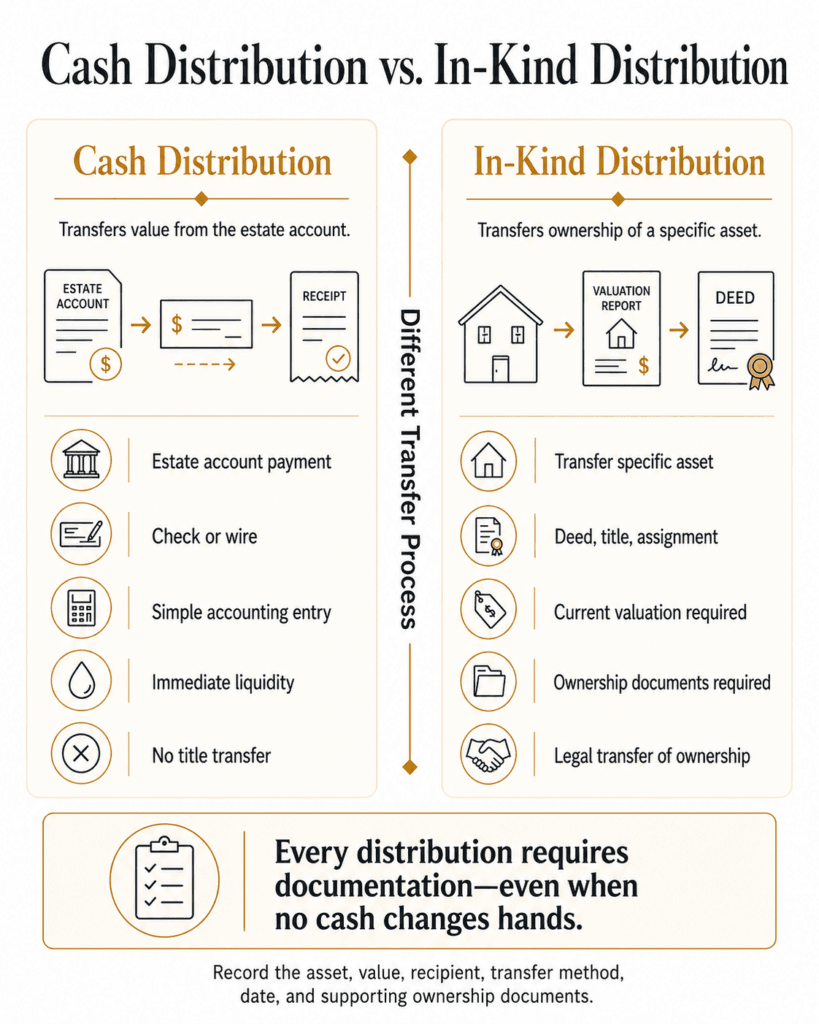
Cash and in-kind distributions are different
Cash distribution
A cash distribution generally comes from the estate account.
The records should identify:
- Recipient
- Amount
- Date
- Payment method
- Partial or final status
- Governing share or devise
In-kind distribution
An in-kind distribution transfers a particular asset instead of selling it and distributing cash.
Examples include:
- Real estate
- Securities
- Vehicles
- Business interests
- Household property
- Collectibles
An in-kind distribution requires more than giving someone possession.
Legal title and estate records must also reflect the transfer.
Arizona generally favors distribution in kind when practical
Unless the will shows a contrary intention, Arizona directs that distributable assets be distributed in kind to the extent possible under the statutory rules.
A specific devisee is generally entitled to the property specifically devised.
Residuary property is distributed in kind when:
- No objection exists, and
- Dividing undivided interests is practical
In other situations, the property may be converted to cash. (A.R.S. § 14-3906)
Consider:
- Terms of the will
- Nature of the property
- Number of beneficiaries
- Whether shared ownership is practical
- Debt secured by the asset
- Tax consequences
- Beneficiary objections
- Estate liquidity
Distribution value may differ from inventory value
The inventory generally uses fair market value as of the date of death.
Distribution may occur months or years later.
During that time:
- A home may increase or decrease in value.
- Investments may change substantially.
- A vehicle may depreciate.
- A business may gain or lose value.
- Repairs may affect market value.
Arizona allows the representative to determine values near the proposed distribution using a reasonable method, including qualified appraisers.
For property without a readily ascertainable value, an otherwise reasonable valuation made no more than 30 days before distribution may control.
Preserve:
- Appraisals
- Brokerage statements
- Comparable sales
- Dealer valuations
- Business valuations
- Written calculations
- Supporting correspondence
Use current values when beneficiaries receive different property
Current values matter when:
- One beneficiary receives a house
- Another receives cash
- Another receives investments
- The shares should be equal
- Values changed materially after death
- One asset remains subject to debt
The calculation should explain:
- Gross value
- Debt or encumbrance
- Net value
- Valuation date
- Source of value
- Effect on each beneficiary’s share
Without a current value, a distribution that appears equal may be substantially unequal.
Send a proposed distribution when appropriate
After the probable charges against the estate are known, the personal representative may mail or deliver a proposed distribution to people who have the right to object.
The proposal may identify:
- Property to be distributed
- Recipient
- Assigned value
- Calculation of shares
- Debt attached to the property
- Reserve retained
- Expected later distribution
A distributee’s right to object based on the kind or value of property proposed for distribution may terminate if the representative does not receive a written objection within 30 days after mailing or delivery.
Arizona Law Note: The 30-day rule applies to objections based on the kind or value of the proposed property. It should not be described as eliminating every possible objection involving ownership, accounting, authority, or the legal validity of the distribution.
What to include in a proposed-distribution package
A clear proposal may include:
- Summary of estate property
- Claims and expenses paid
- Remaining obligations
- Reserve calculation
- Proposed distribution schedule
- Values assigned to noncash property
- Equalization calculation
- Supporting appraisals or statements
- Deadline and method for written objections
- Expected next steps
Use neutral language.
Recipients should receive enough information to understand the calculation without having to reconstruct the entire estate file.
Complete the legal transfer of in-kind property
When the estate makes an in-kind distribution, the personal representative must execute an instrument or deed of distribution assigning, transferring, or releasing the asset to the recipient.
An instrument transferring Arizona real estate and recorded with a county recorder must include the name and address of each distributee. (A.R.S. § 14-3907)
Depending on the property, the transfer may require:
- Deed or instrument of distribution
- Vehicle-title documents
- Brokerage transfer forms
- Bank documents
- Business assignments
- Updated company records
- Delivery and receipt records
Possession alone may not transfer legal title.
Handing someone the keys to a home or car is not necessarily a completed distribution.
Distributions to minors or people under legal disability
A personal representative may discharge the duty to distribute to a person under legal disability by transferring the property to that person’s conservator or another person authorized to provide a valid receipt and discharge. (A.R.S. § 14-3915)
Do not simply transfer substantial property directly to a minor or incapacitated person.
The proper method may depend on:
- Existing conservatorship
- Trust terms
- Custodial arrangement
- Court approval
- Statutory authority
- Type and value of property
- Recipient’s legal status
Individual legal guidance may be necessary before completing the transfer.
Document every Arizona estate distribution
Every distribution should appear clearly in the estate accounting.
For each transfer, record:
- Recipient
- Date
- Amount or property
- Assigned value
- Partial or final status
- Will provision or intestate share
- Payment or transfer method
- Supporting documents
Preserve:
- Canceled check or transfer confirmation
- Signed receipt
- Deed
- Assignment
- Vehicle-title record
- Brokerage confirmation
- Appraisal
- Proposed distribution
- Written objection or waiver
- Delivery records
The records should connect the inventory asset to the person who ultimately received it.
Obtain a receipt or acknowledgment
A signed receipt can confirm:
- Property received
- Date of receipt
- Value assigned
- Partial or final status
- Delivery of title documents
A receipt does not replace a deed, title, assignment, or institutional form required to transfer ownership.
For a partial distribution, avoid wording that suggests the beneficiary received the entire inheritance when more may remain.
Describe whether the distribution is partial or final
Useful descriptions include:
- Partial cash distribution under Article IV of the will
- Final residuary cash distribution
- In-kind distribution of estate vehicle
- Distribution of one-half interest in estate residence
- Equalization payment related to securities distribution
Avoid vague descriptions such as:
- Inheritance
- Beneficiary payment
- Transfer
- Final payment
The accounting should allow another person to understand exactly what happened.
Risks of distributing too early
Premature distribution can leave the estate unable to pay:
- Taxes
- Creditor claims
- Secured debt
- Professional fees
- Property expenses
- Statutory family protections
- Litigation costs
- Closing expenses
It can also create conflict when:
- The recipient was incorrect
- The asset was nonprobate property
- The property was valued inaccurately
- Another beneficiary should have received more
- The court later restricts the representative
- The will is successfully challenged
Recovery may be difficult after money has been spent or property has been sold.
A recipient may have to return an improper distribution
A person who improperly receives estate property or money may be required to return the property and the income received from it.
If the recipient no longer has the property, the recipient may be liable for its value when it was disposed of, together with related income and gain. (A.R.S. § 14-3909)
A repayment agreement may provide practical protection in some partial distributions.
It does not replace the representative’s duty to decide whether the transfer is prudent.
Creditors may pursue distributees after distribution
After estate property has been distributed, an undischarged claim that is not barred may sometimes be pursued against one or more distributees.
A distributee’s liability generally does not exceed the value of the distribution received.
Property received as exempt property, homestead allowance, or family allowance receives specific statutory protection. (A.R.S. § 14-3934)
This is another reason to:
- Complete creditor notice
- Calculate individual deadlines
- Retain adequate reserves
- Resolve tax exposure
- Preserve recipient information
The personal representative may face liability
A personal representative who improperly exercises authority may be liable for resulting damage or loss.
Potential problems include:
- Distributing while a court order prohibits it
- Ignoring a known creditor
- Leaving no tax reserve
- Transferring disputed property
- Failing to apply abatement
- Using outdated values to favor one recipient
- Distributing nonprobate property as an estate asset
- Transferring property to the wrong person
- Failing to complete title documents
Good intentions do not replace a reasonable distribution analysis.
Distribution and closing are different stages
Distribution usually occurs before informal closing.
Arizona’s informal-closing statute generally requires the representative to state that:
- The creditor-claim period expired
- Presented claims and administration expenses were paid, settled, or otherwise addressed
- Applicable death-tax obligations were handled
- Estate assets were distributed to those entitled
- A full written accounting was furnished to affected distributees
The closing statement generally may not be filed earlier than four months after the original appointment.
Distribution and closing are related. They are not the same event.
Outstanding liabilities require special treatment at closing
Arizona’s closing statute recognizes that some liabilities may remain unresolved.
When that occurs, the closing statement must explain whether:
- The estate was distributed subject to possible liability with the distributees’ agreement, or
- Other detailed arrangements were made for the outstanding liabilities
This is not a routine shortcut.
Obtain legal guidance before distributing an estate subject to a material unresolved liability.
The four-month closing minimum is not a distribution deadline
Do not infer from the four-month closing minimum that:
- Every creditor matter is resolved
- Taxes are complete
- Property has been valued
- Beneficiaries have been identified
- A home is ready to transfer
- A final accounting can be completed
- Distribution is safe
Many estates properly remain open longer because they require:
- Real estate sales
- Tax filings
- Business administration
- Creditor litigation
- Heir investigation
- Title correction
- Updated valuation
- Beneficiary negotiations
Distribute when the estate is ready—not when someone selects an arbitrary date.
Rahnema Law’s Arizona probate roadmap provides a broader view of the process from filing through final distribution and closing.
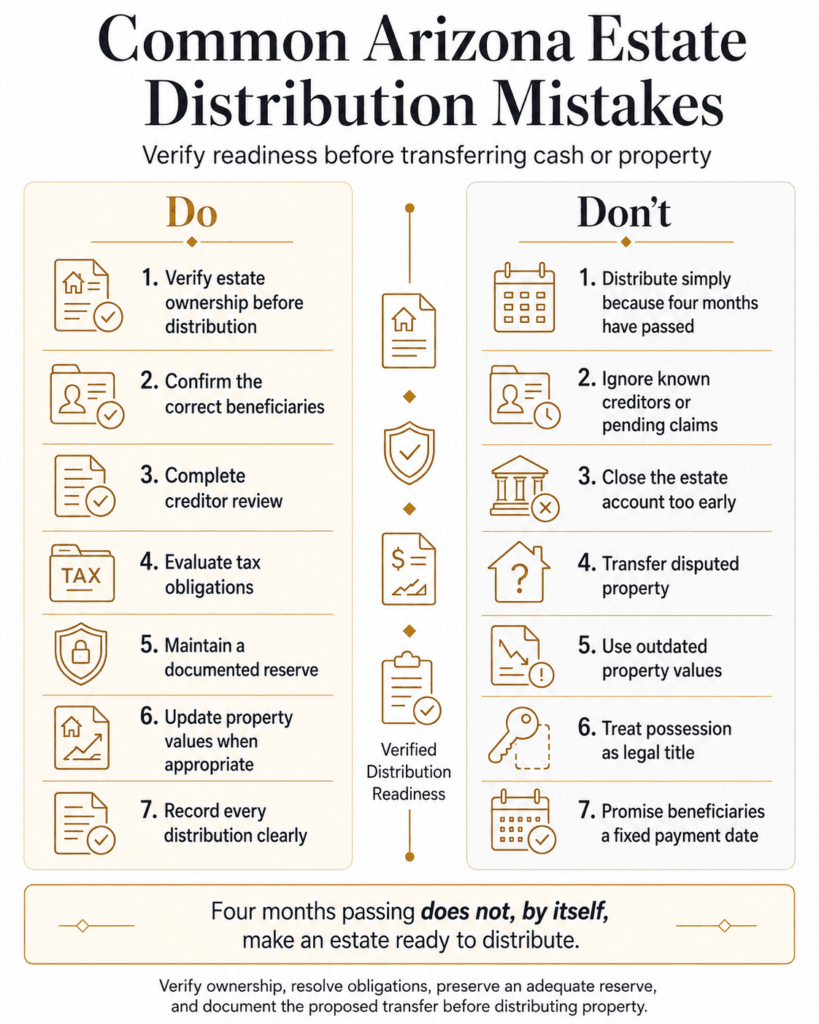
Common Arizona estate distribution mistakes
Common mistakes include:
- Treating appointment as permission to distribute immediately
- Promising beneficiaries a fixed payment date
- Relying only on the published four-month creditor period
- Failing to send direct notice to known creditors
- Ignoring liens and post-death claims
- Distributing before taxes are evaluated
- Keeping no reserve
- Ignoring statutory family protections
- Assuming the will controls nonprobate property
- Distributing disputed assets
- Failing to review court restrictions
- Distributing during a pending supervision petition
- Using only date-of-death values for a later in-kind distribution
- Failing to apply abatement
- Treating possession as legal title
- Transferring substantial property directly to a minor
- Failing to obtain receipts
- Using vague accounting descriptions
- Closing the estate account too early
- Filing a closing statement before distribution and accounting are complete
Arizona estate distribution checklist
Before distributing estate property, confirm that:
- The personal representative’s appointment remains active.
- The Letters and court orders have been reviewed.
- The estate is not supervised, or the required order was obtained.
- No pending supervision petition prevents distribution.
- No restraining order applies.
- The property belongs to the probate estate.
- The inventory is complete and accurate.
- The status of every material inventory asset is documented.
- The correct recipients have been identified.
- The will and applicable succession rules have been reviewed.
- Published notice to creditors was completed.
- Known creditors received direct notice.
- Applicable creditor deadlines expired or were addressed.
- Secured, contingent, post-death, insured, and disputed claims were evaluated.
- Allowed claims were paid or adequately reserved for.
- Homestead, exempt-property, and family-allowance rights were considered.
- Required federal and Arizona tax filings were identified.
- Known taxes were paid or adequately reserved for.
- Remaining administration expenses were estimated.
- Pending litigation and ownership disputes were considered.
- A written reserve calculation was prepared.
- A partial distribution will leave enough property to finish administration.
- Abatement was analyzed if every gift cannot be paid in full.
- Current values were obtained when necessary.
- A proposed distribution was sent when appropriate.
- Required deeds, assignments, titles, and institutional forms are ready.
- Distribution to a minor or incapacitated person will use an authorized recipient.
- Each transfer will appear in the estate accounting.
- Signed receipts or acknowledgments will be preserved.
- Final distribution will leave the estate able to complete closing.
Distribute when the estate is ready
An Arizona estate is ready to distribute when the personal representative can complete the transfer without placing creditors, taxes, administration expenses, family protections, or disputed interests at unreasonable risk.
The end of the published creditor period is an important milestone. It is not the only requirement.
Known creditors may have later deadlines. Liens may remain enforceable. Taxes may be unfinished. Property may require a current valuation or formal title documents. A court order may restrict distribution.
A partial distribution may be appropriate when the estate has enough property and retains a documented reserve.
Final distribution should generally wait until remaining obligations are known, paid, settled, or otherwise adequately addressed.
A strong distribution decision is supported by:
- A complete inventory
- A current financial summary
- Resolved creditor issues
- A reasonable tax and expense reserve
- Correct recipient identification
- Reliable valuations
- Proper transfer documents
- A clear estate accounting
An estate involving litigation, a business, substantial debt, uncertain taxes, difficult property, beneficiary conflict, or supervised administration may require individualized legal and tax guidance before property is released.
Legal Disclaimer: This information is for educational purposes only and does not constitute legal advice. Arizona probate law is complex and varies based on individual circumstances. Always consult with a qualified probate attorney for guidance specific to your situation.
FAQs
An estate may distribute when the personal representative can identify the correct recipients and complete the transfer without leaving creditors, taxes, expenses, family protections, or disputed interests inadequately protected.
No. Timing depends on creditor deadlines, taxes, estate property, disputes, court restrictions, and the remaining work.
Arizona does not establish an absolute rule prohibiting every earlier distribution. However, an early distribution must still be prudent. The representative must protect known and potential obligations, and known creditors may have later direct-notice deadlines.
Yes. A known creditor generally receives the later of four months after the first publication or 60 days after direct written notice.
No. Arizona’s ordinary claim limitations do not prevent enforcement of a valid mortgage, pledge, or other lien against estate property.
Yes, when appropriate. A partial distribution may be reasonable when the estate has enough property, remaining obligations can be estimated reliably, no court restriction applies, and an adequate reserve remains.
There is no universal amount. The reserve should reflect expected taxes, creditor claims, professional fees, property expenses, disputes, litigation, and closing costs.
Yes. A supervised personal representative may not distribute estate property without a prior court order.
After receiving notice of the petition, a previously appointed personal representative may not distribute estate property while the request is pending. Other powers generally continue unless the court restricts them.
Yes. The court may temporarily restrain a distribution when the proposed action could unreasonably jeopardize an interested person’s rights.
Potentially. Arizona generally permits in-kind distributions when they are consistent with the will and statutory requirements. The house may require updated valuation, lien analysis, and a recorded instrument or deed of distribution.
No. Arizona permits valuation near the distribution date. Property without a readily ascertainable value may use an otherwise reasonable valuation made no more than 30 days before distribution.
An objection based on the kind or value of the property may be lost if the personal representative does not receive it in writing within 30 days after mailing or delivery of the proposal. That rule does not necessarily eliminate other types of objections.
Beneficiary shares may abate. Unless the will requires another result, Arizona generally uses property not disposed of by the will first, followed by residuary, general, and specific devises.
Yes. A person who improperly receives estate property may be required to return the property, its value, and related income or gain.
An undischarged and unbarred claim may sometimes be pursued against distributees, generally up to the value received and subject to statutory protections.
Generally, yes, for an informal closing. Arizona’s closing statement requires the representative to state that assets were distributed and that affected distributees received a full written accounting.