

Learn how probate and nonprobate assets in Arizona transfer through trusts, beneficiaries, survivorship rights, deeds, and probate.
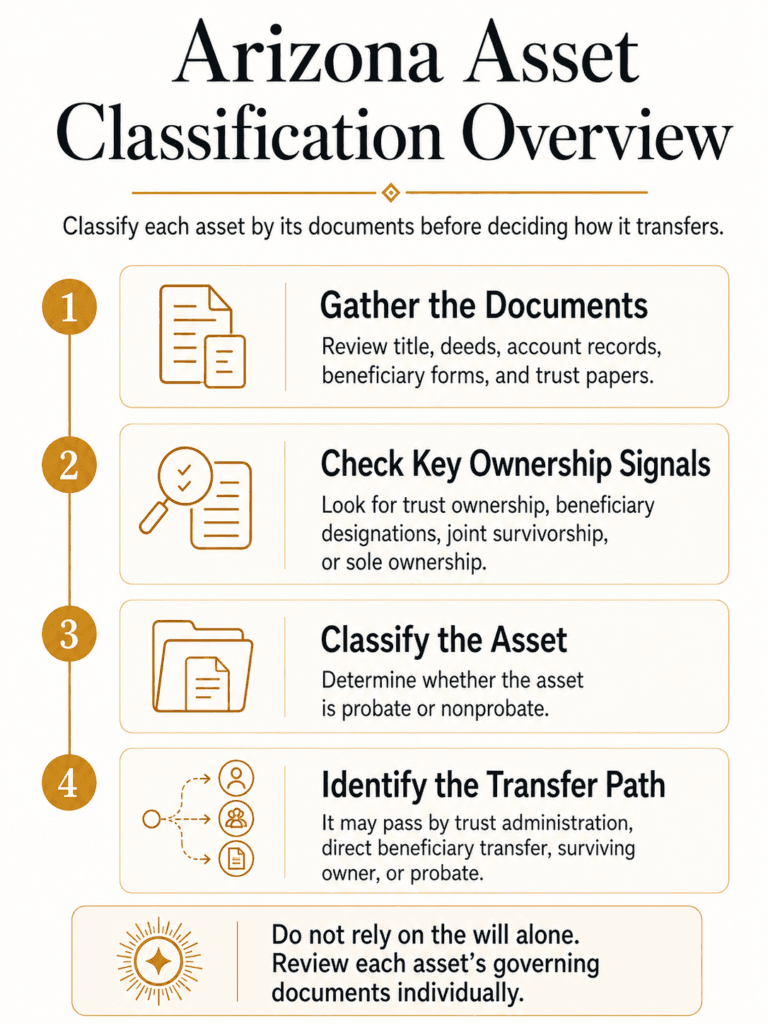
Probate and nonprobate assets in Arizona follow different transfer rules after someone dies. A probate asset generally requires administration through the estate or another authorized estate procedure. A nonprobate asset generally passes through a trust, beneficiary designation, survivorship right, deed, account registration, or contract.
The will alone does not answer the question.
You must review each asset separately and ask:
- Who owned it?
- How was it titled?
- Was a beneficiary named?
- Did someone else have survivorship rights?
- Was it legally owned by a trust?
- Did another document control the transfer?
One estate can contain both probate and nonprobate property.
For example:
- A home titled only in the decedent’s name may require probate.
- A retirement account may pass to a named beneficiary.
- One bank account may belong to the estate.
- Another account at the same bank may pass to a surviving owner.
- Property held in a living trust may be managed by the successor trustee.
The governing document for each asset matters more than assumptions about what the person intended.
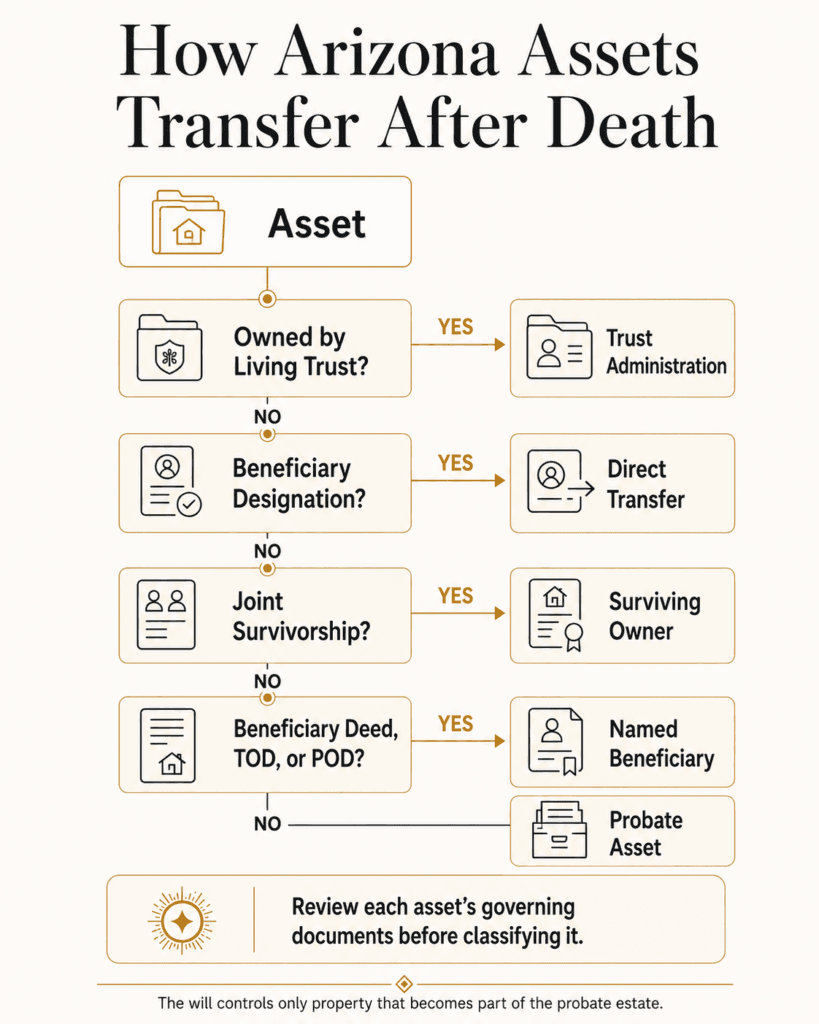
What is a probate asset?
A probate asset is property the person owned at death that does not have another effective method of transfer.
The person who died is called the decedent.
Probate assets commonly include solely owned property without a valid:
- Beneficiary designation
- Survivorship provision
- Trust ownership
- Payable-on-death instruction
- Transfer-on-death instruction
- Beneficiary deed
- Other contractual transfer arrangement
Examples may include:
- A home titled only in the decedent’s name
- An individual bank account without a payable-on-death beneficiary
- A solely owned vehicle
- Household belongings
- A business interest owned individually
- Money owed to the decedent
- A brokerage account without a surviving beneficiary
The personal representative may need to collect, protect, value, manage, sell, or distribute these assets during probate.
Arizona generally requires the personal representative to prepare an inventory identifying probate property with reasonable detail, its date-of-death value, whether it was community or separate property, and any mortgage, lien, or other encumbrance.
Rahnema Law’s Arizona probate inventory guide explains that process and the general 90-day deadline in more detail.
What is a nonprobate asset?
A nonprobate asset transfers through a legal arrangement other than administration under the decedent’s will or Arizona intestacy law.
The transfer may be controlled by:
- A living trust
- A beneficiary designation
- An account agreement
- A survivorship provision
- A beneficiary deed
- An insurance policy
- A retirement plan
- A transfer-on-death registration
- Another written contract or instrument
Arizona law recognizes that written instruments can create transfers at death that are nontestamentary. The statute applies broadly to insurance, retirement benefits, trusts, account agreements, securities, deeds, contracts, and similar arrangements.
A recipient usually works directly with the institution or fiduciary responsible for the asset, such as:
- A bank
- A brokerage firm
- An insurance company
- A retirement-plan administrator
- A trustee
- A county recorder
- The Arizona Motor Vehicle Division
Nonprobate does not mean no paperwork.
The recipient may still need to provide:
- A certified death certificate
- Identification
- Tax information
- Beneficiary claim forms
- Trust documents
- An affidavit
- Institution-specific paperwork
Why the distinction matters
Correctly identifying probate and nonprobate assets in Arizona affects nearly every stage of estate administration.
Classification determines:
- Which property the personal representative may control
- Which assets belong on the probate inventory
- Which property passes under the will
- Which property passes through intestate succession
- Which assets transfer directly to another person
- Which trustee, institution, owner, or beneficiary handles the transfer
- Which property may be available for estate obligations
If a nonprobate asset is mistakenly treated as probate property, the personal representative may try to control property that legally belongs to someone else.
If a probate asset is mistakenly treated as nonprobate property, it may be omitted from the inventory or transferred without proper authority.
Review the legal records for the individual asset. Do not rely only on the will, a monthly statement, or a family member’s understanding.
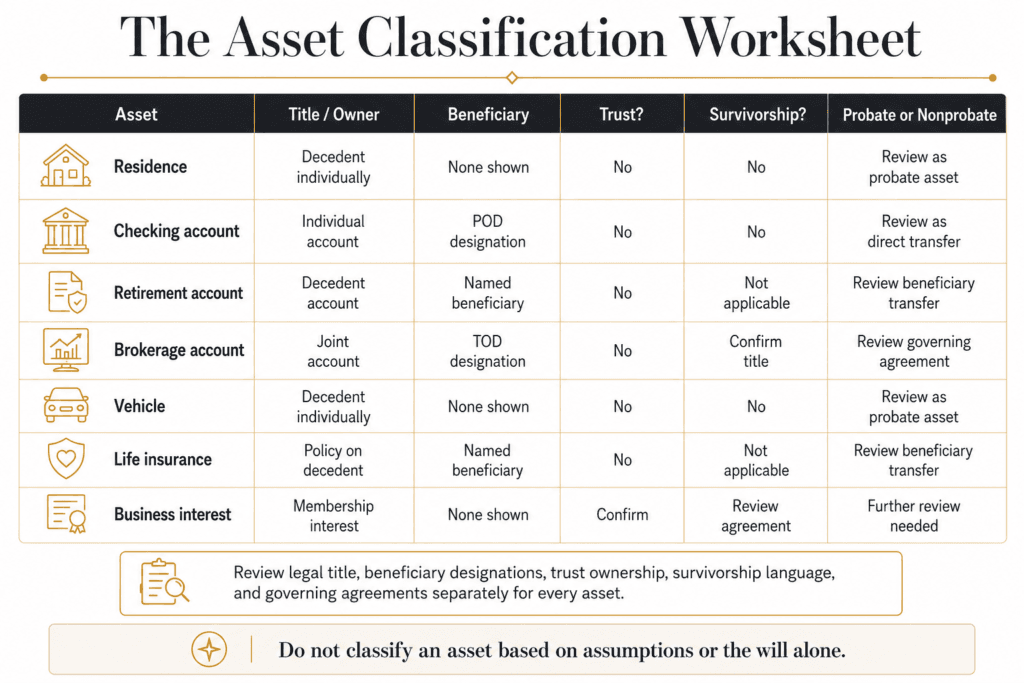
Review every asset separately
For each significant asset, identify:
- The legal owner on the date of death
- The form of title or registration
- Any surviving co-owner
- Any right of survivorship
- Any beneficiary designation
- Any trust ownership
- Any contract controlling the transfer
- Whether the beneficiary survived the decedent
- Whether the estate was named as beneficiary
- The decedent’s actual percentage or ownership interest
Useful records may include:
- Deeds
- Vehicle titles
- Bank-account agreements
- Signature cards
- Beneficiary forms
- Trust documents
- Insurance policies
- Retirement-plan records
- Business agreements
- Transfer-on-death registrations
- Institution correspondence
A tax return, account statement, or family recollection may help locate property. It may not prove how the property legally transfers.
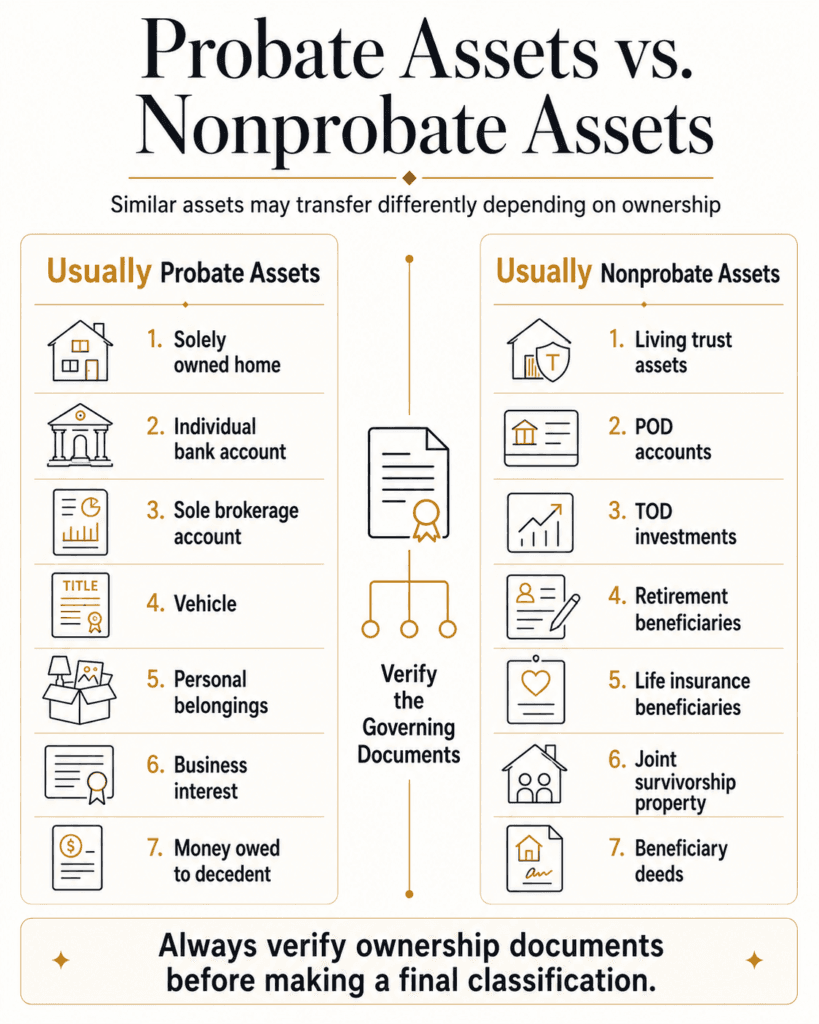
Property owned only by the decedent
Property titled only in the decedent’s name is commonly a probate asset when no valid beneficiary or other transfer arrangement applies.
Examples may include:
- An individual checking account
- A parcel of land
- A vehicle
- A brokerage account
- A sole proprietorship
- Household property
- A promissory note payable to the decedent
Having a will does not make the asset nonprobate.
The will may explain who should ultimately receive the property. But someone may still need authority to collect, manage, or transfer it.
For substantial estate property, banks, title companies, and other institutions may request certified Letters showing that the personal representative has been appointed and qualified. Rahnema Law explains the purpose of Letters and why institutions may request them.
Property held in a living trust
Property legally owned by a living trust is generally managed by the trustee rather than the probate personal representative.
Arizona trustees may exercise powers granted by the trust and, unless the trust limits them, powers appropriate for managing and distributing trust property. Those powers remain subject to the trustee’s fiduciary duties.
The central question is:
Was the asset actually transferred to the trust?
Signing a trust does not automatically retitle every asset.
Depending on the property:
- Real estate may need to be conveyed by deed.
- Financial accounts may need to be retitled.
- Business interests may require an assignment or company approval.
- Vehicles may require title changes.
- Personal property may be covered by an effective assignment.
An asset intended for the trust but left in the decedent’s individual name may still require probate.
A pour-over will may direct probate property into the trust after estate administration. It does not automatically eliminate probate for property that remained outside the trust.
After a formerly revocable trust becomes irrevocable because of the settlor’s death, Arizona law also imposes certain notice and reporting duties on the trustee for qualifying beneficiaries.
Payable-on-death bank accounts
A payable-on-death account, commonly called a POD account, names a beneficiary to receive funds after the account owner dies.
Arizona permits single-party and multiple-party accounts to include POD designations.
When a valid beneficiary survives the last account owner, the balance generally belongs to the surviving beneficiary or beneficiaries.
If no beneficiary survives, the funds generally belong to the estate of the last surviving account owner.
The bank’s records should be reviewed to confirm:
- Whether a POD designation exists
- The beneficiary’s identity
- Whether the beneficiary survived
- Whether the designation was changed or revoked
- Whether the estate was named as beneficiary
A beneficiary’s name in a will or personal note does not necessarily create an effective POD designation.
Arizona Law Note: A.R.S. § 14-6212 addresses rights in multiple-party, POD, and single-party accounts after an account owner dies. It also provides that the decedent’s interest in certain accounts without survivorship or POD rights transfers as part of the estate.
Transfer-on-death investment accounts
Stocks, brokerage accounts, and other securities may be registered in beneficiary form using a transfer-on-death, or TOD, designation.
The designation does not change ownership while the owner is alive. The owner can generally change or cancel it during life.
After the death of the sole owner or last surviving owner, securities registered in beneficiary form pass to the surviving beneficiary or beneficiaries after the institution’s requirements are satisfied.
If no beneficiary survives, the securities belong to the deceased owner’s estate.
Do not assume an investment account is TOD because a beneficiary’s name appears on an informal statement. Obtain the brokerage firm’s actual beneficiary records.
Life insurance policies
Life insurance proceeds usually pass under the beneficiary designation maintained by the insurance company.
When a surviving person or trust is the valid beneficiary, the proceeds ordinarily transfer under the policy rather than the will.
Proceeds may become payable to the probate estate when:
- The estate is the designated beneficiary
- No designated beneficiary survives
- The designation is invalid or ineffective
- Another applicable legal rule or court order changes the result
Arizona’s nonprobate-transfer statute expressly recognizes beneficiary provisions in insurance contracts as nontestamentary transfers.
Do not treat proceeds payable directly to a beneficiary as estate money merely because the decedent paid the premiums.
Retirement accounts and employment benefits
Retirement and employment-related assets may include:
- Individual retirement accounts
- 401(k) accounts
- Pension benefits
- Deferred-compensation accounts
- Employer-sponsored death benefits
- Other employment plans
These assets generally transfer according to the plan’s beneficiary designation and governing documents.
The plan administrator should confirm:
- The beneficiary on file
- Whether the beneficiary survived
- Whether alternate beneficiaries exist
- Available distribution options
- Required claim documents
- Applicable tax reporting
Arizona’s nonprobate-transfer statute recognizes provisions in pension, retirement, compensation, and employment-benefit plans.
Retirement distributions may have significant tax consequences. A beneficiary should understand the available options before requesting a distribution or rollover.
Joint bank accounts
A joint account requires two separate questions:
- Who owned the money during life?
- What happens to the account at death?
Arizona permits multiple-party accounts with or without survivorship rights. An account may also include a POD or agency designation.
At death, an account with effective survivorship rights generally passes to the surviving party or parties.
An account without survivorship rights may leave the decedent’s beneficial interest in the probate estate.
The account title shown on a statement may not provide the complete answer.
Obtain:
- The signature card
- The account agreement
- Ownership designations
- Survivorship terms
- Beneficiary records
- Transaction history when ownership is disputed
Do not assume that someone added to an account only to help pay bills owns the money or has survivorship rights.
An agent listed on an account is also not automatically an owner or beneficiary.
Jointly owned Arizona real estate
Arizona real estate may be held as:
- Tenancy in common
- Joint tenancy with right of survivorship
- Community property
- Community property with right of survivorship
Arizona generally treats a conveyance to two or more people as creating a tenancy in common unless the deed expressly creates another recognized ownership form or an exception applies.
Joint tenancy with right of survivorship must be expressly created. Married owners may also hold real estate as community property with right of survivorship when the deed expressly provides for it.
When effective survivorship rights remain in place, the deceased owner’s interest generally passes to the survivor rather than through probate.
When owners held title as tenants in common, the decedent’s fractional interest does not automatically pass to the other owner. That share may become a probate asset.
Review the recorded deed.
Do not rely only on:
- The mortgage statement
- The property-tax bill
- Who occupied the property
- Who paid the expenses
- Family assumptions
Arizona beneficiary deeds
Arizona allows an owner to use a beneficiary deed to transfer real property at death.
For the statutory transfer to work, the deed must be properly executed and recorded in the county where the property is located before the owner’s death.
A signed deed discovered after death is not the same as a beneficiary deed that was timely recorded.
A valid beneficiary deed:
- Takes effect at death
- Is not revoked by a later will
- May name multiple or successor beneficiaries
- Transfers the owner’s interest subject to applicable liens and encumbrances
When property is already held with survivorship rights, the survivorship ownership can affect whether and how the beneficiary deed operates. Arizona law provides that survivorship rights may prevail when fewer than all owners executed the beneficiary deed.
Arizona Law Note: A.R.S. § 33-405 establishes Arizona’s beneficiary-deed requirements and requires recording before the owner’s death.
Obtain the complete recorded deed and review any later revocation or replacement.
Vehicles
Whether an Arizona vehicle is probate or nonprobate property can depend on:
- The title
- The legal-status designation
- Co-ownership
- Survivorship rights
- A beneficiary designation
- The availability of a qualifying estate-transfer procedure
Arizona MVD uses legal-status designations such as OR, AND, and AND/OR.
According to MVD:
- OR ownership allows either owner to transfer the vehicle, and after one owner dies, the survivor may transfer it.
- AND ownership is treated as tenancy in common, and the deceased owner’s interest generally must be handled through probate or a qualifying nonprobate affidavit.
- AND/OR ownership includes a right of survivorship, allowing the survivor to act after providing proof of death.
Arizona MVD also provides a beneficiary-designation form for a sole vehicle owner.
A vehicle titled only to the decedent, without a surviving owner or effective beneficiary, may belong to the probate estate.
Before transferring a vehicle, review:
- The title
- The legal-status designation
- Beneficiary records
- Loan and lien information
- MVD requirements
Possession of the keys does not establish ownership.
Household belongings and personal property
Furniture, jewelry, artwork, tools, electronics, firearms, collections, and ordinary household items are often probate assets.
Most do not have separate beneficiary designations or title documents.
Do not distribute them simply because family members agree informally about who should receive them.
The estate may need the property to:
- Pay administration expenses
- Address creditor claims
- Equalize beneficiary distributions
- Complete a sale
- Resolve a dispute
The will may also contain specific gifts.
Valuable or unusual property may require an appraisal.
If an item must be moved for protection, document:
- What was moved
- Who took possession
- Where it is stored
- Why it was moved
- Its condition
Photographs and a written receipt can help prevent later disagreement.
Business interests
A business interest may be probate or nonprobate depending on its structure, ownership records, trust status, and governing agreements.
A solely owned business interest may become estate property.
Another transfer may instead be controlled by:
- A trust
- An operating agreement
- A shareholder agreement
- A partnership agreement
- A buy-sell agreement
- A redemption provision
- Another binding contract
The agreement may require the interest to be:
- Purchased by the company
- Offered to another owner
- Redeemed
- Transferred to a successor
- Valued under a contractual formula
Do not assume the company’s bank accounts, equipment, or real estate were personally owned by the decedent.
The estate may own an interest in the entity rather than the entity’s underlying property.
Management rights, company debts, taxes, employee obligations, and valuation may require prompt professional review.
Money owed to the decedent
A right to receive money can be a probate asset even when the estate has not yet collected it.
Examples include:
- Personal loans
- Promissory notes
- Unpaid wages
- Commissions
- Business receivables
- Court judgments
- Tax refunds
- Security deposits
- Settlement proceeds
The personal representative may need to:
- Notify the debtor
- Provide certified Letters
- Continue a lawsuit
- File a claim
- Negotiate payment
- Collect installments
The probate inventory should generally identify the decedent’s right and its reasonable date-of-death value, even when collection is uncertain. Arizona’s inventory statute applies to property owned at death, not only to cash already in hand.
Digital assets and cryptocurrency
Digital property may include:
- Cryptocurrency
- Exchange accounts
- Domain names
- Monetized websites
- Intellectual property
- Online financial accounts
- Cloud-stored business records
- Other electronic interests
Ownership and access are different questions.
Knowing a password does not necessarily give a family member authority to access, transfer, or close an account.
Arizona law provides procedures for a personal representative to request disclosure of certain digital assets from a custodian.
Depending on the information requested, the personal representative may need to provide:
- A written request
- A certified death certificate
- Certified Letters, a qualifying small-estate affidavit, or a court order
- Account identifiers
- Evidence connecting the account to the decedent
- Evidence that disclosure is reasonably necessary for administration
Different requirements apply to the contents of electronic communications and to other digital assets or account catalogues.
A fiduciary’s authority remains subject to duties of care, loyalty, and confidentiality, applicable terms of service, and other law. The authority may not be used to impersonate the deceased user.
For cryptocurrency, protect:
- Hardware wallets
- Devices
- Seed-phrase records
- Exchange statements
- Authentication devices
Do not experiment with transfers before ownership, authority, security, and tax consequences are understood.
Community property in an Arizona estate
Arizona is a community-property state.
Property acquired by either spouse during marriage is generally community property, subject to statutory exceptions. Property acquired by gift, devise, or descent is excluded from the general community-property rule.
Property owned before marriage, and property acquired during marriage by gift, devise, or descent, is generally separate property.
At death, the decedent’s separate property and share of community property pass subject to estate administration and protected rights and claims.
Arizona also provides that the surviving spouse’s share of community property may remain subject to administration until the claim-presentation period expires and afterward to the extent necessary to pay community claims.
The name on the account or deed may not answer every community-property question.
The analysis may depend on:
- When the property was acquired
- The source of the purchase funds
- Whether community and separate funds were mixed
- Marital agreements
- Changes in title
- Refinancing
- Contributions made during marriage
A jointly titled asset may require two separate questions:
- What was its marital-property character?
- How does the ownership interest transfer at death?
Do not assume every asset automatically belongs entirely to the surviving spouse.
A power of attorney does not determine ownership
A power of attorney gives an agent authority to act for the principal during the principal’s life.
It does not make the agent:
- An owner
- A beneficiary
- A trustee
- A personal representative
Arizona protects certain good-faith acts performed by an agent or another person who lacks actual knowledge of the principal’s death.
That protection should not be treated as continuing authority after the agent learns that the principal has died.
After death:
- Authority over probate property generally belongs to the personal representative.
- Authority over trust property generally belongs to the trustee.
- Authority to claim a nonprobate asset generally belongs to the beneficiary or surviving owner.
One person may serve in more than one role. Each role still has a separate source and scope of authority.
The will does not control every asset
A common misunderstanding is that the will determines who receives everything connected to the decedent.
The will generally controls probate property.
It ordinarily does not replace:
- A valid beneficiary designation
- A trust provision
- A survivorship right
- A beneficiary deed
- A POD or TOD registration
- Another enforceable transfer agreement
Arizona treats qualifying provisions in these instruments as nontestamentary.
For example, a will may divide the probate estate equally among three children.
If a valid POD account names only one child, that account may pass directly to that child while the probate estate is divided under the will.
That result may appear inconsistent with the larger estate plan. The account agreement and beneficiary designation still must be reviewed.
Rahnema Law’s guide to determining whether probate is required explains why ownership and transfer documents often matter more than the estate’s total value or the existence of a will.
Nonprobate assets may still affect estate obligations
Nonprobate does not necessarily mean the property is beyond every estate-related obligation.
If the probate estate is insufficient to pay allowed claims and statutory allowances, Arizona law may impose limited liability on certain nonprobate transferees.
That liability generally cannot exceed the value of the nonprobate property the transferee received or controlled. The statute also includes rules concerning priority, enforcement, demands, and deadlines.
Arizona also permits the trustee of a nontestamentary trust to publish and provide creditor notices after the settlor’s death.
This does not mean every beneficiary must return property.
It means that classifying an asset as nonprobate may not end the analysis when the estate has substantial unpaid claims or allowances.
Small-estate procedures do not change the asset’s character
Arizona permits qualifying successors to collect certain estate property through affidavit procedures when all statutory requirements are satisfied.
The personal-property procedure may apply after at least 30 days when the estate falls within the applicable limit and the appointment-related conditions are satisfied.
Arizona also provides a separate affidavit process for qualifying real property after a longer waiting period.
These procedures simplify the collection of estate property.
They do not change the reason the property belonged to the decedent’s estate.
For example, a solely owned vehicle transferred through a qualifying MVD nonprobate affidavit was still property of the deceased owner. The affidavit provides a simplified transfer procedure for an eligible successor.
Arizona MVD currently identifies a 30-day waiting period, a $200,000 personal-property limit, and other conditions for its vehicle nonprobate process.
How to classify each asset
For every significant asset, create a worksheet containing:
- Asset description
- Institution or location
- Owner shown in the records
- Form of co-ownership
- Survivorship language
- Beneficiary designation
- Trust ownership
- Governing contract
- Decedent’s percentage interest
- Community or separate classification
- Loan or lien
- Date-of-death value
- Probate or nonprobate conclusion
- Person or fiduciary responsible for the transfer
- Documents supporting the conclusion
Keep copies of:
- Deeds
- Titles
- Account agreements
- Beneficiary forms
- Trust records
- Business agreements
- Insurance records
- Retirement records
- Institution correspondence
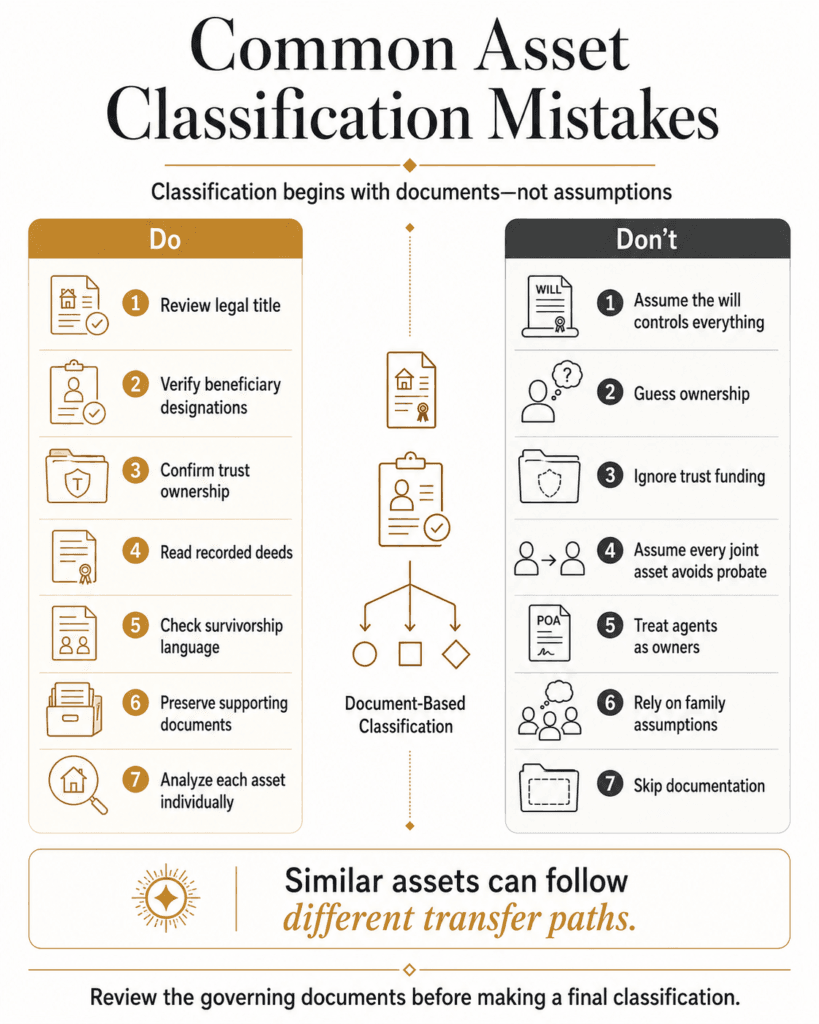
Base the classification on the controlling legal documents, not only on how the asset appears on a monthly statement.
Correcting a mistaken classification
Asset information may change as records arrive from banks, insurers, title companies, trustees, and other institutions.
If an asset was treated as probate property and later confirmed to transfer outside probate, document:
- What new information was received
- Why the classification changed
- Who controls the asset
- Whether the inventory must be corrected
- Whether the accounting records need an update
If probate property was omitted from the inventory, Arizona requires a supplementary inventory or appraisement.
A supplement is also required when an original description or value was erroneous or misleading.
Correcting a supported mistake is generally safer than leaving inaccurate estate records in place.
Common classification mistakes
Common mistakes include:
- Assuming every asset mentioned in the will is a probate asset
- Treating every jointly titled asset as survivorship property
- Assuming marriage automatically transfers every asset
- Treating an account agent as an owner
- Assuming possession establishes ownership
- Relying on an old, incomplete, or unsigned beneficiary form
- Treating intended trust property as funded trust property
- Assuming a signed but unrecorded beneficiary deed is effective
- Ignoring a business transfer agreement
- Overlooking the estate as a named beneficiary
- Treating small-estate affidavit property as nonprobate
- Accessing digital accounts without confirming authority
- Failing to determine the decedent’s actual ownership percentage
Avoid these mistakes by reviewing the deed, title, account agreement, beneficiary record, trust instrument, or contract controlling the individual asset.
Probate and nonprobate asset checklist
For every asset, confirm:
- Who owned it at death?
- Was it owned solely or jointly?
- Did the ownership include survivorship rights?
- Was a POD or TOD beneficiary named?
- Did the beneficiary survive?
- Was the estate named as beneficiary?
- Was the asset legally owned by a trust?
- Was a beneficiary deed recorded before death?
- Does a business agreement control the transfer?
- Did the decedent own the entire asset or only a share?
- Was the property community or separate?
- Does the will apply to this asset?
- Does a small-estate procedure apply?
- Who has authority to request the transfer?
- Should the asset appear on the probate inventory?
- Are the supporting ownership records preserved?
- Could the asset remain relevant to estate or community obligations?
- Is a supplementary inventory needed after reclassification?
Understand the estate one asset at a time
The difference between probate and nonprobate assets in Arizona depends on the legal method that transfers each asset after death.
Probate property generally requires administration by a personal representative or collection through another authorized estate procedure.
Nonprobate property generally transfers through:
- A trust
- A beneficiary designation
- A survivorship right
- A deed
- An account registration
- A contract
- Another valid transfer arrangement
The same person may receive both probate and nonprobate property. The legal transfer processes remain different.
Careful classification helps the personal representative:
- Prepare an accurate inventory
- Avoid controlling property that belongs to someone else
- Identify property available for estate obligations
- Preserve reliable records
- Complete the correct transfers
- Reduce ownership disputes
When ownership is unclear, or the estate involves competing deeds, community-property questions, trust-funding problems, disputed beneficiaries, business agreements, substantial debt, or digital assets, legal and tax guidance may be necessary before property is collected or transferred.
Legal Disclaimer: This information is for educational purposes only and does not constitute legal advice. Arizona probate law is complex and varies based on individual circumstances. Always consult with a qualified probate attorney for guidance specific to your situation.
FAQs
An asset is generally a probate asset when the decedent owned it at death, and no effective trust, beneficiary designation, survivorship right, deed, contract, or other nonprobate transfer arrangement controls it.
No. A will generally controls probate property. Arizona recognizes many nonprobate transfers created through trusts, account agreements, insurance policies, retirement plans, securities registrations, deeds, and other written instruments.
Property legally transferred to a trust is generally managed by the trustee. Property intended for the trust but left in the decedent’s individual ownership may still require probate.
A valid POD account generally passes to the surviving designated beneficiary. If no beneficiary survives, the funds generally belong to the estate of the last surviving account owner.
A security registered in beneficiary form generally passes to the surviving TOD beneficiary after the owner’s death and completion of the institution’s requirements. If no beneficiary survives, the security belongs to the owner’s estate.
No. Arizona permits multiple-party accounts with or without survivorship rights. Review the account agreement, signature card, ownership terms, and beneficiary records.
It depends on the deed. Express joint-tenancy or community-property survivorship language may transfer the deceased owner’s interest to the survivor. A tenancy-in-common interest generally does not pass automatically to the other owner.
Arizona’s beneficiary-deed statute generally requires the deed to be executed and recorded before the owner’s death. A signed but unrecorded deed generally does not complete the statutory beneficiary-deed transfer.
Proceeds payable to a surviving designated beneficiary usually transfer outside probate. They may become estate property when the estate is named as beneficiary, no effective beneficiary survives, or another applicable rule changes the result.
A power of attorney should not be treated as continuing authority after the agent knows the principal has died. Arizona protects certain good-faith acts performed without actual knowledge of death, but that protection is not general post-death authority.
They may be. The answer depends on ownership and any applicable beneficiary, trust, contract, or transfer arrangement. Arizona also provides procedures for a personal representative to request disclosure of certain digital assets.
In some circumstances, a nonprobate transferee may have limited liability when the probate estate is insufficient to pay allowed claims and statutory allowances. The liability generally cannot exceed the value of the covered nonprobate transfer received or controlled.
No. The affidavit provides a simplified way to collect qualifying estate property. It does not change the property’s underlying probate character.
Preserve the new ownership evidence, correct the estate records, and determine whether a supplementary inventory is required. Arizona requires supplementation when property was omitted, or an original description or value was erroneous or misleading.