

Learn how to open and manage an Arizona estate bank account, separate funds, pay expenses, keep records, reserve cash, and close it.
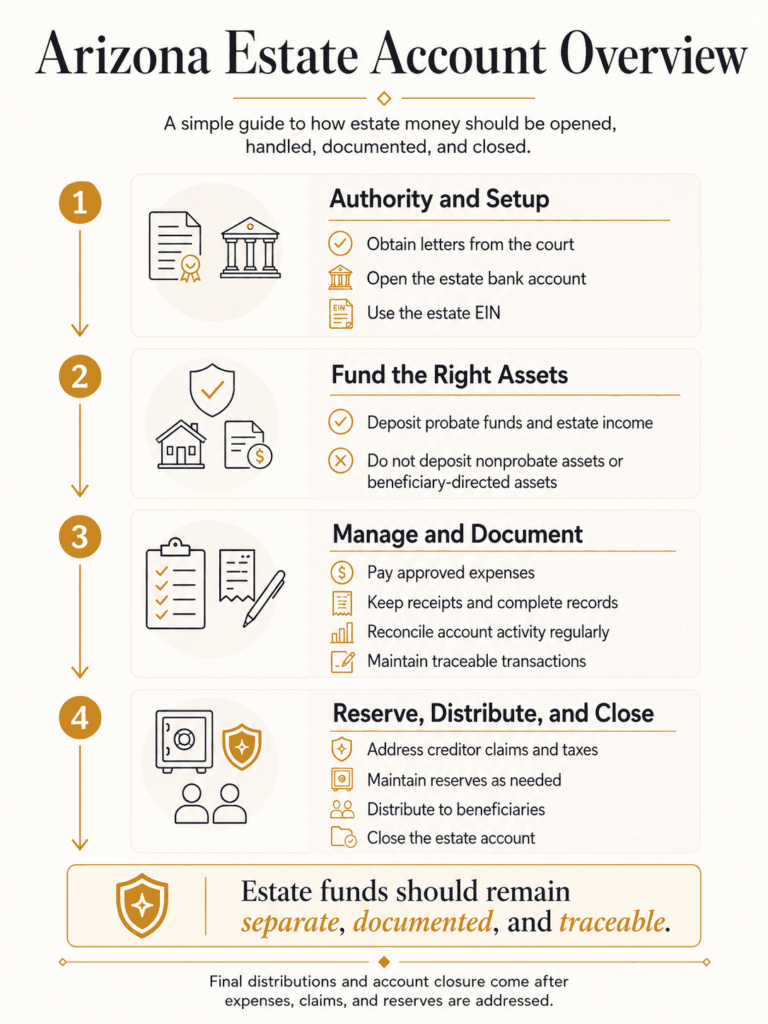
An Arizona estate bank account gives the probate estate one clear place to receive money, pay legitimate expenses, and document financial activity.
The appointed personal representative manages the account for the estate. The money does not belong to the representative personally.
A well-managed account can make creditor claims, tax work, beneficiary reporting, distributions, and the final accounting much easier. A poorly managed account can create confusion, disputes, and possible personal liability.
Arizona estate bank account checklist
The personal representative should generally:
- Confirm that appointment, qualification, and Letters are complete.
- Decide whether the estate needs an account.
- Identify which money belongs to the probate estate.
- Obtain an EIN for the estate.
- Ask the bank which documents it requires.
- Open the account in the estate’s name.
- Deposit only probate-estate funds.
- Pay only legitimate, documented estate expenses.
- Keep estate and personal money separate.
- Maintain a complete transaction ledger.
- Reconcile the account regularly.
- Reserve enough money for claims, taxes, fees, and closing costs.
- Document every beneficiary distribution.
- Close the account only after the estate’s financial work is complete.
An estate bank account is an account opened in the name of a deceased person’s probate estate.
The personal representative controls it in a fiduciary capacity. That means the representative manages the money for the estate and the people whose interests Arizona law protects.
The account may receive:
- Money collected from solely owned accounts
- Income from probate property
- Rent
- Refunds payable to the estate
- Interest and dividends
- Proceeds from selling probate assets
- Money owed to the decedent
- Insurance proceeds payable to the estate
- Tax refunds belonging to the estate
The account may be used to pay:
- Court costs
- Insurance
- Necessary property expenses
- Taxes
- Valid creditor claims
- Professional fees
- Proper reimbursements
- Reasonable personal-representative compensation
- Beneficiary distributions
A bank statement shows that money moved. It does not always explain why the transaction was proper.
You still need invoices, receipts, explanations, and a separate estate ledger.
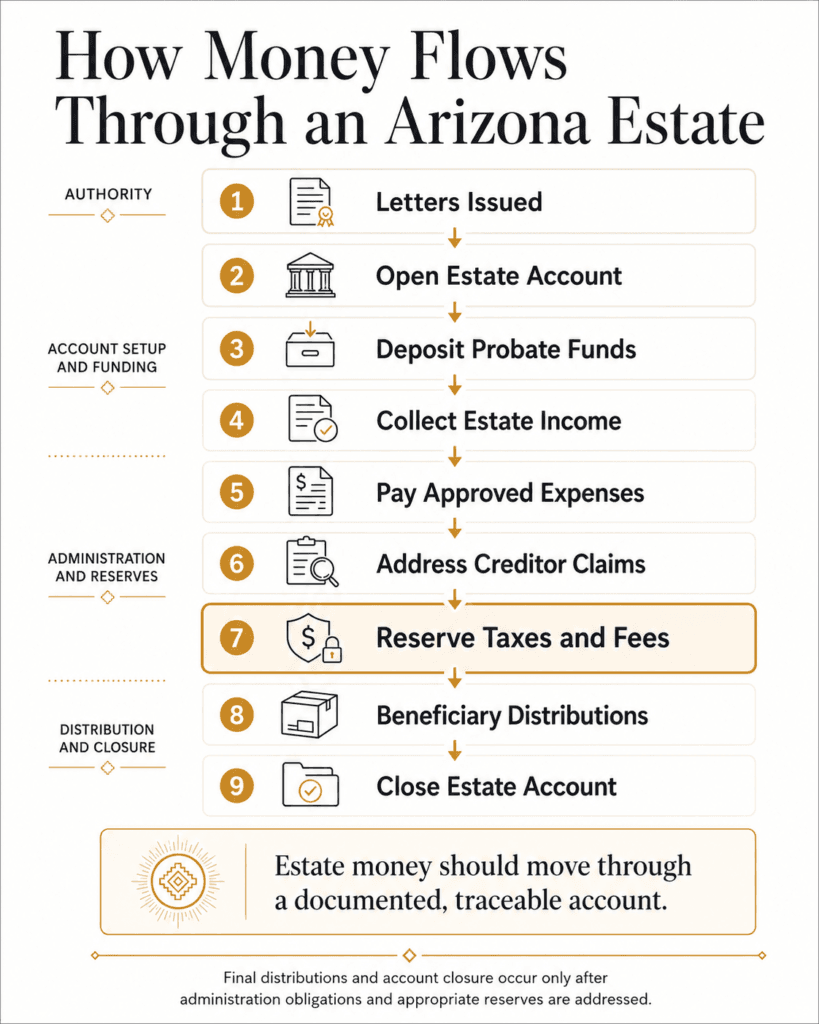
Confirm that you have authority to open the account
Being named in a will does not automatically give someone authority to open or control an estate account.
The person generally must:
- Be appointed by the court or probate registrar.
- Complete the required qualification steps.
- Receive Letters of Personal Representative.
Letters are the official court documents showing the appointment and authority to act for the estate.
Arizona Law Note: A.R.S. § 14-3103 generally requires appointment, qualification, and issuance of Letters before a person acquires the powers and duties of a personal representative. Estate administration begins with issuance of Letters.
Before opening the account, review:
- The Letters
- The appointment order or registrar’s statement
- The will
- Any required bond
- Any supervised-administration order
- Other restrictions imposed by the court
A will or court order may restrict account activity, investments, property sales, or distributions.
Banks may request a certified copy of the Letters. Some institutions also ask for a recently certified copy.
For more information, see Rahnema Law’s guide to Letters of Appointment in Arizona probate.
Does every Arizona probate estate need a bank account?
No.
An account is commonly useful when money will move through the probate estate.
That may happen when the personal representative needs to:
- Collect a solely owned bank balance
- Receive rent or other estate income
- Deposit refunds
- Collect money owed to the decedent
- Receive proceeds from an asset sale
- Pay property expenses
- Pay creditor claims
- Pay taxes or professional fees
- Make cash distributions
An account may be less important when the estate has no meaningful cash activity and the only probate asset can be transferred directly to the proper recipient.
Before deciding that no account is necessary, consider whether the estate will need money for:
- Court filing fees
- Insurance
- Utilities
- Repairs
- Taxes
- Appraisals
- Legal or accounting fees
- Closing expenses
An estate involving real estate, a business, litigation, recurring income, or a long administration usually needs more formal financial management.
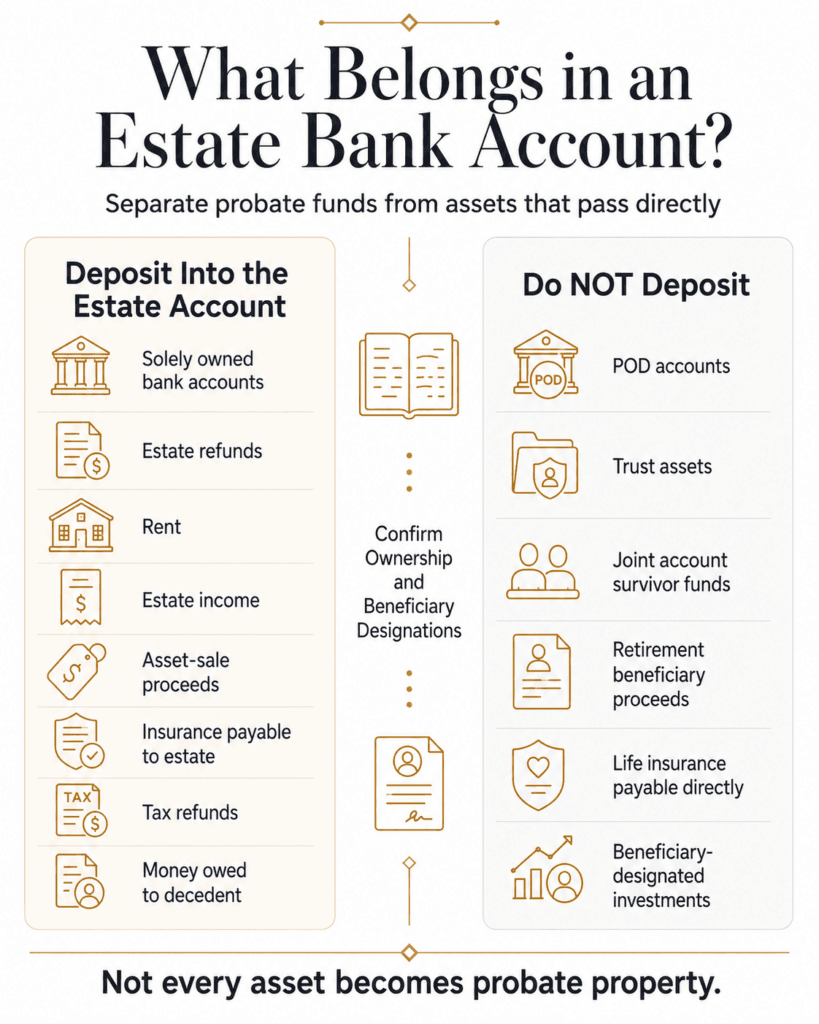
Identify probate and nonprobate money first
Not every asset connected to the decedent belongs in the estate account.
Some property may pass outside probate through:
- Life insurance
- Retirement accounts
- Payable-on-death designations
- Joint ownership with survivorship rights
- Trusts
- Transfer-on-death registrations
- Beneficiary deeds
- Other written transfer arrangements
Arizona Law Note: A.R.S. § 14-6101 recognizes many transfers created through insurance policies, account agreements, trusts, retirement plans, deeds, and similar written instruments as nonprobate transfers.
For a bank account, ask:
- How was the account titled?
- Was there a surviving joint owner?
- Was a payable-on-death beneficiary named?
- Did the account include survivorship rights?
- Was the account owned by a trust?
- Was the estate named as beneficiary?
- Do the funds legally belong to the probate estate?
Arizona law generally provides that funds in a qualifying multiple-party account pass to the surviving party. Funds in a payable-on-death account generally pass to the surviving beneficiary. A single-party account without a payable-on-death designation generally becomes part of the decedent’s estate.
Arizona Law Note: A.R.S. § 14-6212 addresses who receives funds in multiple-party, payable-on-death, and single-party accounts after death.
Do not route money belonging directly to a trust, joint owner, or beneficiary through the probate account simply because it seems convenient.
Obtain an EIN for the estate
An estate generally uses its own federal Employer Identification Number, or EIN.
Despite the name, the estate does not need employees.
The EIN is different from:
- The decedent’s Social Security number
- The personal representative’s Social Security number
- A trust’s EIN
- The EIN of a business owned by the decedent
The IRS directs personal representatives to use Form SS-4 to apply for an estate EIN. Eligible applicants in the United States or U.S. possessions may also apply online without a fee.
The estate may need the EIN for:
- Opening the estate account
- Reporting interest or other estate income
- Filing Form 1041
- Receiving tax documents
- Communicating with payers
- Completing other federal tax filings
Keep the EIN confirmation with the estate’s permanent tax and financial records.
Use the estate’s legal name consistently. IRS instructions for Form 1041 direct filers to use the same estate name used on the Form SS-4 EIN application.
Understand the estate’s separate tax identity
The decedent’s personal tax reporting and the estate’s post-death tax reporting are different matters.
Income received before death may belong on the decedent’s final individual return.
Income earned by estate property after death may need to be reported by the estate. That income may include:
- Bank interest
- Dividends
- Rent
- Business income
- Royalties
- Gains or losses from property sales
Depending on the estate’s income and circumstances, a federal fiduciary income-tax return using Form 1041 may be required.
The IRS identifies Publication 559 as a resource for personal representatives handling a decedent’s property and tax obligations.
Form 56 may also be used in appropriate circumstances to notify the IRS of the creation or termination of a fiduciary relationship.
An Arizona fiduciary return using Form 141AZ may also apply, depending on the estate’s income and filing circumstances.
Opening an account does not determine which tax returns are required. That depends on the estate’s income, deductions, sales, distributions, and other facts.
Ask the bank what documents it requires
Each financial institution sets its own procedures.
A bank may request:
- Certified Letters
- A certified death certificate
- The EIN confirmation
- Government-issued identification
- The appointment order
- A copy of the will
- The estate’s mailing address
- The personal representative’s contact information
- Information about additional personal representatives
The bank may ask for more documents when:
- Two or more representatives are serving
- The representatives must act jointly
- The Letters contain restrictions
- A bond is required
- The estate is supervised
- A court order limits account activity
- The representative lives outside Arizona
Before visiting a branch, ask:
- Which documents are required?
- Must the Letters be recently certified?
- Must every co-representative appear?
- Will certified documents be returned?
- Is an appointment required?
- Can online access be established?
- How will the account be titled?
Keep copies of everything you provide.
Title the Arizona estate bank account correctly
The account should be titled in the estate’s name and should show that the personal representative acts in a fiduciary role.
The exact format depends on the bank. It may resemble:
Estate of Jane Smith, Deceased
John Smith, Personal Representative
Do not open the account only in the personal representative’s individual name.
Correct titling helps show that:
- The money belongs to the estate
- The representative is acting as a fiduciary
- The estate’s EIN applies
- The account is not personal property
- The account belongs in the estate accounting
Review the signature card, checks, account-opening documents, and online profile.
Confirm that the estate name and EIN are correct.
If the bank abbreviates the account title, ask for written confirmation showing the full legal ownership in its records.
Choose a practical account type
A checking account is often useful because the estate may need to receive deposits, pay bills, issue checks, and make distributions.
Depending on the amount of cash and expected length of administration, the representative may also consider:
- Interest-bearing checking
- Savings
- A money-market deposit account
- A short-term certificate of deposit
- Another prudent and sufficiently liquid option
Arizona law permits a personal representative, acting reasonably for interested people, to deposit or invest liquid estate assets that are not currently needed for expenses and are not immediately distributable.
Arizona Law Note: A.R.S. § 14-3715 permits qualifying liquid estate funds to be placed in federally insured interest-bearing accounts or other prudent investments, subject to the will, court orders, statutory priorities, and the duty to act reasonably.
Consider:
- Liquidity
- Monthly fees
- Minimum balances
- Interest rates
- Transaction limits
- Check-writing access
- Online features
- Expected administration length
- Upcoming claims and taxes
Do not lock up money that may soon be needed for claims, expenses, taxes, or distributions.
Check FDIC insurance coverage
The FDIC generally treats a decedent’s estate account as a single-account ownership category.
For estate accounts, coverage passes through the administrator to the deceased owner. The deceased owner is generally insured up to $250,000 in the single-account category at the same insured institution.
Estate deposits are insured separately from the personal accounts of the administrator and beneficiaries.
When the estate will hold a large cash balance:
- Confirm that the bank is FDIC insured.
- Ask how the account will be categorized.
- Identify other qualifying deposits for the decedent at the same bank.
- Determine whether the combined balance may exceed coverage.
- Consider whether funds should be divided among institutions.
- Keep written records supporting the decision.
Deposit-insurance rules can be technical. Confirm current coverage with the bank or FDIC instead of relying only on the account’s marketing name.
Deposit only probate-estate funds
Use the account only for money that legally belongs to the probate estate.
Common deposits may include:
- Funds collected from solely owned accounts
- Checks payable to the estate
- Income from probate property
- Rent from estate real estate
- Refunds payable to the estate
- Proceeds from probate-asset sales
- Payments on debts owed to the decedent
- Insurance proceeds payable to the estate
- Interest earned by the estate account
For every deposit, record:
- Date
- Amount
- Source
- Asset involved
- Why the money belongs to the estate
- Deposit confirmation
- Supporting correspondence
Checks payable to the decedent individually may require special handling. The bank may ask for Letters, a death certificate, a fiduciary endorsement, or other documentation.
Do not deposit the representative’s money into the account unless a documented advance or other proper transaction requires it.
Keep estate and personal money separate
Estate money should not pass through the personal representative’s account, even temporarily.
Do not:
- Deposit estate checks into a personal account
- Pay personal expenses from the estate account
- Borrow estate funds
- Use the account as a personal credit line
- Make unexplained cash withdrawals
- Combine estate and personal deposits
- Allow beneficiaries to use the account
- Use estate money for an unrelated business
Arizona treats the personal representative as a fiduciary. An improper use of estate authority that causes damage may create personal liability.
Arizona Law Note: A.R.S. § 14-3703 establishes the representative’s fiduciary duties. A.R.S. § 14-3712 addresses liability for damage resulting from an improper exercise of authority and breach of fiduciary duty.
A separately titled account and complete ledger help show that estate money was identified, protected, and used only for estate purposes.
Pay only legitimate estate expenses
Before paying a bill, confirm:
- The obligation belongs to the estate.
- The amount is accurate.
- An invoice or other record supports it.
- Payment is appropriate at that stage.
- The estate has enough money for higher-priority obligations.
- The claim is not barred or subject to a valid defense.
- The will, Arizona law, or a court order permits the payment.
Possible estate expenses include:
- Court costs
- Insurance
- Necessary utilities
- Property maintenance
- Security
- Appraisals
- Legal fees
- Accounting fees
- Taxes
- Funeral expenses
- Valid creditor claims
- Costs of selling estate property
- Reasonable compensation
- Proper reimbursements
Arizona law gives a personal representative authority to pay taxes, compensation, and administration expenses while acting reasonably for interested people.
That does not mean every demand should be paid immediately.
Coordinate payments with creditor notice
Arizona’s creditor process affects when and whether debts should be paid.
Unless notice has already been given, the personal representative generally must publish notice to creditors once a week for three successive weeks.
The general deadline for published creditors is four months after the first publication.
Known creditors must also receive direct notice. Their deadline is generally the later of:
- Four months after the first publication, or
- 60 days after the direct notice is mailed or delivered
Arizona Law Note: A.R.S. § 14-3801 establishes the published and direct creditor-notice requirements.
Review each claim to determine whether it is:
- Timely
- Properly presented
- Supported
- Enforceable
- Secured
- Covered by insurance
- Already paid
- Subject to a defense
- Subject to disallowance
Arizona allows the personal representative to disallow a timely presented claim in whole or in part.
A claimant generally has 60 days after notice of disallowance to ask the court to allow the claim or begin a proceeding against the personal representative.
Arizona Law Note: A.R.S. § 14-3806 governs allowance and disallowance of claims.
Keep enough cash available until the estate’s claims and unresolved obligations are understood.
Follow Arizona’s claim priorities
When the estate cannot pay every claim in full, payment is not first come, first served.
Arizona generally requires payment in this order:
- Costs and expenses of administration
- Reasonable funeral expenses
- Debts and taxes with preference under federal law
- Reasonable and necessary expenses of the decedent’s last illness
- Debts and taxes with preference under Arizona law
- Other claims
Claims within the same class generally have equal priority. A claim does not move ahead simply because it became due earlier.
Arizona Law Note: A.R.S. § 14-3805 establishes the payment order when estate assets are insufficient.
Before making large payments, prepare a simple cash forecast showing:
- Current balance
- Expected deposits
- Known claims
- Estimated taxes
- Property expenses
- Professional fees
- Closing costs
- Proposed distributions
- A reasonable reserve
Use traceable payment methods
Whenever practical, pay estate expenses directly from the estate account.
Useful methods include:
- Estate checks
- Bank transfers
- Electronic bill payments
- Cashier’s checks
- Other traceable bank payments
Avoid unexplained cash withdrawals.
For every payment, keep:
- Date
- Amount
- Payee
- Estate purpose
- Invoice or agreement
- Payment confirmation
- Check image
- Supporting correspondence
Use clear descriptions.
“Property insurance—estate residence” is more useful than “expenses.”
Protect online access
Online banking can help the representative:
- Monitor balances
- Download statements
- Review checks
- Pay bills
- Transfer estate funds
- Detect unauthorized activity
Use:
- A secure email address
- A strong, unique password
- Multifactor authentication
- Secure devices and networks
- Limited access rights
Do not share login credentials with beneficiaries, relatives, or unauthorized assistants.
When co-representatives are serving, confirm whether they must act jointly and whether the bank’s online system can enforce that requirement.
Review automatic payments one at a time. A payment that was appropriate during the decedent’s life may no longer be necessary.
Reconcile the account regularly
Reconciliation means comparing the estate ledger with the bank statement.
Confirm that both records show the same:
- Deposits
- Cleared checks
- Outstanding checks
- Transfers
- Bank fees
- Interest
- Returned payments
- Reversals
- Pending deposits
Regular reconciliation can reveal:
- Duplicate payments
- Missing deposits
- Unauthorized transactions
- Bank errors
- Unrecorded fees
- Stale checks
- Incorrect balances
Monthly reconciliation is a practical standard while the account is active.
For each period, keep:
- Bank statement
- Check images
- Deposit records
- Reconciliation report
- Corresponding ledger
- Explanations for unusual transactions
Problems are easier to fix when found early.
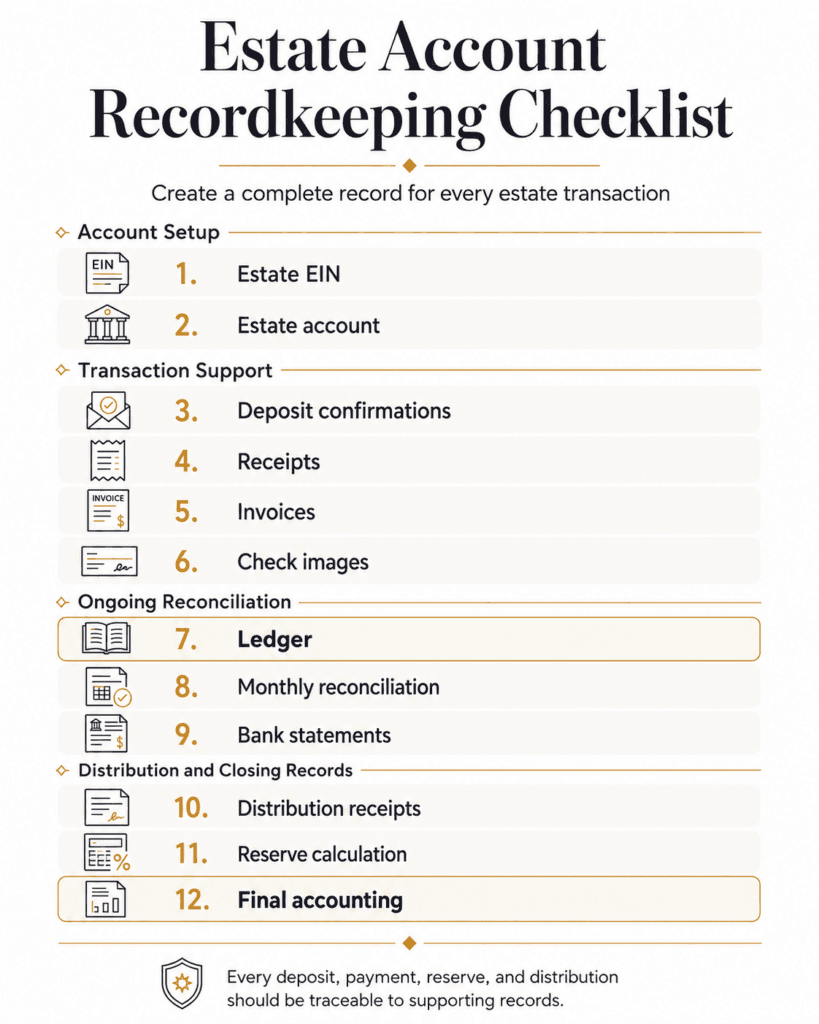
Maintain a complete financial ledger
A bank statement is not a complete estate accounting.
For every receipt, record:
- Date
- Source
- Amount
- Asset involved
- Income or principal classification when relevant
- Deposit location
- Supporting record
For every payment, record:
- Date
- Payee
- Amount
- Purpose
- Expense category
- Supporting invoice or receipt
- Check or transaction number
Useful categories may include:
Money received
- Account collections
- Interest
- Dividends
- Rent
- Refunds
- Sale proceeds
- Insurance proceeds
- Debt repayments
Money paid
- Court costs
- Insurance
- Property expenses
- Taxes
- Creditor claims
- Legal fees
- Accounting fees
- Appraisals
- Compensation
- Reimbursements
- Distributions
A qualifying verified closing statement requires a full written account for distributees whose interests are affected.
Arizona Law Note: A.R.S. § 14-3933 includes the accounting and notice requirements for closing a qualifying unsupervised estate by verified statement.
Handle asset-sale proceeds carefully
When the estate sells probate property, the net proceeds generally should go into the estate account.
Keep:
- Listing agreement
- Purchase agreement
- Appraisal or valuation records
- Settlement statement
- Commissions
- Repair invoices
- Loan payoff information
- Taxes and fees
- Deposit confirmation
Reconcile the amount deposited with the settlement statement.
A sale may also create tax consequences. Preserve:
- Date-of-death value
- Inventory value
- Appraisal
- Sale price
- Selling expenses
- Improvement records
- Depreciation information
- Distribution records
Do not distribute sale proceeds just because they cleared the bank.
Claims, taxes, expenses, and other obligations may still need to be addressed.
Separate advances, reimbursements, and compensation
A duly appointed personal representative may sometimes pay an urgent estate expense personally before the estate account is available or funded. Expenses incurred before appointment require additional care, and reimbursement should not be assumed.
Examples may include:
- Filing fees
- Emergency repairs
- Locks or security
- Insurance
- Property-preservation costs
For each advance, keep:
- Date
- Amount
- Payment method
- Payee
- Estate purpose
- Receipt or invoice
- Reason immediate payment was necessary
When reimbursement is appropriate, make a separate, traceable payment from the estate account.
Label it clearly as a reimbursement.
Compensation is different.
Arizona law entitles a personal representative to reasonable compensation. The representative may also renounce all or part of that compensation.
Arizona Law Note: A.R.S. § 14-3719 establishes the reasonable-compensation standard and addresses renunciation.
Maintain separate records for:
- Reimbursements
- Personal-representative compensation
- Professional fees
- Beneficiary distributions
Do not treat the same cost as both compensation and reimbursement.
Avoid conflicted transactions
Do not use the estate account for an improper personal benefit.
Possible concerns include:
- Paying personal expenses
- Making undocumented loans to the representative
- Purchasing estate property on favorable terms
- Paying a related business without support
- Transferring money to a spouse or agent without authority
- Paying excessive compensation
- Reimbursing unsupported expenses
A transaction affected by a substantial conflict of interest may be voidable when it involves the personal representative, the representative’s spouse, agent, attorney, or an entity in which the representative has a substantial interest.
An exception may apply when:
- The decedent expressly authorized the transaction,
- The court approved it after notice, or
- The affected person consented after fair disclosure.
Arizona Law Note: A.R.S. § 14-3713 addresses conflicted transactions and the circumstances in which they may be voidable.
Address a possible conflict before money moves.
Do not distribute the account balance too early
Cash in the account is not automatically available for distribution.
Before distributing money, reserve enough for:
- Administration expenses
- Creditor claims
- Taxes
- Insurance
- Property expenses
- Professional fees
- Compensation and reimbursements
- Disputed obligations
- Final accounting
- Closing costs
Also consider:
- Outstanding checks
- Expected refunds
- Pending tax returns
- Property-sale adjustments
- Unresolved claims
- Possible litigation
- Final professional invoices
After estate assets are distributed, an undischarged claim that is not barred may still be pursued against distributees. Liability is generally limited to the value of the distribution, subject to statutory exceptions.
Arizona Law Note: A.R.S. § 14-3934 addresses possible liability of distributees for certain undischarged claims.
That is one reason to maintain a reasonable reserve.
Document beneficiary distributions
Every distribution should be supported by:
- The will
- Arizona intestate-succession law
- An agreement
- A court order
- Another valid legal basis
For each cash distribution, record:
- Recipient
- Amount
- Date
- Governing share or provision
- Whether it is partial or final
- Reserve retained
- Payment method
- Effect on the remaining balance
Obtain a receipt or written acknowledgment when practical.
When distributing property in kind, the personal representative must execute an instrument or deed assigning, transferring, or releasing the asset.
Arizona Law Note: A.R.S. § 14-3907 requires an instrument or deed of distribution for in-kind transfers and additional identifying information for recorded real-property transfers.
Do not call a payment a beneficiary distribution when it is actually compensation, reimbursement, a creditor payment, or a sale adjustment.
Keep a reasonable reserve
A reserve is money kept in the estate account for expenses that are not yet final.
The amount should reflect the estate’s actual needs rather than an arbitrary percentage.
Possible reserve items include:
- Final tax preparation
- Estimated taxes
- Legal and accounting fees
- Property expenses
- Insurance
- Utilities
- Court costs
- Storage
- Compensation
- Unresolved claims
- Closing expenses
Prepare a written reserve calculation showing:
- Expected obligation
- Estimated amount
- Supporting information
- Expected payment date
- What will happen to any unused balance
Once the obligations are resolved, the unused reserve can be distributed to the proper recipients.
Prepare for federal and Arizona tax reporting
Banks may issue tax documents under the estate EIN.
Keep:
- Forms 1099
- Interest statements
- Brokerage records
- Transaction histories
- Year-end statements
- Certificates of deposit
- Withholding records
- Tax-payment confirmations
The ledger should distinguish between:
- Principal collected from the decedent’s assets
- Income earned after death
- Capital gains or losses
- Estate expenses
- Beneficiary distributions
A tax professional may need:
- Account-opening date
- Beginning cash balance
- Interest and dividends
- Sale proceeds
- Administration expenses
- Creditor payments
- Distributions
- Year-end balance
Start tax work before emptying the account.
A tax obligation discovered after all cash has been distributed can create serious problems.
Close the estate account at the proper time
Keep the account open until the estate’s financial work is complete.
Before closing it, confirm that:
- All expected estate money has been collected.
- All checks and transfers have cleared.
- Valid claims and expenses have been addressed.
- Taxes have been paid or adequately reserved for.
- Professional fees have been paid.
- Compensation and reimbursements are documented.
- Beneficiary distributions are complete.
- No additional refunds or payments are expected.
- The final ledger matches the bank balance.
- The estate accounting is complete.
A qualifying unsupervised estate generally cannot be closed by verified statement earlier than four months after the original appointment of a general personal representative.
The statement generally must confirm that the claims period expired, the estate was fully administered, and the required account was provided.
Arizona Law Note: A.R.S. § 14-3933 establishes the requirements for closing a qualifying unsupervised estate. If no proceeding involving the representative is pending, the appointment generally ends one year after the closing statement is filed.
After the last proper payment:
- Obtain the final bank statement.
- Complete a final reconciliation.
- Obtain written confirmation that the account was closed.
- Preserve the zero-balance record.
- Keep the final accounting and distribution receipts.
Closing the bank account and closing the probate estate are related, but they are not the same event.
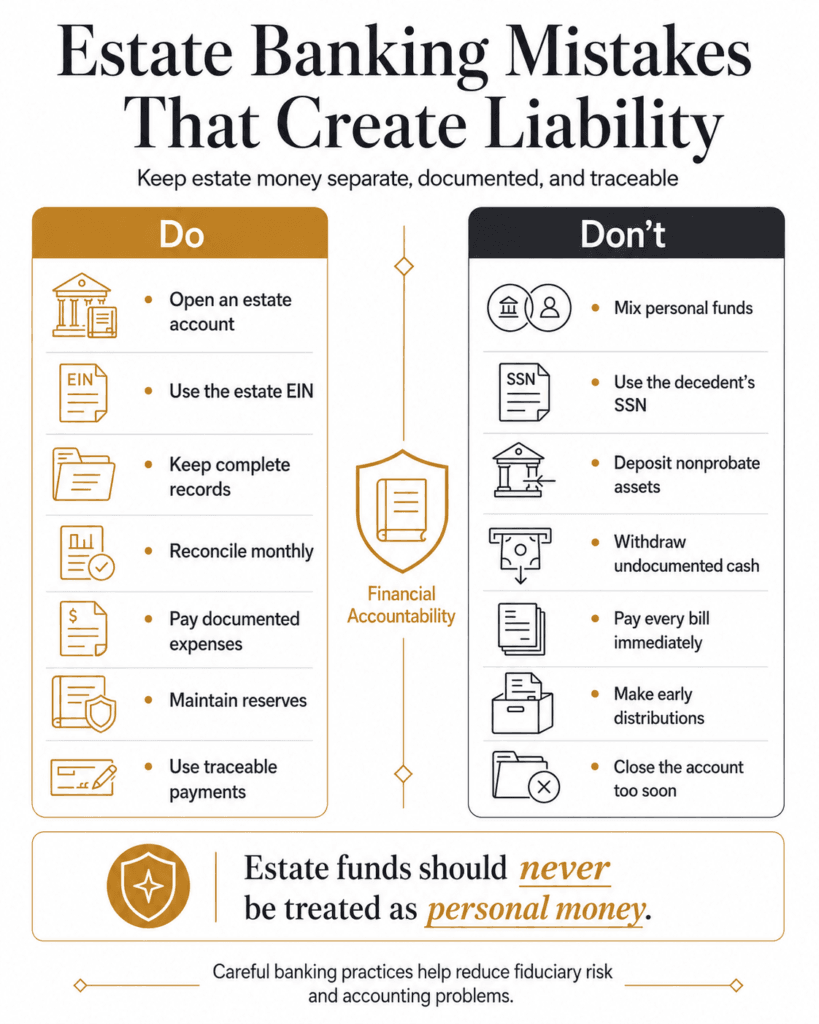
Common estate bank account mistakes
Avoid:
- Opening an account before authority is established
- Using the wrong tax identification number
- Titling the account only in the representative’s name
- Depositing nonprobate funds
- Depositing estate money into a personal account
- Paying personal expenses
- Making unexplained cash withdrawals
- Paying every bill immediately
- Ignoring creditor priorities
- Failing to reconcile the account
- Keeping no separate ledger
- Reimbursing expenses without receipts
- Treating compensation as reimbursement
- Making distributions too early
- Failing to reserve money for taxes
- Closing the account with outstanding checks
- Failing to preserve the final statement
Even a small estate can become difficult to account for when money moves without clear records.
Manage the account as a fiduciary
An Arizona estate bank account is more than a place to hold money.
It is one of the main records showing how the personal representative handled the estate.
A properly titled account, complete ledger, supporting documents, and regular reconciliations make it easier to:
- Evaluate creditor claims
- Prepare tax returns
- Explain transactions
- Answer beneficiary questions
- Prepare the final accounting
- Complete distributions
- Close the estate
The personal representative should be able to explain:
Where did every dollar come from?
Why was every payment made?
How was the final balance distributed?
When the estate involves substantial cash, a business, disputed claims, complex taxes, unusual investments, or conflict among beneficiaries, legal and tax guidance may be appropriate before money is invested, paid, or distributed.
For a broader overview of estate administration, see Rahnema Law’s Arizona probate administration guide, probate inventory guide, and Arizona Probate FAQs.
Legal Disclaimer: This information is for educational purposes only and does not constitute legal advice. Arizona probate law is complex and varies based on individual circumstances. Always consult with a qualified probate attorney for guidance specific to your situation.
FAQs
Not necessarily. An account is commonly appropriate when the estate will receive money, pay expenses, sell assets, earn income, or make cash distributions. The decision depends on the estate’s financial activity and administrative needs.
The person generally must be appointed, complete any qualification requirements, and receive Letters before acquiring the authority to administer the estate.
An estate generally uses its own EIN for federal tax identification. The IRS directs personal representatives to use Form SS-4 to apply for the number.
The bank generally should associate the estate account with the estate’s EIN rather than the personal representative’s Social Security number or continued post-death use of the decedent’s number.
The title should identify the decedent’s estate and the personal representative’s fiduciary role. It should not be opened solely in the representative’s individual name.
Not merely for convenience. Property passing through a beneficiary designation, trust, survivorship provision, or other nonprobate arrangement may belong directly to another person.
Estate funds should be maintained separately and supported by a clear accounting. Mixing the funds can obscure ownership and create questions about whether the representative satisfied fiduciary duties.
A proper estate expense personally advanced by the representative may be reimbursed when adequately documented and appropriate under the circumstances. Reimbursement should be recorded separately from compensation.
No. Claims should be reviewed, and Arizona’s statutory payment priorities apply when the estate cannot pay every claim in full.
Arizona law permits liquid funds that are not currently needed and are not immediately distributable to be placed in federally insured interest-bearing accounts or other prudent investments.
Monthly reconciliation is a practical standard while the account is active. More frequent review may be appropriate when the estate has substantial or unusual activity.
A partial distribution may sometimes be appropriate, but the representative should retain enough money for claims, taxes, fees, expenses, and unresolved obligations. An unbarred claimant may have remedies against distributees after distribution.
The account should ordinarily remain open until expected funds have been collected, obligations and taxes have been addressed, checks have cleared, distributions are complete, and the final accounting reconciles to the account balance.