

First 30 days as an Arizona personal representative: handle notices, protect estate property, organize finances, and prepare the inventory.
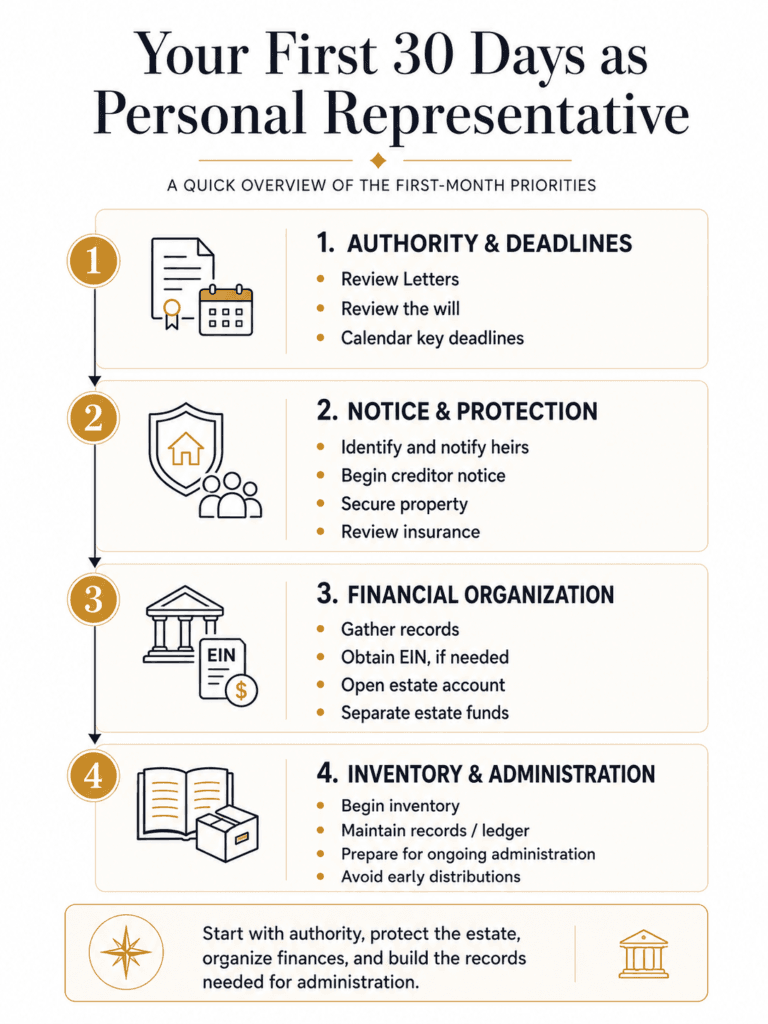
The first 30 days as an Arizona personal representative are about building a strong foundation for the estate. The goal is not to distribute property or finish probate.
Instead, focus on confirming your authority, reviewing the will and court documents, protecting estate property, sending required notices, starting the creditor process, organizing the estate’s finances, and preparing for the inventory.
The first month matters because several duties begin quickly—and not every deadline starts on the same date.
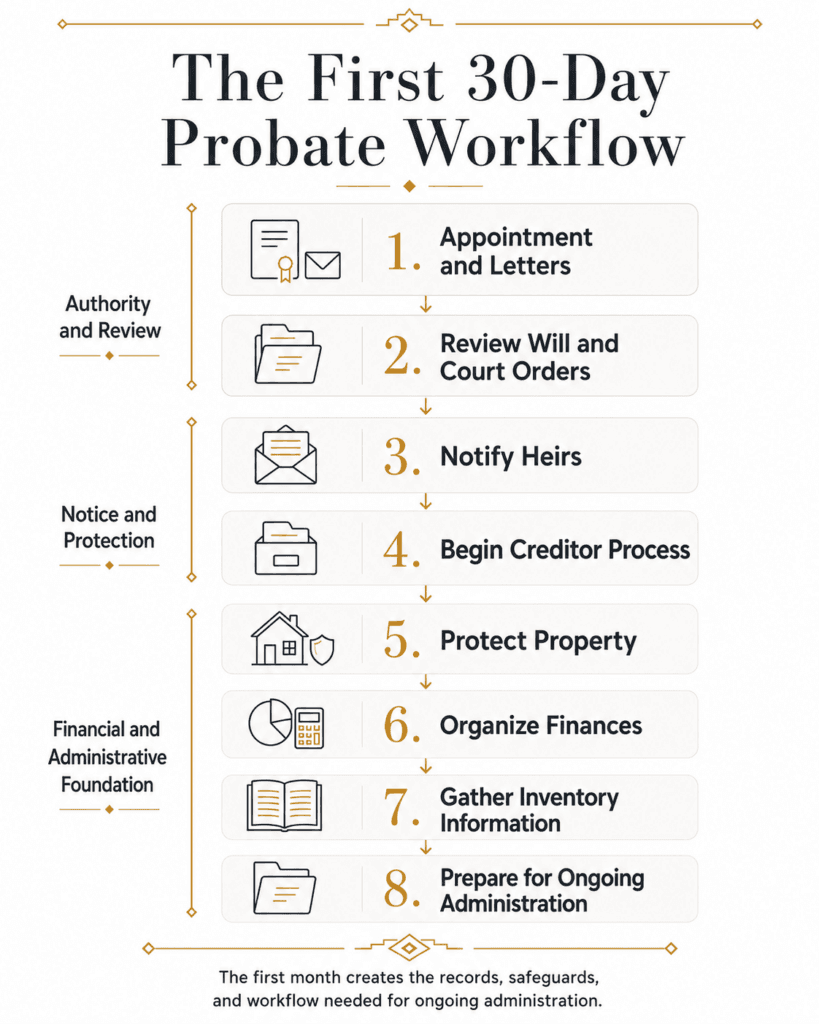
First 30 days at a glance
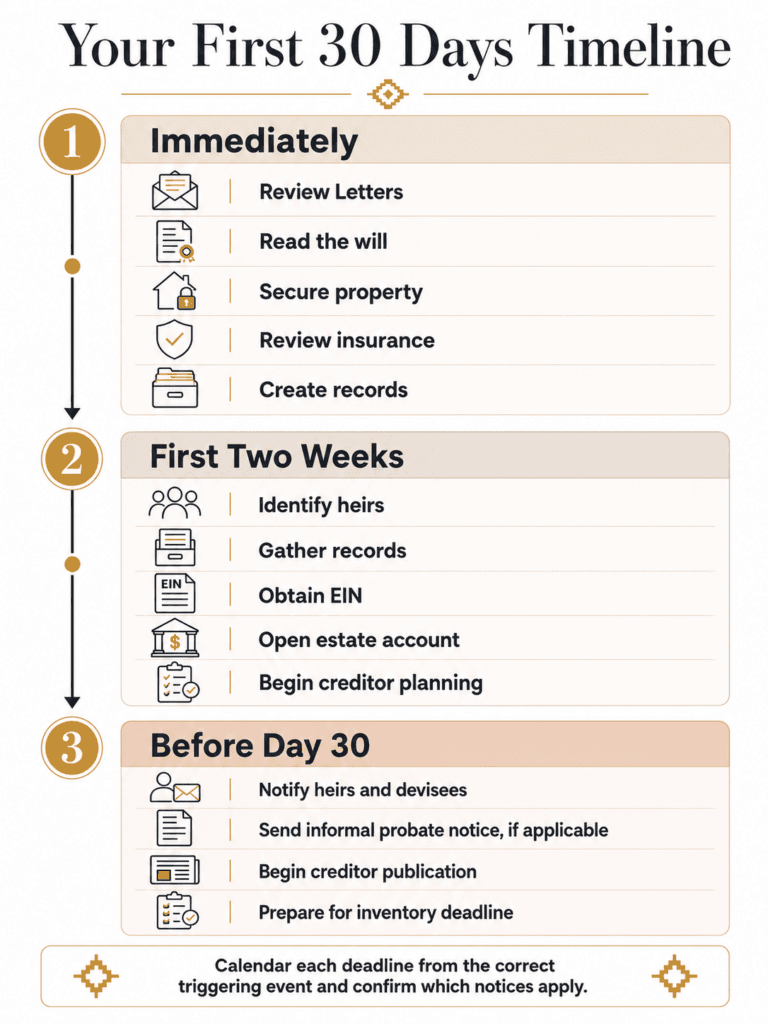
A practical first-month schedule may look like this.
Immediately after receiving Letters
- Confirm that the appointment, qualification, and Letters are complete.
- Review the will, appointment order, Letters, and bond.
- Identify any restrictions on your authority.
- Create a deadline calendar and coordinate creditor publication promptly; Arizona treats publication as an appointment-triggered obligation rather than a 30-day deadline.
- Secure real estate, vehicles, valuables, records, and digital devices.
- Review insurance and urgent property expenses.
- Create an estate recordkeeping system.
During the first two weeks
- Identify all heirs and devisees.
- Prepare the required appointment information.
- Determine whether a separate informal probate notice is required.
- Track creditor publication dates and preserve proof of publication.
- Begin identifying known creditors.
- Gather financial, tax, ownership, and debt records.
- Apply for an estate EIN when needed.
- Open an estate bank account when appropriate.
- Start gathering information for the inventory.
Before the applicable 30-day deadlines
- Send appointment information to heirs and devisees.
- Send informal-probate information and a copy of the will when required.
- Preserve proof of every mailing or delivery.
- Continue identifying and directly notifying known creditors, and track the applicable claim deadlines.
- Review progress toward the 90-day inventory deadline.
- Check that estate money remains separate from personal money.
The trigger date matters.
The appointment-information deadline generally runs from the date of appointment. The informal-probate notice deadline generally runs from the issuance of the statement admitting the will to informal probate.
Do not assume those dates are always the same.
Confirm that your authority is complete
Before managing the estate, confirm that the legal authority to act has been established.
Arizona law generally requires a person to:
- Be appointed by the court or probate registrar.
- Complete the applicable qualification requirements.
- Receive Letters.
Letters of Personal Representative, usually called Letters, provide official evidence that the personal representative has authority to act for the estate.
Banks, title companies, insurance companies, government agencies, and other organizations may ask for certified Letters before providing information or allowing a transaction.
Arizona Law Note: A.R.S. § 14-3103 generally requires appointment, qualification, and issuance of Letters before a person acquires the powers and duties of a personal representative. It also states that estate administration begins with issuance of Letters.
Consider obtaining several certified copies. Some institutions may also require Letters certified within a recent period.
For a more detailed explanation, see Rahnema Law’s guide to Letters of Appointment in Arizona probate.
Review the will and court documents
Read the entire will before making decisions about estate money or property.
The will may include:
- Specific gifts
- Instructions about real estate or personal property
- Successor personal representatives
- Trusts created at death
- Restrictions on administrative authority
- Rules affecting property sales
- Compensation provisions
- Bond provisions
- Distribution instructions
- Tax-allocation provisions
Also review:
- The application or petition
- The registrar’s statement
- The appointment order
- The Letters
- The acceptance
- The bond
- Any formal court order
- Any demand for notice
- Any scheduled hearing
Look for restrictions that may affect what you can do.
For example, the will or a court order may limit a sale, require court approval, impose supervised administration, or restrict access to a particular asset.
Do not assume every Arizona personal representative has identical authority.
Understand your fiduciary role
A personal representative is a fiduciary.
In practical terms, this means you must administer the estate for the benefit of the people legally interested in it—not for your own benefit or for the benefit of one favored family member.
You must follow:
- The valid will
- Arizona law
- Applicable court orders
- Your duties to creditors, heirs, and devisees
Arizona law requires a personal representative to settle and distribute the estate as efficiently and promptly as is consistent with the estate’s best interests.
That does not mean rushing.
It means moving the estate forward carefully, keeping reliable records, meeting deadlines, and avoiding unnecessary delay.
Create a probate deadline calendar
Arizona probate deadlines run from different events.
Some begin with appointment. Others begin with publication, mailing, delivery, receipt, or a court filing.
Your calendar should include:
- Date of appointment
- Date Letters were issued
- Date the will was admitted to informal probate
- 30-day appointment-information deadline
- 30-day informal-probate notice deadline, when applicable
- First, second, and third creditor publication dates
- Dates of direct notices to known creditors
- 90-day inventory deadline
- Court hearings
- Insurance renewals
- Mortgage due dates
- Property-tax deadlines
- Business obligations
- Federal and Arizona tax deadlines
Three early timing rules deserve special attention:
- Appointment information generally must be sent within 30 days after appointment.
- Informal-probate information and a copy of the will generally must be sent within 30 days after issuance of the statement of informal probate.
- The probate inventory generally must be prepared within 90 days after appointment.
Do not rely on memory.
Record each deadline and keep the document showing what triggered it.
Send appointment information to heirs and devisees
A personal representative, other than a special administrator, generally must provide information about the appointment to heirs and devisees no later than 30 days after appointment.
An heir is someone entitled to inherit under Arizona intestate-succession law.
A devisee is a person or organization named in a will to receive property.
The appointment information generally must:
- Provide the personal representative’s name and address
- Explain that the recipient has or may have an interest in the estate
- State whether a bond has been filed
- Identify the court where estate papers are filed
The information must be delivered or sent by first-class mail to each heir and devisee whose address is reasonably available.
If the appointment occurred in a formal proceeding, separate information under this statute may not be required for people who already received notice of that formal proceeding.
Arizona Law Note: A.R.S. § 14-3705 creates the general 30-day appointment-information requirement and identifies what the information must contain. Failure to provide it is a breach of duty to the affected people, although it does not invalidate the appointment or the personal representative’s other powers.
Keep:
- A copy of the information sent
- A complete recipient list
- Each address used
- Mailing or delivery dates
- Proof of mailing or delivery
- Returned mail
- Records of reasonable address searches
An informal family conversation does not replace the required written information.
Send the separate informal-probate notice when required
When a will has been admitted through informal probate, another notice requirement generally applies.
Within 30 days after issuance of the statement of informal probate, the applicant must provide heirs and devisees with:
- Written information that the will was admitted to probate
- A copy of the will
- Identification of the court where estate documents are filed
- A statement explaining the general four-month period to contest the informal probate
A recipient generally has four months after receiving the required information to begin a formal testacy proceeding contesting the informal probate.
The statute preserves a separate rule for a later-discovered will.
When the will and appointment were processed together, the informal-probate information may be combined with the appointment information if every requirement for both notices is satisfied.
Arizona Law Note: A.R.S. § 14-3306 establishes the 30-day informal-probate notice requirement and the general four-month contest period following receipt.
Preserve:
- A complete copy of the notice
- The copy of the will that was sent
- Recipient addresses
- Mailing or delivery records
- Returned mail
- Receipt dates when known
Do not assume that someone’s informal knowledge of the will replaces statutory notice.
Begin the creditor-notice process
Start creditor administration promptly. Unless notice has already been given under A.R.S. § 14-3801, creditor publication is triggered at the time of appointment rather than by a later first-month deadline.
Arizona law generally requires the personal representative to publish notice to creditors once a week for three successive weeks in a newspaper of general circulation in the county, beginning from the appointment-triggered publication obligation described in A.R.S. § 14-3801.
The publication announces the appointment, gives an address for presenting claims, and generally tells creditors to present their claims within four months after the first publication.
Publication is only part of the process.
Known creditors must generally receive direct written notice. Their deadline is generally the later of:
- Four months after the first publication, or
- 60 days after the direct notice is mailed or delivered
Arizona Law Note: A.R.S. § 14-3801 governs publication and direct notice to known creditors. A.R.S. § 14-3803 contains additional limitations on the presentation of claims.
How do you identify known creditors?
Review:
- Bank statements
- Credit-card statements
- Medical bills
- Loan documents
- Tax notices
- Business records
- Pending lawsuits
- Insurance correspondence
- Personal financial records
- Existing contracts
Do not assume a creditor is unknown merely because no formal claim has arrived.
Keep:
- The published notice
- Newspaper invoices
- Proof or affidavit of publication
- Copies of direct notices
- Mailing and delivery records
- Claims received
- Records showing whether claims were allowed or disallowed
Receiving a bill or claim does not automatically mean it should be paid immediately.
Secure estate property
Once appointed, the personal representative generally has the right and duty to take possession or control of estate property when necessary for administration.
Early steps may include:
- Securing a home
- Collecting or changing keys
- Protecting vehicles
- Safeguarding jewelry, firearms, records, and valuables
- Preventing unauthorized removal of property
- Maintaining necessary utilities
- Collecting estate income
- Redirecting important mail
- Addressing urgent repairs
- Documenting the condition of major assets
For a vacant Arizona home, consider whether the property needs:
- Air conditioning
- Electricity
- Water
- Landscaping
- Pool service
- Pest control
- Security monitoring
Create photographs or video of:
- Rooms and their contents
- Vehicles
- Valuables
- Existing damage
- Maintenance problems
- Items moved for safekeeping
Arizona Law Note: A.R.S. § 14-3709 addresses the personal representative’s possession or control of estate property and the duty to take reasonable steps to manage, protect, and preserve property in the representative’s possession.
Not every item must automatically be removed from the person currently holding it. But if possession by the personal representative becomes necessary for administration, the statute gives the representative tools to request delivery.
Review insurance immediately
Insurance problems can become expensive quickly.
Determine whether these assets remain properly insured:
- The decedent’s residence
- Vacant property
- Vehicles
- Rental property
- Valuable personal property
- Business property
- Other liability risks
The insurer may need to know:
- That the insured owner died
- That a home is vacant
- That a vehicle is no longer regularly used
- That a personal representative has been appointed
- That another person occupies or manages the property
Do not assume the existing policy will continue unchanged.
Ask the insurer or agent:
- What documents are required?
- Does the named insured need to change?
- Does vacancy affect coverage?
- Is replacement coverage needed?
- How should premiums be paid?
- Are any inspections or maintenance requirements involved?
Arizona law authorizes a personal representative, acting reasonably for interested persons, to insure estate assets against damage, loss, and liability, subject to restrictions in the will or applicable court orders.
Do not cancel coverage until replacement protection is confirmed.
Locate and organize financial records
You need a clear picture of what the estate owns, owes, receives, and spends.
Gather:
- Bank statements
- Investment statements
- Deeds
- Vehicle titles
- Retirement-account records
- Life insurance policies
- Business agreements
- Tax returns
- Loan documents
- Credit-card statements
- Digital-asset records
- Documents showing money owed to the decedent
- Property appraisals
- Beneficiary designations
- Trust documents
Review incoming mail regularly.
It may reveal:
- An unknown account
- A recurring expense
- A tax obligation
- A refund
- Insurance coverage
- A creditor
- A business interest
- A pending lawsuit
Identify automatic deposits and payments.
Some may need to continue temporarily. Others may need to stop. Before changing anything, consider the effect on estate property, contracts, insurance, taxes, and ownership.
Protect sensitive information such as:
- Social Security numbers
- Account numbers
- Passwords
- Medical information
- Tax records
- Beneficiary information
Determine which assets belong to the probate estate
Not every asset associated with the decedent belongs to the probate estate.
An asset may pass outside probate through:
- A trust
- A beneficiary designation
- A payable-on-death account
- A transfer-on-death registration
- Survivorship rights
- A beneficiary deed
- Another valid transfer agreement
For each major asset, record:
- The owner shown on the title or account
- The form of ownership
- Any joint owner
- Any survivorship language
- Any beneficiary
- Whether the asset is held in a trust
- Approximate date-of-death value
- Any mortgage, loan, lien, or encumbrance
- The institution or person controlling the asset
- Documents supporting the transfer method
The will does not control every asset.
Resolve ownership questions before property is:
- Added to the probate inventory
- Sold
- Used to pay estate expenses
- Transferred
- Distributed
Apply for an estate EIN when needed
An estate may need its own Employer Identification Number, commonly called an EIN.
Despite the name, an estate does not need employees to use one.
An EIN is commonly needed for:
- Estate tax reporting
- Opening an estate bank account
- Reporting estate income
- Providing tax information to financial institutions
The IRS directs executors and administrators to use Form SS-4 to apply for an EIN for a decedent’s estate. Qualified applicants in the United States or U.S. possessions may also apply online without a fee.
The IRS also identifies Publication 559 as a resource for survivors, executors, and administrators. It covers matters such as the decedent’s final income-tax return and the estate’s tax responsibilities.
A fiduciary may also need to use Form 56 to notify the IRS of the creation or termination of a fiduciary relationship in appropriate circumstances.
Tax issues that may need early attention include:
- The decedent’s final income-tax return
- Estate income
- Sale of appreciated property
- Business income
- Retirement distributions
- Property taxes
- Estimated taxes
- Beneficiary tax reporting
Identify a tax professional early when the estate includes significant income, a business, complex assets, or planned sales.
Open an estate bank account when appropriate
An estate bank account helps separate estate money from personal money.
A bank may request:
- Certified Letters
- The estate EIN
- A certified death certificate
- Identification
- The appointment order
- Institution-specific forms
Title the account clearly in the estate’s name and show the personal representative’s fiduciary role.
Money deposited into the account may include:
- Probate account balances
- Refunds
- Rent
- Dividends
- Business income
- Insurance proceeds payable to the estate
- Sale proceeds
- Money collected from debtors
For every payment, record:
- Date
- Amount
- Payee
- Purpose
- Supporting invoice or receipt
- Check or transaction number
Do not deposit estate money into your personal account, even temporarily.
Avoid cash transactions when an estate check or documented electronic payment is reasonably available.
Build a reliable recordkeeping system
Good records protect both the estate and the personal representative.
Create folders for:
- Court documents
- Appointment records
- The will and trust documents
- Heir and devisee notices
- Creditor publication
- Direct creditor notices
- Claims
- Asset records
- Bank statements
- Income
- Expenses
- Tax documents
- Insurance
- Property maintenance
- Appraisals
- Beneficiary communications
- Distributions
Maintain a transaction ledger showing:
- Date
- Description
- Money received
- Money paid
- Account used
- Category
- Supporting document
- Current balance
A valid transaction can become difficult to explain when the supporting records are missing.
Complete records make the inventory, tax work, beneficiary reporting, and final accounting much easier.
Consider keeping a time log if compensation may later be requested. Record the date, task, time spent, and why the work was necessary.
Start preparing the probate inventory
The inventory is generally not due during the first month, but the work should start immediately.
Arizona generally requires the personal representative to prepare an inventory within 90 days after appointment.
The inventory must describe the decedent’s property in reasonable detail and include:
- Fair market value as of the date of death
- Whether each asset is community or separate property
- The type and amount of any mortgage, lien, or other encumbrance
Arizona Law Note: A.R.S. § 14-3706 creates the 90-day inventory deadline and identifies the information the inventory must contain.
Inventory work may require:
- Date-of-death bank statements
- Brokerage statements
- Deeds
- Vehicle information
- Appraisals
- Business valuations
- Loan balances
- Ownership research
- Personal-property lists
- Community-property analysis
Start early when the estate includes:
- Real estate
- A closely held business
- Valuable jewelry
- Artwork or collections
- Digital assets
- Property in another state
- Disputed ownership
- Missing records
For more detail, see Rahnema Law’s Arizona probate inventory guide.
Review bills before paying them
Collect bills and claims, but do not automatically pay every demand.
Some expenses may need immediate attention to protect estate property, including:
- Insurance
- Utilities
- Mortgage payments
- Property taxes
- Storage
- Security
- Emergency repairs
- Necessary business costs
Other debts may need to go through the creditor-claim process.
For each bill or claim, ask:
- Was it submitted on time?
- Is it properly documented?
- Is it legally enforceable?
- Is it secured by property?
- Is insurance responsible for it?
- Was it already paid?
- Is it disputed?
- Does a statutory priority apply?
If estate assets are insufficient to pay all claims, Arizona law establishes an order of payment.
That order begins with costs and expenses of administration, followed by reasonable funeral expenses and other statutory categories. Claims in the same category do not gain priority simply because one became due first.
Arizona Law Note: A.R.S. § 14-3805 establishes the priority of claims when the estate cannot pay all claims in full.
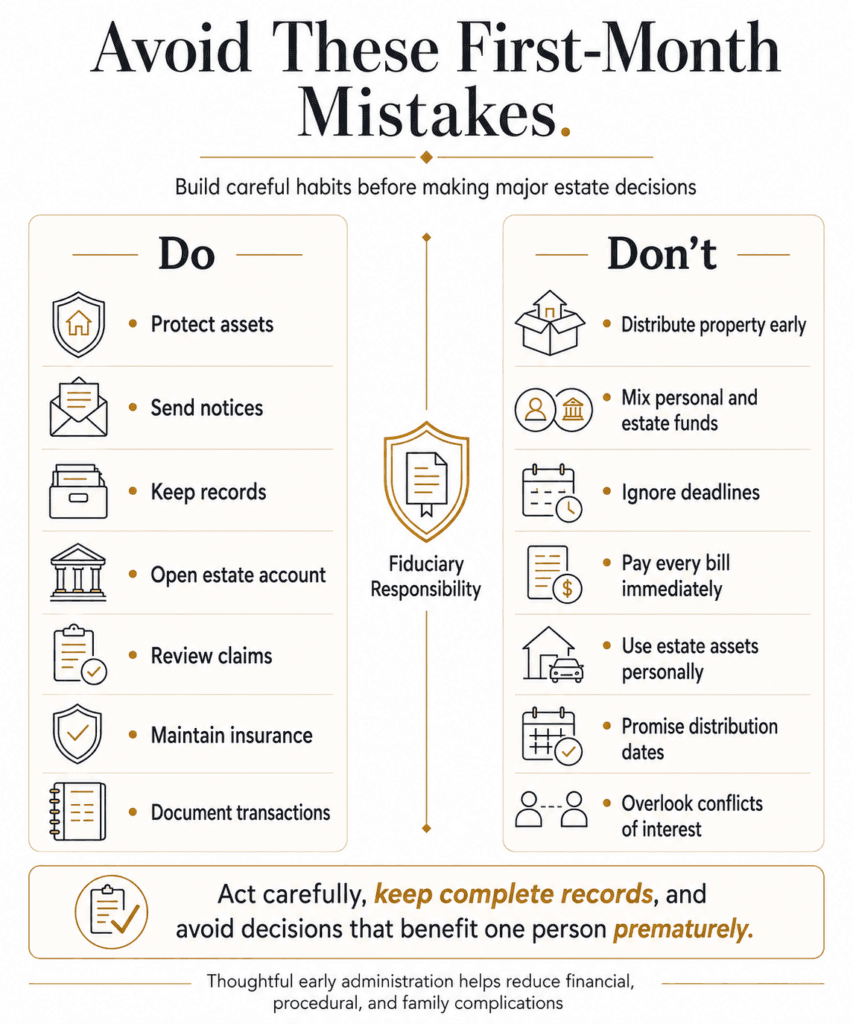
Do not distribute estate money while it may still be needed for:
- Administration expenses
- Creditor claims
- Taxes
- Property maintenance
- Statutory allowances
- Professional fees
- Closing costs
Communicate carefully with heirs and devisees
Clear communication can prevent misunderstandings.
Explain that appointment begins administration. It does not mean the estate is ready for distribution.
The estate may still need to:
- Identify assets
- Determine ownership
- Complete creditor notice
- Review claims
- Prepare the inventory
- Address taxes
- Sell property
- Resolve disputes
- Confirm the proper recipients
- Prepare transfer documents
Provide measured updates.
Avoid:
- Promising a distribution date too early
- Giving one beneficiary special access to information
- Sharing sensitive financial details unnecessarily
- Taking sides in family disputes
- Making ownership promises before reviewing the documents
- Discussing disputed matters casually through text or social media
Confirm important decisions and communications in writing.
You act for the estate—not for the loudest relative or the person closest to you.
Avoid early distributions
The first 30 days are usually too early for final distributions.
Before distributing money or property, understand:
- Whether the asset belongs to the probate estate
- Whether someone else owns part of it
- Creditor rights
- Tax obligations
- Administration expenses
- The will’s instructions
- The identity of the proper recipient
- Whether court approval is required
- Whether enough property will remain for unresolved obligations
An early distribution can leave the estate without enough money to pay what it owes.
It can also create liability for the personal representative or require the recipient to return property.
Avoid personal use of estate property
Do not use estate property for your own benefit.
Potential problems include:
- Living in an estate home without a documented arrangement
- Driving an estate vehicle for personal reasons
- Borrowing estate money
- Using an estate credit card
- Paying personal expenses from the estate account
- Buying estate property on favorable terms
- Transferring estate property to a family member or related business
Arizona law provides that certain transactions involving a substantial conflict of interest may be voidable.
This includes certain transactions involving the personal representative, the representative’s spouse, agent, attorney, or an entity in which the representative has a substantial beneficial interest.
Exceptions may apply when:
- The decedent expressly authorized the transaction,
- The court approves it after notice, or
- An interested person consents after fair disclosure.
Arizona Law Note: A.R.S. § 14-3713 addresses conflicted transactions and when they may be voidable.
Disclosure alone may not solve every conflict.
Get appropriate guidance before completing the transaction.
Bring in professional help when needed
Some estates need more than one type of professional.
A tax professional may help with:
- The decedent’s final return
- Estate income-tax returns
- Property sales
- Business income
- Beneficiary tax documents
- Federal estate-tax questions
An appraiser may be needed for:
- Real estate
- Business interests
- Jewelry
- Artwork
- Collectibles
- Other property with uncertain value
Other assistance may come from:
- An Arizona probate attorney
- An accountant
- A financial adviser
- A property manager
- A real estate professional
- A business specialist
- A digital-asset specialist
- An insurance professional
Arizona law permits a personal representative, acting reasonably for interested persons, to employ attorneys, auditors, investment advisers, and other agents to help with administration, subject to the will and applicable court orders.
Hiring a professional does not eliminate your fiduciary responsibility.
Keep engagement letters, invoices, recommendations, and records showing why the assistance benefited the estate.
Complete a day-30 review
Before the first month ends, review what has been completed.
Confirm that:
- Appointment, qualification, and Letters are complete.
- Certified Letters are available.
- The will and court documents were reviewed.
- Restrictions and bond requirements are understood.
- The deadline calendar is complete.
- Appointment information was sent when required.
- Informal probate information and the will were sent when required.
- Proof of mailing and delivery is preserved.
- Creditor publication has begun.
- Known creditors are being identified and notified.
- Real estate and valuables are secure.
- Insurance has been reviewed.
- Estate records are organized.
- An EIN was obtained when needed.
- An estate bank account was opened when appropriate.
- Estate and personal funds remain separate.
- Inventory work is underway.
- Bills are being reviewed before payment.
- No premature distributions have occurred.
- Conflicts have been identified before transactions.
- Professional help has been arranged when needed.
Then identify the priorities for the next 60 days.
Those may include:
- Completing valuations
- Sending additional creditor notices
- Reviewing claims
- Addressing tax issues
- Managing or selling property
- Completing the inventory
- Resolving ownership questions
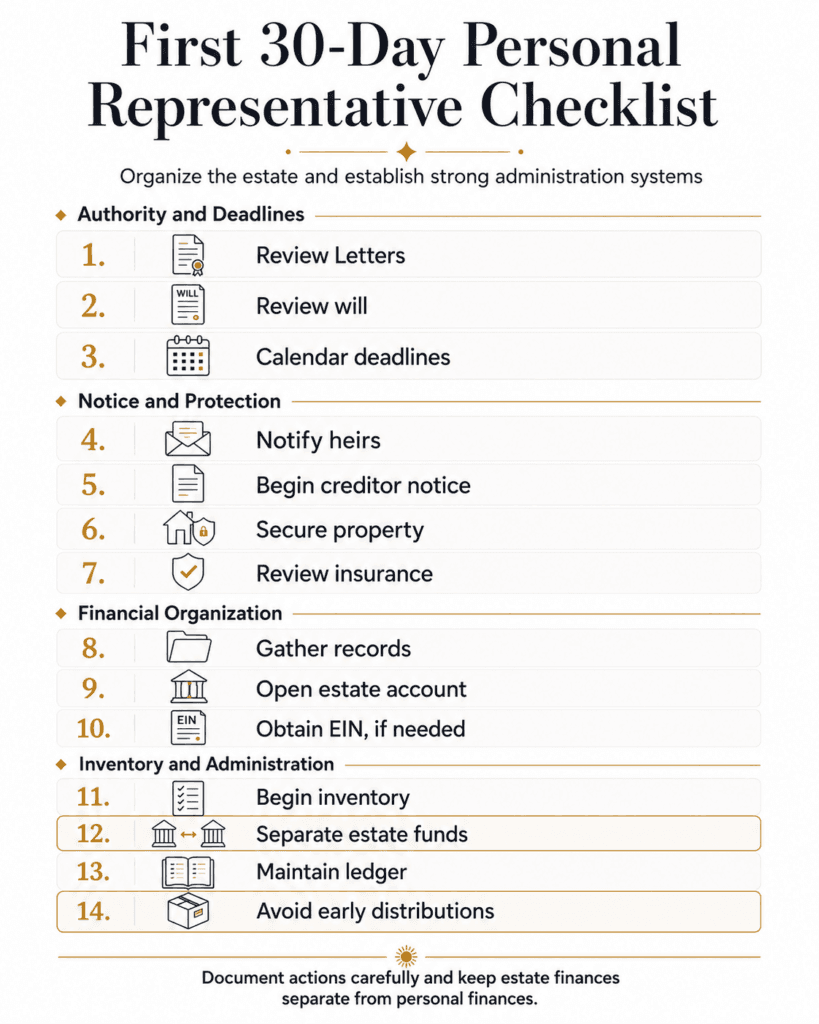
First 30 days checklist
During the first month, an Arizona personal representative should generally:
- Review the Letters, appointment order, will, and court filings.
- Identify restrictions, bond requirements, or supervision.
- Obtain certified copies of Letters.
- Calendar the 30-day and 90-day deadlines.
- Send appointment information to heirs and devisees.
- Send informal probate information and the will when required.
- Keep proof of every mailing and delivery.
- Begin creditor publication.
- Identify and notify known creditors.
- Secure real estate, vehicles, records, and valuables.
- Review and maintain insurance.
- Gather financial, tax, ownership, and debt records.
- Determine which assets belong to the probate estate.
- Obtain an estate EIN when needed.
- Open an estate bank account when appropriate.
- Keep estate and personal money separate.
- Create a transaction ledger and document system.
- Begin gathering values for the inventory.
- Review bills and claims before paying them.
- Communicate carefully with heirs and devisees.
- Avoid early distributions.
- Avoid personal use of estate property.
- Address conflicts before completing transactions.
- Obtain professional help when appropriate.
- Review progress before the first month ends.
Build a strong foundation for the estate
The first 30 days set the direction for the rest of the probate process.
A personal representative who sends timely notices, protects property, begins creditor administration, separates estate money, keeps reliable records, and prepares for the inventory is in a much better position to manage the months ahead.
The goal is not to finish the estate during the first month.
The goal is to:
- Establish control
- Meet immediate legal duties
- Protect property
- Preserve accurate records
- Prepare for claims
- Address tax and valuation issues
- Avoid preventable mistakes
Every estate has different assets, debts, beneficiaries, tax concerns, and court requirements.
When an estate includes a business, disputed property, substantial debt, unclear ownership, difficult family relationships, or significant tax concerns, early legal and tax guidance may prevent problems that are harder to correct later.
For a broader overview of the entire process, see Rahnema Law’s Arizona probate administration guide and Arizona Probate FAQs.
Legal Disclaimer: This information is for educational purposes only and does not constitute legal advice. Arizona probate law is complex and varies based on individual circumstances. Always consult with a qualified probate attorney for guidance specific to your situation.
FAQs
First, confirm that appointment, qualification, and Letters are complete. Then review the will and court orders, secure estate property, create a deadline calendar, and begin preparing the required notices.
A person generally must be appointed, qualify, and receive Letters. A.R.S. § 14-3103 states that estate administration begins with issuance of Letters.
The personal representative generally must provide heirs and devisees with information about the appointment. That information includes the personal representative’s name and address, the court where estate papers are filed, whether a bond has been filed, and a statement that the recipient has or may have an interest in the estate.
Generally, yes. Within 30 days after issuance of the statement of informal probate, the applicant must provide the required information and a copy of the will to each heir and devisee whose address is reasonably available. The statute permits delivery or mail and, when a personal representative has been appointed, allows the information to be combined with appointment information and given by either the applicant or the personal representative on behalf of both. For a notified recipient, the general four-month contest period runs from receipt.
Unless notice has already been given under A.R.S. § 14-3801, creditor publication is triggered at the time of appointment. Arizona generally requires publication once a week for three successive weeks and direct written notice to known creditors.
The inventory generally must be prepared within 90 days after appointment. The deadline runs from appointment—not from the date the probate case was filed.
An estate may need an EIN for federal tax reporting, an estate bank account, or other financial purposes. The IRS directs executors and administrators to use Form SS-4 to apply for an estate EIN.
An estate account is often appropriate when the estate will receive or pay money. It helps keep estate funds separate and creates a clear record of income and expenses.
Final distributions ordinarily should wait until ownership, claims, taxes, expenses, and the proper recipients are understood. An early distribution may leave the estate without enough property to pay its obligations.
Estate property should not be used for personal benefit. Transactions involving the personal representative or related people may be voidable when affected by a substantial conflict of interest unless an applicable exception is satisfied.
Keep court documents, notices, mailing records, creditor documents, asset records, bank statements, invoices, receipts, insurance records, tax documents, beneficiary communications, and a complete transaction ledger.