

Learn Arizona personal representative duties, including notices, inventory, creditors, records, distributions, and closing the estate.
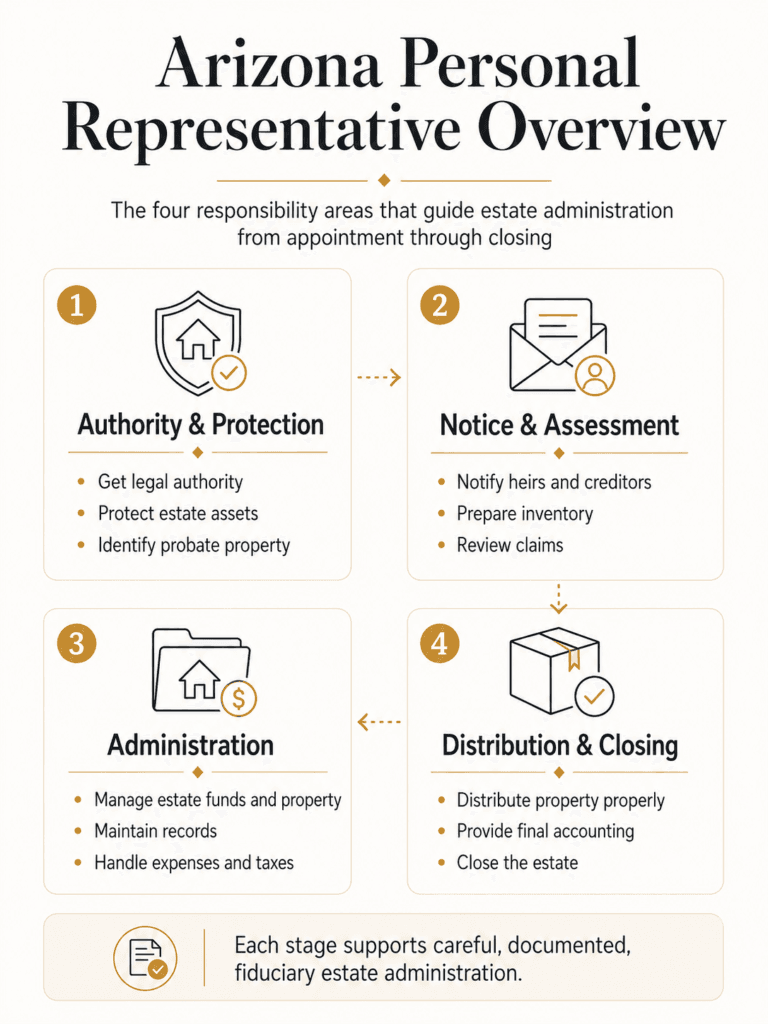
Arizona personal representative duties involve much more than collecting property and giving it to family members.
The personal representative must protect estate assets, notify the right people, identify debts, keep accurate financial records, follow the will and court orders, and transfer property to the people legally entitled to receive it.
The role also comes with a basic rule:
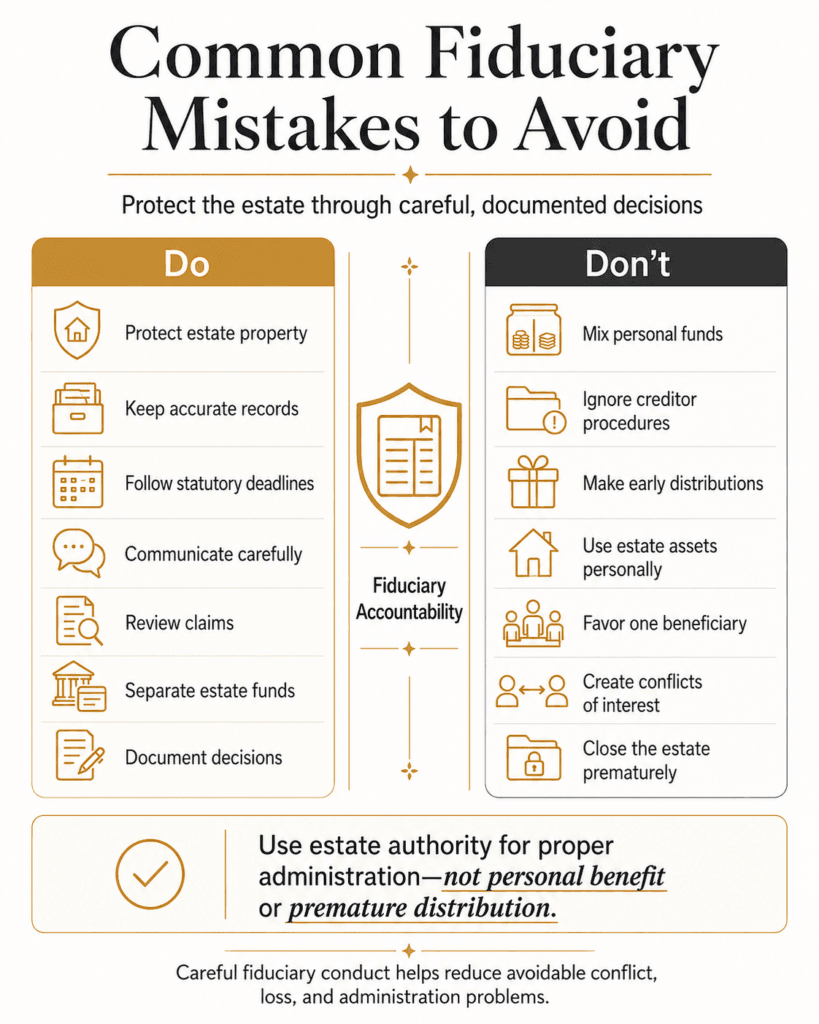
Use estate authority for the estate—not for personal benefit or to favor one beneficiary over another.
What is the main duty of an Arizona personal representative?
An Arizona personal representative is a fiduciary.
That means the representative must settle and distribute the estate according to any valid will, Arizona law, and applicable court orders. The work should move forward as efficiently as possible without harming the estate’s interests.
Arizona Law Note: A.R.S. § 14-3703 requires the personal representative to settle and distribute the estate according to the will and Arizona law, as efficiently as is consistent with the estate’s best interests.
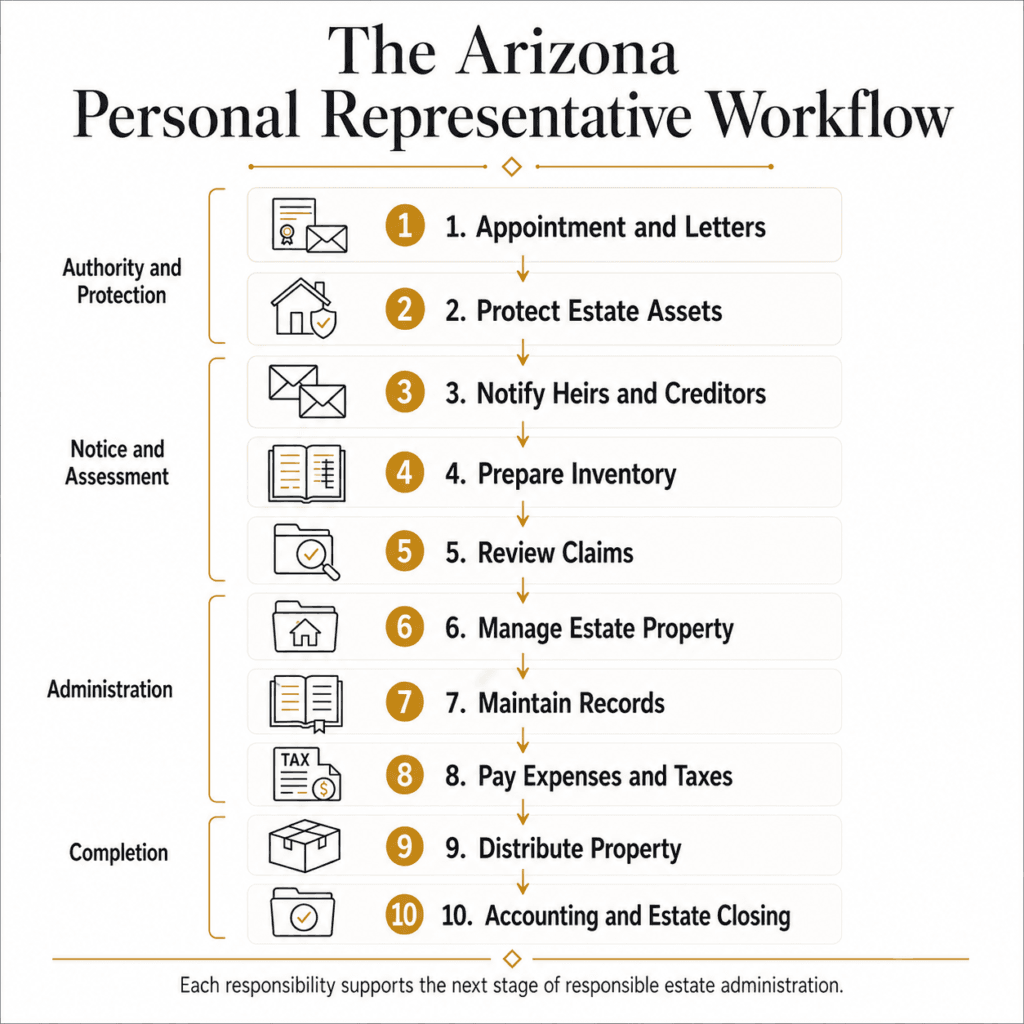
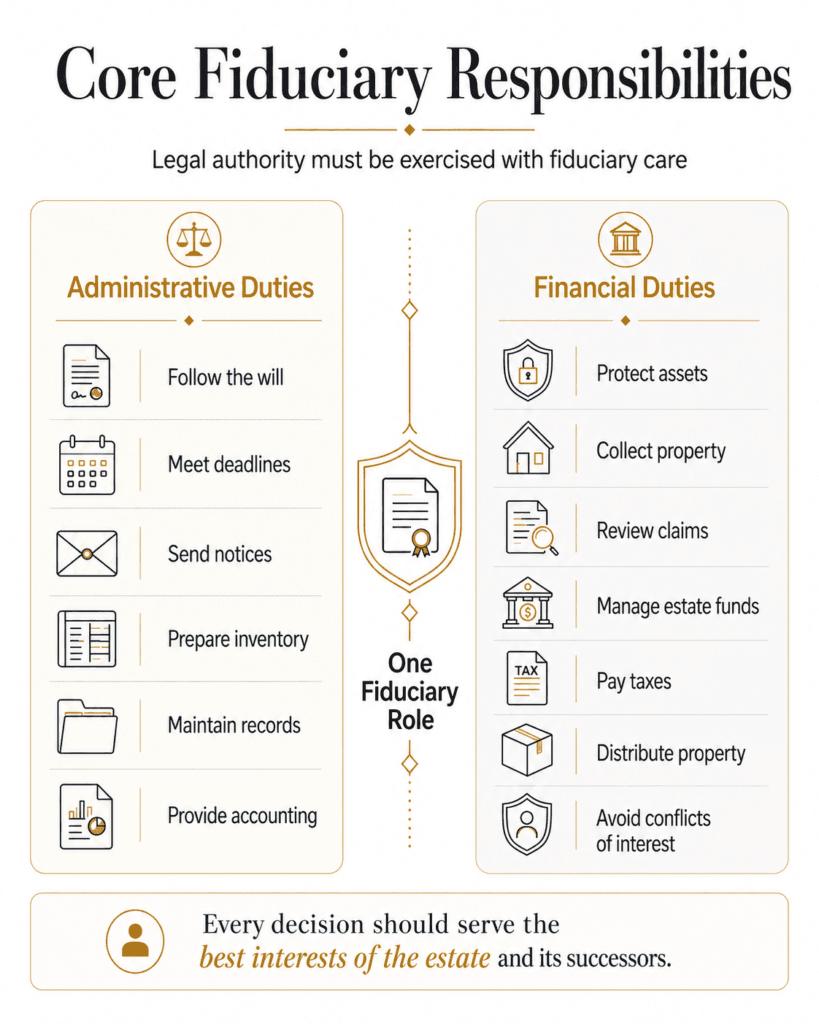
The principal duties generally include:
- Following the will, Arizona law, and court orders
- Protecting and collecting estate property
- Notifying heirs, devisees, and creditors
- Preparing the probate inventory
- Reviewing and paying valid claims
- Keeping estate money separate
- Maintaining complete financial records
- Managing property reasonably
- Avoiding conflicts of interest
- Addressing taxes and ongoing expenses
Does the will control every asset?
No.
Some property may pass outside probate through:
- A trust
- A beneficiary designation
- A payable-on-death account
- A transfer-on-death registration
- A beneficiary deed
- Survivorship ownership
- Another valid nonprobate arrangement
Before managing or distributing an asset, determine whether it actually belongs to the probate estate.
Court orders also matter. A supervised-administration order, bond requirement, restriction on authority, or other judicial direction may limit what the personal representative can do.
Move efficiently without rushing
Arizona law requires efficient administration. It does not require reckless speed.
The estate may need time to:
- Identify and value property
- Determine ownership
- Complete creditor notice
- Review claims
- Resolve tax matters
- Sell property
- Locate beneficiaries
- Address family disputes
- Prepare an accounting
Moving too quickly can be as harmful as allowing the estate to sit without a valid reason.
Before distributing property, keep enough estate assets available for:
- Administration expenses
- Creditor claims
- Taxes
- Property maintenance
- Professional fees
- Statutory allowances
- Unresolved liabilities
- Closing expenses
The goal is steady progress supported by careful investigation and documentation.
Protect and preserve estate property
The personal representative generally has the right and duty to take possession or control of estate property when needed for administration.
Some real estate or tangible personal property may remain with the person expected to receive it. However, the representative may take possession when necessary to protect the property or administer the estate.
Protective steps may include:
- Securing a home
- Collecting or changing keys
- Reviewing insurance
- Maintaining necessary utilities
- Protecting vehicles
- Storing valuables
- Arranging urgent repairs
- Collecting rent
- Supervising rental property
- Preventing unauthorized removal of belongings
- Paying appropriate property taxes
- Documenting the condition of assets
A vacant Arizona home may need electricity, air conditioning, landscaping, pest control, pool service, security, or vacancy insurance to prevent damage.
Photograph significant property. Keep records of repairs, maintenance, insurance, access, and anything moved for safekeeping.
Arizona Law Note: A.R.S. § 14-3709 addresses the personal representative’s right and duty to control estate property and take reasonable steps to manage, protect, and preserve it.
Identify and collect probate assets
The personal representative must determine what the decedent owned and which assets belong to the probate estate.
Review:
- Deeds
- Bank statements
- Investment records
- Vehicle titles
- Business documents
- Tax returns
- Insurance policies
- Beneficiary designations
- Retirement records
- Trust documents
- Loan agreements
- Digital records
- Safe-deposit-box information
You may also need to contact:
- Banks
- Investment companies
- Employers
- Insurance companies
- Government agencies
- Business partners
- Debtors
- Property managers
- Title companies
Certified Letters of Personal Representative are commonly used to prove authority.
Look for assets that are easy to miss
Examples include:
- Refunds
- Unpaid wages
- Money owed to the decedent
- Safe-deposit-box contents
- Business interests
- Mineral rights
- Digital property
- Cryptocurrency
- Intellectual property
- Pending legal claims
- Security deposits
- Uncashed checks
- Tax refunds
For each possible asset, record:
- The legal owner
- Any joint owner
- Any beneficiary
- Approximate date-of-death value
- Loans, liens, or other encumbrances
- The institution or person controlling it
- Whether it appears to be probate or nonprobate property
For a deeper asset-identification guide, see Rahnema Law’s Arizona probate inventory checklist.
What if someone is hiding property or records?
If someone may be concealing estate property or important ownership documents, the personal representative or another interested person may be able to ask the probate court to investigate.
The procedure may apply to suspected concealment or withholding of:
- Estate property
- The original will
- Deeds
- Contracts
- Bonds
- Ownership records
- Documents showing the decedent’s property interests
This is a court remedy for serious concerns about hidden or withheld property and information. It should not be used merely because relatives disagree informally about an item.
Notify heirs and devisees
A personal representative, other than a special administrator, generally must provide appointment information to heirs and devisees within 30 days after appointment.
An heir is someone entitled to inherit under Arizona intestate-succession law.
A devisee is a person or organization named in a will to receive property.
The information generally must:
- Identify the personal representative
- Provide the representative’s address
- Explain that the recipient has or may have an interest
- State whether a bond was filed
- Identify the court where estate documents are filed
Send or deliver the information to each heir and devisee whose address is reasonably available.
If appointment occurred in a formal proceeding, separate appointment information may not be required for people who already received notice of that proceeding.
Arizona Law Note: A.R.S. § 14-3705 establishes the general 30-day appointment-information requirement. Failure to provide it is a breach of duty to the affected person, although it does not invalidate the appointment or the representative’s other powers.
Keep:
- Copies of notices
- The recipient list
- Addresses used
- Mailing or delivery records
- Returned mail
- Records of efforts to locate missing addresses
Informal family knowledge does not replace required notice.
Provide notice after informal probate of a will
When a will is admitted through informal probate, an additional notice generally must be sent within 30 days after issuance of the statement of informal probate.
Heirs and devisees generally must receive:
- Written information that the will was admitted
- A copy of the will
- Identification of the court
- Notice of the general four-month period for contesting informal probate
The appointment notice and informal-probate notice may be sent together when both apply, but every requirement for each notice must still be satisfied.
Arizona Law Note: A.R.S. § 14-3306 establishes the informal-probate notice requirement and the general four-month contest period after receipt. It preserves a separate rule for a later-discovered will.
Prepare the Arizona probate inventory
The personal representative generally must prepare an inventory within 90 days after appointment.
The inventory must describe the decedent’s property in reasonable detail and identify:
- Fair market value as of the date of death
- Whether the asset was community or separate property
- The type and amount of any mortgage, lien, or other encumbrance
Arizona Law Note: A.R.S. § 14-3706 establishes the 90-day inventory deadline and the required information.
The representative may file the inventory with the court and provide it to interested people who request it.
Alternatively, the representative may elect not to file the inventory with the court. If the representative does not file it, A.R.S. § 14-3706 requires delivery or mailing to the heirs or devisees specified by the statute and to other interested persons who request it. Court confidentiality and filing procedures should be checked for the county handling the case.
Professional appraisals may be appropriate for:
- Real estate
- Business interests
- Jewelry
- Artwork
- Collectibles
- Unusual vehicles
- Intellectual property
- Other property with uncertain value
If another asset is discovered later, or an important value or description was wrong or misleading, prepare a supplemental inventory or appraisal.
The 90-day deadline runs from appointment, not from the date the probate papers were filed.
Notify creditors
Creditor administration is one of the most important Arizona personal representative duties.
Unless notice has already been given, the representative generally must publish notice to creditors once a week for three successive weeks in a newspaper of general circulation in the county.
The publication generally states:
- That the representative was appointed
- The representative’s address
- Where claims must be presented
- The four-month period measured from the first publication
Known creditors generally must also receive direct written notice.
Their deadline is generally the later of:
- Four months after the first publication, or
- 60 days after the direct notice is mailed or delivered
Arizona Law Note: A.R.S. § 14-3801 governs published notice and direct notice to known creditors.
Make a reasonable effort to identify creditors by reviewing:
- Bills
- Account statements
- Tax notices
- Medical bills
- Credit-card statements
- Loan documents
- Pending lawsuits
- Business records
- Contracts
- Insurance correspondence
Keep proof of publication, copies of direct notices, delivery records, claims, and related correspondence.
Rahnema Law’s Arizona probate creditor guide explains how to search for and organize possible claims.
Review claims before paying them
Do not pay a claim automatically just because it arrives.
Determine whether it is:
- Timely
- Properly presented
- Supported by records
- Legally enforceable
- Already paid
- Covered by insurance
- Secured by property
- Subject to a defense
- Subject to disallowance
Also determine whether the estate can pay every valid obligation.
If estate assets are insufficient, Arizona law generally requires payment in this order:
- Costs and expenses of administration
- Reasonable funeral expenses
- Debts and taxes with preference under federal law
- Reasonable and necessary expenses of the decedent’s last illness
- Debts and taxes with preference under Arizona law
- Other claims
Claims in the same class generally do not receive priority simply because one became due first.
Arizona Law Note: A.R.S. § 14-3805 establishes the payment order when the estate cannot pay all claims in full.
Paying a lower-priority bill too early may leave too little money for a claim that legally must be paid first.
Keep estate money separate
Estate money should never be mixed with the personal representative’s personal funds.
When appropriate:
- Obtain an EIN for the estate.
- Open an account in the estate’s name.
- Deposit estate income and proceeds into that account.
- Pay legitimate estate expenses from the estate account.
- Keep supporting records for every transaction.
Estate receipts may include:
- Collected account balances
- Refunds
- Rent
- Dividends
- Business income
- Insurance proceeds payable to the estate
- Sale proceeds
- Money recovered from debtors
Do not:
- Deposit estate funds into a personal account
- Borrow estate money
- Use estate money for personal expenses
- Mix funds temporarily
- Make undocumented cash withdrawals
- Use estate property without a proper arrangement
The IRS explains that estates may need an EIN for tax administration and directs executors and administrators to use Form SS-4. Its guidance also identifies Publication 559 as a resource for survivors and personal representatives.
Maintain complete financial records
The personal representative should be able to explain every major estate transaction.
Keep:
- The opening inventory
- Supplemental inventories
- Bank and investment statements
- Income records
- Property-sale documents
- Paid expenses
- Creditor claims
- Tax records
- Professional invoices
- Reimbursement records
- Distribution documents
- Property-transfer records
Preserve supporting documents such as:
- Receipts
- Invoices
- Canceled checks
- Deposit confirmations
- Appraisals
- Settlement statements
- Contracts
- Correspondence
- Electronic transaction records
Maintain a ledger showing:
- Date
- Description
- Amount received
- Amount paid
- Payee or payer
- Purpose
- Account used
- Supporting document
- Running balance
When an unsupervised estate closes by verified statement, the representative generally must provide a full written account to the distributees whose interests are affected.
A reasonable transaction can become difficult to defend when no records explain what happened or why it benefited the estate.
Manage estate property reasonably
Arizona law gives personal representatives broad authority to manage estate property unless the will or a court order imposes restrictions.
Acting reasonably for interested people, the representative may have authority to:
- Retain or sell assets
- Handle continuing contracts
- Deposit or invest funds
- Repair property
- Lease property
- Insure estate assets
- Borrow for estate purposes
- Pay taxes and administration expenses
- Hire professionals
- Bring or defend legal claims
- Continue a business within applicable limits
- Settle claims
- Distribute the estate
Arizona Law Note: A.R.S. § 14-3715 lists many transactions a personal representative may perform when acting reasonably for interested persons, subject to the will, court orders, and statutory priorities.
Having legal authority does not automatically make every transaction appropriate.
Before selling a house, business, investment, or other major asset, consider:
- The will
- Creditor needs
- Carrying costs
- Tax consequences
- Market conditions
- Beneficiary interests
- Liquidity needs
- Insurance and maintenance costs
- Whether court approval is required
Document the reasons for major decisions.
Avoid conflicts of interest
A personal representative should not use the position to obtain a personal advantage.
A conflict may arise when estate property is sold, transferred, leased, or encumbered for the benefit of:
- The personal representative
- The representative’s spouse
- The representative’s agent
- The representative’s attorney
- A company or trust in which the representative has a substantial interest
A transaction affected by a substantial conflict may be voidable unless:
- The will or a contract made by the decedent expressly authorized it,
- The court approved it after notice, or
- The affected person consented after fair disclosure.
Arizona Law Note: A.R.S. § 14-3713 addresses conflicted transactions and the circumstances in which they may be voidable.
Address the conflict before completing the transaction.
Disclosing it after the property has already been sold or transferred may not solve the problem.
Hire qualified professionals when appropriate
A personal representative is not expected to perform every specialized task alone.
Professional assistance may be appropriate when the estate involves:
- Tax questions
- Real estate
- Business interests
- Contested claims
- Litigation
- Unusual investments
- Complex ownership
- Difficult valuations
- Property in another state
- Beneficiary disputes
Professionals may include:
- An Arizona probate attorney
- A certified public accountant
- A tax adviser
- An appraiser
- A property manager
- A financial adviser
- An insurance professional
- A real estate broker
- A digital-asset specialist
Arizona law allows a representative acting reasonably for interested people to employ attorneys, auditors, investment advisers, and other agents.
Hiring a professional does not eliminate the representative’s fiduciary duty.
Select qualified people, understand the engagement, review important recommendations, monitor the work, and keep engagement letters and invoices.
Address taxes and ongoing expenses
The personal representative may need to handle:
- The decedent’s final income-tax return
- Prior unfiled returns
- Estate income-tax returns
- Property taxes
- Business taxes
- Other federal or Arizona obligations
The estate may also continue to pay:
- Insurance
- Mortgage payments
- Utilities
- Maintenance
- Storage
- Professional fees
- Court costs
- Security
- Business expenses
Reserve enough money for expected taxes and expenses before making final distributions.
Closing the estate account or distributing all available cash too early can leave the estate unable to pay a later obligation.
Communicate carefully
Clear communication can reduce confusion and disputes.
The representative should:
- Provide required notices
- Respond appropriately to reasonable questions
- Explain important developments
- Avoid promising distributions too early
- Confirm major decisions in writing
- Remain neutral
- Protect confidential information
Beneficiaries should understand that appointment does not mean the estate is ready for distribution.
The estate may still need to complete:
- Asset identification
- Inventory
- Creditor notice
- Claim review
- Tax work
- Property sales
- Valuations
- Accounting
- Transfer documents
Do not let one beneficiary control decisions that affect the entire estate merely because that person has a close relationship with the representative.
Handle compensation and reimbursements properly
Arizona law entitles a personal representative to reasonable compensation.
If the will provides a compensation arrangement and no separate contract controls, the representative may be able to renounce the will’s provision before qualifying and instead receive reasonable compensation.
The representative may also renounce all or part of the compensation.
Arizona Law Note: A.R.S. § 14-3719 establishes the reasonable-compensation standard and addresses renunciation of compensation.
Keep records showing:
- Work performed
- Date
- Time spent
- Complexity
- Benefit to the estate
Compensation is different from reimbursement.
A reimbursement repays money personally advanced for a legitimate estate expense. Keep the receipt, proof of payment, purpose, and explanation of how the expense benefited the estate.
Do not claim the same cost as both compensation and reimbursement.
Distribute property to the correct recipients
Before final distribution, confirm that:
- The applicable creditor period has expired.
- Valid claims have been addressed.
- Taxes have been paid or adequately reserved for.
- Administration expenses have been paid or reserved for.
- The correct recipient has been identified.
- The asset belongs to the probate estate.
- The will’s conditions have been satisfied.
- Required court approval has been obtained.
- Enough property remains for unresolved obligations.
Cash distributions should be documented by check or electronic records when practical.
Titled assets may require deeds, assignments, titles, or other transfer documents.
When property is distributed in kind, the personal representative must execute an instrument or deed of distribution assigning, transferring, or releasing the asset to the recipient.
Arizona Law Note: A.R.S. § 14-3907 requires an instrument or deed of distribution for in-kind transfers and identifies additional information required for recorded real-property transfers.
Obtain receipts or written acknowledgments identifying:
- The recipient
- The asset or amount
- The transfer date
- Value when relevant
- Any conditions or reservations
Close the estate
The personal representative remains responsible until the closing requirements have been completed.
Before closing, confirm that:
- Known estate assets have been collected or transferred.
- The creditor period has expired.
- Claims and expenses have been addressed.
- Tax matters are complete or sufficient funds remain reserved.
- Property has been distributed properly.
- The accounting is complete.
- Required notices and documents have been provided.
A qualifying unsupervised estate may close through a verified closing statement.
The statement generally cannot be filed earlier than four months after the original appointment of a general personal representative.
It generally must confirm that:
- The creditor-claim period expired.
- The estate was fully administered.
- Claims, expenses, and applicable taxes were addressed.
- Estate property was distributed.
- Copies were sent to the required distributees and unresolved claimants.
- A full written account was provided to affected distributees.
If no proceeding involving the personal representative is pending, the appointment generally terminates one year after the closing statement is filed.
Arizona Law Note: A.R.S. § 14-3933 establishes the requirements for closing a qualifying unsupervised estate by verified statement.
Filing the closing statement does not immediately end the appointment.
Can a personal representative be personally liable?
Yes, when an improper exercise of estate authority causes damage through a breach of fiduciary duty.
Possible problems include:
- Misusing estate money
- Failing to protect property
- Making an improper distribution
- Entering an unauthorized conflicted transaction
- Ignoring creditor priorities
- Disobeying a court order
- Selling property on unreasonable terms
- Failing to keep records
- Using estate property personally
Personal liability is not automatic whenever the estate loses money.
The issue is whether the representative improperly exercised authority, breached a fiduciary duty, and caused damage.
Arizona Law Note: A.R.S. § 14-3712 addresses liability for damage or loss caused by an improper exercise of estate authority and breach of fiduciary duty.
Complete records, professional guidance, proper disclosure, and court approval when needed can help show that the representative acted reasonably.
Can an Arizona personal representative be removed?
Yes.
An interested person may ask the court to remove a personal representative for cause.
Grounds may include:
- Removal would serve the estate’s best interests.
- Material facts were intentionally misrepresented during appointment.
- The representative disregarded a court order.
- The representative became unable to perform the duties.
- The representative mismanaged the estate.
- The representative failed to perform a duty.
- The representative disregarded reasonable written instructions about the decedent’s remains.
After receiving notice of a removal proceeding, the representative generally may act only to account, correct maladministration, or preserve the estate unless the court orders otherwise.
Arizona Law Note: A.R.S. § 14-3611 identifies grounds and procedures for removal.
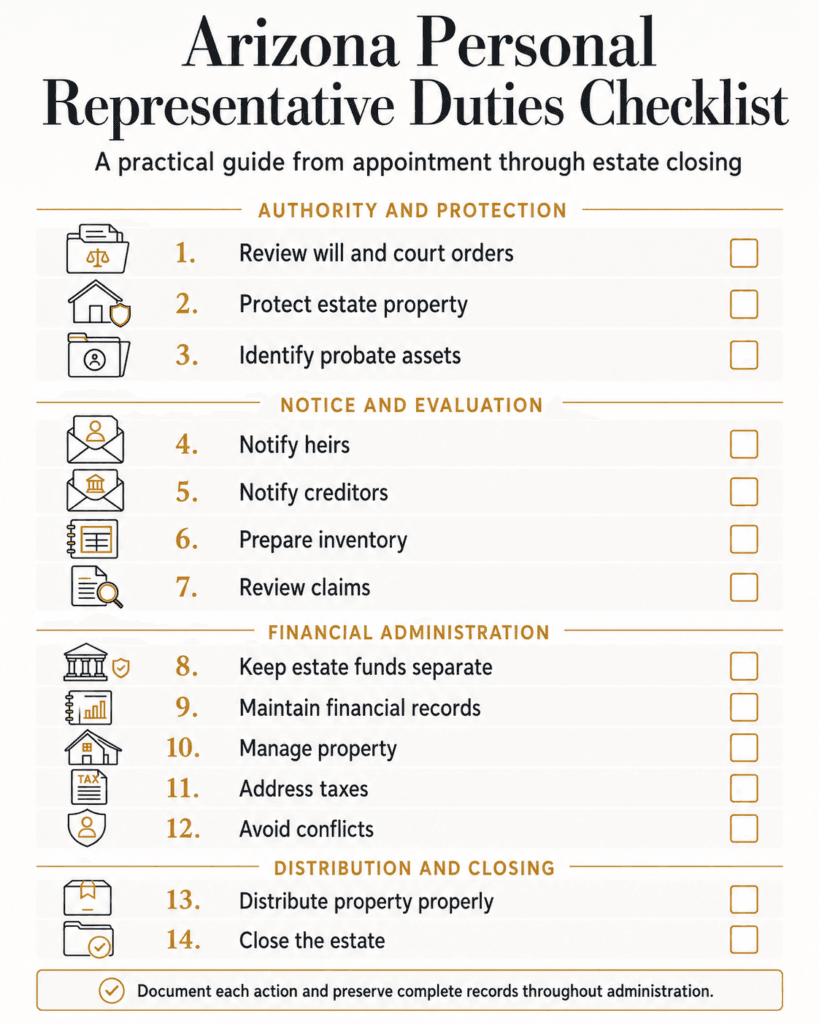
Arizona personal representative duties checklist
A personal representative should generally:
- Review the Letters, will, bond, and court orders.
- Follow the will, Arizona law, and judicial restrictions.
- Protect and insure estate property.
- Identify and collect probate assets.
- Send required information to heirs and devisees.
- Prepare the inventory within 90 days after appointment.
- Publish and directly deliver creditor notices.
- Review claims before paying them.
- Follow statutory payment priorities when funds are limited.
- Keep estate money separate.
- Maintain a transaction ledger and supporting records.
- Manage estate property reasonably.
- Avoid self-dealing and conflicts.
- Hire qualified professionals when needed.
- Address taxes and ongoing expenses.
- Communicate carefully with interested people.
- Document compensation and reimbursements.
- Distribute property to the correct recipients.
- Provide the required accounting.
- Complete the appropriate closing process.
Carry out the role one stage at a time
A personal representative does not need to finish the entire estate immediately.
At the beginning, focus on authority, governing documents, property protection, and notices.
The middle of the administration focuses on:
- Assets
- Inventory
- Creditors
- Taxes
- Property management
- Recordkeeping
Distribution and closing come later, after obligations have been addressed and the proper recipients have been identified.
Care, neutrality, documentation, and timely action matter throughout the process.
When an estate includes disputed property, substantial debt, a business, complex taxes, unclear ownership, or beneficiary conflict, professional guidance may help the personal representative perform the role and avoid mistakes that are difficult to correct.
For a broader overview, see Rahnema Law’s Arizona probate administration guide and Arizona Probate FAQs.
Legal Disclaimer: This information is for educational purposes only and does not constitute legal advice. Arizona probate law is complex and varies based on individual circumstances. Always consult with a qualified probate attorney for guidance specific to your situation.
FAQs
The representative must settle and distribute the estate according to any effective will and Arizona law, acting as efficiently as is consistent with the estate’s best interests.
Yes. The personal representative must use estate authority for the estate’s proper administration and the interests protected by Arizona law—not for personal benefit.
Appointment information generally must be provided within 30 days after appointment. A separate notice may also be required within 30 days after a will is admitted through informal probate.
The inventory generally must be prepared within 90 days after appointment. It must include date-of-death values, community or separate character, and applicable encumbrances.
The representative generally must publish notice once a week for three successive weeks and provide direct written notice to known creditors.
No. Each claim should be reviewed. If the estate cannot pay all valid claims, Arizona’s statutory order of priority generally must be followed.
Arizona law gives personal representatives broad transaction authority unless the will or a court order restricts it. The representative must still act reasonably for interested people and consider claims, taxes, costs, and beneficiary interests.
A purchase involving the representative may create a substantial conflict of interest and may be voidable. Authorization in the will, court approval after notice, or consent after fair disclosure may be necessary, depending on the circumstances.
Yes. Arizona law allows reasonable compensation, subject to applicable will provisions and possible challenges concerning reasonableness.
When an estate closes by verified statement, the representative generally must provide a full written account to distributees whose interests are affected.
The representative must execute an instrument or deed of distribution assigning, transferring, or releasing the property to the recipient.
Yes. An improper exercise of authority that causes loss through a breach of fiduciary duty may result in personal liability.
Yes. An interested person may seek removal for reasons including mismanagement, failure to perform duties, incapacity, disregard of a court order, or circumstances in which removal serves the estate’s best interests.
For an estate closed by verified statement, the appointment generally terminates one year after filing if no proceeding involving the personal representative remains pending.