

Learn how to review Arizona probate creditor claims, verify deadlines, request proof, allow or disallow debts, and apply payment priorities.
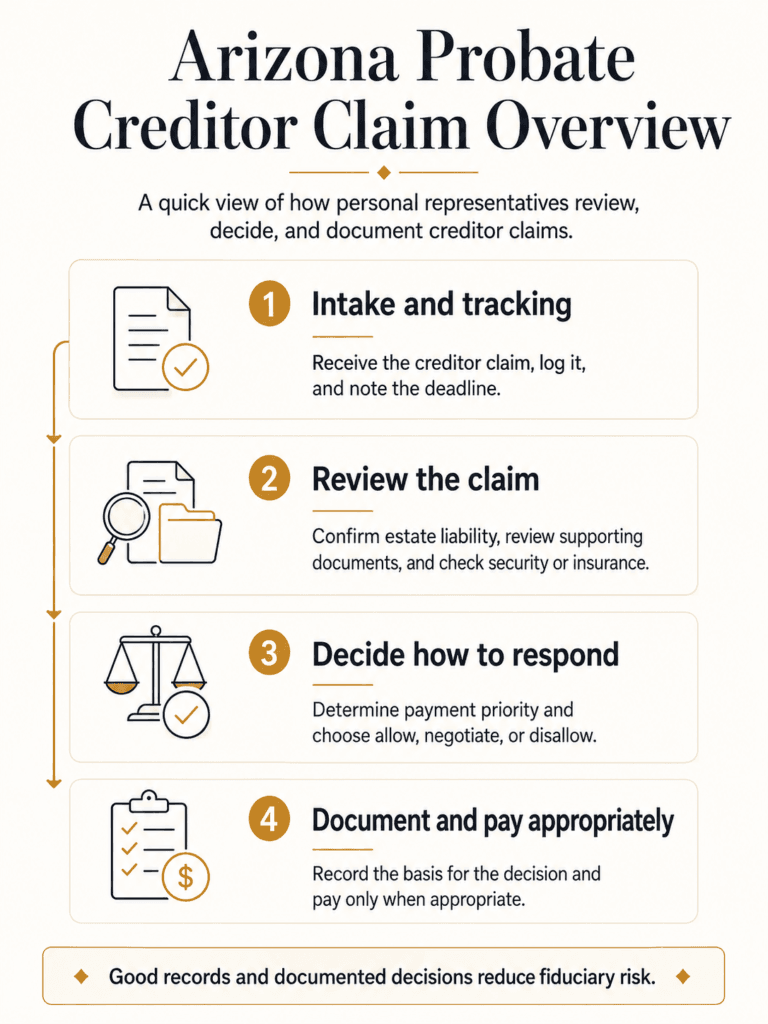
Arizona probate creditor claims should not be paid or rejected automatically. The personal representative must record each demand, check the applicable deadline, review the supporting evidence, identify possible defenses, and decide whether to allow, negotiate, or disallow the claim.
Bills may continue arriving after someone dies for:
- Medical care
- Credit cards
- Loans
- Taxes
- Utilities
- Business obligations
- Property expenses
- Professional services
- Other debts
Some demands will be valid. Others may be late, unsupported, duplicated, insured, secured by property, owed by someone else, or subject to a defense.
The personal representative’s job is not to pay every person who asks for money.
The job is to determine which claims are timely, supported, enforceable, and payable from the estate.
Creditor notice and claim handling are different stages
Creditor notice gives potential creditors an opportunity to present claims.
Claim handling begins when a bill, written claim, lawsuit, tax demand, or other request for payment reaches the estate.
Arizona generally requires the personal representative to publish notice once a week for three successive weeks and provide separate written notice to known creditors. A creditor covered by publication generally has four months after the first publication. A known creditor who receives direct notice generally has the later of that period or 60 days after the direct notice was mailed or delivered.
Rahnema Law’s guide to the Arizona probate notice to creditors explains publication, direct notice, and the deadlines that allow claims to reach the estate.
Once a demand arrives, the personal representative must answer different questions:
- Was it presented correctly?
- Was it received on time?
- Does the debt belong to the decedent or estate?
- Is the requested amount supported?
- Is the debt secured or insured?
- Does the estate have a defense or counterclaim?
- Which property may be used to pay it?
- Where does it fall in Arizona’s payment order?
Publication alone does not answer those questions.
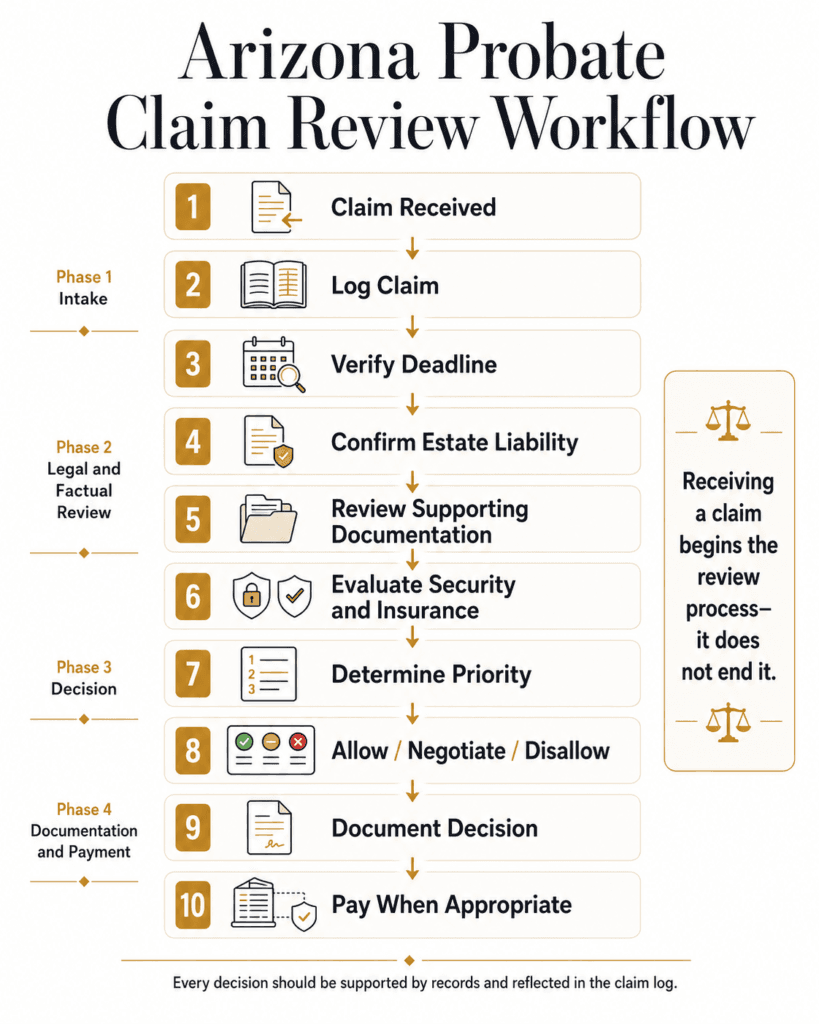
Create a claim log immediately
Create a creditor-claim log as soon as bills or demands begin arriving.
For each claim, record:
- Creditor or claimant
- Contact information
- Account or reference number
- Amount claimed
- Basis of the obligation
- Date received
- Applicable deadline
- Whether the claim is secured
- Whether insurance may apply
- Supporting documents received
- Additional information requested
- Community or separate classification, when applicable
- Current status
- Amount allowed
- Amount disallowed
- Settlement amount
- Payment date
Useful status labels include:
- Under review
- Additional documents requested
- Allowed
- Partially allowed
- Disallowed
- Negotiation pending
- Settled
- Paid
- Referred to insurance
- Referred for legal or tax review
Keep the claim itself together with:
- Envelopes
- Emails
- Account statements
- Contracts
- Invoices
- Mailing records
- Correspondence
- Settlement agreements
- Payment confirmations
The file should allow another person to understand what happened without reconstructing the claim from scattered documents.
Record when the claim was received
The date of receipt may determine whether a written claim was timely.
Arizona allows a claimant to deliver or mail a written statement to the personal representative. A claim presented this way is considered presented when the personal representative receives it—not when the creditor writes or mails it.
When a claim arrives:
- Date-stamp it.
- Preserve the envelope or electronic transmission.
- Enter it in the claim log.
- Save the complete original.
- Calculate the applicable deadline.
- Create reminders for review and response.
Do not rely only on the date printed on the creditor’s letter.
Determine whether the claim was properly presented
A written claim should identify:
- The basis of the claim
- The claimant’s name
- The claimant’s address
- The amount claimed
If the obligation is not yet due, the claim should state when it will become due.
If it is contingent or unliquidated, the claimant should explain the uncertainty.
If it is secured, the claim should describe the security.
Arizona provides that an incorrect description of the security, uncertainty, or future due date does not necessarily invalidate an otherwise effective presentation.
A creditor may instead begin an appropriate court proceeding against the personal representative within the applicable claim period.
When litigation involving the decedent was already pending at death, Arizona generally does not require a separate presentation of the same matter.
An ordinary bill may not be a complete claim
The estate may receive:
- Monthly statements
- Collection notices
- Medical invoices
- Past-due letters
- Loan statements
- Emails
- Telephone calls
- Informal demands from relatives
Do not discard these communications.
However, an ordinary bill may not explain:
- Why the estate is liable
- How the balance was calculated
- Whether insurance was applied
- Whether fees or interest are authorized
- Whether another person owes the debt
- Whether collateral secures the obligation
- Whether the account was previously settled
Preserve the communication and request enough information to evaluate it.
Do not assume that an incomplete document is automatically ineffective, especially when the creditor’s intent to request payment is clear.
Check whether the claim is timely
For many claims arising before death, timeliness depends on the creditor-notice process.
A creditor covered by publication generally must present its claim within four months after the first publication.
A known creditor who receives direct written notice generally has the later of:
- Four months after the first publication, or
- 60 days after the direct notice was mailed or delivered
Arizona also applies an outside limit tied to the decedent’s date of death and the remaining notice period. Another statute of limitations or nonclaim statute may bar the claim earlier.
Claims arising at or after death follow different rules.
For example:
- A claim based on a contract with the personal representative generally must be presented within four months after the representative’s performance became due.
- Another post-death claim is generally subject to the later of four months after it arises or the outside period described in the statute.
Because these rules interact, do not pay a late claim merely because the underlying debt once existed.
Do not use one deadline for every creditor
Calculate the deadline for each claimant separately.
The claim log should show:
- First publication date
- Published deadline
- Date direct notice was mailed or delivered
- End of the 60-day direct-notice period
- Applicable outside limitation
- Date the claim was received
- Timeliness conclusion
A known creditor notified late may receive more time than a creditor relying only on publication.
A post-death contract claim may have a different deadline.
A secured or insured claim may also require analysis beyond the ordinary presentation period.
Review the legal and factual basis of the claim
A timely demand is not automatically a valid debt.
Determine what created the obligation and what evidence supports it.
Relevant records may include:
- Written contracts
- Promissory notes
- Account agreements
- Account statements
- Medical invoices
- Insurance explanation-of-benefits documents
- Loan records
- Payment histories
- Receipts
- Tax assessments
- Judgments
- Correspondence
- Proof of goods or services provided
The review should determine whether:
- The decedent incurred the obligation.
- The requested balance is accurate.
- Payments were properly credited.
- Interest and fees are authorized.
- The debt was settled, discharged, or forgiven.
- Insurance paid part of the balance.
- Another claimant is requesting the same debt.
- Another person or business is responsible.
- A legal defense applies.
Request additional documentation before deciding when the available records are incomplete.
Compare the claim with the decedent’s records
The creditor’s records should be compared with the estate’s information.
Review:
- Bank statements
- Canceled checks
- Credit-card records
- Tax returns
- Insurance records
- Business books
- Emails
- Contracts
- Prior settlement documents
Common discrepancies include:
- Payments that were not credited
- Duplicate collection claims
- Unauthorized fees
- Incorrect interest
- Charges incurred after death
- Insurance adjustments that were not applied
- Accounts belonging to a business
- Debts owed by a co-borrower or another person
A collection statement showing only a total balance may not provide enough support for payment.
Confirm who actually owes the debt
Not every bill associated with the decedent belongs to the probate estate.
The obligation may belong to:
- A trust
- A corporation
- A limited liability company
- A partnership
- A surviving co-borrower
- A joint account holder
- Another family member
- The personal representative individually
- The estate as a post-death administration expense
Determine:
- Who signed the contract
- Who received the benefit
- Whether the decedent personally guaranteed the debt
- Whether the expense arose before or after death
- Whether another entity owns the related property
- Whether the personal representative properly contracted for the estate
An invoice sent to the decedent’s residence does not, by itself, establish estate liability.
Claims involving a married decedent
When the decedent was married, an allowed claim may need to be classified as a community claim or a separate claim.
Arizona permits the personal representative to classify:
- A community claim as payable from community property
- A separate claim as payable from separate property and the balance of the decedent’s half of community property
Either classification is treated as a partial disallowance. The creditor must receive notice of that classification.
If an allowed claim is not classified, or the creditor does not receive the required notice, the claim is treated as payable from whichever property source is more beneficial to the claimant.
Classification may depend on:
- When the debt arose
- Why it was incurred
- Who signed the agreement
- Whether it benefited the marital community
- The source of prior payments
- Applicable marital agreements
- Separate and community property records
Do not assume a debt is separate merely because only one spouse’s name appears on the account.
Identify secured claims
A secured claim is supported by collateral.
Examples include:
- A mortgage or deed of trust
- A vehicle loan
- A secured business loan
- A pledge of investments
- A lien on equipment
- A recorded tax or judgment lien
For each secured debt, identify:
- Collateral
- Outstanding balance
- Payment status
- Interest rate
- Default status
- Insurance requirements
- Collateral value
- Payoff amount
- Estate equity
Arizona’s ordinary claim limitations do not prevent a creditor from enforcing a mortgage, pledge, or other lien against estate property. A lender may therefore retain rights against a home or vehicle even when its right to payment from unrestricted estate funds is limited.
Decide how to handle secured property
Possible options may include:
- Continuing payments temporarily
- Selling the collateral
- Paying the secured obligation
- Negotiating a modification or payoff
- Surrendering the property
- Allowing enforcement against the collateral
- Distributing the property subject to the debt when legally appropriate
Consider:
- Whether the estate needs the property
- Whether payments preserve meaningful equity
- Whether a sale would benefit the estate
- Whether default may cause avoidable loss
- Whether beneficiaries want the property
- Whether the estate has enough cash
Do not continue payments automatically without determining whether they benefit the estate.
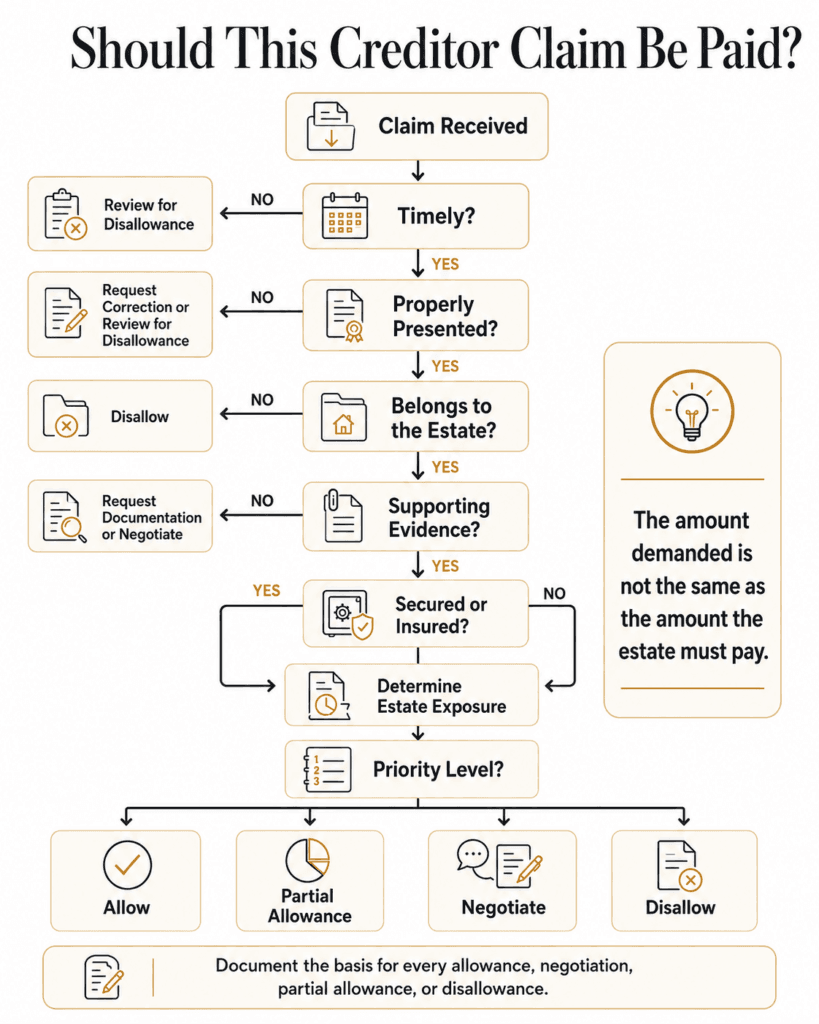
How collateral affects payment of a secured claim
Arizona distinguishes between a creditor that surrenders its security and one that keeps or exhausts it.
If the creditor surrenders the security, payment may be based on the allowed claim.
If the creditor retains or exhausts the security, the amount payable from other estate assets is reduced by the fair or agreed value of the collateral under the statutory rules.
This prevents a secured creditor from receiving both:
- The full collateral value
- The full unreduced claim from other estate funds
The calculation may require:
- An appraisal
- Sale records
- A payoff statement
- An agreement with the lender
- Arbitration
- Compromise
- Court determination
Check for available insurance
Some claims may be covered by liability insurance.
This commonly includes claims arising from:
- Automobile accidents
- Personal injuries
- Property damage
- Professional services
- Homeowner liability
- Business activities
Arizona’s claim-limitations rules preserve certain proceedings used to establish liability when recovery is limited to available insurance protection.
Notify every potentially responsible insurance carrier promptly.
Preserve:
- Insurance policies
- Claim numbers
- Notices sent
- Adjuster information
- Coverage correspondence
- Reservation-of-rights letters
- Defense correspondence
- Settlement documents
Do not negotiate or pay a potentially insured claim without considering the insurer’s rights and obligations.
Allowing an Arizona probate creditor claim
A claim is allowed when the personal representative accepts it as an enforceable estate obligation.
Before allowing it, confirm:
- Timely presentation
- Correct claimant
- Valid basis
- Accurate amount
- Supporting records
- Available defenses
- Security or insurance
- Appropriate community or separate classification
Document the decision in the claim log.
The records should identify:
- Amount allowed
- Date of decision
- Supporting evidence
- Payment-priority class
- Payment conditions
- Any disputed portion
Allowance does not necessarily mean the estate should pay the claim immediately.
The personal representative must still consider estate liquidity, payment priorities, unresolved demands, taxes, administration expenses, and required reserves.
Partially allowing a claim
The personal representative may accept part of a claim and reject the rest.
For example, a creditor may request $15,000 while the records support only $10,000.
The personal representative may allow $10,000 and disallow $5,000.
Partial allowance may be appropriate when:
- The principal is valid, but some fees are not.
- Part of the balance was already paid.
- Some services are unsupported.
- Interest was calculated incorrectly.
- Charges were duplicated.
- Insurance should have reduced the amount.
The written notice should identify:
- Total amount claimed
- Amount allowed
- Amount disallowed
- Mailing date
The disallowed portion is subject to the same 60-day challenge period as a fully disallowed claim.
Disallowing a claim
A claim may be disallowed because it is:
- Untimely
- Unsupported
- Incorrect
- Duplicated
- Already paid
- Unenforceable
- Owed by another person or entity
- Subject to a defense or counterclaim
Arizona permits the personal representative to mail written notice stating that the claim is disallowed in whole or in part.
The notice should identify:
- Estate
- Claimant
- Claim
- Amount claimed
- Amount disallowed
- Date of mailing
Preserve:
- A copy of the notice
- Mailing records
- Tracking information
- Returned mail
- Correspondence concerning the decision
A telephone call alone does not begin the statutory challenge period.
The creditor’s 60-day period after disallowance
A creditor whose claim is disallowed generally must:
- File a petition for allowance, or
- Begin another appropriate proceeding
The creditor generally must act within 60 days after the notice of disallowance was mailed.
If the creditor does not act within that period, the disallowed portion is ordinarily barred.
Calendar:
- Mailing date
- End of the 60-day period
- Any agreed or court-ordered extension
- Final disposition
For a claim that is not yet due, contingent, or unliquidated, Arizona permits certain extensions by agreement or court order. An extension cannot continue beyond the applicable statute of limitations.
Do not ignore a presented claim
Failing to act can cause a claim to be treated as allowed.
Arizona provides that when the personal representative fails to mail notice of action for 60 days after the original claim-presentation period has expired, the inaction has the effect of a notice of allowance.
This is not simply measured 60 days from the date the estate received the claim.
Track:
- The end of the original presentation period
- The additional 60-day period
- Whether written notice of action was mailed
Silence is not a safe way to handle a doubtful claim.
Allowed claims may begin accruing interest
Unless a judgment provides otherwise, Arizona generally provides that an allowed claim bears interest at the legal rate beginning 60 days after the original presentation period expires.
If the underlying contract contains an interest provision, that provision may control instead.
Before calculating or paying interest, confirm:
- Whether the claim was allowed
- Whether a contract controls the rate
- When the original presentation period expired
- Whether a judgment provides different terms
- Whether the claim was settled
Can an allowed claim later be disallowed?
Before payment, the personal representative generally may rescind an allowance and change the decision to a full or partial disallowance.
The change ordinarily must occur no later than six months after the claim was presented.
The personal representative cannot rescind after:
- A court has allowed the claim
- A judgment has established the claim
- An order directing payment has been entered
The creditor must receive notice of the changed decision and may pursue the newly disallowed amount.
A decision may need to change when:
- New payment records are discovered
- The claim duplicates another demand
- Insurance information becomes available
- The creditor supplied inaccurate information
- The estate discovers a defense or counterclaim
Document the new evidence and the reason for the change.
Can a disallowed claim later be allowed?
The personal representative may change a disallowance to an allowance before the creditor’s time to challenge it expires.
After the disallowed claim becomes barred, Arizona permits allowance and payment only when:
- The estate is solvent, and
- All successors whose interests would be affected consent
Do not revive and pay a barred claim merely because the creditor continues asking for money.
Negotiate when settlement benefits the estate
A disputed claim may be resolved through negotiation when settlement is appropriate, consistent with the personal representative’s authority and fiduciary duties, and more favorable to the estate than continued uncertainty or litigation.
A creditor may agree to:
- Accept a reduced amount
- Remove unsupported fees
- Reduce interest
- Accept installment payments
- Release collateral
- Resolve several accounts together
- Withdraw threatened litigation
Consider:
- Strength of the creditor’s evidence
- Estate defenses
- Litigation expense
- Payment priority
- Estate liquidity
- Effect on other creditors
- Effect on beneficiaries
- Time required to resolve the dispute
Every settlement should be documented in writing.
The agreement should state:
- Claim being resolved
- Settlement amount
- Payment deadline
- Treatment of interest and fees
- Treatment of collateral or liens
- Whether payment fully releases the estate
- Whether litigation must be dismissed
Handle family loans with the same care
A relative or friend may claim that the decedent promised repayment.
Evaluate the claim neutrally.
Request evidence such as:
- Promissory note
- Bank transfers
- Canceled checks
- Repayment history
- Emails or text messages
- Tax reporting
- Witness information
- Security documents
Relevant questions include:
- Was the transfer a loan or a gift?
- Were repayment terms established?
- Did the decedent make payments?
- Is the claim timely?
- Is the amount supported?
- Did the claimant forgive the debt?
- Does another defense apply?
The claimant’s relationship to the family should not determine whether the claim is allowed.
Contingent, unliquidated, and future claims
Not every valid claim has a fixed amount or an immediate due date.
A contingent claim depends on a future event.
An unliquidated claim may exist even though its final amount is uncertain.
A claim may also be valid but not yet due.
If an allowed or established claim becomes due or certain before distribution, Arizona generally requires it to be paid like other currently due claims in the same class.
When uncertainty remains, the personal representative or court may address the claim through:
- Present or agreed value
- A trust
- A mortgage
- A bond
- Security from a distributee
- Another reasonable arrangement for possible future payment
Do not distribute all remaining estate property while a material unresolved claim lacks adequate protection.
Consider estate counterclaims
The estate may have its own claim against the creditor.
Possible counterclaims include:
- Overpayments
- Breach of contract
- Property damage
- Money owed to the decedent
- Unreturned property
- Improper fees
- Another transaction between the parties
Arizona allows the personal representative to deduct an estate counterclaim when allowing a creditor’s claim.
A court deciding the matter must reduce the allowed amount by the counterclaim. If the estate’s counterclaim is larger, the court may enter judgment against the claimant for the difference.
Do not review the creditor’s demand in isolation when the creditor also owes money or property to the estate.
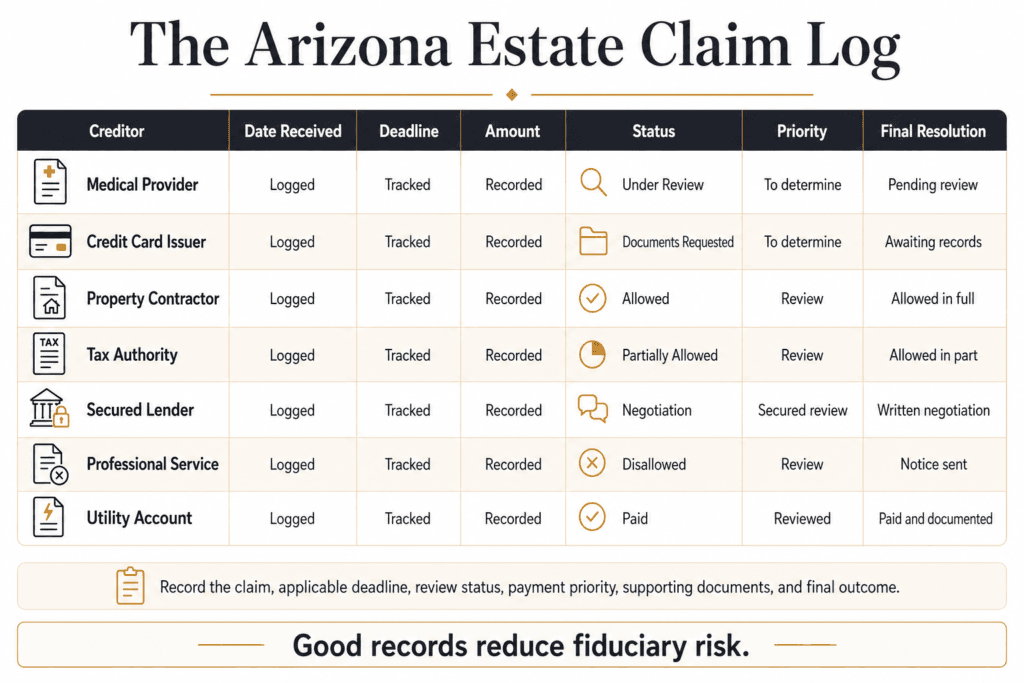
Understand Arizona’s payment priorities
Valid claims are not necessarily paid in the order they arrive.
When the estate lacks enough applicable property to pay every claim in full, Arizona requires payment in this order:
- Costs and expenses of administration
- Reasonable funeral expenses
- Debts and taxes entitled to preference under federal law
- Reasonable and necessary medical and hospital expenses of the decedent’s last illness, including compensation of attendants
- Debts and taxes entitled to preference under Arizona law
- All other claims
Claims within the same class generally have equal priority. A claim that is currently payable does not receive priority merely because another claim in the same class is not yet due.
When the estate may be insolvent, payment is not first come, first served.
Rahnema Law’s guide to which debts get paid first in an Arizona estate explains the priority classes and what happens when the estate cannot pay every claim.
Do not pay ordinary claims before understanding the estate
Before paying a lower-priority claim, determine:
- Available estate cash
- Expected collections
- Administration expenses
- Funeral expenses
- Last-illness expenses
- Federal and Arizona taxes
- Secured debts
- Statutory family allowances
- Professional fees
- Pending litigation
- Unresolved claims
- Property-maintenance expenses
A credit-card claim may be valid but still should not be paid before the personal representative understands whether higher-priority obligations exist.
Prepare a cash forecast showing:
- Current liquid funds
- Expected receipts
- Claims by priority class
- Unresolved liabilities
- Estimated taxes
- Remaining administration expenses
- Proposed reserve
Paying claims before the presentation period expires
Arizona permits the personal representative to pay a just, unbarred claim before the applicable presentation period expires, with or without formal presentation.
However, early payment may create personal liability if:
- Another allowed claimant is harmed
- The personal representative failed to obtain adequate security for a necessary refund
- Negligence or willful fault caused another claimant to lose statutory priority
Paying every familiar bill immediately may feel responsible. It can still reduce the estate’s ability to satisfy higher-priority or later-discovered claims.
Keep an adequate reserve
Even after the published period ends, the estate may still face:
- A known creditor’s later direct-notice deadline
- A claim under review
- A creditor’s open challenge period after disallowance
- Tax obligations
- Litigation
- A contingent claim
- An insured claim
- A secured debt
- A post-death administration claim
- Remaining professional fees
After the applicable claim period, the personal representative generally pays allowed claims in the required order only after making provision for:
- Homestead-related allowances
- Exempt property
- Family allowance
- Claims presented but not yet allowed
- Claims whose allowance is being appealed
- Other unbarred claims that may still be presented
- Administration costs and expenses
The reserve should reflect documented risks, not an arbitrary percentage.
Document every creditor payment
Creditor payments should generally be made from the estate account using a traceable method.
The records should identify:
- Creditor
- Amount
- Payment date
- Claim reference
- Priority class
- Purpose
- Settlement terms
- Remaining balance
Preserve:
- Claim
- Invoice
- Allowance decision
- Settlement agreement
- Check image
- Transfer confirmation
- Bank statement
- Release or satisfaction
- Lien-release document
Avoid cash payments.
The accounting should describe the expense clearly instead of listing only “bill” or “debt.”
For practical guidance on separating estate funds and documenting transactions, see Rahnema Law’s guide to the Arizona estate bank account.
Rahnema Law’s Arizona estate accounting guide explains how claims, payments, sales, receipts, and distributions should connect in the estate’s financial records.
Protect the personal representative from contract liability
A personal representative generally is not individually liable on a contract properly entered into in a fiduciary capacity when the contract identifies the estate and discloses the representative’s role.
The representative may become individually liable when that capacity is not disclosed.
Arizona also provides that personal liability for obligations arising from ownership or control of estate property, or for torts during administration, generally depends on the representative’s personal fault.
Estate contracts should identify:
- The estate
- The representative’s fiduciary role
- The representative’s authority
- The estate—not the representative individually—as the contracting party
A signature may appear as:
John Smith, Personal Representative of the Estate of Jane Smith
rather than only:
John Smith
Fiduciary liability for improper claim handling
Improper payment, rejection, or distribution decisions may breach the personal representative’s fiduciary duty.
Arizona provides that a personal representative who improperly exercises authority over an estate may be liable to interested persons for the resulting damage or loss.
Potential problems include:
- Paying a barred claim without authority
- Preferring a lower-priority creditor
- Failing to preserve estate defenses
- Ignoring a claim until it is treated as allowed
- Distributing assets without an adequate reserve
- Paying a secured claim without crediting the collateral
- Using estate money for a personal obligation
Documenting the reasoning behind significant decisions helps show that the representative acted carefully and in the estate’s interests.
Avoid improper beneficiary distributions
Beneficiaries should not receive estate property before the personal representative understands creditor risks and retains an adequate reserve.
After distribution, an unbarred and undischarged claim may sometimes be pursued against one or more distributees.
A distributee’s exposure generally cannot exceed the value of the distribution received. Certain statutory allowances are excluded.
A beneficiary or creditor who received an improper distribution or payment may also be required to return:
- The property
- Income produced by the property
- Its value if the recipient no longer has it
- Related income or gain
The possibility of repayment is another reason to resolve claims before final distribution.
Rahnema Law’s guide to when an Arizona estate is ready to distribute assets explains how creditor deadlines, taxes, reserves, and unresolved disputes affect distribution timing.
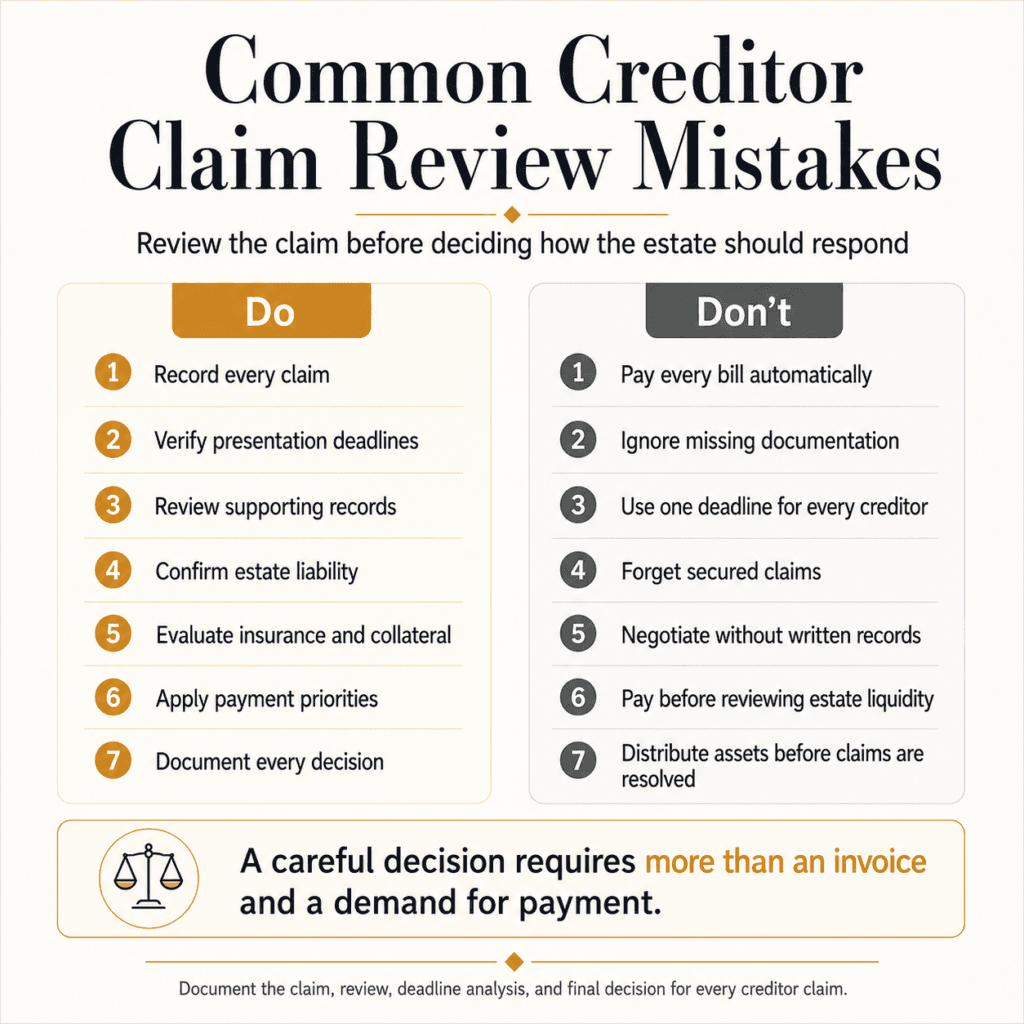
Common Arizona probate creditor-claim mistakes
Common mistakes include:
- Failing to record the date of receipt
- Using one deadline for every creditor
- Treating every bill as a valid claim
- Rejecting incomplete demands without preserving them
- Paying claims without supporting records
- Ignoring possible insurance coverage
- Failing to identify collateral
- Paying a secured creditor without crediting the security
- Failing to classify a married decedent’s claim
- Using a telephone call instead of written disallowance
- Missing the creditor’s 60-day challenge period
- Allowing a claim through inaction
- Paying lower-priority claims too early
- Failing to consider an estate counterclaim
- Settling without a written release
- Distributing estate assets without an adequate reserve
- Contracting in the representative’s individual name
A reliable log, documented review process, and deadline calendar reduce these risks.
Arizona probate creditor claims checklist
For every claim, confirm that:
- The date received was recorded.
- The complete original was preserved.
- The applicable deadline was calculated.
- The claim identifies its basis, claimant, address, and amount.
- Supporting records were requested and reviewed.
- Prior payments were verified.
- Interest and fees were checked.
- The correct debtor was identified.
- Security or collateral was documented.
- Insurance coverage was investigated.
- Community or separate classification was considered.
- Estate defenses and counterclaims were reviewed.
- The claim was allowed, partially allowed, settled, or disallowed.
- Written notice was mailed when required.
- The mailing date was preserved.
- The creditor’s challenge period was calendared.
- Payment priority was assigned.
- Estate liquidity and reserves were reviewed.
- Payment was made through the estate account.
- A release or satisfaction was obtained when appropriate.
- The resolution was entered in the accounting.
- Beneficiary distributions were delayed until creditor risks were addressed.
Move through the claims process carefully
Handling Arizona probate creditor claims requires organization, neutral decision-making, accurate deadlines, and complete records.
The personal representative should:
- Preserve every demand
- Request missing information
- Review the obligation
- Identify insurance and collateral
- Consider defenses and counterclaims
- Respond in writing when necessary
- Apply Arizona’s payment priorities
- Retain enough property for unresolved obligations
The goal is not to reject every claim or pay every bill.
The goal is to resolve valid obligations fairly while protecting the estate from unsupported, late, duplicate, or improperly prioritized demands.
An estate involving insufficient funds, substantial taxes, secured property, business debts, litigation, insurance claims, family loans, community-property questions, or contingent liabilities may require individual legal and financial guidance before claims are accepted, rejected, negotiated, or paid.
For a broader view of how creditor work fits into the administration, see Rahnema Law’s Arizona probate administration overview.
Legal Disclaimer: This information is for educational purposes only and does not constitute legal advice. Arizona probate law is complex and varies based on individual circumstances. Always consult with a qualified probate attorney for guidance specific to your situation.
FAQs
A written claim should state:
· Its basis
· The claimant’s name and address
· The amount claimed
It should also describe a future due date, uncertainty, contingency, or security when applicable.
A written claim mailed or delivered to the personal representative is considered presented when the personal representative receives it.
No. Timeliness is only one part of the analysis. The personal representative should also evaluate the obligation, requested amount, supporting records, defenses, insurance, collateral, priority, and available estate property.
Yes. Requesting contracts, statements, invoices, payment records, insurance information, and other support is a reasonable part of deciding whether the claim should be allowed.
Yes. A claim may be partially allowed and partially disallowed. The creditor generally has 60 days after the partial-disallowance notice is mailed to pursue the rejected portion.
The personal representative may mail the claimant written notice stating that the claim is disallowed in whole or in part. A telephone call alone does not begin the statutory 60-day challenge period.
The claimant generally must file a petition for allowance or begin another appropriate proceeding within 60 days after the notice of disallowance was mailed.
Failure to mail notice of action for 60 days after the original claim-presentation period expires has the effect of a notice of allowance. That deadline is not measured simply from the date the estate received the claim.
Generally, yes. Before payment, the personal representative may rescind an allowance no later than six months after presentation, unless a court order, judgment, or payment order prevents the change.
Only in limited circumstances. If a timely presented claim was disallowed and then became barred because the claimant did not act within the 60-day period under A.R.S. § 14-3806(A), subsection (B) permits later allowance and payment only if the estate is solvent and all successors whose interests would be affected consent. This limited rule does not override separate presentation deadlines or other statutes of limitation or nonclaim.
Not necessarily. Arizona’s claim limitations do not prevent enforcement of a mortgage, pledge, or other lien against estate property.
Yes. A documented settlement may be appropriate when it reduces expense, uncertainty, interest, unsupported fees, or litigation risk while protecting other creditors and beneficiaries.
Arizona generally gives priority in this order:
1. Administration expenses
2. Reasonable funeral expenses
3. Federally preferred debts and taxes
4. Reasonable and necessary last-illness medical expenses
5. Arizona-preferred debts and taxes
6. All other claims
Arizona permits early payment of a just, unbarred claim. However, the personal representative may face personal liability if that payment harms another allowed claimant or defeats Arizona’s priority rules.
Yes. A beneficiary who received an improper distribution may be required to return the property, its value, and related income or gain.