

Learn how Arizona probate notice to creditors works, including publication, direct notice, claim deadlines, disallowance, and payment priority.
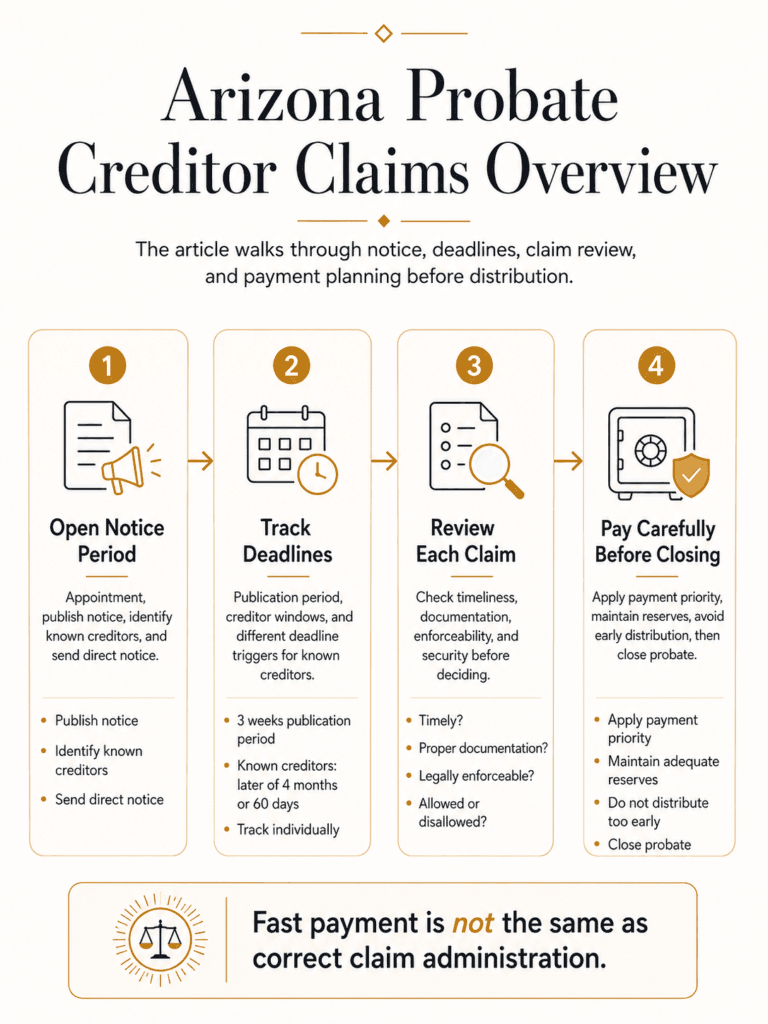
The Arizona probate notice to creditors process gives people and organizations a formal opportunity to present claims against a deceased person’s estate.
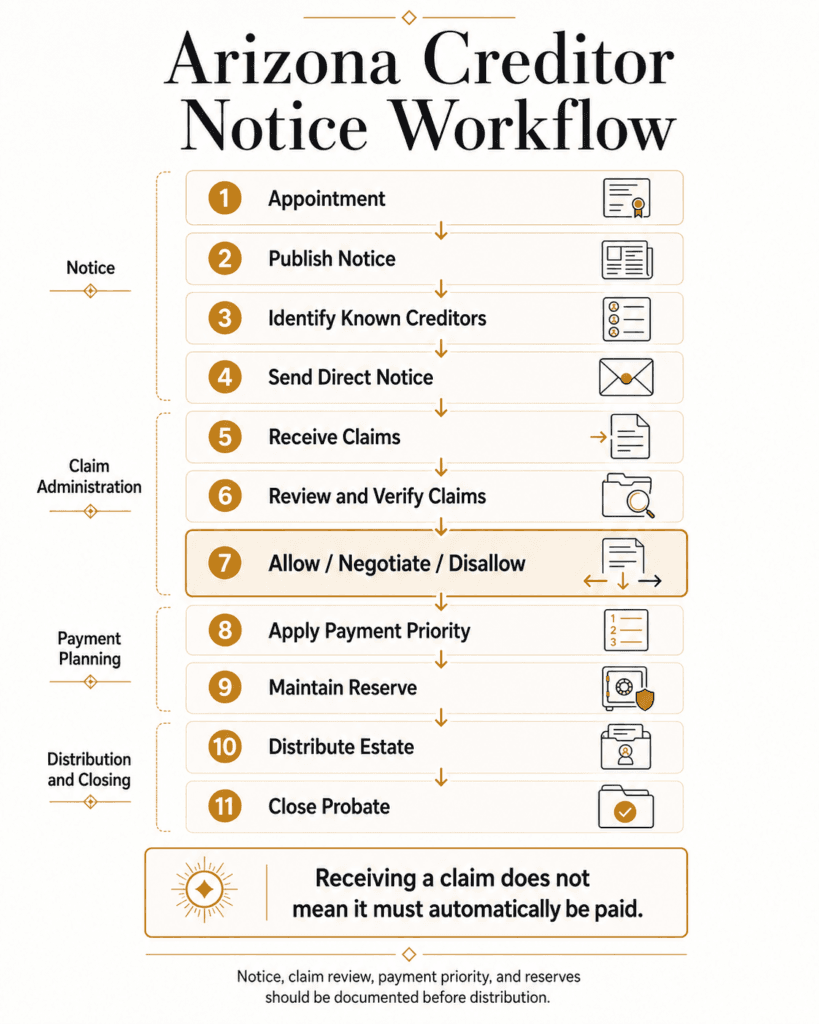
After appointment, the personal representative generally must publish notice to creditors and send direct written notice to known creditors. These notices have different purposes and different timing rules.
Publishing a notice does not replace direct notice to a known creditor. It also does not mean every bill must be paid.
A creditor must present a claim within the applicable period. The personal representative must then decide whether the claim is timely, properly supported, legally enforceable, secured, insured, subject to a defense, or entitled to payment.
The creditor process involves more than publishing a notice and waiting four months.
What is an Arizona probate notice to creditors?
A notice to creditors is a formal announcement that a personal representative has been appointed to administer a deceased person’s estate.
The notice generally:
- Announces the appointment
- Identifies the personal representative
- Provides the representative’s address
- Tells creditors where to present claims
- States the applicable deadline
- Warns that untimely claims may be barred
Arizona’s publication statute requires creditors to be told that claims must be presented within four months after the first publication or be forever barred. Known creditors must receive written notice stating the applicable four-month or 60-day deadline. (Legislature of Arizona)
The purpose is to create an orderly process for identifying and resolving estate obligations before the remaining property is distributed.
When must creditor notice begin?
Arizona law states that, unless notice has already been given, the personal representative must publish notice at the time of appointment.
The publication must occur once a week for three successive weeks in a newspaper of general circulation in the county. (Legislature of Arizona)
As a practical matter, the representative should arrange publication promptly after:
- Appointment becomes effective
- Any required qualification is complete
- Letters of Personal Representative are issued
- The correct mailing address for claims is established
Delaying publication can delay the point at which the representative can confidently evaluate the estate’s unresolved creditor exposure.
The representative may also need to retain additional cash for a longer period if publication and direct notice are postponed.
Arizona Law Note: The statute says publication occurs “at the time of appointment.” The first publication date is especially important because it begins the general four-month published claim period. (Legislature of Arizona)
How published notice works
Published notice must appear:
- Once each week
- For three successive weeks
- In a newspaper of general circulation
- In the county connected to the probate proceeding
The published notice must announce:
- The personal representative’s appointment
- The personal representative’s address
- The requirement that creditors present claims
- The four months measured from the first publication
The four-month period begins with the first publication, not the second or third. (Legislature of Arizona)
The newspaper will commonly provide an affidavit, certificate, or other proof showing:
- The newspaper used
- Each publication date
- The notice that appeared
- Completion of the publication sequence
Preserve that proof with the estate records.
The first publication date should also be entered in the estate’s master deadline calendar and creditor log.
Choose the newspaper carefully
The selected newspaper must satisfy Arizona’s requirement that publication occur in a newspaper of general circulation in the county. (Legislature of Arizona)
Before arranging publication, confirm:
- The newspaper publishes probate legal notices.
- It serves the correct county.
- It will publish once a week for three successive weeks.
- It can provide formal proof of publication.
- Its notice format satisfies the applicable court’s procedures.
- The case number, estate name, and representative’s address are correct.
The newspaper may request:
- The decedent’s legal name
- The probate case number
- The county
- The personal representative’s name
- The address where claims must be sent
- The required notice language
Arizona Judicial Branch probate forms are generic and may be accepted statewide, but an individual Superior Court may use preferred forms or procedures. The representative should review the instructions for the court handling the estate. (azcourts.gov)
Known creditors must receive direct written notice
Publication is only part of the creditor-notice process.
Arizona requires the personal representative to provide written notice by mail or other delivery to all known creditors. The notice must inform each creditor of the appointment and explain the deadline for presenting a claim. (Legislature of Arizona)
A creditor should not be ignored merely because:
- The creditor has not contacted the estate.
- Payments were current when the decedent died.
- The creditor is secured by property.
- The debt appears on only one old statement.
- A surviving relative believes the debt is invalid.
- The creditor has continued sending ordinary monthly bills.
The representative should review available records to identify potential creditors.
Useful sources include:
- Credit reports
- Bank statements
- Credit-card statements
- Medical bills
- Mortgage and vehicle-loan records
- Tax notices
- Insurance correspondence
- Business documents
- Contracts
- Pending litigation
- Recurring electronic payments
Possible known creditors may include:
- Banks and lenders
- Credit-card issuers
- Medical providers
- Landlords
- Contractors
- Business creditors
- Taxing authorities
- Individuals who loaned money to the decedent
- Claimants involved in pending disputes
The deadline for a known creditor
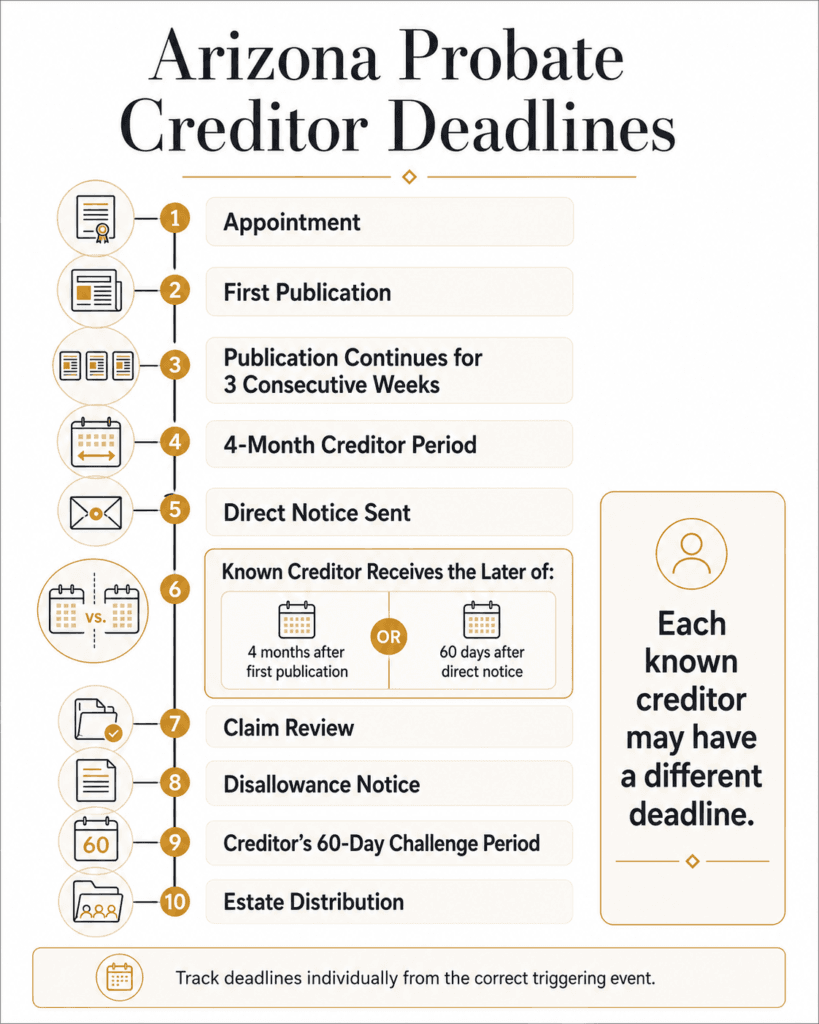
A known creditor who receives direct written notice generally must present the claim by the later of:
- Four months after the first published notice, when publication was given
- Sixty days after the direct notice was mailed or otherwise delivered
The later deadline controls for that creditor. (Legislature of Arizona)
This means direct notice sent later in the administration can extend the deadline for an individual known creditor beyond the general published period.
For that reason, direct notices should ordinarily be sent promptly rather than near the end of the four-month period.
For each creditor, calculate and record:
- The first publication date
- The end of the published period
- The direct-notice delivery or mailing date
- The end of the 60-day period
- The later applicable deadline
Do not rely on memory or use one universal deadline for every creditor.
What should direct notice include?
A notice to creditors is a formal announcement that a personal representative has been appointed to administer an estate.
The notice generally:
- Announces the appointment
- Identifies the personal representative
- Provides an address for presenting claims
- States the applicable deadline
- Warns that an untimely claim may be barred
Arizona generally requires two forms of notice:
- Published notice to creditors generally
- Direct written notice to known creditors
Under A.R.S. § 14-3801, the published notice instructs creditors to present claims within four months after the first publication. Known creditors receive written notice stating the applicable four-month or 60-day deadline.
The purpose is to create an organized process for identifying and resolving estate obligations before the remaining property is distributed.
Create a creditor-notice log
A creditor log helps prevent missed deadlines and inconsistent treatment.
Useful fields include:
- Creditor name
- Address
- Account or claim reference
- Type of obligation
- Whether the creditor was known
- Date direct notice was sent
- Delivery method
- Proof of delivery
- First publication date
- Applicable claim deadline
- Date a claim was received
- Amount claimed
- Claim status
- Amount allowed or disallowed
- Payment or settlement information
You may also maintain separate sections for:
- Published notice
- Direct notices
- Claims received
- Claim decisions
- Payments
- Secured debts
- Insurance matters
- Contingent obligations
The records should allow another person to understand what happened without reconstructing the entire file from scattered correspondence.
What counts as a creditor claim?
Arizona’s claim statutes cover many kinds of estate obligations.
Claims arising before death may be:
- Due or not yet due
- Absolute or contingent
- Liquidated or unliquidated
- Based on a contract
- Based on a tort
- Based on another legal theory
The law also contains separate timing rules for claims that arise at or after death.
Common claims may involve:
- Credit cards
- Personal loans
- Medical services
- Mortgages
- Vehicle loans
- Taxes
- Contracts
- Business obligations
- Property damage
- Personal injuries
- Professional services
- Unpaid rent
- Guarantees
- Court judgments
A claim does not need to be immediately payable or stated in a final exact amount.
A contingent claim depends on a future event.
An unliquidated claim exists even though the exact amount has not yet been determined.
How does a creditor present a claim?
A creditor may present a claim by delivering or mailing a written statement to the personal representative.
The statement should identify:
- The basis of the claim
- The claimant’s name
- The claimant’s address
- The amount claimed
If the claim is not yet due, it should state when it will become due.
If it is contingent or unliquidated, it should explain the uncertainty.
If the claim is secured, it should describe the security.
A claim delivered or mailed to the personal representative is considered presented when the representative receives it.
A creditor may instead begin an appropriate proceeding against the personal representative within the applicable period.
A separate claim presentation is not required for a matter already being pursued in a proceeding against the decedent that was pending when the decedent died.
An ordinary bill may not be a complete claim
The estate may continue receiving:
- Monthly statements
- Collection letters
- Past-due notices
- Medical invoices
- Loan statements
- Automatic-payment notices
Preserve these documents.
However, an ordinary bill may not include every piece of information required for a properly presented claim.
The personal representative should determine:
- Whether the document identifies the basis of the debt
- Whether the claimant and address are clear
- Whether the amount is stated
- Whether the obligation is secured
- Whether the communication was received in time
- Whether supporting documents are needed
Do not discard an informal or incomplete demand simply because it does not appear to satisfy every requirement.
Preserve it, investigate the obligation, and obtain legal guidance when the effect of the communication is uncertain.
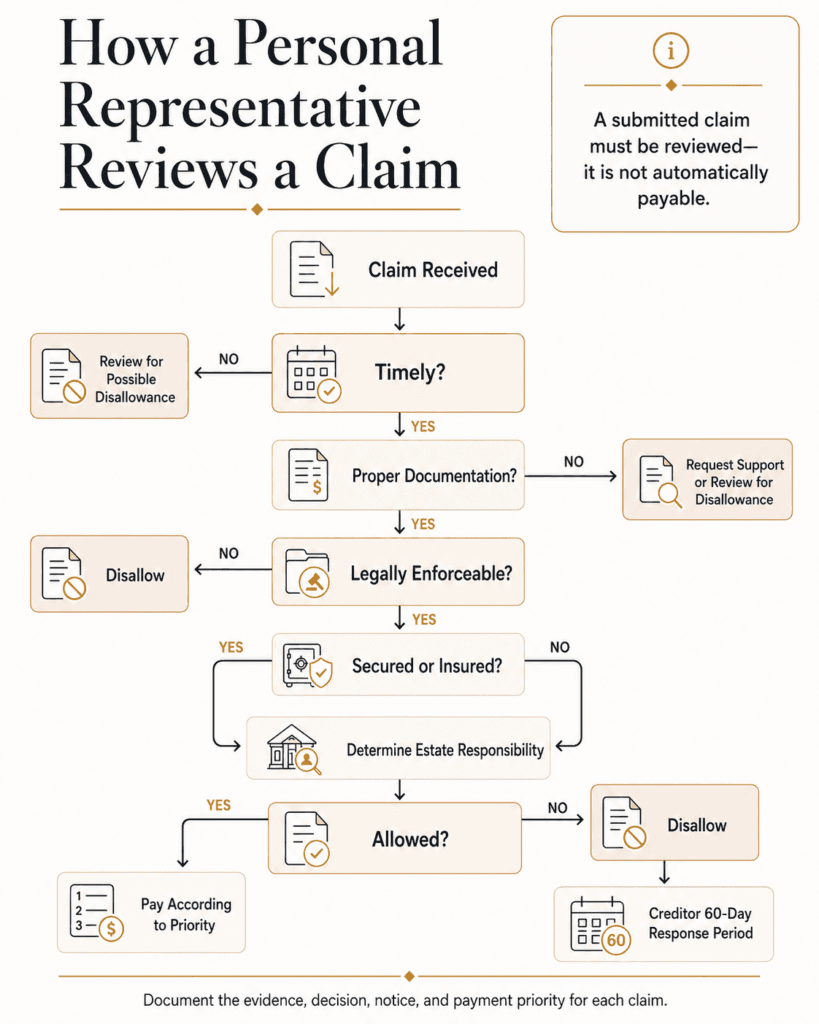
Receiving a claim does not mean it must be paid
Creditor notice gives the creditor an opportunity to present a claim.
It does not require the personal representative to approve every demand.
For each claim, review whether it:
- Was presented within the applicable period
- Identifies the claimant
- Explains the basis of the obligation
- Supports the amount requested
- Belongs to the decedent or estate
- Was already paid
- Is legally enforceable
- Was already barred by another limitations period
- Is covered by insurance
- Is secured by property
- Includes unsupported interest, fees, or penalties
- Is subject to a counterclaim or defense
Request additional documents when appropriate.
Those records may include:
- Contracts
- Account statements
- Invoices
- Payment histories
- Medical bills
- Loan documents
- Promissory notes
- Judgments
- Tax assessments
- Security agreements
- Correspondence
The personal representative should remain neutral. Family pressure or personal opinions about the creditor should not replace a documented review.
Allowing, negotiating, or disallowing a claim
After reviewing a timely claim, the personal representative may:
- Allow it in full
- Allow it in part
- Negotiate a compromise
- Disallow it in full
- Ask the court to determine the claim
Arizona permits the personal representative to mail the claimant a notice stating that the claim is disallowed.
A partially allowed claim is treated as disallowed to the extent it was not accepted.
A partial allowance may be appropriate when:
- The creditor seeks unsupported fees
- Part of the balance was already paid
- Some services are disputed
- Interest was calculated incorrectly
- The available records support only part of the demand
A clear notice should identify:
- The claim
- The amount allowed
- The amount disallowed
- The date of the decision
- The consequence of failing to pursue the disallowed portion
Preserve proof showing when the notice was mailed.
How long does a creditor have after disallowance?
A creditor whose claim is disallowed in whole or in part generally must:
- File a petition for allowance with the probate court, or
- Begin an appropriate proceeding against the personal representative
The creditor generally must act within 60 days after the notice of disallowance or partial allowance was mailed.
Otherwise, the disallowed portion is barred.
For a claim that is not yet due, contingent, or unliquidated, the personal representative may consent to an extension in certain circumstances. A court may also order an extension to prevent injustice, but not beyond the applicable statute of limitations.
Calendar the end of the creditor’s 60-day response period before treating the dispute as finished.
What happens if the personal representative does not act?
Ignoring a presented claim can have significant consequences.
Arizona provides that if the personal representative fails to mail notice of action on a claim for 60 days after the original claim-presentation period has expired, the inaction has the effect of a notice of allowance.
This is not simply a 60-day period measured from the date the claim arrived.
The rule depends on:
- The expiration of the original claim-presentation period
- An additional 60 days
- The absence of a notice allowing or disallowing the claim
Track both:
- The creditor’s deadline to present the claim
- The personal representative’s deadline to act
Silence should not be used as a strategy for handling a questionable claim.
Can an allowed claim later be disallowed?
Before payment, the personal representative may rescind an allowance and change it to a full or partial disallowance.
However, this generally must occur no later than six months after the claim was presented.
An allowance generally cannot be rescinded after:
- A court has allowed the claim
- A judgment has established it
- An order directing payment has been entered
The personal representative may also change a disallowance to an allowance before the creditor’s time to pursue the claim expires.
Any change should be:
- Documented
- Communicated in writing
- Supported by the estate records
- Reflected in the claim log
Late creditor claims
Many claims are barred if they are not presented within the applicable Arizona period.
For claims arising before death, the law considers:
- The publication deadline
- The known-creditor direct-notice deadline
- An outside period tied to two years after death and the remaining notice period
- Any earlier statute of limitations or nonclaim statute
The correct deadline cannot always be reduced to one universal “two-year rule.”
Claims that arise at or after death have different timing rules.
For example:
- A claim based on a contract with the personal representative is generally subject to a period tied to when the representative’s performance became due.
- Other post-death claims are generally subject to the later of four months after they arise or the applicable outside period stated in the statute.
A claim already barred by another statute of limitations when the decedent died generally is not revived merely because probate begins.
Before paying an apparently late claim, determine:
- Which statutory category applies
- Whether notice was effective
- Whether another limitation applies
- Whether an exception exists
- Whether payment could harm another claimant or beneficiary
Probate opened more than two years after death
Arizona generally restricts original probate, testacy, and appointment proceedings filed more than two years after death, subject to statutory exceptions.
One exception may permit a later proceeding when no succession or administration case occurred during the two-year period.
In that type of late proceeding:
- The personal representative’s authority is limited
- Possession of assets is generally limited to confirming title in the rightful successors
- Claims other than administration expenses may not be presented against the estate
That is different from an ordinary probate opened within the standard period.
Do not assume that routine creditor-publication procedures apply in exactly the same way to a late, limited administration.
Secured debts require separate analysis
A mortgage, vehicle loan, deed of trust, pledge, or other secured obligation is not handled exactly like an unsecured credit-card claim.
Arizona’s claim limitations do not prevent a proceeding to enforce a mortgage, pledge, or other lien against estate property.
This means a creditor may lose or fail to preserve a right to general payment from the estate while still retaining rights against the collateral.
For example, missing an ordinary claim deadline does not automatically remove a deed of trust from an estate residence.
Review:
- Loan agreement
- Promissory note
- Mortgage or deed of trust
- Security agreement
- Payment history
- Insurance
- Current balance
- Collateral value
- Default status
- Available estate funds
Possible options may include:
- Continuing payments temporarily
- Selling the property
- Paying the secured debt
- Negotiating with the lender
- Allowing enforcement against the collateral
- Distributing the property subject to debt when legally appropriate
How secured claims are valued for payment
Arizona has specific rules for determining the amount payable on a secured claim.
If the creditor surrenders the security, payment may be based on the allowed amount.
If the creditor keeps or exhausts the security, the amount payable from other estate assets may be reduced by the fair or realized value of the collateral, depending on the circumstances.
The personal representative should avoid paying the full debt from unrestricted estate funds while also allowing the creditor to retain the complete value of its collateral without accounting for that security.
A secured-claim calculation may require:
- A current payoff statement
- Property valuation
- Sale records
- An agreement with the creditor
- Arbitration
- Compromise
- Court determination
Liability insurance may affect a claim
Arizona’s claim-limitations statute preserves certain proceedings used to establish liability when recovery is limited to available liability-insurance protection.
This may affect claims involving:
- Automobile accidents
- Property damage
- Personal injuries
- Professional liability
- Homeowner liability
- Business events
- Other insured risks
Notify the appropriate insurance carrier promptly after learning of a potentially covered claim.
Preserve:
- Insurance policy
- Claim number
- Notice to the insurer
- Coverage correspondence
- Reservation-of-rights letters
- Defense information
- Settlement communications
Do not treat an insured liability matter as only an ordinary unpaid bill. The insurance company may have duties involving investigation, defense, negotiation, or payment.
Claims not yet due, contingent claims, and uncertain amounts
Some claims cannot be paid immediately because they:
- Become due later
- Depend on a future event
- Have an uncertain amount
- Remain in litigation
- Require further calculation
If a claim becomes due or certain before distribution and has been allowed or established, Arizona generally treats it like other presently due claims in the same priority class.
When uncertainty remains, possible arrangements may include:
- Paying an agreed present value
- Creating a trust
- Providing a mortgage
- Obtaining a bond
- Requiring security from a distributee
- Making another reasonable arrangement for future payment
These arrangements may require an agreement or court involvement.
Estate counterclaims may reduce a creditor’s claim
The estate may have its own claim against the creditor.
Arizona allows the personal representative to deduct an estate counterclaim when reviewing a creditor’s demand.
A court deciding the claim must reduce the amount allowed by the estate’s counterclaim. If the counterclaim exceeds the creditor’s demand, the court may enter judgment against the claimant for the difference.
Possible counterclaims may involve:
- Overpayments
- Property damage
- Breach of contract
- Money owed to the decedent
- Improper charges
- Unreturned property
- Another transaction between the parties
Document the counterclaim rather than simply paying the creditor’s gross demand.
Notice does not determine payment priority
A timely and valid claim is not necessarily entitled to immediate payment.
If estate assets are insufficient to pay all claims, Arizona requires payment in this order:
- Costs and expenses of administration
- Reasonable funeral expenses
- Debts and taxes entitled to preference under federal law
- Reasonable and necessary medical and hospital expenses from the decedent’s last illness, including compensation for attendants
- Debts and taxes entitled to preference under Arizona law
- All other claims
Claims within the same class generally have equal priority. A claim does not move ahead of another claim in the same class merely because it became payable first.
When the estate may not have enough money, payment is not first come, first served.
For example, an unsecured credit-card claim should not automatically be paid before the personal representative understands:
- Administration costs
- Funeral expenses
- Tax obligations
- Last-illness medical bills
- Other claims in the same or higher class
When should allowed claims be paid?
After the applicable claim-presentation period, the personal representative generally proceeds to pay allowed claims in the statutory order.
Before doing so, the representative must make appropriate provision for:
- Allowance in lieu of homestead
- Exempt property
- Family allowance
- Claims presented but not yet allowed
- Claims whose allowance is being appealed
- Other unbarred claims that may still be presented
- Administration costs and expenses
A creditor with an allowed but unpaid claim may ask the court to order payment to the extent estate funds are available.
Can a valid claim be paid early?
Arizona allows a personal representative to pay a just, unbarred claim before the ordinary period expires.
However, early payment can create personal liability if:
- Another allowed claimant is harmed
- The personal representative failed to require adequate security for a necessary refund
- Negligence or willful fault caused another claimant to lose statutory priority
Before paying a substantial claim early, review:
- Estate cash
- Expected collections
- Administration expenses
- Taxes
- Funeral and last-illness expenses
- Secured obligations
- Contested claims
- Family allowances
- Professional fees
- Property expenses
- Whether the estate may be insolvent
A valid claim may still need to wait until the estate’s full financial position is understood.
Keep an appropriate reserve
The end of the published four-month period does not always eliminate creditor risk.
For example:
- A known creditor may have a later direct-notice deadline
- A claim may still be under review
- The creditor may remain within the 60 days after disallowance
- A lawsuit may be pending
- A contingent claim may remain unresolved
- A secured debt may affect estate property
- Taxes may remain uncertain
- A post-death claim may have a separate deadline
The estate should retain enough property for:
- Allowed claims
- Disputed claims
- Administration expenses
- Taxes
- Property costs
- Insurance
- Professional fees
- Closing expenses
- Other unresolved obligations
The reserve should reflect the estate’s actual risks, not an arbitrary percentage.
Do not distribute estate property prematurely
A beneficiary’s expected inheritance comes after proper estate administration.
Before making a distribution, the personal representative should understand:
- Which claim periods expired
- Which known creditors received direct notice
- Which claims were presented
- Which claims were allowed or disallowed
- Whether disallowance periods remain open
- Whether the estate can pay its obligations
- Whether taxes remain unresolved
- Whether sufficient reserves will remain
After estate property has been distributed, an undischarged and unbarred claim may sometimes be pursued against one or more distributees.
A distributee’s exposure generally does not exceed the value of the distribution received, and certain statutory allowances are excluded.
A person who received an improper distribution may also be required to return the property, its value, and certain income or gains.
Rahnema Law’s guide to when an Arizona estate is ready to distribute assets explains how creditor deadlines, taxes, expenses, reserves, and disputes affect distribution timing.
Creditors of a married decedent
When the decedent was married, an allowed claim may need to be classified according to the property from which it is payable.
Arizona permits the personal representative to classify a claim as:
- A community claim payable from community property, or
- A separate claim payable from separate property and the balance of the decedent’s half of community property
Either classification is treated as a partial disallowance.
The claimant must receive notice of the classification.
If the personal representative fails to classify an allowed claim or fails to notify the claimant, the claim is treated as payable from whichever property source is more beneficial to the claimant.
Classification may require reviewing:
- When the obligation arose
- Why the debt was incurred
- Who signed the contract
- Marital-property records
- Business records
- Separate and community assets
- The surviving spouse’s possible liability
Do not assume every debt in one spouse’s name is separate or that every obligation incurred during marriage is payable from the same property.
Obligations created during estate administration
Not every claim concerns a debt incurred by the decedent.
Claims may also arise from:
- Contracts entered into by the personal representative
- Ownership or control of estate property
- Accidents during administration
- Property-maintenance obligations
- Professional services
- Business operations continued after death
A personal representative generally is not individually liable on a properly executed estate contract when the representative discloses the fiduciary role and identifies the estate.
Individual liability may arise when the representative fails to disclose that capacity or is personally at fault for an obligation or tort during administration.
Estate contracts should identify:
- The estate
- The representative’s fiduciary capacity
- The representative’s authority
- The estate—not the representative individually—as the contracting party
Keep complete creditor records
The creditor file should show what the personal representative did, when it was done, and why each decision was made.
Preserve:
- Published notice
- Proof of publication
- Direct notices
- Mailing and delivery records
- Returned notices
- Claims received
- Supporting documents
- Requests for more information
- Allowance notices
- Disallowance notices
- Proof of mailing
- Settlement agreements
- Payment records
- Insurance communications
- Court filings
- Orders and judgments
For each resolved claim, record:
- Amount requested
- Amount allowed
- Amount disallowed
- Settlement amount
- Priority classification
- Community or separate classification
- Security
- Insurance coverage
- Payment date
- Payment method
These records support:
- Estate accounting
- Tax work
- Beneficiary communications
- Closing documents
- Defense of the personal representative’s decisions
Rahnema Law’s Arizona probate administration overview explains how creditor work fits with inventory, estate banking, accounting, distribution, and closing.
Closing the estate after creditor administration
A qualifying unsupervised estate generally cannot close by verified statement until:
- The creditor-presentation period has expired
- Presented claims have been paid, settled, otherwise resolved, or properly accommodated
- Administration expenses and applicable taxes have been addressed
- Estate assets have been distributed
- Required accounting has been provided
If claims remain undischarged, the closing statement must explain how the estate has addressed those liabilities.
The personal representative must also send the statement to required distributees and to known creditors or claimants whose claims remain unpaid and unbarred.
The closing statement generally cannot be filed earlier than four months after the original appointment of a general personal representative.
That four-month appointment minimum and the creditor-presentation period are related but separate requirements.
Both must be evaluated.
For the larger closing process, see Rahnema Law’s guides to closing an Arizona probate estate and the Arizona probate closing checklist.
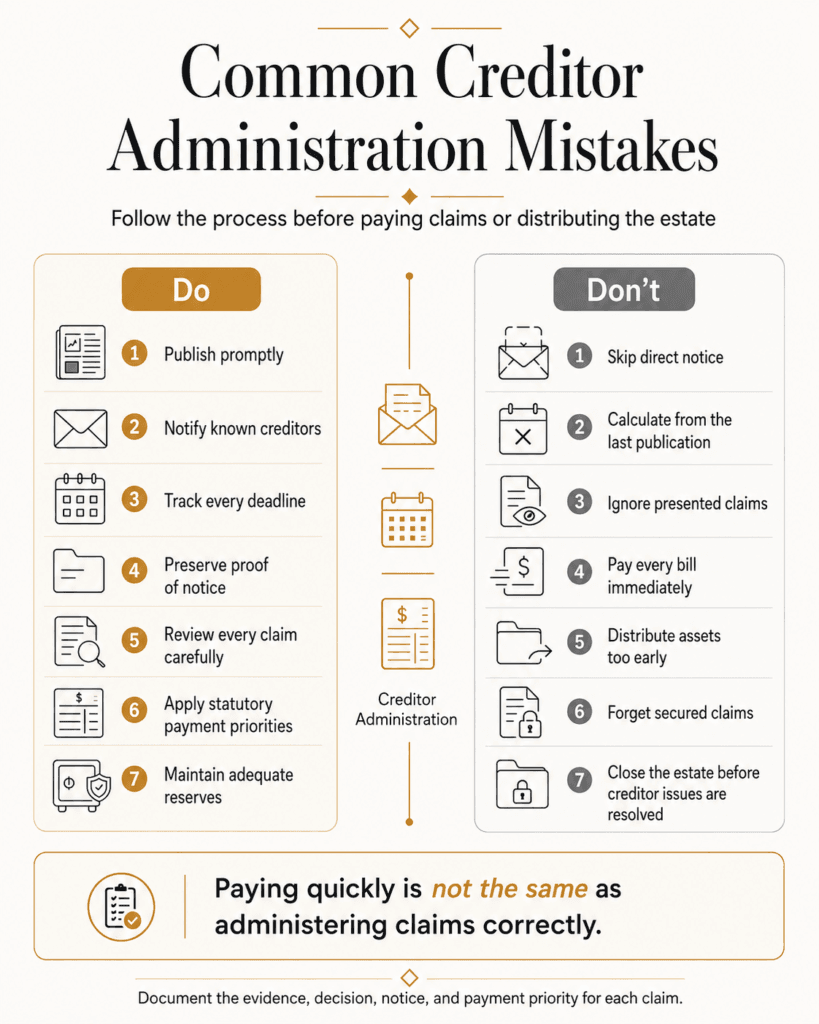
Common Arizona probate notice-to-creditors mistakes
Common mistakes include:
- Delaying publication without considering the consequences
- Publishing in the wrong county
- Using a newspaper that does not satisfy the requirement
- Publishing fewer than three successive weeks
- Calculating four months from the final publication
- Failing to notify a known creditor directly
- Sending incomplete deadline language
- Using an outdated address without further investigation
- Failing to preserve proof of publication
- Failing to preserve proof of direct notice
- Using one deadline for every creditor
- Treating an ordinary bill as automatically valid
- Ignoring a presented claim
- Miscalculating the deadline for action on a claim
- Missing the creditor’s 60-day period after disallowance
- Paying lower-priority claims too early
- Paying a secured creditor without accounting for collateral
- Ignoring insurance coverage
- Failing to classify a married decedent’s claim
- Making beneficiary distributions before creditor risks are understood
- Assuming every debt disappears at death
The creditor process is not complete merely because a newspaper notice was published and four months passed.
Arizona probate notice-to-creditors checklist
Soon after appointment, the personal representative should:
- Confirm the appointment and Letters.
- Identify the correct address for receiving claims.
- Select an appropriate newspaper.
- Arrange publication once a week for three successive weeks.
- Record the first publication date.
- Preserve proof of all three publications.
- Review financial, legal, business, and tax records.
- Identify known creditors.
- Send each known creditor direct written notice.
- Preserve proof of mailing or delivery.
- Calculate each creditor’s deadline separately.
- Create a creditor and claim log.
- Preserve every bill, demand, and claim received.
- Determine whether each claim was presented on time.
- Request supporting records when necessary.
- Identify secured and insured claims.
- Allow, negotiate, or disallow each claim.
- Calendar the 60 days after disallowance.
- Track the deadline for acting on unresolved claims.
- Classify community and separate claims when applicable.
- Apply Arizona’s payment priorities.
- Maintain sufficient reserves.
- Avoid premature beneficiary distributions.
- Preserve settlement and payment records.
- Confirm unresolved claims are accommodated before closing.
Move the estate forward carefully
The Arizona probate notice to creditors process creates an orderly method for identifying and resolving estate obligations.
Published notice generally creates a four-month claim period measured from the first publication.
Direct written notice protects known creditors and may give an individual creditor a later deadline.
After receiving a claim, the personal representative must determine:
- Whether it was presented on time
- Whether it is supported and enforceable
- Whether it is secured or insured
- Whether it should be allowed or disallowed
- Which estate property may be used to pay it
- Where it falls in the statutory priority order
This stage requires more than publication.
It also requires accurate deadline calculations, direct notices, documented claim decisions, proper payment priorities, and adequate reserves.
An estate involving substantial debt, litigation, secured property, business obligations, community claims, tax issues, contingent liabilities, or insufficient assets may require individual legal and financial guidance before claims are accepted, rejected, negotiated, paid, or used to delay distributions.
Legal Disclaimer: This information is for educational purposes only and does not constitute legal advice. Arizona probate law is complex and varies based on individual circumstances. Always consult with a qualified probate attorney for guidance specific to your situation.
FAQs
The personal representative generally must publish notice once a week for three successive weeks in a newspaper of general circulation in the county.
The general published period begins on the date of the first publication, not the second or third.
Yes. Arizona requires written notice by mail or other delivery to all known creditors. Publication does not replace that obligation.
A known creditor generally receives the later of:
· Four months after the first published notice, or
· 60 days after the direct notice was mailed or delivered
A written claim should identify:
· The basis of the claim
· The claimant’s name and address
· The amount claimed
It should also explain the due date, uncertainty, contingency, and security when applicable.
No. The personal representative should review timeliness, supporting documents, enforceability, defenses, security, insurance, and payment priority before allowing or paying the claim.
The personal representative may mail the claimant written notice stating that the claim is disallowed in whole or in part.
The creditor generally must petition for allowance or begin an appropriate proceeding within 60 days after the notice of disallowance was mailed.
If the personal representative fails to mail notice of action for 60 days after the original claim-presentation period expires, the inaction has the effect of a notice of allowance.
Not necessarily. Arizona’s claim-limitations statute does not prevent enforcement of a mortgage, pledge, or other lien against estate property.
In some circumstances. Arizona preserves certain proceedings used to establish liability when recovery is limited to available liability-insurance coverage.
Arizona generally gives priority in this order:
1. Administration costs and expenses
2. Reasonable funeral expenses
3. Federally preferred debts and taxes
4. Reasonable and necessary last-illness medical expenses
5. Arizona-preferred debts and taxes
6. All other claims
Arizona permits early payment of a just, unbarred claim. However, the personal representative may become personally liable if the payment improperly harms another allowed claimant or defeats the statutory priority order.
A partial distribution may sometimes be appropriate. However, the personal representative should retain enough property for claims, taxes, administration expenses, secured debts, and other unresolved obligations.
The personal representative may classify an allowed claim as a community or separate claim. The classification is treated as a partial disallowance and must be communicated to the claimant.