

Learn what happens after Arizona probate closes, including authority, final transfers, taxes, records, claims, and later assets.
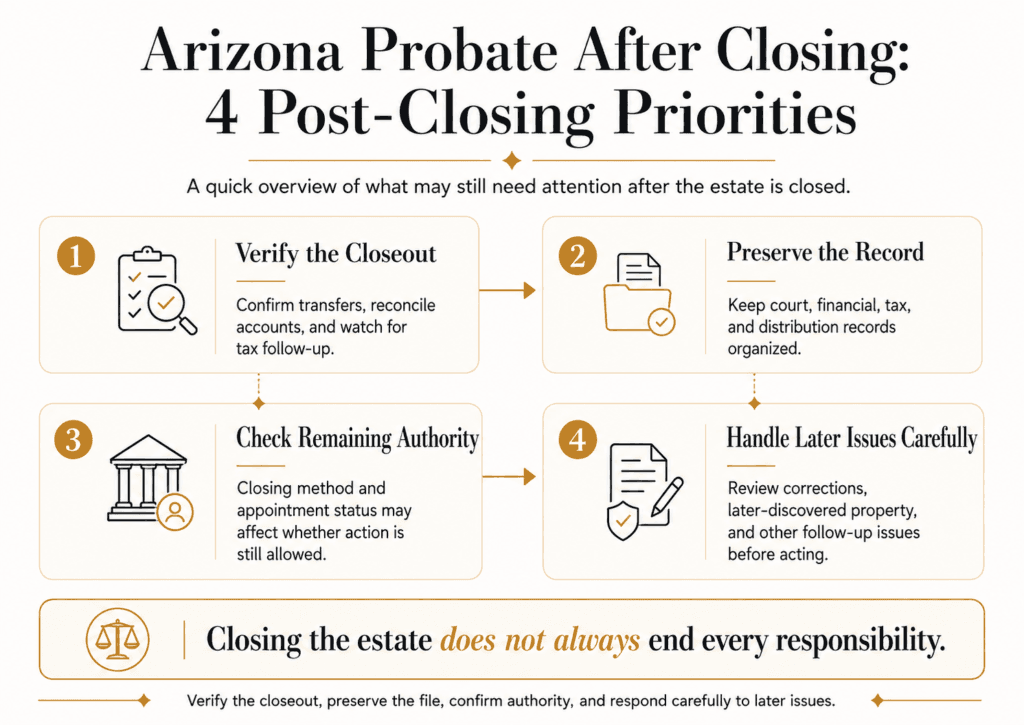
What happens after Arizona probate closes depends partly on how the estate was closed. An informal closing statement does not immediately end the personal representative’s appointment, while a formal closing order generally creates a more immediate legal endpoint.
Either way, the main probate administration should already be complete.
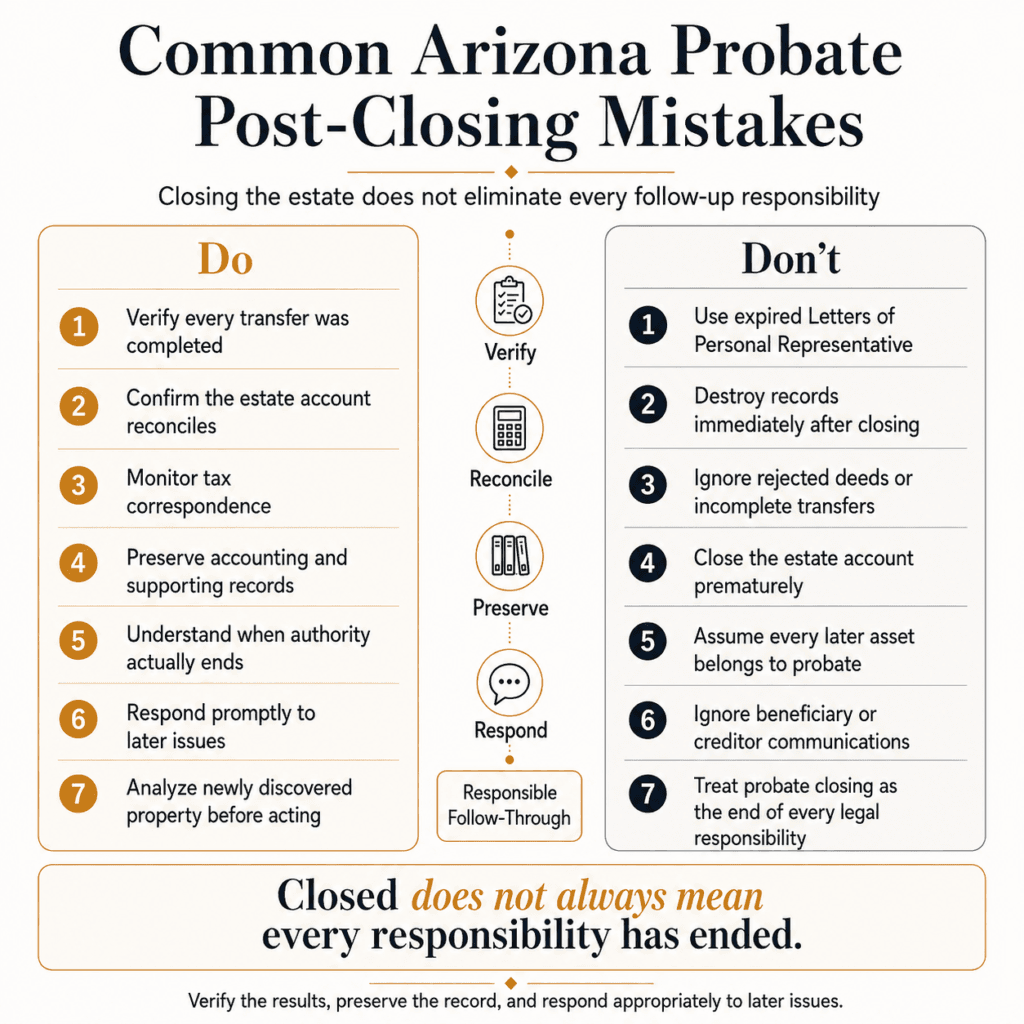
The post-closing period usually focuses on:
- Confirming that final payments cleared
- Verifying that deeds, titles, and account transfers were accepted
- Reconciling and closing the estate bank account
- Monitoring tax and financial correspondence
- Preserving the accounting and supporting records
- Correcting limited transfer or clerical problems
- Responding to beneficiary questions
- Addressing property discovered later
Closing should mark the completion of administration. It should not be used as a substitute for unfinished work.
Closing Can Have Different Legal Effects
Arizona provides informal and formal ways to complete estate administration.
The legal result after closing is not identical under both procedures.
Informal Closing
An eligible unsupervised estate may close by filing a verified closing statement.
The statement addresses matters including:
- Expiration of the creditor-presentation period
- Payment, settlement, or other treatment of presented claims
- Administration expenses
- Applicable death taxes
- Distribution of estate property
- Accommodation of any disclosed undischarged liability
- Delivery of the closing statement and accounting to required recipients
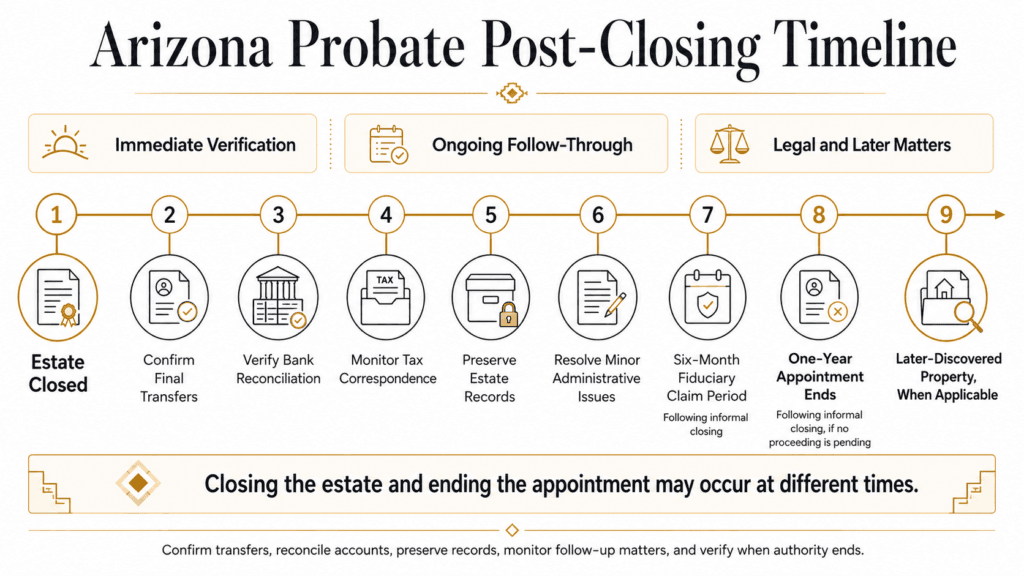
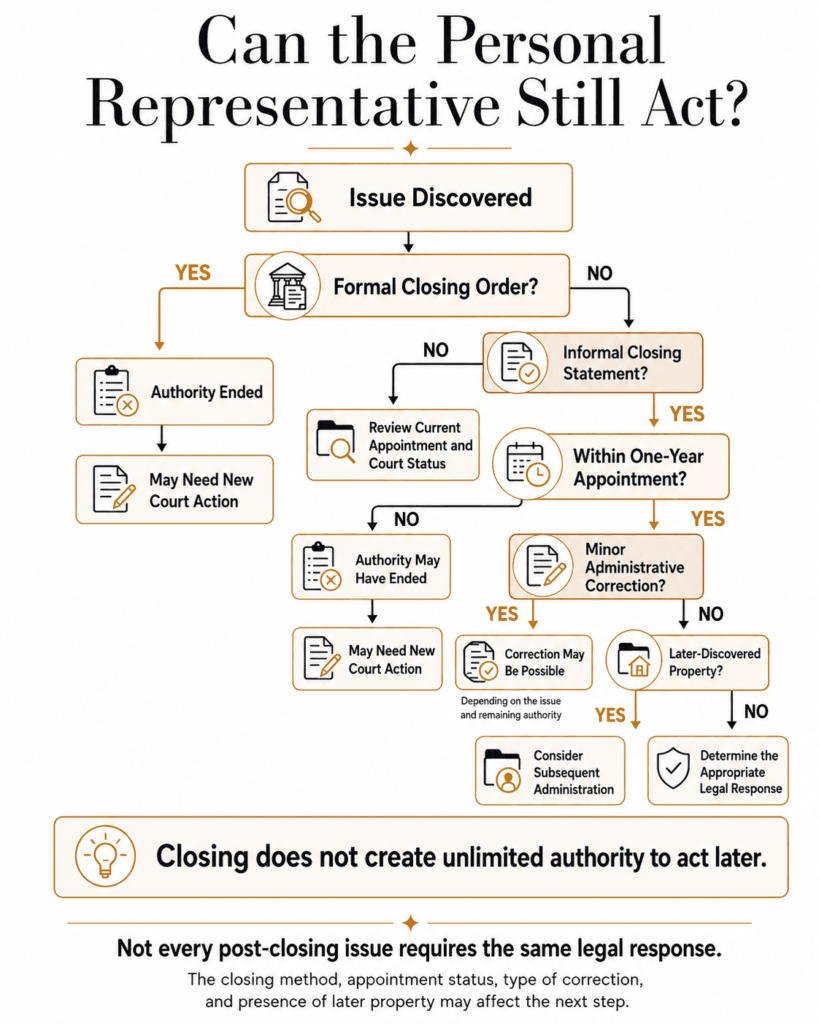
Filing the statement does not immediately terminate the personal representative’s appointment. If no proceeding involving the representative is pending, the appointment generally terminates one year after filing. See A.R.S. § 14-3933.
Formal Closing
Formal closing occurs through a court proceeding and order.
Depending on the petition and issues presented, the court may:
- Review or approve the accounting
- Determine who is entitled to receive property
- Interpret the will
- Determine heirs
- Approve the settlement
- Direct or approve distributions
- Discharge the personal representative from claims covered by the proceeding
An order closing the estate under Arizona’s formal-settlement statutes terminates the personal representative’s appointment. The protection created by the order depends on the relief requested, disclosures made, notice provided, people bound, and terms of the order. See A.R.S. § 14-3931 and A.R.S. § 14-3932.
For a detailed comparison, see Rahnema Law’s guide to informal vs. formal probate closing in Arizona.
What Happens After Arizona Probate Closes Informally?
One of the most important post-closing rules concerns the year after an informal closing statement is filed.
If no proceeding involving the personal representative is pending, the appointment generally terminates one year after the filing date.
That continued appointment can matter when a limited administrative problem appears after filing.
Examples include:
- A distribution check is returned.
- An expected refund arrives.
- A county recorder rejects a deed for correction.
- A financial institution requests an additional document.
- An account transfer remains incomplete.
- A replacement payment must be issued.
- A clerical mistake appears in an estate record.
However, the continued appointment does not mean that substantial probate administration should still be underway.
The closing statement should already have reflected a fully administered estate, except for an undischarged liability that was expressly disclosed and accommodated as Arizona law permits.
Arizona Law Note: The one-year period following an informal closing statement is a limited post-filing period. It is not permission to file before required administration is complete.
A Pending Proceeding Can Affect Termination
The one-year termination rule applies only when no proceeding involving the personal representative remains pending.
If an accounting, fiduciary, distribution, or other probate proceeding is active at the end of that period, the representative should not assume that the appointment terminated automatically.
Review:
- The court docket
- Pending petitions
- Objections
- Hearing dates
- Orders entered after the closing statement
- Any proceeding naming or involving the representative
An active dispute may require a court order before the representative can determine that the appointment has ended.
What Happens After a Formal Probate Closing Order?
A formal order creates a different endpoint.
When the court enters an order closing an estate under Arizona’s formal-settlement procedures, the appointment terminates through that order.
A general order of complete settlement may also discharge the representative from claims or demands of interested persons covered by the proceeding. A formal settlement under an informally probated will may provide similar protection concerning devisees who participated or were properly represented.
The scope of that protection depends on:
- What relief the petition requested
- Which issues were disclosed
- Who received notice
- Who participated
- Who was legally represented
- What the court actually decided
- The language of the final order
A formal order should not be treated as protection for:
- Fraud
- Concealed property
- Inaccurate disclosures
- Omitted interested persons
- False testimony
- Matters outside the proceeding
Formal closing provides judicial resolution of the matters properly placed before the court. It does not make undisclosed conduct harmless.
Do Not Use Old Authority After the Appointment Ends
After the appointment terminates, the former personal representative should not assume that old Letters of Personal Representative continue to authorize estate transactions.
Termination means that the prior appointment no longer provides continuing fiduciary authority.
Before signing a later deed, account instruction, settlement, tax document, or transfer instrument for the estate, determine:
- Whether the appointment remains active
- Whether the proposed action falls within existing authority
- Whether a court order is required
- Whether later administration and a new appointment are necessary
A bank, title company, recorder, brokerage, or other institution may request current Letters or another form of proof that authority still exists.
Using expired appointment documents can create problems involving:
- Property title
- Account ownership
- Enforceability
- Institutional acceptance
- Personal liability
When in doubt, pause before signing as personal representative.
Confirm That Final Distributions Cleared
Filing a closing document does not prove that every financial transaction reached the intended recipient.
After filing, confirm that:
- Estate checks cleared.
- Electronic transfers reached the correct accounts.
- Cashier’s checks were delivered.
- Returned payments were corrected.
- Equalization payments were completed.
- Residual balances were addressed.
For each distribution, preserve:
- Recipient
- Amount
- Date
- Payment method
- Check or confirmation number
- Partial or final designation
- Related accounting entry
An outstanding or returned check may require additional action while the representative’s appointment remains active.
Do not assume that mailing a payment completed the distribution.
Confirm That Property Transfers Were Accepted
Signing a deed, title application, assignment, or financial-account instruction is not always the final transfer step.
Confirm that:
- The county recorder accepted the deed.
- The recorded legal description is correct.
- The vehicle title was updated.
- The brokerage completed the securities transfer.
- The receiving account was credited.
- The company updated its ownership ledger.
- The trustee accepted the transferred property.
- Any lien release was processed.
Preserve proof of the completed result—not merely the submitted request.
Useful evidence may include:
- Recorded deed or instrument
- New vehicle title
- Brokerage confirmation
- Final estate statement
- Receiving-account statement
- Updated company ledger
- Trust acknowledgment
- Institutional completion letter
A rejected deed or incomplete account transfer can leave property titled in the estate’s or decedent’s name even after a closing statement has been filed.
Rahnema Law’s guide to transferring Arizona estate property to beneficiaries explains why each asset requires its own transfer method.
Correct Transfer Problems Promptly
Address a transfer problem as soon as it is discovered.
Possible issues include:
- A typographical error in a beneficiary’s name
- An incorrect legal description
- A missing acknowledgment
- A recorder formatting rejection
- Incomplete vehicle-title documentation
- A missing signature guarantee
- An incorrect receiving account
- An omitted ownership percentage
- An unreleased lien
During the year after an informal closing statement, the representative’s appointment may remain active if no proceeding has produced a different result. Whether a particular correction can be made without additional court involvement depends on:
- The nature of the error
- Current court orders
- Whether ownership is disputed
- Whether beneficiary shares would change
- Whether the original transaction was already authorized
- Whether the appointment remains active
Correcting a clerical defect is different from making a new distribution decision.
A problem involving disputed ownership, a reallocation of beneficiary shares, or substantial newly discovered property may require a court proceeding rather than a simple correction.
Close the Estate Bank Account at the Right Time
If the closing procedure lawfully permits an outstanding-liability arrangement that requires continued account activity, keep the account only as long as authorized and necessary. Do not assume that an ordinary material estate reserve is compatible with an informal closing statement; confirm the arrangement or delay closing as appropriate.
Before closing it, confirm that:
- All checks cleared.
- Electronic payments were completed.
- Final professional invoices were paid.
- Expected refunds were received or otherwise addressed.
- Automatic payments stopped.
- Final distributions were completed.
- The ending balance agrees with the accounting.
- Any lawfully accommodated outstanding-liability arrangement was completed or adjusted as authorized.
Preserve:
- Final bank statement
- Final reconciliation
- Account-closing confirmation
- Proof of the final distribution
- Explanation of any last adjustment
If the account reached zero and was fully reconciled before the closing statement, it may already have been closed.
If money was retained for a disclosed claim, tax payment, or final expense, the account may remain open until that matter is resolved.
Leaving the account open indefinitely can create unnecessary charges and statements. Closing it too early can make it difficult to deposit a refund or correct a payment.
Watch for Delayed Income and Refunds
Money may arrive after the principal administration appears complete.
Examples include:
- Federal or state tax refunds
- Insurance payments
- Utility-deposit refunds
- Escrow refunds
- Replacement checks
- Class-action payments
- Business distributions
- Interest
- Unclaimed funds
- Money owed to the decedent
When money arrives, determine whether it:
- Was expected and already reflected in the closing records
- Belongs to the probate estate
- Belongs directly to a beneficiary or another owner
- Requires tax reporting
- Requires another distribution
- Is substantial enough to require additional court administration
A small anticipated refund received while the informal appointment remains active may present a different issue from a previously unknown parcel of real estate discovered after the appointment ended.
Do not distribute a later payment until its ownership and the representative’s authority are clear.
Tax Responsibilities Can Continue After Probate Closes
Closing an Arizona probate case does not prevent a federal or state tax authority from later:
- Reviewing a return
- Requesting records
- Issuing a refund
- Questioning reported income
- Proposing an adjustment
- Assessing additional tax
Continue monitoring tax correspondence and preserve the complete tax file.
The IRS’s Publication 559 explains federal tax responsibilities for survivors, executors, and administrators.
Review the Federal Fiduciary Relationship
The IRS explains that Form 56 may be used to notify it of the creation or termination of a fiduciary relationship.
The estate’s tax professional should determine:
- Whether Form 56 was previously filed
- Whether the fiduciary relationship should now be reported as terminated
- Which taxpayer or estate the notice concerns
- When the notice should be submitted
- Whether another address or authorization form is also necessary
The closing of the Arizona probate case and termination of the federal tax fiduciary relationship may not occur on the same date.
Consider Whether Prompt Assessment Is Appropriate
A fiduciary representing a decedent’s estate may use IRS Form 4810 to request prompt assessment of eligible tax.
A properly made request may shorten the ordinary assessment period for qualifying taxes, but the form does not apply identically to every return, tax, or estate.
The decision should be coordinated with a qualified tax professional who can confirm:
- Which returns qualify
- Whether all required returns were filed
- Whether the request is timely
- Which tax periods should be identified
- Whether an exception may apply
- Whether the request supports the estate’s closing goals
Closing state probate and resolving federal tax exposure are related but separate matters.
Consider Whether Discharge From Personal Tax Liability Is Appropriate
IRS Form 5495 allows an executor of a decedent’s estate or a qualifying fiduciary of a decedent’s trust to request discharge from personal liability for specified income, gift, and estate taxes.
The form does not automatically apply to every personal representative or every tax obligation.
The estate’s tax adviser should determine:
- Whether the requester qualifies
- Which tax liabilities may be covered
- Whether the required returns were filed
- What supporting information is necessary
- Whether separate requests are needed
- What the requested discharge would and would not protect
Do not file a federal tax form solely because probate has closed. The tax professional should evaluate its purpose and applicability to the particular estate.
Preserve the Final Tax File
Post-closing tax records may include:
- The decedent’s final federal income-tax return
- The decedent’s final Arizona income-tax return
- Federal fiduciary income-tax returns
- Arizona fiduciary income-tax returns
- Estate-tax returns when applicable
- Forms 1099
- Beneficiary Schedules K-1
- Property-sale records
- Appraisals
- Date-of-death values
- Basis records
- Tax-payment confirmations
- Refund records
- Tax notices
- Responses to tax authorities
- Forms 56, 4810, or 5495 when used
Do not rely on continued access to a closed account, tax portal, or professional platform.
Download and store important records before access expires.
Keep the Accounting and Supporting Records
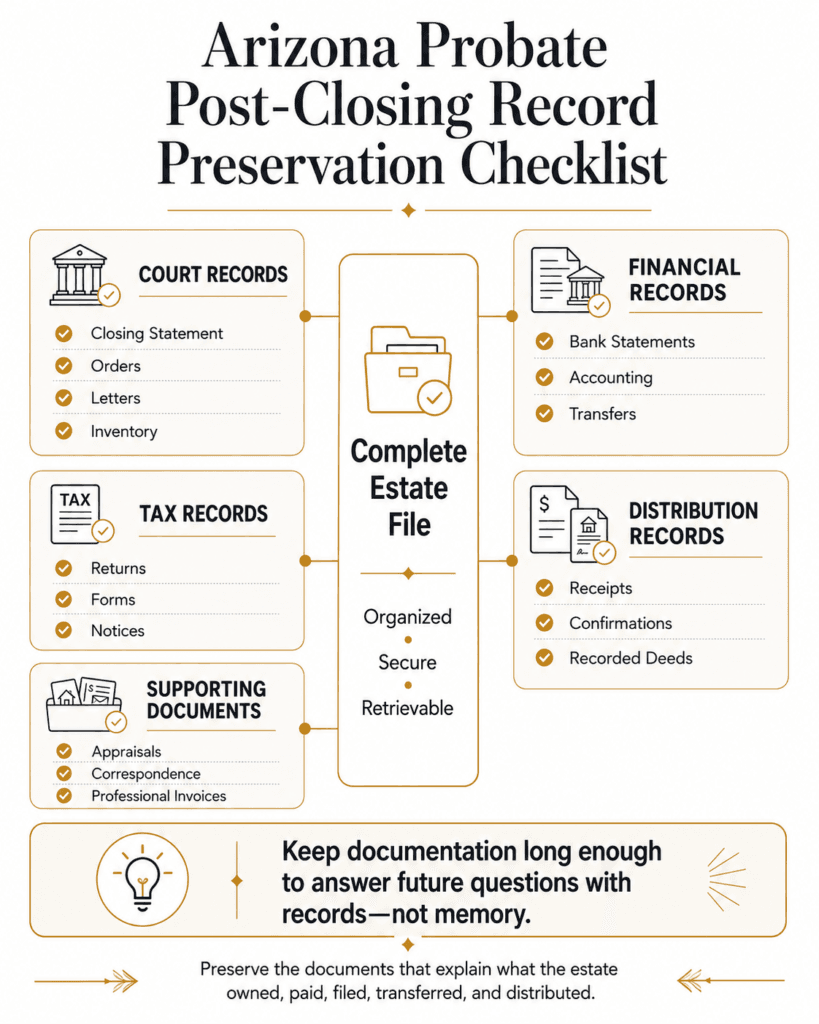
The estate file should remain organized after closing.
A complete file may include:
Court and Appointment Records
- Will
- Death certificate
- Appointment order
- Letters of Personal Representative
- Court orders
- Inventory
- Supplemental inventory
- Closing statement
- Formal settlement order
- Proof of filing
Creditor Records
- Published notice
- Proof of publication
- Direct notices
- Claims
- Allowance and disallowance records
- Settlements
- Payment confirmations
Asset and Transaction Records
- Bank statements
- Brokerage statements
- Appraisals
- Deeds
- Vehicle titles
- Business records
- Sale agreements
- Settlement statements
- Transfer confirmations
Tax Records
- Filed returns
- Tax schedules
- Tax notices
- Payment records
- Refund records
- Professional correspondence
- Basis and appraisal records
Distribution and Accounting Records
- Final accounting
- Estate ledger
- Bank reconciliations
- Distribution checks
- Electronic-transfer confirmations
- Receipts
- Deeds and assignments
- Compensation records
- Reimbursement records
- Proof of delivery
Arizona’s post-closing statutes use different periods for different types of claims and proceedings. Tax rules, title questions, contractual obligations, and fiduciary issues may create additional retention needs.
Do not choose one early destruction date for the entire file without legal and tax review.
For a detailed record list, see Rahnema Law’s guide to probate records to keep after an Arizona estate closes.
Store Estate Records Securely
Estate records often contain:
- Social Security numbers
- Account numbers
- Taxpayer identification numbers
- Beneficiary addresses
- Medical information
- Financial statements
- Signatures
- Property records
Electronic records should be:
- Stored in an access-controlled location
- Protected by strong authentication
- Backed up
- Organized by category and date
- Exported from systems that may later close
Protect paper originals from:
- Water
- Fire
- Theft
- Unauthorized access
- Accidental disposal
The retained file should allow a beneficiary, successor representative, tax adviser, attorney, title professional, or court to reconstruct the administration when necessary.
Beneficiaries May Ask Questions After Closing
A beneficiary may review the accounting more carefully after receiving the distribution.
Questions may concern:
- The difference between inventory value and sale price
- Professional fees
- Personal representative compensation
- Reimbursements
- Property-sale expenses
- Tax allocation
- The value assigned to an in-kind distribution
- Calculation of a residuary share
- A final adjustment under a lawful outstanding-liability arrangement
- Why another beneficiary received different property
Responses should be based on records rather than memory.
A helpful response may include:
- The relevant accounting schedule
- An invoice
- An appraisal
- The closing statement
- A distribution calculation
- Transfer confirmation
- A will provision
- A court order
Clear records can resolve a question before it becomes a formal dispute.
Closing Does Not Make Inadequate Disclosure Harmless
Arizona’s limitation for certain post-closing fiduciary claims expressly excludes claims involving fraud, misrepresentation, or inadequate disclosure related to settlement.
The closing statement and final accounting should accurately disclose material matters, including:
- Remaining liabilities
- Reserves
- Compensation
- Reimbursements
- Related-party transactions
- Property sales
- Valuation changes
- Noncash distributions
- Property retained
- Disputed claims
- Incomplete transfers
Silence from beneficiaries immediately after closing should not be treated as approval of undisclosed conduct.
Certain Fiduciary Claims Have a Six-Month Limitation
Arizona generally bars certain claims by successors and creditors against a personal representative for breach of fiduciary duty unless a proceeding is started within six months after the closing statement is filed.
That limitation is subject to claims already barred or adjudicated and the disclosures made in the closing statement.
It does not include rights to recover for:
- Fraud
- Misrepresentation
- Inadequate disclosure related to settlement
See A.R.S. § 14-3935.
The six-month period is not a universal deadline for every possible probate dispute.
Different rules may apply to:
- Claims against distributees
- Recovery of improperly distributed property
- Fraud
- Taxes
- Title disputes
- Matters decided through a formal order
- Claims barred earlier in the administration
Evaluate each deadline according to the claimant, legal theory, and procedural history.
A Valid Unpaid Claim May Reach Distributees
After estate assets have been distributed, an undischarged and unbarred claim may sometimes be pursued against one or more distributees.
A distributee generally is not liable for more than the value received. Arizona also protects specified amounts received as exempt property, homestead allowance, or family allowance.
As between distributees, responsibility is generally allocated in the way that would have applied if the claim had been paid during administration. The statute also addresses notice between distributees when one later seeks contribution from another.
See A.R.S. § 14-3934.
A beneficiary who receives a post-closing creditor demand should preserve it and obtain individual legal guidance before paying, rejecting, or ignoring it.
An Unresolved Claim Should Have Been Disclosed
Arizona’s informal closing statute allows a closing statement to address an undischarged claim by stating either:
- That the estate was distributed subject to possible liability with the distributees’ agreement, or
- What other detailed arrangements were made to accommodate the liability
The post-closing file should preserve:
- Claimant identity
- Nature of the liability
- Amount or estimated exposure
- Reserve or other payment source
- Distributee agreement
- Settlement negotiations
- Insurance information
- Legal or tax advice
- The explanation included in the closing statement
An unresolved claim that was omitted rather than properly accommodated may create risk for both the personal representative and distributees.
Improper Distributions May Require Repayment
A person who improperly received estate money or property may be required to return it and the income earned after distribution.
If the recipient no longer possesses the property, that person may be liable for its value when it was disposed of, together with related income and gain.
Examples may include:
- A distribution to the wrong heir
- A duplicate payment
- Transfer of property that did not belong to the probate estate
- An excess payment caused by a calculation error
- A distribution contrary to the will
- A transfer made before a controlling dispute was resolved
Whether repayment is required depends on the facts, any prior adjudication, estoppel, applicable limitation periods, and other defenses.
See A.R.S. § 14-3909.
Separate Limitation Periods Apply to Recovery From Distributees
Arizona generally bars specified noncreditor claims to recover from a distributee at the later of:
- Three years after the decedent’s death, or
- One year after the distribution
The rule is subject to prior adjudication, other bars, and an exception for property or value received through fraud. Creditor claims against distributees follow separate creditor-claim limitations.
See A.R.S. § 14-3936.
This makes the date of each distribution an important record.
The estate file should identify:
- Date distributed
- Recipient
- Property or amount
- Assigned value
- Supporting appraisal
- Partial or final status
- Delivery evidence
- Title document
- Institutional confirmation
Personal Representative Liability Can Still Matter
Arizona provides that a personal representative may be liable to interested persons for loss caused by an improper exercise of estate authority or breach of fiduciary duty.
Potential post-closing problems include:
- Using authority after the appointment ended
- Failing to correct a known transfer problem
- Omitting a material asset
- Destroying records needed to explain the accounting
- Ignoring a tax notice
- Concealing an unresolved liability
- Refusing to return an estate refund
- Distributing later property without authority
- Providing misleading information to beneficiaries
See A.R.S. § 14-3712.
Closing may limit or resolve certain risks. It does not transform improper conduct into proper administration.
A Small Correction May Not Require Reopening Probate
Not every post-closing problem requires full subsequent administration.
While the appointment remains active after an informal closing statement, a limited correction may involve:
- Reissuing a returned distribution check
- Correcting a clerical error
- Depositing an anticipated refund
- Completing an already authorized account transfer
- Correcting a rejected deed
- Obtaining final institutional confirmation
Document:
- What went wrong
- Why the correction was authorized
- Money or property affected
- Date corrected
- Updated accounting entry
- Evidence of completion
A correction that changes ownership rights, reallocates beneficiary shares, resolves a dispute, or administers substantial new property may require court involvement.
Newly Discovered Property May Require Subsequent Administration
Arizona provides a procedure for later-discovered estate property.
When property is discovered after:
- The estate was settled, and the personal representative was discharged, or
- One year passed after an informal closing statement was filed
an interested person may apply or petition for appointment of the same personal representative or a successor to administer the later property.
See A.R.S. § 14-3938.
Examples of later-discovered property include:
- An unknown bank account
- Omitted real estate
- Unclaimed property
- A mineral interest
- A business interest
- Settlement proceeds
- A tax refund
- Loan repayment
- Insurance proceeds payable to the estate
- A digital financial asset
Rahnema Law’s guide to reopening a closed Arizona probate estate explains when a later asset or unresolved matter may require another court process.
Subsequent Administration Does Not Necessarily Restart Everything
Later administration generally focuses on the newly discovered property and the work needed to administer it.
The newly appointed representative may need to:
- Determine whether the property belongs to probate
- Collect it
- Obtain a value
- Address ownership or title
- Complete tax reporting
- Identify the correct recipients
- Update the accounting
- Transfer or distribute the property
- Complete another closing procedure
Arizona provides that a claim previously barred may not be asserted in the subsequent administration.
Previously completed matters do not ordinarily need to be repeated solely because another asset was found. However, the exact scope depends on the property, original court orders, and any new legal issues.
Determine Whether the Later Item Is Probate Property
Not every payment or asset found after closing belongs to the probate estate.
Before seeking another appointment, determine whether it passes through:
- A beneficiary designation
- Survivorship ownership
- A trust
- A payable-on-death arrangement
- A transfer-on-death arrangement
- An insurance contract
- A retirement-plan designation
- Another nonprobate mechanism
Review:
- Payee name
- Title records
- Account agreement
- Contract
- Beneficiary form
- Source of the payment
Opening another probate proceeding for property that already belongs directly to someone else can create unnecessary expense and delay.
Later Property May Require New Tax Analysis
A newly discovered asset may affect:
- Estate income
- Beneficiary reporting
- Capital gain or loss
- Basis records
- Fiduciary income-tax returns
- Amended returns
- Arizona tax filings
- Property taxes
- Business returns
Provide the tax professional with:
- A description of the property
- Date it was discovered
- Date-of-death information
- Prior inventory treatment
- Income received
- Sale or transfer information
- Proposed recipient
The tax consequences may differ depending on whether the estate receives cash, sells property, or distributes the asset in kind.
Continue Monitoring Important Correspondence
For a reasonable post-closing period, monitor correspondence sent to:
- The estate
- The decedent
- The address used on tax returns
- The address used by financial institutions
- The address associated with estate property
- The personal representative’s professional advisers
Important correspondence may include:
- A tax notice
- Refund
- Replacement check
- Returned distribution
- Recorder rejection
- Insurance payment
- Unclaimed-property notice
- Beneficiary inquiry
- Creditor demand
- Institutional request
Do not end mail forwarding before evaluating the likelihood of additional estate correspondence.
Preserve Access to Digital Records
Online access may disappear after:
- The estate bank account closes
- A brokerage transfer is completed
- A professional engagement ends
- An email account closes
- A cloud subscription is cancelled
Before access ends, download:
- Monthly statements
- Tax documents
- Transaction histories
- Transfer confirmations
- Invoices
- Appraisals
- Court filings
- Beneficiary correspondence
- Accounting files
- Closing documents
Also preserve the software or export format needed to read the files later.
A backup that cannot be opened is not a useful record.
Notify Appropriate Professionals When Authority Ends
After termination of the appointment, the former personal representative may need to inform:
- Tax preparer
- Attorney
- Accountant
- Financial institution
- Insurance professional
- Property manager
- Business manager
- Successor fiduciary
The notice should distinguish among:
- Closing of the Arizona probate case
- Termination of the Arizona appointment
- Termination of the federal tax fiduciary relationship
- Completion of a particular professional engagement
These events may not occur on the same date.
Arizona Post-Closing Probate Checklist
After the estate closes, confirm the following.
Appointment and Authority
- The closing method is identified as informal or formal.
- The closing-statement filing date or formal-order date is recorded.
- The representative understands when the appointment terminates.
- The court docket was checked for pending proceedings.
- Old Letters will not be used after authority ends.
Payments and Transfers
- Final distribution checks cleared.
- Electronic payments reached the correct recipients.
- Returned payments were corrected.
- Real-property instruments were recorded.
- Vehicle titles were updated.
- Financial-account transfers were completed.
- Business ownership records were updated.
- Receipts and transfer confirmations were preserved.
Estate Accounts
- Outstanding checks were resolved.
- Expected refunds were received or addressed.
- Automatic payments were stopped.
- The final balance agrees with the accounting.
- The estate bank account was closed at the appropriate time.
- The final statement and closing confirmation were saved.
Taxes
- Required final returns were filed.
- Beneficiary tax documents were delivered.
- Tax-payment confirmations were preserved.
- Tax correspondence continues to be monitored.
- Form 56 treatment was reviewed with the tax professional.
- Forms 4810 and 5495 were evaluated when appropriate.
- Appraisals, basis records, and sale documents were preserved.
Records and Communication
- The final accounting was preserved.
- Court filings and orders were preserved.
- Creditor records were preserved.
- Distribution records were preserved.
- Electronic records were downloaded and backed up.
- Beneficiary questions are answered from documentation.
- Important estate mail continues to be monitored.
Later Issues
- Any transfer rejection is addressed promptly.
- Any creditor demand is reviewed before action is taken.
- Any repayment request is documented.
- Later property is analyzed to determine whether it belongs to probate.
- Subsequent administration is considered when required.
- No new estate transaction is completed without current authority.
Finish the Estate Responsibly
After an Arizona probate estate closes, the main administration should be complete.
The remaining period usually focuses on:
- Confirming final transactions
- Completing limited corrections
- Closing estate accounts
- Monitoring tax and financial correspondence
- Preserving the administration record
- Responding to later questions
- Handling property discovered afterward
An informal closing statement generally leaves the appointment in place for one year if no proceeding involving the personal representative remains pending. A formal closing order terminates the appointment through the court’s order.
Closing also does not eliminate later-discovered property. Arizona permits appointment of the same representative or a successor when subsequent administration becomes necessary.
Careful follow-through protects the work already completed and helps prevent a correctable issue from becoming a new probate dispute.
Legal Disclaimer: This information is for educational purposes only and does not constitute legal advice. Arizona probate law is complex and varies based on individual circumstances. Always consult with a qualified probate attorney for guidance specific to your situation.
FAQs
No. If no proceeding involving the personal representative is pending, the appointment generally terminates one year after the closing statement is filed.
An order closing the estate under Arizona’s formal-settlement statutes terminates the personal representative’s appointment. The order may also discharge the representative from claims or demands covered by the proceeding.
Possibly. The appointment may remain active during the one-year post-filing period. Whether the representative can make the correction depends on the error, current court orders, whether ownership is disputed, and whether the correction falls within existing authority.
The former personal representative should not rely on expired Letters as current authority. A new appointment or court order may be required.
If the closing procedure lawfully permits an outstanding-liability arrangement that requires continued account activity, keep the account only as long as authorized and necessary. Do not assume that an ordinary material estate reserve is compatible with an informal closing statement; confirm the arrangement or delay closing as appropriate.
Yes. Probate closing does not prevent the IRS from reviewing returns, requesting records, issuing refunds, proposing adjustments, or assessing additional tax.
Form 56 may be used to notify the IRS of the creation or termination of a fiduciary relationship.
Form 4810 allows a fiduciary representing a decedent’s estate to request prompt assessment of eligible tax.
Form 5495 allows an executor or qualifying fiduciary to request discharge from personal liability for specified income, gift, and estate taxes.
There is no single practical destruction date suitable for every estate. Tax, fiduciary, creditor, title, distribution, and fraud issues may involve different periods. Review the retention plan with legal and tax professionals.
Yes. A beneficiary may ask about the accounting, fees, valuation, sale price, tax allocation, or distribution calculation. Responses should be based on the estate records.
Certain successor and creditor claims for breach of fiduciary duty generally must begin within six months after filing. Claims involving fraud, misrepresentation, or inadequate disclosure are excluded from that limitation.
An undischarged and unbarred claim may be pursued against one or more distributees, generally subject to the value each received and statutory protections for specified family allowances and exempt property.
Yes. A recipient may be required to return improperly received property or money. If the recipient no longer has the property, the person may be liable for its value and related income or gain.
Specified noncreditor recovery claims are generally barred at the later of three years after the decedent’s death or one year after distribution, subject to earlier adjudication, other bars, and the fraud exception.
No. A limited correction may be possible while an informal appointment remains active. A substantial new asset, disputed matter, or expired appointment may require subsequent administration or another court proceeding.
Arizona permits subsequent administration after formal settlement and discharge or after one year following an informal closing statement. The same personal representative or a successor may be appointed.
No. A claim that was previously barred cannot be asserted in the subsequent administration.
No. A later payment may pass through a beneficiary designation, survivorship ownership, trust, insurance contract, or another nonprobate arrangement. Review the title and governing document before treating it as estate property.