

Arizona probate records to keep after closing include accountings, tax files, bank statements, deeds, valuations, claims, and distributions.
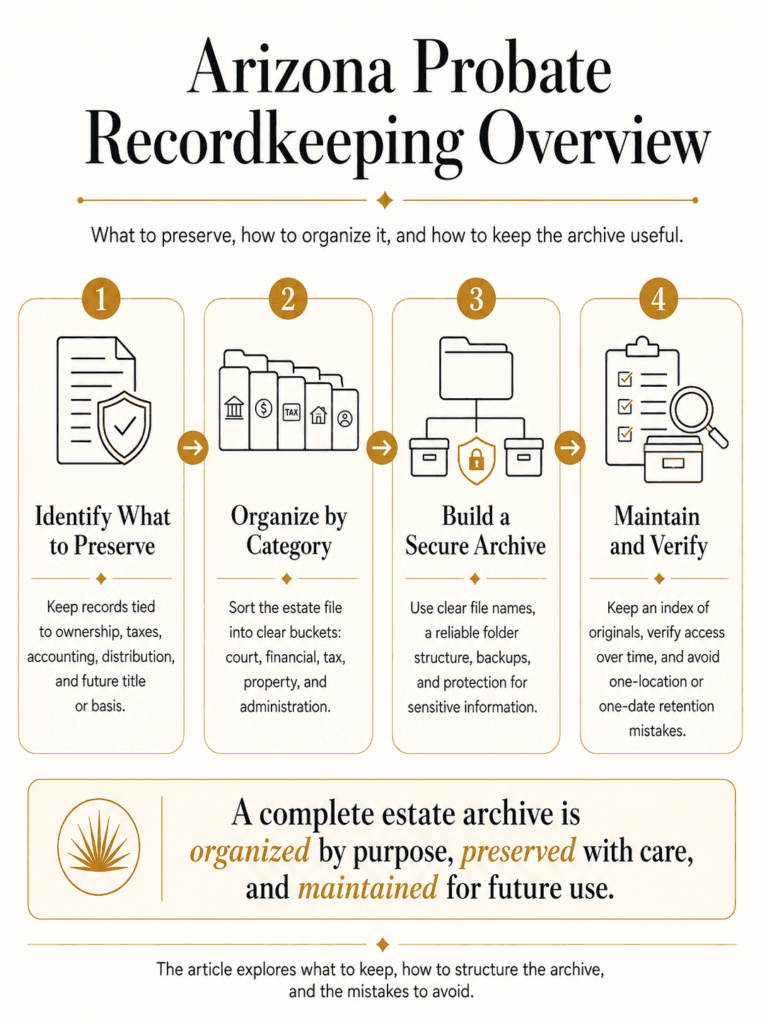
A closing statement or formal order documents the end of the estate’s administration.
The supporting records explain why the closing representations were accurate.
In an informal closing, the personal representative verifies matters that include:
- Expiration of the creditor-presentation period
- Payment, settlement, or other disposition of claims
- Payment or accommodation of administration expenses
- Treatment of applicable death taxes
- Distribution of estate property
- Disclosure and accommodation of undischarged liabilities
- Delivery of the closing statement to required recipients
- Delivery of a full written accounting to affected distributees
These requirements appear in A.R.S. § 14-3933.
The supporting file may later be needed to explain:
- Inventory values
- Sale prices
- Creditor decisions
- Administration expenses
- Reimbursements
- Personal representative compensation
- Tax reporting
- Property transfers
- Beneficiary distributions
- Entries in the final accounting
A court-stamped closing statement proves that the statement was filed. It does not independently prove every transaction summarized within it.
For an explanation of the continuing responsibilities that may arise after closing, see Rahnema Law’s guide to what happens after an Arizona probate estate closes.
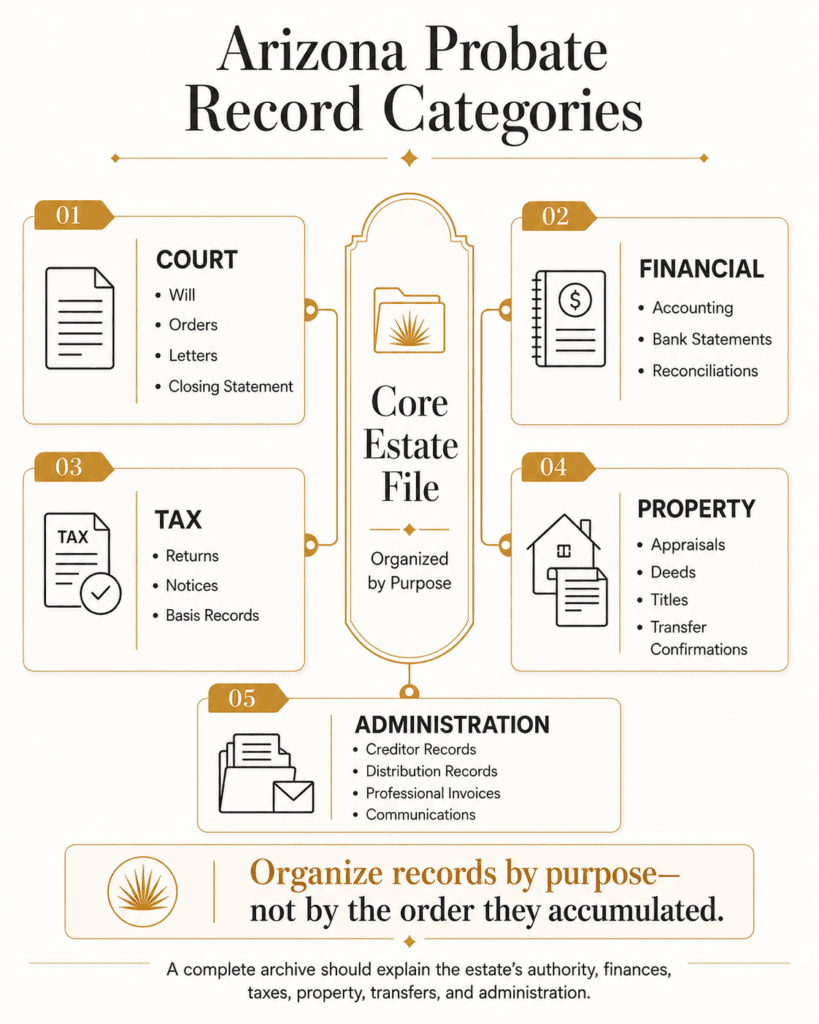
There Is No Single Retention Period for Every Probate Record
Arizona law establishes limitation periods for particular claims and proceedings. Those periods are not universal instructions to destroy an estate file.
For example:
- Certain successor and creditor claims against the personal representative are generally subject to a six-month period after an informal closing statement, with exceptions involving fraud, misrepresentation, or inadequate disclosure.
- Certain noncreditor claims against distributees are generally subject to the later of three years after death or one year after distribution.
- Previously barred creditor claims are not revived merely because later-discovered property requires subsequent administration.
- Federal tax records may need to remain available for three, six, seven, or more years, depending on the return and issue.
- Property-basis records may remain important until after a beneficiary later sells or otherwise disposes of the inherited property.
Arizona’s six-month limitation for certain fiduciary claims expressly excludes recovery based on fraud, misrepresentation, or inadequate disclosure. A.R.S. § 14-3935 addresses that distinction.
For certain claims seeking recovery from a distributee, A.R.S. § 14-3936 generally uses the later of three years after death or one year after distribution, subject to other bars and the fraud exception. Creditor claims follow separate rules.
These periods serve different purposes. None should automatically become the destruction date for every probate document.
Arizona Law Note: The expiration of one type of claim does not necessarily make the supporting records irrelevant for taxes, title, later-discovered property, another legal claim, or a beneficiary’s future sale of inherited property.
Create a Core Long-Term Estate File
The core file should identify the estate, establish the representative’s authority, record the major administration decisions, and show how the probate ended.
Consider preserving long-term:
- Original will and codicils
- Certified death certificate
- Appointment order
- Letters of Personal Representative
- Bond documents
- Significant court orders
- Inventory and supplemental inventories
- Important appraisals
- Final accounting
- Closing statement
- Formal settlement or discharge order
- Recorded property-transfer instruments
- Final distribution schedule
- Proof of filing and delivery
These documents provide the framework needed to understand the rest of the administration.
Keep the Original Will and Codicils
Protect the original will and any codicils even after the court admits them to probate.
The estate file should identify:
- The date the will was admitted
- Whether probate was informal or formal
- Whether a later will contest occurred
- Which document controlled distribution
- Whether any property passed by intestacy
Court systems, retention policies, and document-access procedures can change. A court copy may also be insufficient when someone later requests an original or certified document.
Store the original will in a secure, dry location. The electronic estate index should identify where the original is kept.
Preserve the Death Certificate and Appointment Records
Keep:
- Certified death certificate
- Probate application or petition
- Registrar’s statement or appointment order
- Acceptance of appointment
- Letters of Personal Representative
- Restricted or updated Letters
- Bond and bond-release documents
- Orders limiting authority
- Resignation or removal records
- Successor-appointment documents
These records may later establish:
- Who had authority
- When that authority began
- Whether the authority was restricted
- Which representative completed a transaction
- How and when the appointment ended
After an informal closing statement, the appointment generally terminates one year after filing if no proceeding involving the personal representative remains pending. A formal closing order under Arizona’s settlement statutes terminates the appointment through the order. See A.R.S. § 14-3610.
The file should therefore preserve the exact closing-statement filing date or formal-order date.
Letters should remain in the historical file, but the former personal representative should not use expired Letters as current authority after the appointment ends.
Keep All Significant Court Orders
Preserve orders concerning:
- Admission of the will
- Appointment
- Supervised administration
- Bond
- Restrictions on authority
- Sale of property
- Distribution
- Heirship
- Will interpretation
- Creditor disputes
- Compensation
- Accounting approval
- Settlement
- Discharge
- Later administration
The order itself may define what the personal representative could do and which people are bound by the court’s decision.
A docket printout can help organize the file, but it should not replace copies of the actual orders.
Preserve the Original Inventory
Arizona generally requires a personal representative to prepare an inventory within 90 days after appointment.
The inventory should describe probate property with reasonable detail and state:
- Fair market value as of the date of death
- Community or separate-property character
- The type and amount of any encumbrance
Keep:
- Original inventory
- Filed or delivered copy
- Supporting schedules
- Proof of delivery when the inventory was not filed
- Notes identifying nonprobate assets
- Records showing how ownership was determined
The inventory is the estate’s opening financial record. The final accounting should explain what happened to every asset listed there.
Keep Every Supplemental Inventory
Arizona requires a supplemental inventory when the personal representative discovers omitted property or learns that an original value or description was erroneous or misleading.
Preserve:
- Supplemental inventory
- Corrected asset description
- Revised valuation
- Appraisal or supporting data
- Filing confirmation
- Proof of delivery to affected interested persons
- Explanation of why the correction was necessary
Do not retain only the revised total. Keep the records showing how and why the inventory changed.
Preserve Date-of-Death Valuation Records
Valuation records may remain important long after probate closes.
Keep documentation supporting the reported value of:
- Real estate
- Bank accounts
- Securities
- Vehicles
- Business interests
- Jewelry
- Artwork
- Collectibles
- Mineral interests
- Promissory notes
- Digital assets
- Other valuable property
Supporting documents may include:
- Formal appraisal
- Broker price opinion
- Financial statement
- Account statement
- Comparable-sales analysis
- Vehicle valuation
- Business valuation
- Photographs
- Expert correspondence
- Appraiser qualifications
The file should identify the valuation date and whether the value was used for:
- Probate inventory
- Tax reporting
- Distribution
- Sale
- Another legal or financial purpose
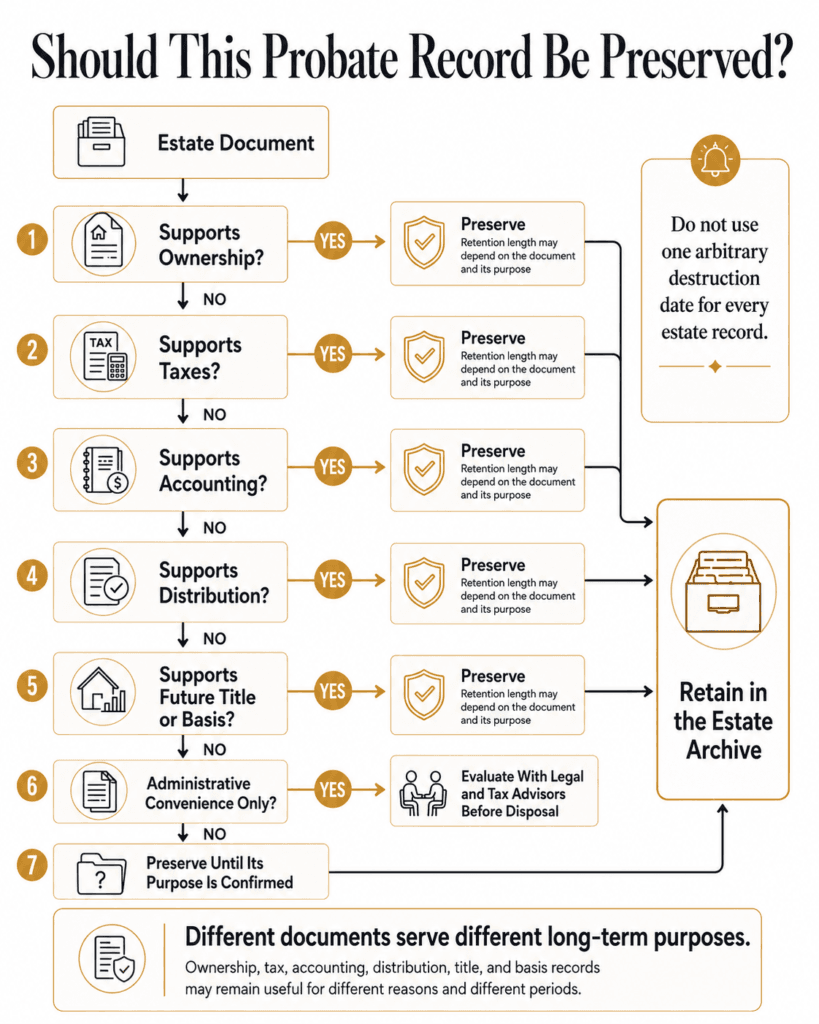
Basis Records May Need to Be Kept Much Longer
A beneficiary may need inherited-property basis records years after the probate estate closes.
Basis is used to calculate gain or loss when property is later sold or otherwise disposed of. Inherited-property basis is often connected to fair market value at the date of death, subject to federal tax rules and exceptions. The IRS advises taxpayers to maintain accurate records of all items that affect the basis of property, including property received through inheritance.
A beneficiary may later need:
- Date-of-death appraisal
- Alternate valuation information, when applicable
- Value reported on an estate-tax return
- Ownership records
- Improvement records
- Allocation schedules
- Form 8971 information, when applicable
- Community-property information
- Records of later basis adjustments
IRS guidance generally recommends retaining property records until the limitation period expires for the tax year in which the property is disposed of.
A beneficiary who keeps an inherited home for 15 years may therefore need the date-of-death appraisal long after routine estate banking records have become historical.
Provide relevant basis documents to the beneficiary when the property is distributed. Doing so reduces the risk that the records will need to be reconstructed years later.
Keep the Final Accounting
The final accounting is one of the most important Arizona probate records to keep after closing.
It should trace the administration from the opening property through:
- Receipts
- Estate income
- Refunds
- Asset sales
- Creditor payments
- Administration expenses
- Taxes
- Reimbursements
- Personal representative compensation
- Cash distributions
- Noncash distributions
- Final reserve or balance
Keep:
- The exact accounting delivered to beneficiaries
- All schedules
- Supporting worksheets
- Estate ledger
- Bank reconciliations
- Draft calculations that explain material adjustments
- Proof identifying who received the final version
- Date and method of delivery
Arizona’s informal-closing statute requires the personal representative to furnish a full written account to distributees whose interests were affected by the administration.
The estate file should preserve both the accounting and proof that it was furnished.
Identify the Version Actually Delivered
Drafts may be useful, but the file should clearly identify the final accounting sent to recipients.
Record:
- Document date
- Version number
- Recipient names
- Recipient addresses
- Delivery date
- Delivery method
- Returned mail
- Corrected delivery
- Beneficiary acknowledgment, when available
A later reviewer should not have to guess which of several spreadsheets or PDF files was the final accounting.
Preserve Every Estate Bank Statement
Bank records provide independent evidence of the estate’s financial activity.
Keep:
- Every monthly estate account statement
- Deposit records
- Check images
- Wire-transfer confirmations
- Electronic-payment confirmations
- Cashier’s-check records
- Bank-fee records
- Interest statements
- Monthly reconciliations
- Final reconciliation
- Account-closing confirmation
The bank records should agree with the final accounting.
Do not treat online banking access as permanent storage. Download complete records before the institution removes access to the closed account.
Keep Records for Every Account That Held Estate Property
An estate may have used:
- Primary checking account
- Savings account
- Brokerage account
- Property-management account
- Attorney trust account
- Escrow account
- Temporary account used before consolidation
Preserve statements and transfer records for every account that received, held, or distributed estate money.
The file should show how money moved between accounts so that internal transfers are not mistaken for income, expenses, or distributions.
Keep Evidence of Estate Income and Other Receipts
The file should identify the source of every material amount received.
Receipts may include:
- Interest
- Dividends
- Rent
- Business income
- Tax refunds
- Insurance proceeds payable to the estate
- Property-sale proceeds
- Escrow refunds
- Returned deposits
- Loan repayments
- Settlement proceeds
- Money collected from someone who owed the decedent
Keep:
- Check or payment notice
- Deposit record
- Account statement
- Tax form
- Lease statement
- Settlement statement
- Correspondence explaining the payment
- Related accounting entry
Distinguish property the decedent already owned from income earned by the estate after death.
Preserve Invoices and Expense Records
Every material estate expense should have support beyond a line on a bank statement.
Keep invoices and payment records for:
- Court fees
- Publication
- Certified documents
- Appraisals
- Insurance
- Utilities
- Repairs
- Maintenance
- Storage
- Security
- Property management
- Funeral or burial costs paid by the estate
- Legal services
- Accounting services
- Tax preparation
- Real-estate commissions
- Recording fees
- Business expenses
Each record should identify:
- Payee
- Amount
- Date
- Service or property provided
- Estate purpose
- Payment method
- Accounting category
A cancelled check shows that money was paid. The invoice helps explain why the payment served the estate.
Keep Reimbursement Records Separate
Personal representative reimbursements should remain separate from compensation, vendor expenses, and beneficiary distributions.
For each reimbursement, preserve:
- Invoice or receipt
- Proof that the representative paid personally
- Date of the personal payment
- Estate purpose
- Request for reimbursement
- Estate payment confirmation
- Accounting entry
These records show that the estate repaid an actual expense rather than making an additional compensation payment or distribution.
Preserve Compensation and Time Records
Arizona permits a personal representative to receive reasonable compensation for services, subject to the will, any agreement, renunciation, objections, and court review.
When compensation was paid, preserve:
- Time log
- Description of services
- Date of each task
- Time spent
- Rate or calculation method
- Compensation summary
- Beneficiary communications
- Written agreement
- Renunciation, when applicable
- Court petition or order
- Payment confirmation
These records are especially important when the personal representative was also a beneficiary.
They distinguish payment for fiduciary services from the person’s inheritance.
Preserve Professional Fee Records
Keep engagement agreements, invoices, payment records, and important work product for:
- Probate counsel
- Tax counsel
- Accountant
- Tax preparer
- Appraiser
- Real-estate professional
- Property manager
- Business adviser
- Investment professional
- Other retained specialists
Invoices should describe the estate-related services with enough detail to explain the expense without unnecessarily disclosing privileged communications.
Before a professional engagement ends, obtain copies of final work product and other records the estate may need later.
Keep the Complete Creditor File
Creditor records should show how the estate identified, notified, evaluated, and resolved possible claims.
Preserve:
- Published creditor notice
- Newspaper affidavit
- Publication dates
- Direct notices
- Mailing or delivery records
- Returned notices
- Creditor list
- Claim log
- Deadline calculations
The records should allow a later reviewer to determine which deadline applied to each material creditor.
Keep the File for Every Presented Claim
For each claim, preserve:
- Written claim
- Supporting invoice, contract, or statement
- Date received
- Correspondence
- Allowance or partial allowance
- Disallowance notice
- Proof that the response was mailed
- Settlement agreement
- Release
- Court pleadings
- Payment confirmation
- Explanation of any determination that the claim was barred
If an unpaid or undischarged liability remained when the informal closing statement was filed, preserve the records showing:
- How the liability was disclosed
- What reserve or payment arrangement existed
- Whether distributees agreed to possible liability
- How the closing statement described the arrangement
After distribution, an undischarged and unbarred claim may sometimes be pursued against one or more distributees, generally subject to the value received and statutory protections. See A.R.S. § 14-3934.
Preserve Every Distribution Record
The estate file should show exactly what each beneficiary, heir, devisee, claimant, trust, or other recipient received.
For every distribution, identify:
- Recipient
- Amount or property
- Date
- Assigned value
- Partial or final status
- Legal authority for the distribution
- Method of transfer
- Proof of completion
Useful records include:
- Cancelled check
- Wire confirmation
- Signed receipt
- Recorded deed
- Vehicle title
- Assignment
- Brokerage confirmation
- Bank transfer confirmation
- Business ownership record
- Trust acknowledgment
Distribution dates matter because Arizona uses the date of distribution in certain limitation rules involving claims against distributees.
Keep the Calculations Supporting Beneficiary Shares
When recipients received different assets or unequal interim distributions, preserve calculations showing:
- Share under the will or intestacy
- Specific gifts
- Prior partial distributions
- Property values
- Equalization payments
- Reserve allocation
- Tax allocation
- Final residue
- Rounding adjustments
A final check amount by itself may not explain how the beneficiary’s share was calculated.
Keep Receipts Without Overstating Their Effect
A distribution receipt may establish:
- Property received
- Date received
- Assigned value
- Partial or final status
Preserve the exact signed document.
Do not treat a receipt as broader legal protection than its language and circumstances support. An acknowledgment that property was received does not necessarily resolve an undisclosed accounting or fiduciary dispute.
For more information about documenting the change in ownership, see Rahnema Law’s guide to transferring Arizona estate property to beneficiaries.
Preserve Real-Estate Sale Records
When the estate sold real property, keep:
- Listing agreement
- Purchase contract
- Amendments
- Appraisal or market analysis
- Repair invoices
- Property-management records
- Escrow instructions
- Settlement statement
- Loan payoff
- Lien releases
- Commission records
- Tax prorations
- Proof that net proceeds entered the estate account
The records should explain the difference among:
- Date-of-death value
- Listing price
- Contract price
- Gross proceeds
- Net proceeds
Those amounts measure different stages of the property’s administration and should not be treated as interchangeable.
Preserve Real-Estate Distribution Records
When the estate distributed real property rather than selling it, keep:
- Deed or instrument of distribution
- Complete legal description
- Beneficiary name and address
- Notarial acknowledgment
- Recorder submission
- Recorder rejection, if any
- Corrected instrument
- Final recorded copy
- Transfer valuation
- Mortgage and lien information
- Beneficiary receipt
Title problems may not appear until the beneficiary later refinances, sells, insures, or transfers the property.
The recorded instrument and supporting valuation records may therefore remain important for many years.
Keep Vehicle Records
For vehicles, preserve:
- Prior title
- Date-of-death valuation
- Lien release
- Transfer application
- Bill of sale, when sold
- Sale-payment record
- Distribution receipt
- New-title confirmation
- Motor vehicle correspondence
Do not rely only on a signed title or application. Keep evidence that the title authority accepted and completed the ownership change.
Preserve Records for Tangible Personal Property
For jewelry, artwork, collections, equipment, furniture, and other tangible items, preserve as appropriate:
- Inventory
- Photographs
- Appraisal
- Sale record
- Auction statement
- Beneficiary selection agreement
- Distribution list
- Signed receipt
- Shipping or delivery confirmation
Even ordinary household property can become the subject of a later family disagreement.
A dated distribution list is more useful than trying to reconstruct the arrangement from memory.
Preserve Financial-Account and Investment Records
For bank, brokerage, retirement, and investment assets administered through probate, preserve:
- Date-of-death statement
- Ownership records
- Beneficiary-designation review
- Estate account statements
- Trade confirmations
- Income statements
- Transfer instructions
- Signature or medallion records
- Final transfer confirmation
- Account-closing confirmation
- Basis information provided to beneficiaries
When securities were distributed in kind, identify:
- Security
- Number of shares
- Recipient
- Transfer date
- Value used
- Receiving account
- Treatment of fractional shares
Keep proof that the receiving institution completed the transfer, not merely that instructions were submitted.
Keep Business-Interest Records
When the estate included a business interest, preserve:
- Operating agreement
- Partnership agreement
- Shareholder agreement
- Buy-sell agreement
- Ownership ledger
- Business valuation
- Financial statements
- Business tax returns
- Management records
- Sale agreement
- Redemption documents
- Assignment to beneficiary
- Updated company ownership record
- Professional advice concerning transfer restrictions
The file should explain whether the recipient received:
- Ownership
- Voting rights
- Management rights
- Economic rights
- Sale proceeds only
Business tax, employment, contract, licensing, and ownership issues can continue long after the probate court closes the estate.
Preserve the Complete Tax File
The estate tax file may include:
- Decedent’s final federal income-tax return
- Decedent’s final Arizona income-tax return
- Prior returns used during preparation
- Federal estate fiduciary income-tax returns
- Arizona fiduciary income-tax returns
- Federal estate-tax return, when required
- Forms W-2, 1099, and K-1
- Estate employer identification number confirmation
- Payment confirmations
- Estimated-tax records
- Refund records
- Tax notices and responses
- Accountant workpapers
- Tax-preparation invoices
- Property-sale information
- Basis schedules
IRS Publication 559 explains federal tax responsibilities for survivors, executors, and administrators, including the decedent’s final return and the estate’s fiduciary return.
Federal Tax Retention Periods Vary
IRS guidance generally identifies different retention periods for different situations, including:
- Three years for many ordinary records
- Six years when more than 25% of gross income was omitted
- Seven years for certain worthless-security or bad-debt loss claims
- Indefinite retention when no return was filed
- Indefinite retention when a fraudulent return was filed
- At least four years for employment-tax records after the tax becomes due or is paid, whichever is later
These are federal tax guidelines. They are not a complete probate-file destruction schedule.
Evaluate each return and supporting record separately with the estate’s tax professional.
Keep Records Supporting Income and Deductions
The tax file should support:
- Income reported
- Deductions claimed
- Losses
- Professional fees
- Property expenses
- Business activity
- Asset sales
- Beneficiary distributions
- Fiduciary accounting income
- Estimated payments
- Refund claims
The IRS generally requires records to remain available as long as needed to prove income, deductions, or credits on a return.
Give Beneficiaries Relevant Tax and Basis Records
The personal representative does not necessarily need to provide every beneficiary with the entire tax file.
However, a beneficiary should receive the records relevant to the income or property received, which may include:
- Schedule K-1
- Recorded deed
- Date-of-death appraisal
- Brokerage statement
- Basis schedule
- Form 8971 Schedule A, when applicable
- Sale allocation
- Business-interest valuation
- Information concerning later adjustments
Providing these documents at distribution can prevent expensive reconstruction years later.
Keep Material Beneficiary Communications
Preserve significant communications concerning:
- Proposed distributions
- Final accounting
- Property values
- Asset sales
- Compensation
- Reimbursements
- Claim arrangements
- Reserve amounts
- In-kind distributions
- Settlement terms
- Beneficiary objections
- Beneficiary approvals
Emails and text messages can become estate records when they document an agreement, objection, notice, or material administration decision.
Export significant communications from personal devices and accounts into the organized estate file.
Do not leave the only copy of an important agreement in a text-message thread or personal inbox.
Keep Proof of Mailing and Delivery
Preserve evidence showing delivery of:
- Creditor notices
- Inventory
- Supplemental inventory
- Proposed distribution
- Final accounting
- Closing statement
- Tax documents
- Distribution checks
- Court notices
Evidence may include:
- Postal receipt
- Tracking record
- Certificate of mailing
- Signed acknowledgment
- Email delivery confirmation
- Courier receipt
- Returned envelope
- Corrected address record
Do not discard an envelope that establishes a legally significant mailing or receipt date.
Preserve Dispute and Settlement Records
When the estate involved a dispute, preserve the complete material file.
This may include:
- Petition
- Response
- Objection
- Discovery
- Exhibits
- Appraisals
- Expert reports
- Mediation statement
- Settlement agreement
- Hearing notice
- Minute entry
- Final order
The six-month limitation for certain fiduciary claims after an informal closing statement is not a reason to destroy the dispute file after six months. Fraud, misrepresentation, and inadequate-disclosure claims are expressly excluded from that particular limitation.
Keep Records Concerning Unpaid Claims Against Distributees
An undischarged and unbarred claim may sometimes be pursued against one or more distributees after estate assets were distributed.
Preserve:
- Creditor claim
- Distribution values
- Recipient information
- Closing disclosure
- Reserve information
- Distributee agreement
- Communications concerning contribution
- Payment or settlement records
A distributee’s liability is generally limited to the value received, subject to Arizona’s treatment of exempt property and family allowances.
Improper-Distribution Records May Remain Important
A recipient who improperly received estate money or property may be required to return it and related income.
When the person no longer holds the property, liability may be based on its value at disposition, together with income and gain.
Records needed to evaluate an improper-distribution claim may include:
- Will
- Heirship determination
- Distribution schedule
- Valuation
- Transfer date
- Receipt
- Account confirmation
- Evidence of later disposition
- Correspondence
- Court order
Accurate distribution dates matter because different recovery claims can have different limitation periods.
Later-Discovered Property Can Make the Old File Necessary Again
Arizona permits subsequent administration when other estate property is discovered after:
- The estate was settled, and the representative was discharged, or
- One year passed after an informal closing statement was filed
The same personal representative or a successor may be appointed to administer the later-discovered property. Previously barred claims are not revived merely because additional property was found. See A.R.S. § 14-3938.
The original file may be needed to determine:
- Which will controlled
- Who the heirs or beneficiaries were
- How earlier property was divided
- Which creditor claims were paid or barred
- Which tax returns were filed
- Whether the later asset is probate or nonprobate property
- What additional accounting is required
For more information, see Rahnema Law’s guide to reopening a closed Arizona probate estate.
Show What Happened to Every Inventory Asset
A useful estate index should connect each inventory asset to its outcome.
For every asset, identify whether it was:
- Sold
- Distributed
- Transferred
- Used to pay an obligation
- Corrected through a supplemental inventory
- Determined to be nonprobate property
- Determined not to belong to the decedent
- Retained for a documented reason
Connect the asset to:
- Supporting valuation
- Sale record
- Deposit
- Distribution record
- Transfer document
- Accounting entry
No asset should disappear between the opening inventory and final accounting.
Organize the Digital Estate File
Use clearly labeled folders, such as:
- Court and Appointment
- Will and Death Records
- Inventory and Appraisals
- Banking
- Income and Receipts
- Expenses
- Creditors
- Taxes
- Real Estate
- Investments
- Business Interests
- Distributions
- Beneficiary Communications
- Closing Documents
Use descriptive file names containing the date, document type, and subject.
Examples:
2026-03-15 Final Estate Bank Statement2026-04-02 Recorded Instrument of Distribution2026-05-10 Final Accounting Delivered2026-06-01 Closing Statement Filed
Avoid generic names such as:
scandocumentnewfinalfinal2
A descriptive naming system makes later searches faster and reduces confusion about which version is controlling.
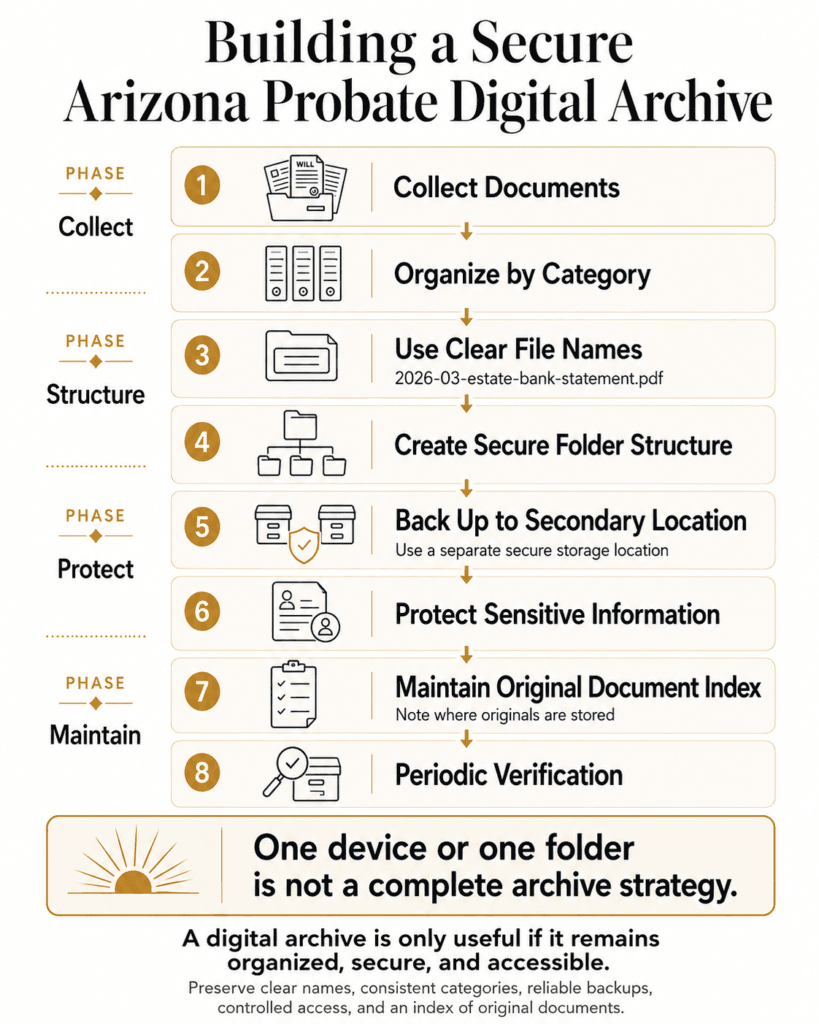
Maintain More Than One Secure Copy
The electronic estate file should not exist only on:
- One computer
- One portable drive
- One personal email account
- One cloud account
- One mobile device
Maintain at least one secure backup separate from the primary storage location.
Protect sensitive estate data through:
- Strong authentication
- Encryption when appropriate
- Limited access
- Secure recovery information
- Current backups
- Malware protection
Probate files often contain account numbers, Social Security numbers, addresses, signatures, and tax information.
A backup should be tested periodically to confirm that the files can still be opened.
Preserve Important Originals
Scanning is useful, but some originals may remain important.
These may include:
- Original will
- Certified death certificate
- Original title
- Recorded deed
- Notarized assignment
- Signed settlement agreement
- Original promissory note
- Court-certified document
- Original stock or ownership certificate
Keep originals in a secure, dry location.
The electronic index should state where each original is stored.
Do Not Rely Exclusively on the Court File
The court file may not contain:
- Complete bank statements
- Tax returns
- Receipts
- Professional invoices
- Full creditor correspondence
- Appraisals
- Beneficiary communications
- Transfer confirmations
- Final accounting in an informal closing
- Supporting distribution calculations
The personal representative’s private file may be the only complete record of the administration.
Do Not Rely Exclusively on Professional Offices
The attorney, accountant, bank, appraiser, title company, and other professionals may follow their own record-retention policies.
Do not assume another professional will preserve the complete estate file indefinitely.
Before an engagement ends, obtain copies of:
- Final work product
- Filed returns
- Accounting files
- Appraisals
- Recorded documents
- Closing statements
- Transfer confirmations
- Material correspondence
The personal representative should maintain an independent, organized estate archive.
Create a Document Index
A simple index can make a large file much easier to use.
The index may identify:
- Document name
- Date
- Category
- Related asset or transaction
- Original or copy
- Storage location
- Recipient
- Retention note
The index can also identify records provided to individual beneficiaries, including:
- Appraisals
- Deeds
- Basis schedules
- Tax documents
- Distribution calculations
A later reviewer should be able to locate a document without searching every folder.
Separate Estate Records From Personal Records
Do not mix the estate file with:
- Personal bank statements
- Unrelated tax records
- Household correspondence
- Records from another estate
- Personal business files
A separate estate archive protects privacy and makes later delivery to a successor, attorney, accountant, beneficiary, title professional, or court more manageable.
Dispose of Records Securely When Appropriate
When legal and tax advisers determine that a category of records no longer needs to be retained, dispose of it securely.
Methods may include:
- Cross-cut shredding
- Professional document destruction
- Secure digital deletion
- Destruction of obsolete storage devices
- Removal of cloud backups
- Deletion of exported email archives
Before destruction, confirm that the record is not still needed for:
- Property basis
- Tax limitations
- Title
- Pending litigation
- Creditor issues
- Beneficiary questions
- Business ownership
- Later-discovered property
- A continuing professional obligation
Keep a brief destruction log identifying the category and destruction date without unnecessarily reproducing sensitive information.
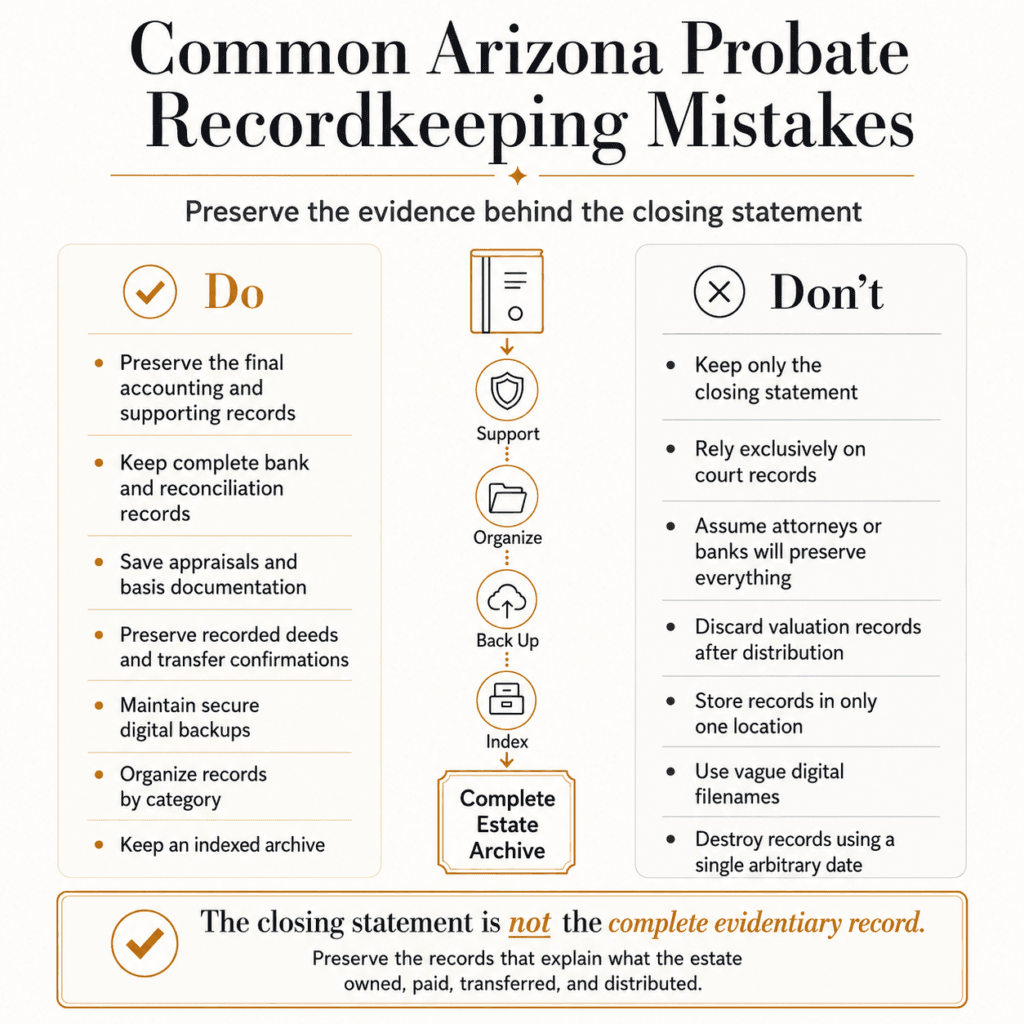
Common Probate Recordkeeping Mistakes
Common mistakes include:
- Discarding the file immediately after closing
- Keeping only the closing statement
- Failing to preserve the final accounting
- Losing proof that the accounting was delivered
- Relying only on online banking access
- Failing to download tax records
- Discarding date-of-death appraisals
- Mixing compensation with reimbursement records
- Keeping payment records without invoices
- Keeping invoices without proof of payment
- Losing creditor-deadline calculations
- Failing to preserve disallowance notices
- Keeping unsigned transfer forms without completion evidence
- Losing recorded deeds
- Failing to preserve distribution dates
- Leaving significant communications only on a personal device
- Storing the file in one location without a backup
- Destroying documents based only on the six-month fiduciary period
- Failing to provide beneficiaries with basis records
- Relying exclusively on the court or attorney file
Do-and-don’t comparison for preserving probate accountings, bank statements, appraisals, tax files, transfer records, and digital archives.
Practical Arizona Probate Records Checklist
After the estate closes, preserve the following records as appropriate.
Core Legal Records
- Original will and codicils
- Certified death certificate
- Probate application or petition
- Appointment order
- Letters of Personal Representative
- Bond records
- Significant court orders
- Closing statement or formal closing petition
- Formal settlement or discharge order
- Proof of filing
Inventory and Valuation Records
- Original inventory
- Supplemental inventories
- Real-estate appraisals
- Business valuations
- Financial-account statements
- Vehicle and personal-property valuations
- Date-of-death basis records
- Supporting valuation correspondence
Accounting and Banking Records
- Final accounting
- Accounting schedules and worksheets
- Estate ledger
- Proof that the accounting was delivered
- Estate bank statements
- Check images
- Deposit records
- Wire and electronic-payment confirmations
- Monthly reconciliations
- Final account-closing confirmation
Creditor and Expense Records
- Published creditor notice
- Proof of publication
- Direct creditor notices
- Mailing records
- Claim log
- Creditor claims
- Allowance and disallowance records
- Settlements and releases
- Proof of payment
- Vendor invoices
- Professional invoices
- Administration-expense receipts
Compensation and Reimbursement Records
- Personal representative time logs
- Compensation calculations
- Compensation communications or orders
- Personal payment records
- Reimbursement requests
- Estate reimbursement confirmations
Tax Records
- Decedent’s final returns
- Estate fiduciary returns
- Estate-tax filings when applicable
- Forms W-2, 1099, and K-1
- Tax-payment records
- Refund records
- Tax notices and responses
- Accountant workpapers
- Basis and appraisal records
- Tax documents delivered to beneficiaries
Sale and Transfer Records
- Real-estate contracts and settlement statements
- Recorded deeds
- Vehicle titles
- Brokerage transfer confirmations
- Business assignments and ownership records
- Lien releases
- Trust-funding documents
- Account-closing confirmations
Beneficiary and Dispute Records
- Distribution schedule
- Checks and transfer confirmations
- Receipts
- Proposed-distribution records
- Beneficiary approvals and objections
- Material emails and text messages
- Settlement agreements
- Pleadings and final dispute orders
Storage and Continuity Records
- Secure electronic copy
- Separate backup
- Index of the estate file
- List of original-document locations
- Access instructions for an appropriate successor
- Record of any later authorized destruction
Protect the Work Completed During Probate
Probate records tell the history of the estate.
They establish:
- What property was found
- How the property was valued
- Which obligations were paid
- What professional services were used
- Which tax returns were filed
- What each beneficiary received
- How legal title was transferred
- Why the estate was closed
There is no single date on which every Arizona probate document automatically becomes unnecessary.
Core court records, final accountings, distribution records, recorded transfers, and inherited-property basis records may remain valuable long after shorter legal or tax periods expire.
An organized estate file, secure backup, and clear record of original-document locations can protect the former personal representative, beneficiaries, and anyone who must address a later issue.
Legal Disclaimer: This information is for educational purposes only and does not constitute legal advice. Arizona probate law is complex and varies based on individual circumstances. Always consult with a qualified probate attorney for guidance specific to your situation.
FAQs
No. The closing document summarizes the administration, but the supporting records show how assets, claims, taxes, expenses, transfers, and distributions were handled.
There is no single period appropriate for every document. Tax, title, fiduciary, creditor, property-basis, distribution, and fraud issues may involve different timelines.
Generally, yes. The original will and any codicils are core estate records and may be needed for later title, tax, or subsequent-administration issues.
Yes. The Letters help establish who had authority and when. However, expired Letters should not be used as current authority after the appointment terminates.
If no proceeding involving the personal representative remains pending, the appointment generally terminates one year after filing.
Yes. Preserve the exact accounting delivered to affected distributees, its schedules and supporting calculations, and proof of delivery.
Complete account statements, check images, deposits, electronic transfers, reconciliations, and account-closing records should remain in the estate’s financial file.
They support the probate inventory and may help a beneficiary establish tax basis when inherited property is later sold.
IRS guidance generally recommends keeping property records until the limitation period expires for the tax year in which the property is disposed of.
Yes. Preserve published and direct notices, deadline calculations, claims, allowances, disallowances, settlements, and payment records.
Keep time logs, task descriptions, calculation methods, beneficiary communications, court filings or orders, and payment confirmation.
No. Reimbursement repays a documented estate expense personally advanced by the representative. Compensation pays for fiduciary services. The records should distinguish them.
Preserve material communications concerning distributions, valuations, fees, objections, agreements, reserves, and unresolved liabilities.
Yes. Preserve the signed instrument, recorder submission, any rejection or correction, and the final recorded copy.
The Arizona six-month period applies only to certain fiduciary claims after an informal closing statement. It excludes fraud, misrepresentation, and inadequate disclosure and is not a universal destruction rule.
Specified noncreditor recovery claims are generally barred at the later of three years after death or one year after distribution, subject to earlier adjudication, other bars, and the fraud exception.
An undischarged and unbarred claim may sometimes be pursued against distributees, generally subject to the value received and statutory protections.
A recipient may be required to return improperly received property or money. When the recipient no longer has the property, liability may include its value and related income or gain.
The original records can identify the controlling will, proper recipients, earlier claim treatment, previous distributions, and tax history if subsequent administration becomes necessary.
Usually not. It may not contain the complete accounting, bank records, tax returns, appraisals, invoices, creditor correspondence, beneficiary communications, or transfer confirmations.
Use organized folders, descriptive filenames, restricted access, and at least one separate backup. Preserve important originals in a protected physical location.