

The Short Version
Yes, an Arizona estate can often sell a house before probate is finished. The important question is not whether the house can be marketed or whether a buyer is ready. The important question is who currently has legal authority to act for the estate, whether the house is actually a probate asset, and whether any restriction or court-confirmation requirement applies to the sale.
You can put a FOR SALE sign in a yard, and everybody understands what it means: somebody wants to sell the house.
What the sign does not tell you is who can legally sign the deed.
That sounds almost too obvious to be useful, but it is exactly where probate real estate sales can get confusing. The house may be cleaned out. The realtor may be ready. A buyer may have made an offer. The title company may already be asking for documents. Every family member may agree that selling is the right move.
Everyone can even bring a pen.
None of that, by itself, answers the legal question: who has authority to act for the estate?
That is why “Can I sell the house during probate?” is not quite the first question I would ask.
I would start with: “Who owns the house now, and who has authority to sign?”
First: Make Sure the House Is Actually a Probate Asset
Before talking about a probate sale, look at the deed.
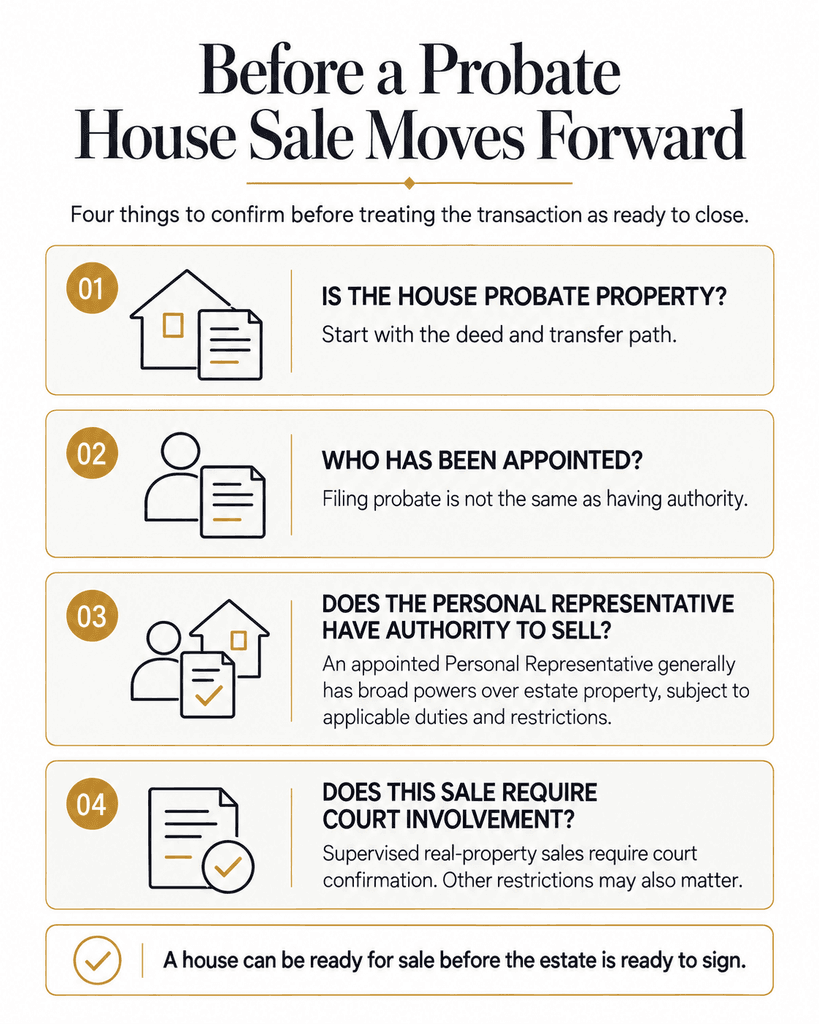
A house does not automatically become a probate asset simply because an owner died. The transfer path depends on how title was held and whether another valid mechanism controls what happens at death.
For example, the house may pass outside probate if:
- It was owned in a trust.
- The deed created a valid right of survivorship.
- A valid beneficiary deed controls the transfer.
- Another ownership or transfer arrangement applies to the property.
If one of those paths applies, the Personal Representative’s probate-sale powers may not be the relevant authority at all.
This is one of the reasons I do not like beginning with “Do we need probate?” as if the estate were one big box. Start with the asset. Pull the deed. Identify the ownership. Then determine the legal transfer path.
If the house is part of the probate estate, then we move to the next question.
Who Has Authority to Sell Estate Property?
In Arizona, the duties and powers of a Personal Representative generally begin on appointment. Being named in a will is important, but nomination is not the same thing as already holding the office.
Think about the difference between being told, “You are the person Mom wanted to handle everything,” and actually having the legal authority to sign for the estate. Those are not always the same moment.
Once properly appointed, an Arizona Personal Representative generally has broad authority over estate property. A.R.S. § 14-3711 gives a Personal Representative power over title to estate property comparable to that of an absolute owner, but the property is held in trust for creditors and other people interested in the estate.
A.R.S. § 14-3715 is even more direct. Subject to the will, court orders, statutory priorities, and the Personal Representative’s duties, it authorizes a Personal Representative to dispose of estate assets, including land, and to sell real or personal property.
Arizona law: A.R.S. § 14-3711 — Powers of Personal Representatives
Arizona law: A.R.S. § 14-3715 — Transactions authorized for Personal Representatives
So the basic Arizona rule is not:
“You have to wait until the entire probate is finished before the house can be sold.”
That is too broad.
A house that belongs to the probate estate can often be sold during the administration once the right person has authority and the applicable rules are satisfied.
Filing Probate Is Not the Same as Having Authority
Here is another shortcut that causes trouble: “We filed the probate, so now we can sell.”
Not necessarily.
Filing starts a court process. Authority to act as Personal Representative comes with the appointment. Arizona law expressly provides that a Personal Representative’s duties and powers commence on appointment. A.R.S. § 14-3701.
Arizona law: A.R.S. § 14-3701 — Time of accrual of duties and powers
This is why timing matters when a family already has a buyer waiting.
The buyer can be ready before the legal authority is ready.
The title company can be ready before the legal authority is ready.
The family can be ready before the legal authority is ready.
Prepared is not the same thing as authorized.
What Does the Title Company Usually Care About?
A title company has a different job from the family and a different job from the probate court. It is trying to determine whether the person signing the closing documents can legally convey the estate’s interest in the property and whether the buyer can receive insurable title.
That is why title companies may ask for probate documents showing the Personal Representative’s appointment and authority. Depending on the transaction, they may ask for recently certified Letters or other court documents.
Arizona law gives protection to people who deal in good faith with a Personal Representative based on a certified copy of Letters as described in A.R.S. § 14-3714. The practical point is simple: third parties do not want to guess who has authority. They want documentation they can rely on.
Arizona law: A.R.S. § 14-3714 — Protection for persons dealing with a Personal Representative
This does not mean every title company uses the same checklist. It also does not mean the title company decides the legal structure of the estate. But if a closing is being planned, finding out what the title company will require early can prevent a lot of last-minute scrambling.
Does the Court Have to Approve Every Arizona Probate House Sale?
No.
This is another place where probate gets oversimplified.
In many unsupervised Arizona estates, the Personal Representative can exercise statutory powers without getting a separate court order for every administrative act. Arizona law generally directs a Personal Representative to proceed with administration without court adjudication or direction unless the law or a court order provides otherwise.
Arizona law: A.R.S. § 14-3704 — Personal Representative to proceed without court order except as otherwise provided
But that does not mean court approval is never required.
If the estate is under supervised administration, A.R.S. § 14-3504 says that sales of real property are subject to court confirmation.
Arizona law: A.R.S. § 14-3504 — Supervised administration; court confirmation for real-property sales
Other restrictions can matter too. A will may contain relevant limitations. A court order may restrict the Personal Representative’s powers. A sale involving a serious conflict of interest or self-dealing can trigger additional rules and scrutiny.
Many probate real-estate sales can proceed without a separate approval order, but you have to know what kind of administration you are in and whether any restriction applies to this particular sale.
The Personal Representative Is Not Just Another Seller
A Personal Representative may have broad powers, but those powers come with fiduciary duties.
A.R.S. § 14-3703 requires the Personal Representative to administer the estate consistently with the will, Arizona law, and the best interests of the estate. The Personal Representative is not selling the house as if it were his or her own personal property.
Arizona law: A.R.S. § 14-3703 — General duties; fiduciary obligations
That matters when deciding things like:
- Whether the sale price is reasonable.
- Whether the property should be repaired or sold as-is.
- Whether an offer is in the estate’s best interests.
- Whether family relationships are influencing the decision.
- Whether the buyer has a relationship with the Personal Representative that creates a conflict. Arizona law separately addresses conflict-of-interest transactions. See A.R.S. § 14-3713
- How the sale proceeds will be handled after closing.
The authority to sell is not a blank check. It is authority held for the estate.
Selling the House Is Not the Same as Distributing the Money
This distinction is easy to miss.
When estate property is sold, the closing does not automatically turn the net proceeds into money that the heirs can divide that afternoon.
The sale proceeds become estate funds. The estate may still have administration expenses, creditor claims, taxes, liens, or other obligations that have to be handled before the remaining estate can be distributed.
In other words, selling is one step in administration. Distribution is another.
The FOR SALE sign may come down at closing, but the probate may still have work left to do.
What If All the Heirs Agree to the Sale?
Family agreement is helpful. It can make a probate much easier.
But unanimous agreement among the heirs does not automatically answer who has legal authority to sign the deed for estate property.
This is the same problem we started with. Willingness and authority are different things.
If the house is being administered as part of the probate estate, the properly authorized Personal Representative is generally the person who acts for the estate. The exact title and probate documents still need to be reviewed, and any restrictions still matter.
So if three siblings all say, “Yes, sell it,” that may solve a family problem. It does not, by itself, solve the title problem.
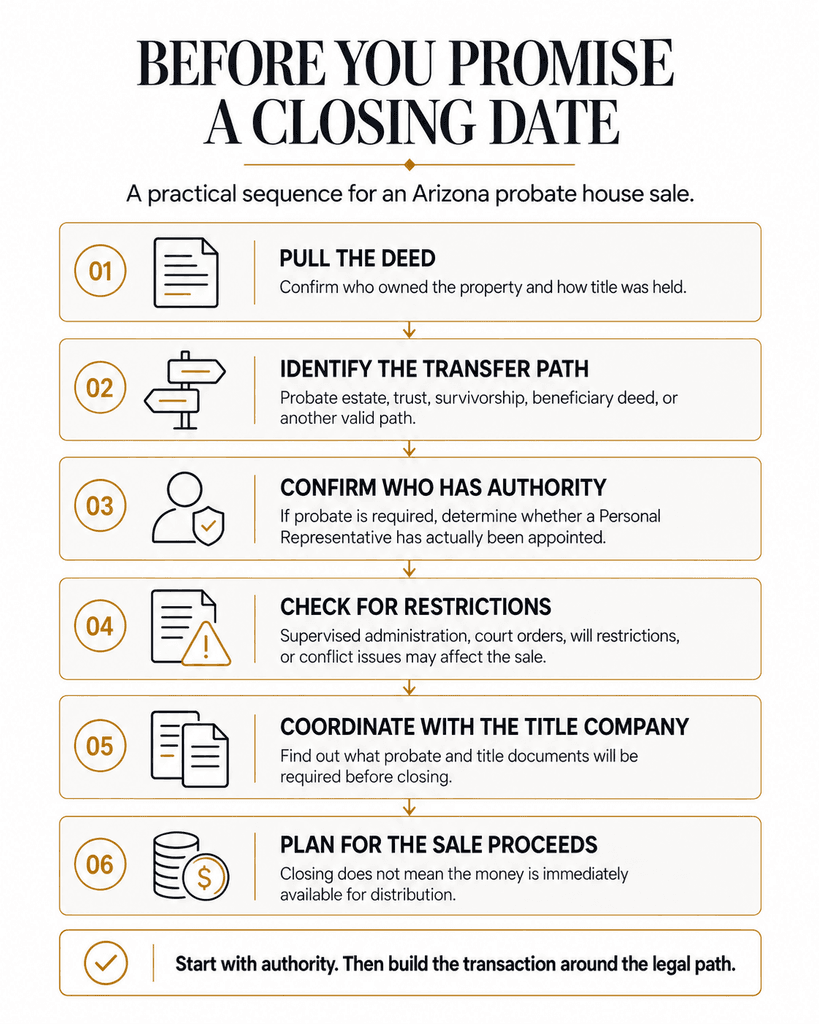
A Practical Sequence Before You Promise a Closing Date
If you are trying to sell a house after someone dies, I would work through the questions in this order:
- Pull the current deed.
Who owned the house at death, and exactly how was title held? - Identify the transfer path.
Does the house pass by survivorship, beneficiary deed, trust ownership, another nonprobate mechanism, or through the probate estate? - Confirm who currently has legal authority.
If probate administration is required, has a Personal Representative actually been appointed? Are the Letters current? Are there co-representatives or other authority issues? - Check for restrictions.
Is the estate supervised? Does the will contain a relevant restriction? Has the court entered an order limiting authority? Is there a conflict-of-interest issue? - Coordinate with the title company before the finish line.
Ask what probate and title documents it will require for the transaction rather than discovering a missing authority document on the day everyone is supposed to sign. - Treat the proceeds as estate property.
Plan for liens, expenses, claims, taxes, accounting, and eventual distribution rather than assuming the net sale proceeds immediately belong to the heirs.
The order matters.
A lot of probate problems come from starting with the transaction and trying to solve the authority problem afterward.
The Better Question
“Can I sell the house during probate?”
Often, yes.
But that answer is not enough to safely move a transaction forward.
The more useful question is:
“Who has legal authority over this house right now, and what has to happen before that person can sign the deed?”
Once we answer that, the rest of the sale becomes much easier to organize.
A FOR SALE sign can tell the neighborhood the house is on the market.
It can bring a buyer to the door.
It can even make everybody feel like the transaction is moving.
It still cannot sign the deed.
If you are trying to sell an Arizona house after someone has died and you are not sure who has authority, start with the deed and the probate appointment. Rahnema Law can help identify the transfer path, confirm who can act for the estate, and determine what needs to happen before the sale moves forward.
Legal Disclaimer: This information is for educational purposes only and does not constitute legal advice. Arizona probate law varies based on individual circumstances. Always consult with a qualified probate attorney for guidance specific to your situation.
FAQs
Often, yes. An appointed Personal Representative generally has broad authority to sell estate real property during administration, subject to fiduciary duties, restrictions in the will or court orders, and any requirement that applies to supervised administration.
See A.R.S. § 14-3711 and A.R.S. § 14-3715.
If the house is probate estate property, the properly authorized Personal Representative generally signs on behalf of the estate. The title company may require certified Letters or other probate documents to verify that authority.
See A.R.S. § 14-3701 and A.R.S. § 14-3714.
No. Many unsupervised administrations do not require a separate court order for a routine real-property sale. In supervised administration, however, A.R.S. § 14-3504 requires court confirmation of real-property sales. Other restrictions or unusual transactions can also require additional court involvement.
See A.R.S. § 14-3704 and A.R.S. § 14-3504.
Not necessarily. Agreement among heirs is not the same thing as authority to convey estate property. The deed, probate status, and Personal Representative’s authority determine who must sign for the estate.
The practical answer depends on the facts and on what documents are being signed. Marketing preparation is different from having authority to bind the estate or convey title. Before signing a listing agreement, purchase contract, or other binding document on behalf of the estate, confirm who currently has legal authority to act.
The net proceeds generally remain estate property and are administered through the estate. Expenses, valid claims, taxes, liens, and other obligations may need to be addressed before the remaining estate can be distributed to heirs or beneficiaries.